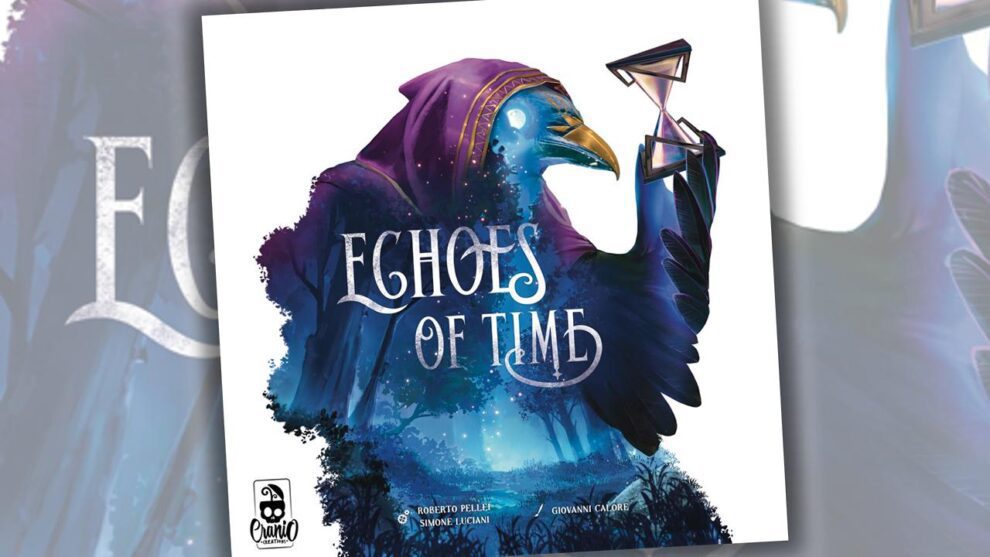

Disclosure: Meeple Mountain received a free copy of this product in exchange for an honest, unbiased review. This review is not intended to be an endorsement.
If you do even a little digging into my review portfolio, you’ll see how much I respect the work of Simone Luciani. So, anything he touches is a game I will happily get to the table.
Echoes of Time (2025, Cranio Creations) is a co-design between Luciani and Roberto Pellei. It’s a very straightforward tableau builder that asks players to draw and play cards in a fashion similar to the IELLO game Ancient Knowledge from a couple years ago. Using the San Juan concept of paying for everything using only the other cards from hand, Echoes of Time is so straightforward that I only needed one pass of the rulebook before getting the game to the table.
Echoes of Time is the solution for players who like more punishing games with tricky scoring conditions (even the Luciani release MESOS seems to fit here) mixed with unclaimed tableau artifacts like the “Places of Power” from Res Arcana. If you’ve ever wondered “is there a more interactive, possibly mean version of Ancient Knowledge that plays in about 45 minutes?”, then run out and buy a copy of Echoes of Time right now.
That is, if you are comfortable with a healthy dose of unbalanced cards. Let me explain.
The Early Plays: Comforting
Echoes of Time is a hand management, tableau-building game for 2-4 players. Players manage a fellowship of creatures across four different factions, represented here by suits, in the hopes that those creature synergies align in ways that trigger the perfect river of card effects. (I’ll pretend that there is a theme that matches the gameplay here, but the reality is that you aren’t coming to Echoes of Time for that!)
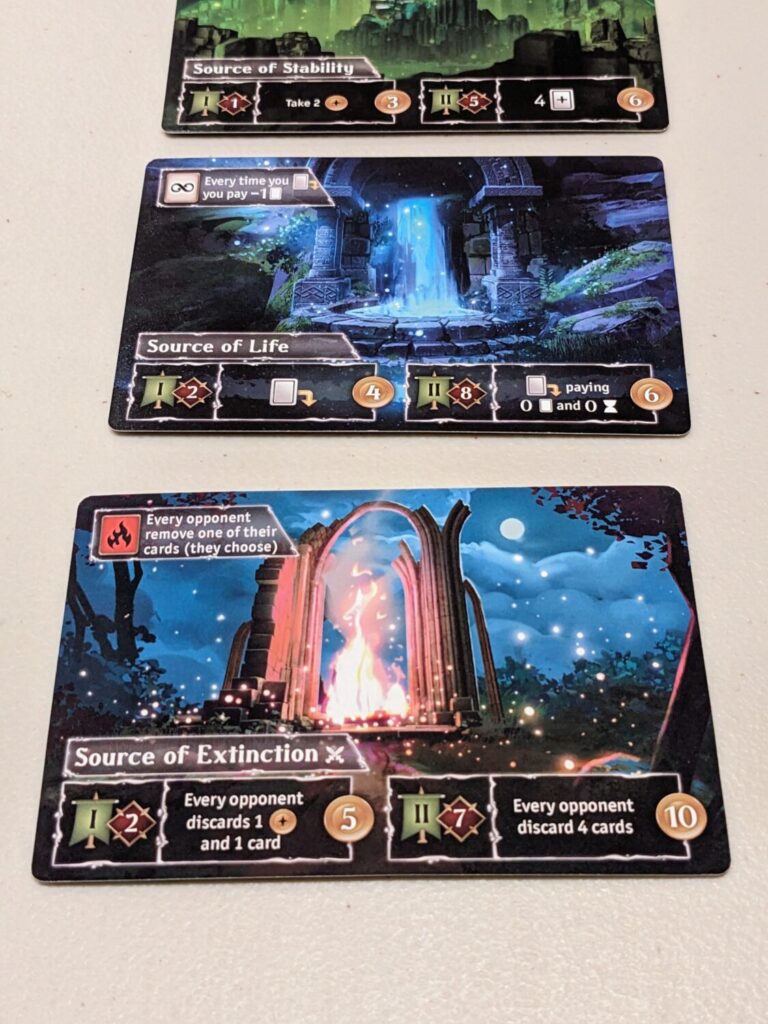
In a race to play 12 cards or exhaust the pool of victory point tokens across all players, Echoes of Time is also a race to conquer, and later fortify, Source cards, with one Source card per player beginning play in the center of the table. The Source cards offer a tug-of-war opportunity to take, or later snatch, a powerful ongoing ability card from another player, as long as it has not yet been fortified earlier in the game. The final win condition is fortified Sources; if all available Sources have been fortified, the game wraps up at the end of the current round.
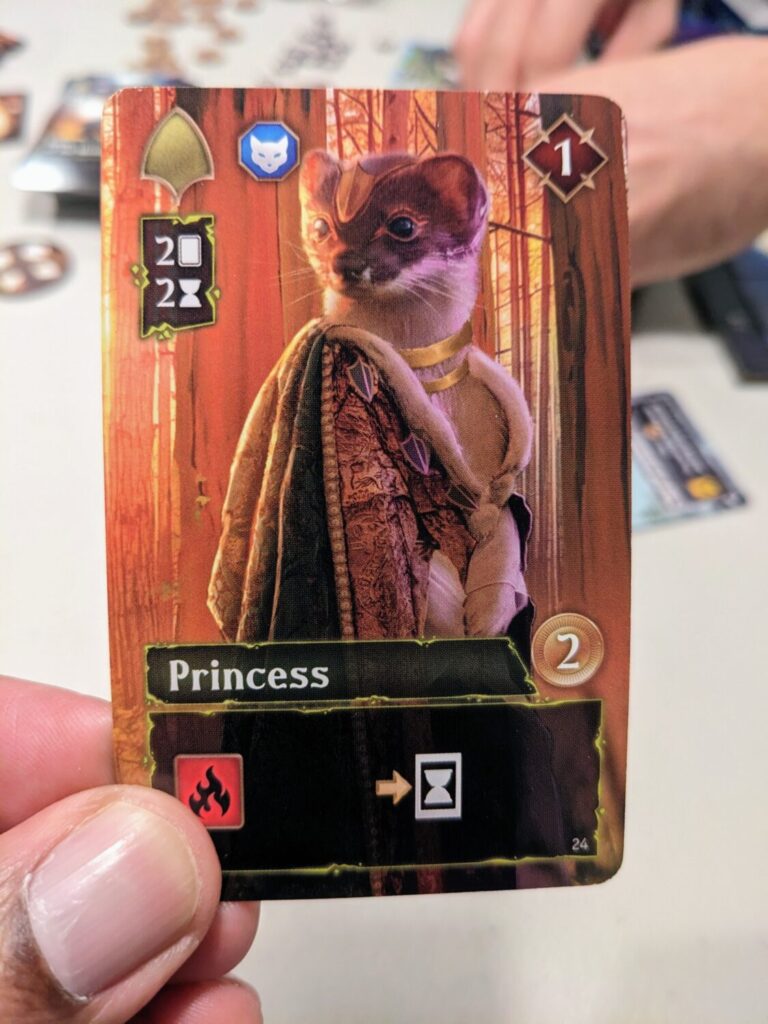
For the most part, everything is about the cardplay. In each round, each player can take one main action and a number of free actions when it is their turn. The actions are super quick—drawing or playing cards, conquering or fortifying a Source, or using the action that will most resonate with players who are familiar with Ancient Knowledge, advance a card down a timeline track. Each player’s personal board has five tiles, acting as a conveyor belt of sorts, and above each tile is a certain amount of time. A card must be played on the tile under the appropriate time listed on the card, then must be paid for with cards from a player’s hand. After each round (two turns per player), everyone’s right-most tile falls off their player board and a new tile takes the left-most place on the time track for that player.
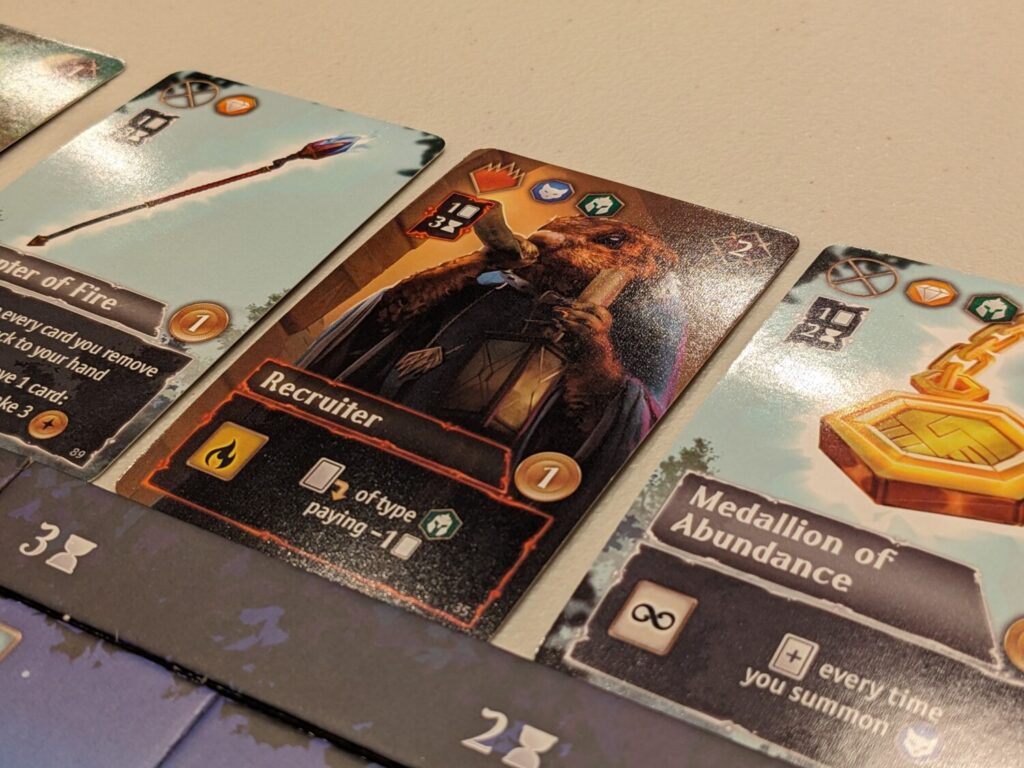
The timing considerations are important, because each card’s effects are not triggered until the card has fallen off the time track. Lining up cards to trigger at the right moment has an additional consideration: many of a card’s powers align with one of three different fire symbols on the tile that has fallen off the time track. It was a blast to put cards in just the right spots so that I could trigger as many effects as possible when that card was “summoned” to my tableau.
Mechanically, Echoes of Time doesn’t have much of a wow factor but it can feel satisfying to build up an engine that triggers abilities and builds up a fellowship at just the right time. However, my first play of Echoes of Time felt a lot different than my next couple plays…because the deck of fellowship cards is so varied that in lower player count games, there is an exceptional amount of swingy play.
“How Do You Keep Getting the Best Cards?”
After my first play—a three-player game with my review crew—I did a two-player game with my buddy John. Regardless of player count, each player begins play with a hand of seven cards, and can play one card before play begins using the normal rule structure.
John played the Abyssal Beast on his pre-game turn. This creature card, which only costs one card to play, gets slotted into the 2-time slot on the player board. I played an artifact card called the Key of Forgotten Doors. It cost me two cards, and also went into the 2-time slot. I thought it had a decent-looking power, with a blue fire symbol, meaning I could trigger it every other round: it allowed me to play another artifact (assuming I had one in hand) as a free action.
Here’s what I haven’t told you about yet: strength. Each card has a strength rating, from 0-5. There is only one 5-strength card in the entire deck, the Rider of the Meadows. There are three 4-strength cards, and six 3-strength cards. Strength is critical for one action in the game: conquering Source cards. And because Source cards grant owners a special one-time power when they are conquered from the center of the table, getting your hands on one quickly can be vital.
So vital, in fact, that John conquered one of the Source cards in the second round of the game, after getting the Abyssal Beast and the Sea Trooper to his tableau by just his third turn. A conquered Source remains available for other players to conquer, as long as they outpace the strength of the cards holding that Source. This means I needed a strength of eight, across my played cards, to even attempt this.
The short version of what this meant in game terms is that the game was over, at least competitively. I was building an engine with low-strength cards, because I wasn’t dealt any higher strength cards during setup. Taking actions to draw more cards did not yield better fruit. The Sources in play included one that forced me to lose a victory point token and discard a card, which at one point emptied my hand. Later, when John fortified the first of the two Sources in play, I lost four cards when I only had five in hand.
So, to recap—I basically had no cards in my tableau. I often had no cards in hand, with a measly single card drawn by each player at the start of a round. Playing new cards costs cards, so getting new cards out takes multiple turns. One player is putting the finishing touches on a victory, and Echoes of Time adds insult to injury with its scoring system: cards played to acquire Sources lose their active powers for a player, but they are still worth victory points at the end of the game.
Our game ended minutes later, 21 points for John, 10 points for me. (I was able to sneak some low-cost cards into the game over the last 2-3 rounds, resulting in enough points to allow me to respect myself.)
If a player is dealt high-strength cards during setup, they should absolutely play those into the conveyor belt as quickly as possible. Playing the engine-building game might work out, and it might not, but the rules here force players to often drag that part of the game out…and it is much faster (and likely smarter) to rush the ending by fortifying Sources. I can’t imagine a scenario where a player could get 12 cards played before an opponent could conquer/fortify Sources, especially at a lower player count.
And that is all before one factors in the shocking amount of negative interaction on display here. I have now played games where I gained and lost victory point tokens in the same round that I got them, thanks to opponent card effects. A number of cards force players to discard cards, half their hand, exactly four cards, etc. One of the Sources forces each opponent to “remove” a card from their fellowship/tableau, a brutal effect in a game where it can be challenging to get cards played to the table.
I wouldn’t mind the direct negative interaction if it felt like all players could affect each game that way…but that is tied specifically to the luck of the draw. And in a game that could end so quickly, it’s tough to count on being able to get the cards out that you want every time.
Woof
For better and for worse, I have played or own Race for the Galaxy, Ark Nova, Wingspan, Finspan, Innovation, Imperial Settlers, Villagers, and countless other great tableau-building experiences. Even if you wanted to say that many of those games take a while, Race for the Galaxy, Res Arcana, and Villagers all play fast.
The main hook for Echoes of Time is the direct negative interaction on display. Some players, like our man Joseph Buszek, love games like that, and I love it as well in settings where everyone can attack everyone else. My main issue with it here is why I hate it in games like Ark Nova and Terraforming Mars: there are not enough cards to ensure that players will have the chance to stab a neighbor just as often as they are getting stabbed themselves.
The strength rating on cards is the bigger offender, though. It is simply easier to play strong cards and conquer Source cards than to play multiple low-cost cards quickly, and having stronger cards allows a player to avoid any concerns about card synergies, or the lack thereof. I’m all for building an engine using a Sky (blue triangle suit) strategy, but I’ve got to hunt for just the right kinds of cards before putting them into the oven and waiting for them to cook and be served into my tableau.
Strong cards? Play ‘em, eat ‘em. If you play enough of them, you can speed your way to the ending.
I don’t use this word often, but I hated Echoes of Time at two players. Simply put, don’t play this game at that player count. At three players, there’s a chance at some divergent strategy and/or balancing play across the table to provide checks and balances against other players who appear to be in the lead.
At four players—and again, knowing that the cardplay here might be off a bit—Echoes of Time offers its best chance to shine, assuming that you are fine with getting gutted from time to time. Some players are just going to luck into better cards, but that is true in every kind of game like this (with Ark Nova being a game that still riles me because of the chance at randomly-amazing card synergies right off the bat).
Echoes of Time is not the game that (my) dreams were made of. I think Simone Luciani is the greatest designer who ever lived…so for me, my disappointment is more pronounced.