
Disclosure: Meeple Mountain received a free copy of this product in exchange for an honest, unbiased review. This review is not intended to be an endorsement.

It’s easy, I think, to take a game like Duel for Cardia for granted, especially if you spend as much time in the board game trenches as I do. Faouzi Boughida and Mathieu Rivero aren’t doing anything exceptional here, by which I mean they aren’t doing anything that stands out if you’re constantly deluged with new game designs. Duel for Cardia isn’t flashy, and it isn’t trying to break new ground. It’s easy to underestimate a game that’s simply doing the work. I think I made this comparison a few years ago, but I will come back to it: Duel for Cardia is the board game equivalent of a good studio picture from back when studios were content to make $35 million on a film with a budget of $10m.
By that I mean, it is competently designed, charming, successful, tense, and you could play it with just about anyone. Both players start with an identical deck of 16 cards, draw a hand of five, and simultaneously reveal one. You can think of this as a lane battler with up to 16 single-card lanes if you want; you wouldn’t be far off the mark. The player who reveals a higher-value card wins a Signet. The player who reveals a lower-value card gets to activate their card’s ability. This process continues until either player has won five Signets.
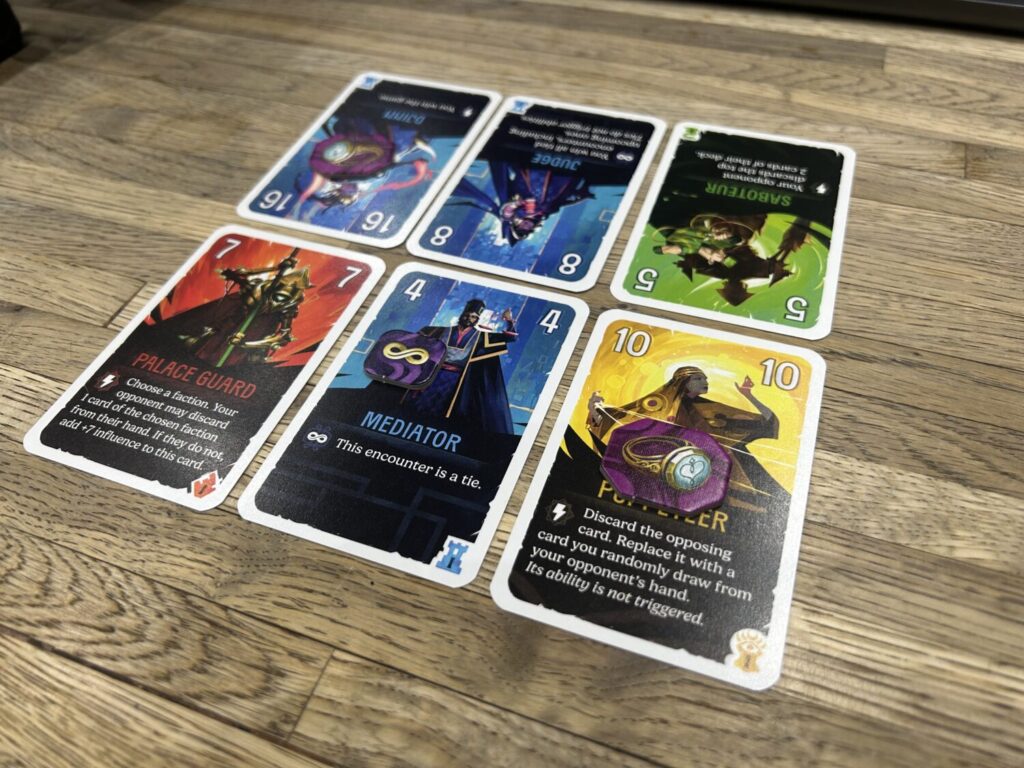
That doesn’t sound like much, and, really, it isn’t. But as you’d expect, the powers are an important piece of all this. No lane is settled until the whole match is over. I might trigger a power that lets me adjust the power ratings of previously-played cards, altering the results. You might cause me to discard a card, permanently reducing my hand size and my options. You are often incentivized to lose in Duel for Cardia, which is something I always enjoy. It lowers the odds that a player will get washed out due to bad draw. The weaker my cards are, the more I get to mess around.
For how little my gut tells me to think of this game, each of my plays has included at least one kernel of delight. In my first game, I learnt through an ability that my opponent didn’t have any blue cards, then on my next turn I used an ability that would lower their card’s power level if they couldn’t discard a blue card. In my second game, I wanted to trigger the ability of a higher card, and saved it for a turn when I’d noticed that my opponent had played a lot of low cards. I figured the odds would be on my side, and they were. These are the kinds of moments that add up to a great game.
It happens to be the case that Duel for Cardia is so short that you’ll have to settle for those moments in aggregate. Duel for Cardia is an ideal lunch break game, a tiny little box that deserves to live in middle school and high school backpacks the world over. I would have gone gaga for it when I was 12, and I would have been right to do so. If you have a 12-year old with lunch breaks in your life, or if you’re looking for ways to spice up your lunch breaks as an adult, have I got a game for you.
Duel for Cardia details
- Designer: Faouzi Boughida, Mathieu Rivero
- Artists: Dominik Mayer, Florian Herold, Ingram Schell, Jonas Schmutzler, Qistina Khalidah
- Publishers: 999 Games, Asmodee, Brain Games, Devir, Feelindigo, Games4you, Giochi Uniti, Hans im Glück, Kaissa Chess & Games, Lucky Duck Games, Mandoo Games, MINDOK, Piatnik, Ponva d.o.o.
- Release Date: 2025
- Player count : 2
- Age range : 9+
- Time range : 15 minutes
- Mechanism(s): Hand Management, Simultaneous Action Selection
- BGG Geek Rating: 7.53838 - converted to Meeple Mountain scale: 4.0.
- More articles about Duel for Cardia.