
Disclosure: Meeple Mountain received a free copy of this product in exchange for an honest, unbiased review. This review is not intended to be an endorsement.
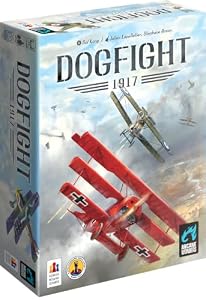
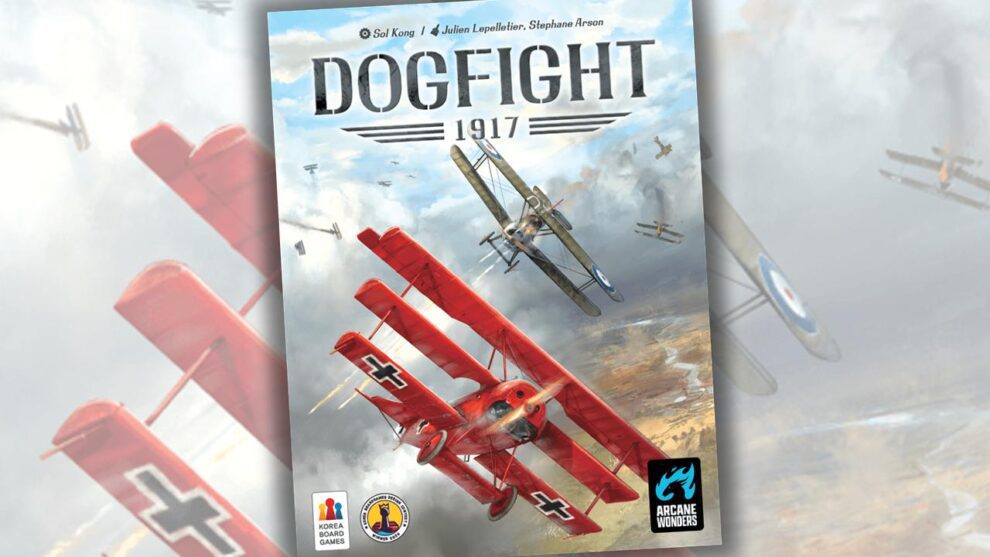
Dogfight 1917 (2025, Arcane Wonders) has a lot going for it…as long as you play it as a free-for-all variant with a full complement of four players. There are cool biplane (and in the case of the Red Baron, a triplane!) miniatures, play time is speedy and mechanics are simple: fly at the other fighters to maneuver into the best positions to damage enemies just enough to make them run out of action cards, a deck which also serves as a player’s health meter.
20 action cards is all a player gets for the entire game to fly, maneuver in and out of harm’s way, and put bullets into the rear of a bad guy. Two of those 20 cards are single-use, meaning they are removed completely from the game after being played. (Those two cards are the same for each player’s deck, but other cards come with slight nuances that make each fighter’s deck unique.) With limited options to add cards back into each deck, a game of Dogfight 1917 might only last for 20-30 minutes.
Tactical tokens can be acquired through those single-use cards, via die roll bonuses on other action cards, or by finishing turns on certain spaces of the very small map representing the skies of World War I. You’ve got real-life pilots, ways to fire at opponents using advanced action techniques, and a very smart hand management mechanic that sometimes pushes a player to not bother trying to defend themselves to ensure they have more card options later in the game.
Unfortunately, Dogfight 1917 is a two-player game with variants that include playing with three or four players, plus a team variant. My first four-player game was efficient, even if a few turns included nothing more interesting than “move plane forward one space, then turn 60 degrees in a rightward direction” on the map’s hex-shaped grid spaces.
At two players, Dogfight 1917 features almost none of the tension I saw in the four-player variant. The game starts with one player positioned directly behind the other, which gave my son and I the impression that the game would come out of the gates with guns blazing.
Nope.

My son and I spent 30 frustrating minutes essentially flying in one big circle, mostly me chasing him. At one point, I played a card that allowed me to turn 60 degrees twice on the same action; on the following turn, I was able to turn again and blow through all of my tactical tokens to fire my Spandau machine guns at the front of his fighter. By that point in the game, my son had hoarded enough evasion cards to mostly dodge these attacks…but it was ultimately enough to force him to draw his 20th and final card two turns later, ending the game.
“Pretty boring,” my son uttered in his review of his first and final play of Dogfight 1917.
I could see reasons to come back to this with four players, though. In that format, all players begin the game facing their planes towards the middle of the map, ensuring that at least something violent will happen during the game’s first few turns. The “Emergency Repair” action, costing three tactical tokens to allow a player to choose three previously-removed cards from their Damage pile to keep their plane alive for a little longer, offers a chance at a late-game bailout.

But even at four players, there’s a tricky caveat: perma-dead players have to sit and watch the game’s ending, because Dogfight 1917 doesn’t actually finish until all but one player remains in the skies. That won’t be long—again, the game might take 30-40 minutes, tops—but it will serve as an unsatisfying end in a game that isn’t only about the skill ceiling, since hits and gunfire misses are tied to D6 die rolls.
(Some of the Fokker Dr.I Evasion action cards include an even funnier bonus: if that plane’s pilot rolls a six while defending itself, they pull off a “Dead Six” flight maneuver and can navigate their plane directly behind an opponent, which is a massive bonus given the free ability to conduct a basic attack as long as they are pointing at an opponent’s rear on their next turn.)
Dogfight 1917 is worth a look for history aficionados who are looking for a snappy card combat game. Just don’t expect to get more than a handful of plays in before you’ve seen everything the game has to offer.
Dogfight: 1917 details
- Designer: Sol Kong
- Artists: Julien Lepelletier, Stephane Arson
- Publishers: Arcane Wonders, Board Zeppelin, Korea Boardgames, Old Dawg
- Release Date: 2025
- Player count : 2 - 4
- Age range : 10+
- Time range : 30 minutes
- Mechanism(s): Dice Rolling, Grid Movement, Hand Management, Hexagon Grid, Player Elimination, Variable Player Powers
- BGG Geek Rating: 7.65579 - converted to Meeple Mountain scale: 4.0.
- More articles about Dogfight: 1917.