
Disclosure: Meeple Mountain received a free copy of this product in exchange for an honest, unbiased review. This review is not intended to be an endorsement.

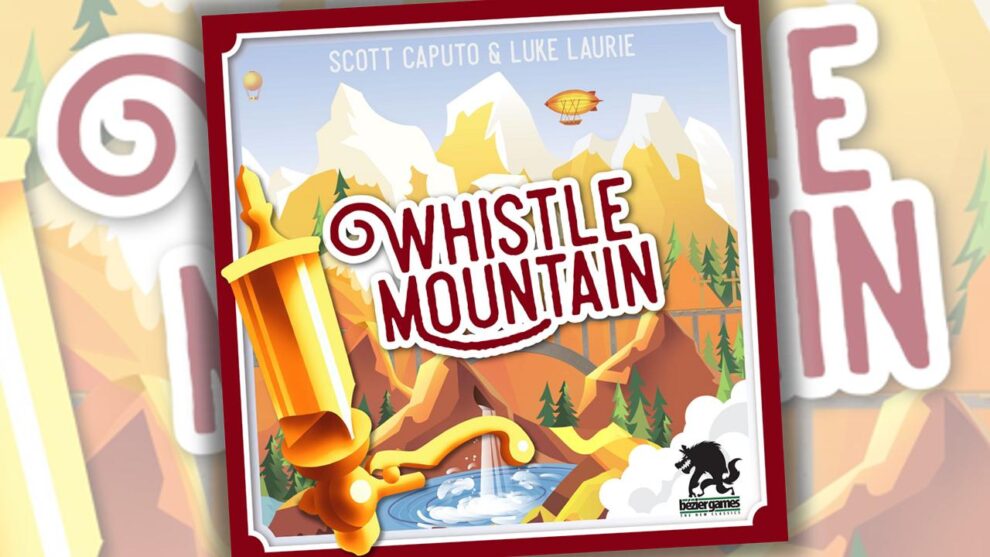
Whistle Mountain (2020, Bezier Games) looks like it should be the direct sequel, or maybe the spiritual successor, to Whistle Stop, an earlier release that focused on a Euro-style train game complete with powers, shares, goods delivery, and a race to go west as quickly as possible.
Whistle Mountain is not that, at all. Designed by the same person who designed Whistle Stop, Scott Caputo, as well as designer Luke Laurie (Andromeda’s Edge, Cryo), Whistle Mountain is a somewhat themeless tile placement game with triggering effects that align with a worker placement mechanic, as players compete for the most points by placing…wait for it…hot air balloons on a map full of scaffolding tiles while trying to evacuate construction workers from both a barracks location and a whirlpool.
Honestly, I don’t get the theme behind this one at all. Luckily, the gameplay is so good that you won’t bother to realize that saving the lives of your construction workers is the main trigger for the endgame!

Total Recall
Whistle Mountain is a tile-laying, worker placement, Euro-style adventure game for 2-4 players that runs about two hours at the highest player counts.
Whistle Mountain takes place in a future state “years…since your successful foray across the great America West, stopping at tiny little Whistle Stops while building a massive railroad empire.” The main board shows a whirlpool and rising water level at the bottom of the play area, with workers aligned with rows of square spaces that can be built upon with scaffolds and machines that come in small, medium, and large sizes.
Using a fleet of hot air balloons (also coming in three sizes: hot air balloon, blimp, and the largest of the three, the Dreadnought), each player leads a company named after one of the share companies from Whistle Stop to build up the mountain. Turns can be spent to either dock a balloon (ostensibly making these balloons a player’s workers) at a position around the board to take new scaffold tiles, machines, or cards, or place those balloons on or adjacent to machines and scaffolds within the grid to gather resources or spend resources to trigger actions.
Showing the touch of Laurie’s influence on the design, Whistle Mountain also features a robust recall action—when a player brings their balloons back to their player mats, they can also take the Forge action. (This is reminiscent of Laurie’s other designs, including Dwellings of Elderdale, the previous iteration of Andromeda’s Edge.)

During a Forge, the active player can build new scaffolding and machines on the map as well as move or rescue one worker meeple from the whirlpool to empty scaffold spaces on the main grid. Covering a worker on a scaffold with a machine moves that meeple to safety, on a tower aligned with the right-hand side of the mountain map.
This mix of actions means that there’s always something meaningful to do, in a game with relatively quick turns (at least in the early game). One of the big findings during my plays of Whistle Mountain was the importance of managing the player count down; at two players, even when players begin taking longer turns as their options increase thanks to bonus card and award actions, the game can still be played in about 75-90 minutes, maybe even less with experienced players.
When it is your turn, Whistle Mountain is a blast. The options on the main grid initially feel limited because of the lack of machines built by the players in the first round or two of the game. However, the action ramps up quickly, particularly when players begin to shuffle the turn sequence by taking Forge actions before they need to recall all three balloons at once. (This, we found, is vital to shaking up the sense that playing last is a detriment, particularly in a four-player game where players all recall in the same order.)
The various machines are, on their own, somewhat vanilla. Placing a machine on the grid that grants a player two coal resources (like Whistle Stop, the resources here include coal and whistles along with steel, gold and water), but when there are a bunch of machines near each other and a player places a balloon on a machine that’s also adjacent to machines and resources…suddenly, Whistle Mountain turns into an engine-producing bonanza, albeit an engine that any player can trigger if they can beat other players to the right spots.
Mixing the play on the grid with two other factors is big here. First, each player has a somewhat juicy starting power—powers that vary in effectiveness, so I appreciate that these are drafted before play begins. Second, the upgrade mechanic also used in Whistle Stop is present in Whistle Mountain, allowing players a chance to build a strategy around the tiles that are added to their player board.

I Wasn’t Always Whistlin’
At four players, there’s a lot of downtime in Whistle Mountain; some players openly complained about this even during my plays, particularly because there’s really nothing to do in-between turns, and late in the game, everyone is finding ways to trigger multiple actions thanks mainly to the bonus cards.
The number of dock positions also seems too low for higher player count games. (The number of dock positions is the same regardless of player count, a minor surprise.) The card spot is the biggest offender—almost every round, a player would snatch up cards at that dock on the north side of the map, spending two resources to get three cards, cards which allow a player to take bonus actions. Both the medium and large machine spots have the same issue.
Those upgrade tiles? Many, if not most, of the upgrade tiles are great, and leaning into those powers can be deadly in the right hands as well as offering victory points at the end of the game. But tracking all of your upgrades can be a chore, and in a game where a player might have maxed out their six upgrade slots by the end of play, just remembering to trigger all the goodies you have is a pain at times. (“I can’t wait for this game to hit BGA so that I don’t forget anything” was a common quote heard during my plays of Whistle Mountain.)

Toot, Toot
Whistle Mountain delivers a solid, quick, not-overly-thinky experience, and is a strong recommendation for players who like to find creative ways to gather resources and solve a spatial puzzle. The combos aren’t bad here either, particularly when mixed with clever cardplay.
Given my thoughts on the differing ways Caputo and Laurie have delivered fun in their other games, this collaboration works as well as I expected and is still a bit of a surprise…how the two men decided on mashing together Whistle Stop with some of the hallmarks of Laurie’s work might be a fascinating conversation.
At lower player counts, give Whistle Mountain a look, and since the game has been on the market for years, this is the kind of game you should look into during a math trade or sale at your favorite in-person or online retailer.