Disclosure: Meeple Mountain received a free copy of this product in exchange for an honest, unbiased review. This review is not intended to be an endorsement.

Cross Bronx Expressway, GMT’s third release in the Irregular Conflicts series, is not for the weak. It is exceptionally complicated, even by the elevated standards of a COIN title. A frequent refrain amongst the GMT faithful, and an accurate refrain at that, is that the rules aren’t all that complicated once you get over the hump of learning them. Not so here. For my first game, I gathered three of the finest gaming minds in New York City, all of whom had read the rules in advance, and it still took an hour or two to get things started. This is no doubt in part a function of the theme, the civic management of The Bronx across the latter half of the 20th century. It’s easier to keep rules in your head when they don’t use words like “coalition,” “partner organization,” and “Census Round Audit.” You may find yourself scratching your head and wondering why you didn’t go back to school to get an MB(oard game)A.
Work your way past the daunting exterior and you’ll find a game that is a fascinating mix of the exceptionally confrontational and the utterly inscrutable. Cross Bronx Expressway is a hard game to talk about as a game, in part because the gamic elements are relatively slight in view of the whole. Designer Non-Breaking Space has created an argument more than a game, a collection of theses about the nature of urban development, about the ways masses of people work. That isn’t to say there isn’t a game here, because there is, but it is a trickle of choices and outcomes that result in a cascade of consequences.
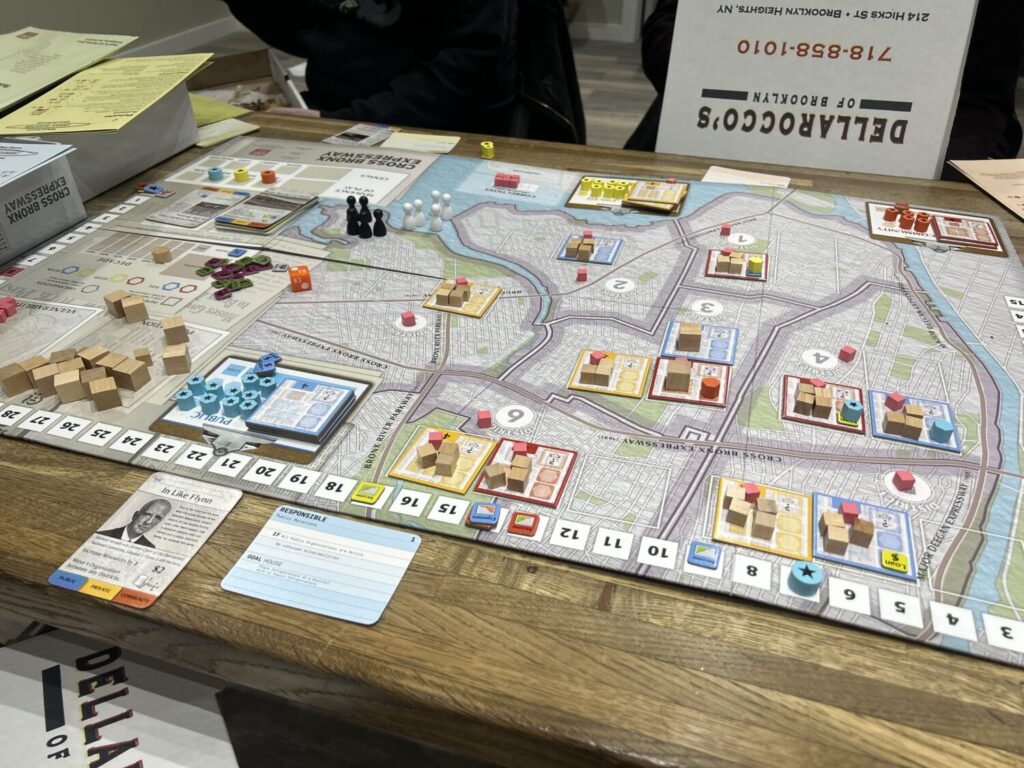
The teeming masses of New York City are divided into three factions: Community, Public, and Private, each with their own priorities and desires. Community is the population of the area, the neighborhood organizations and church groups, who try to push for change while keeping their lives stable and reliable. The game presents issues like unhoused populations or infrastructure decay as Vulnerabilities, which the Community tries to turn into Activists. Public stands in for government institutions, be that at the state or federal level. They seek to keep the economy balanced and to make sure the public doesn’t lose faith in them. Private hardly needs an introduction. Private represents the moneyed interests, the landlords and slumlords and conglomerates who benefit from making other lives more difficult.
This is already an argument, these divisions. The case that Cross Bronx Expressway makes is further clarified by the ways in which these factions interact. You may expect this to be a game in which Private is the villain, and in some ways you’re right, but it’s more complex than that. Cross Bronx Expressway takes a realist’s perspective on the systems that define an urban space. We root for Community, we believe in Public, and we rail against Private, but in action, a mid-century American city without a powerful Private component finds itself without buildings and without capital.
Each player has their own victory conditions, which funnily enough are more transparent than in most COIN games, but there are also communal loss conditions. If the city fails, nobody wins. Like a game of Root, the players have to balance amongst themselves or risk the whole thing falling to pieces. This is the contrapuntal voice against the previous paragraph, a reminder that Private industry needs Community just as much as anything else, and that Public must serve two masters or ultimately face the consequences. If the argument feels a little tired, that doesn’t make it any less true.
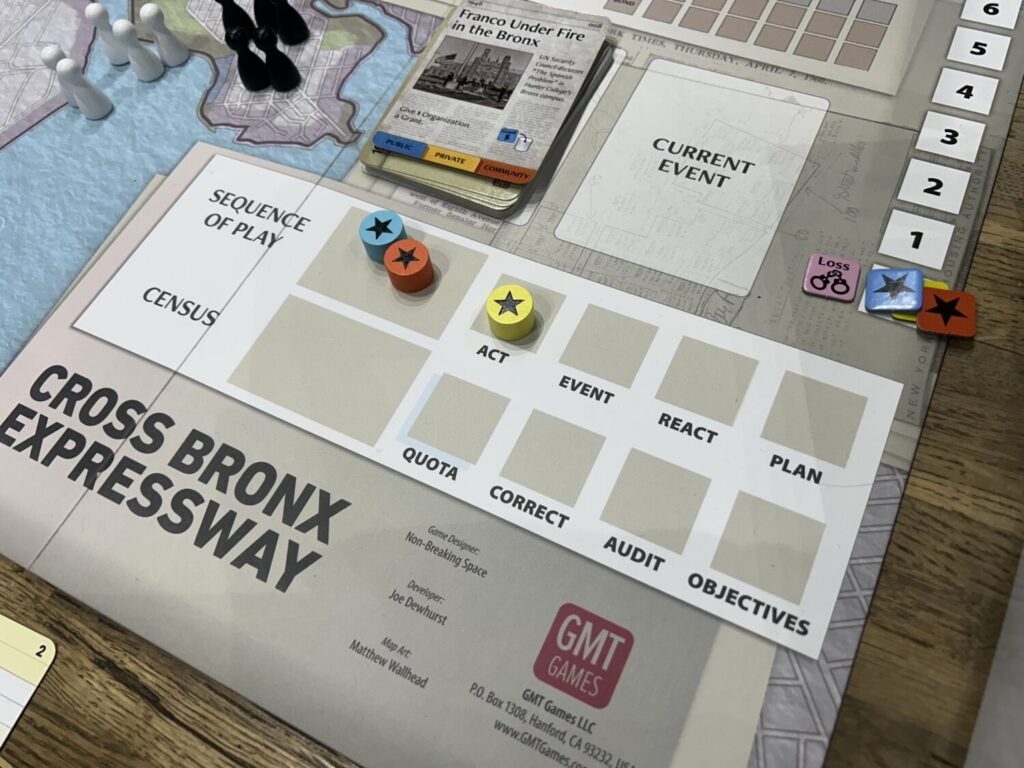
The game hammers home again and again the glacial pace, the outright tedium, of large-scale societal progress. There are no magic bullets, there are no turns in which your fortunes suddenly reverse. Homelessness doesn’t go away in a moment, nor does an excess of housing readily solve itself. It’s all a grind. It’s all board meetings and ballot measures and course adjustments. If that description makes it sound as though nobody enjoyed playing this game, that’s because they didn’t. Cross Bronx Expressway embodies its arguments. It is a set of gears filled with sand. But a game doesn’t necessarily have to be fun to be good. It depends on why you’re here. Everyone leaves the table feeling exhausted and alienated, but within 12 hours, you’re getting texts eager to rejoin the fray. “I have different ideas this time.”
After reading Robert Caro’s The Power Broker last year, I found myself getting lost in consideration of modest city installations like benches on random patches of green. Somebody filed paperwork. Somebody approved it. Somebody scheduled workers to create the space. Somebody schedules workers to maintain it. Cross Bronx Expressway is more abstract than that, it is looking at the same issues from a greater distance, but it too has this power. Universal pre-school was signed into law in New York City earlier this year as a result of decades of activism. The same is true of congestion pricing. Both will do immeasurable good. Neither was easy, and both are worthwhile. The gears are full of sand, but turn they do.
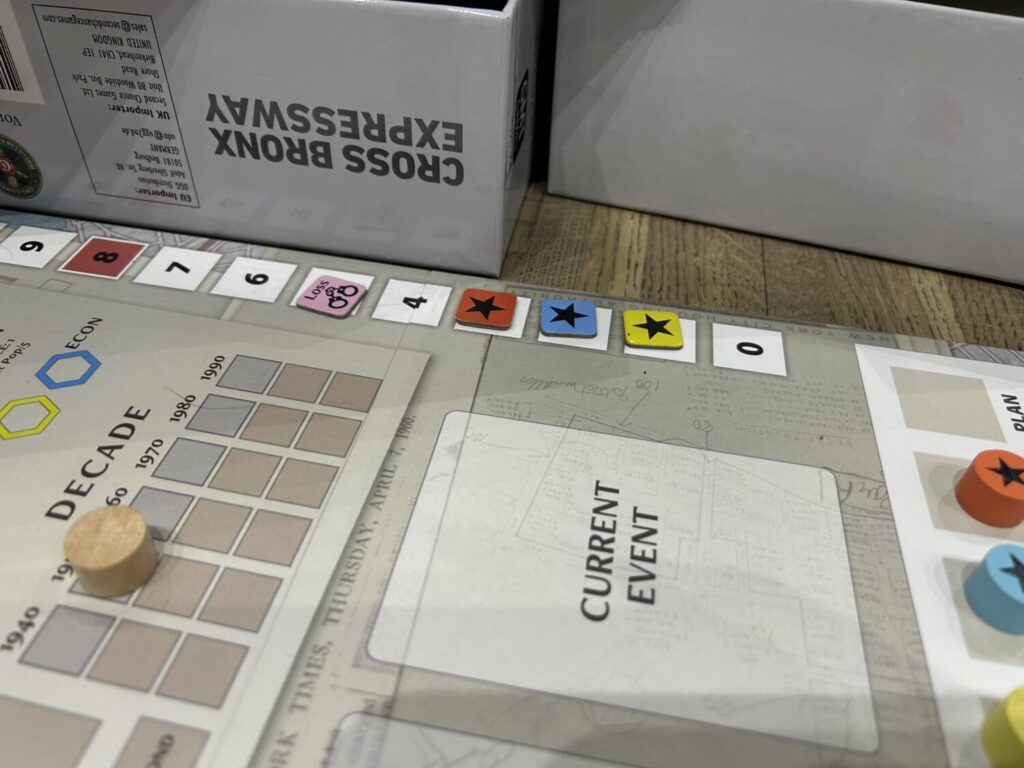
Cross Bronx Expressway details
- Designer: Non-Breaking Space
- Artists: Matthew Wallhead
- Publishers: GMT Games
- Release Date: 2025
- Player count : 1 - 3
- Age range : 14+
- Time range : 90 - 180 minutes
- Mechanism(s): Action Queue, Action/Event, Events, Semi-Cooperative Game, Solo / Solitaire Game, Sudden Death Ending, Take That, Turn Order: Claim Action
- BGG Geek Rating: 7.61554 - converted to Meeple Mountain scale: 4.0.
- More articles about Cross Bronx Expressway.