
Disclosure: Meeple Mountain received a free copy of this product in exchange for an honest, unbiased review. This review is not intended to be an endorsement.

I’ve had a tough tabletop gaming year. More and more, it seems like bad games—truly awful tabletop experiences—are seeking me out, not the other way around.
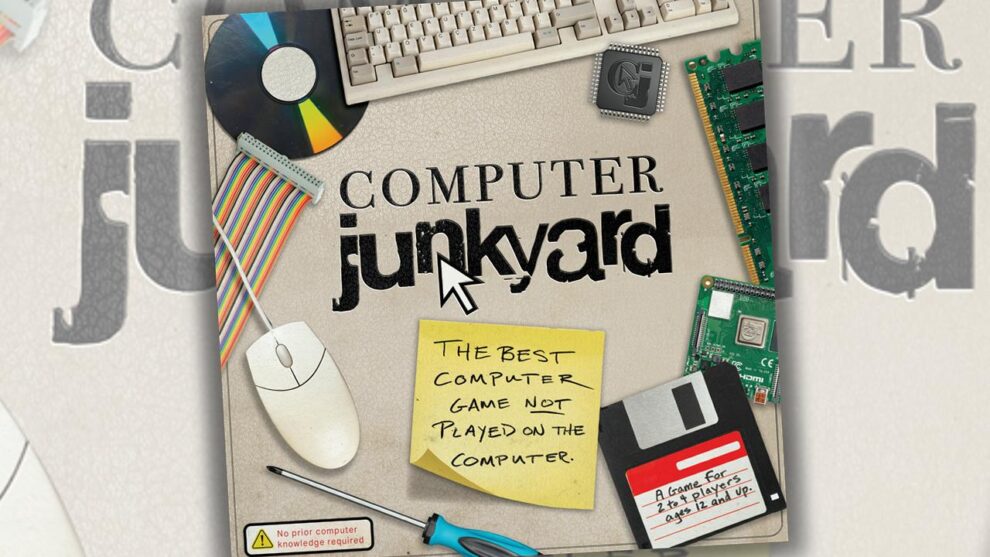
Computer Junkyard is a new game from a new publisher, Dream Egg Games. Designers Allan Pincus and Jared Pincus have created a title that is supposed to be about building a computer from spare parts bought at a local junkyard…or, maybe from stolen parts instead. It’s a simple race game with no other win conditions: the first player to build a computer out of the parts needed to make a working device wins.
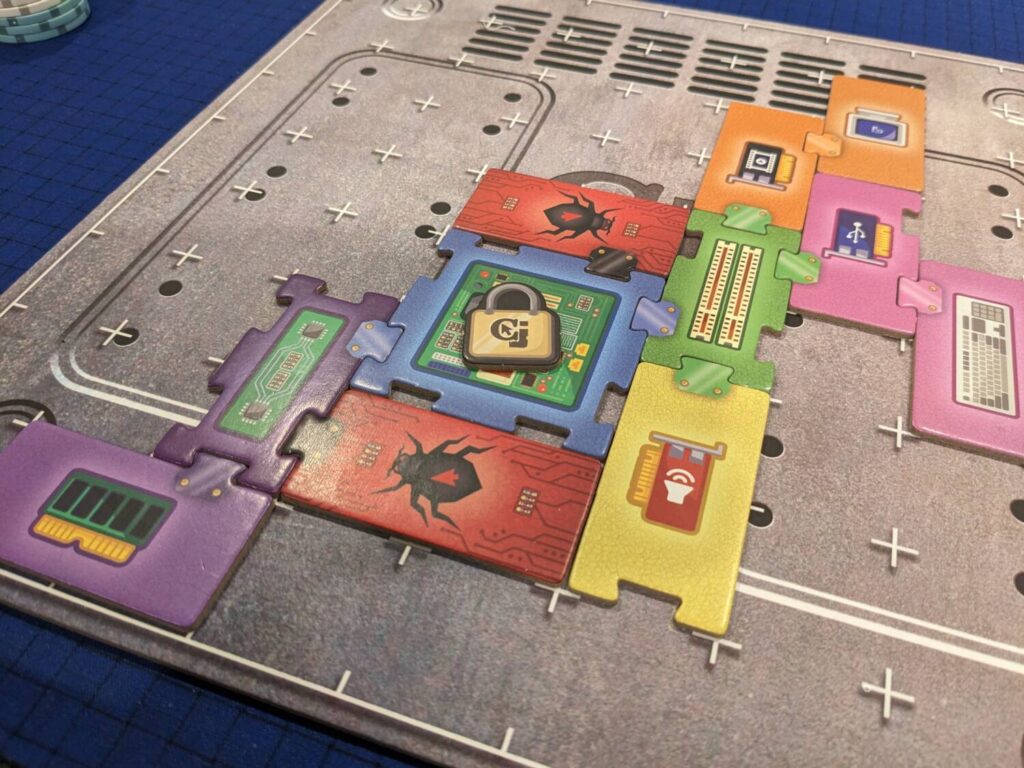
Here was the first sign of trouble: the solo/single player game. To learn the game, I did a play using the single player rules at the back of the rulebook. The goal? Time yourself and build a working computer using the requirements shown on the player aid—your mainframe needs things like a power source, a CD-ROM drive, a monitor, etc.—and a certain number of components unique to the software, like a certain number of RAM and HDD components added through a databus on your computer’s chassis, a board where you can lock puzzle pieces together for your rig.
In solo, this is how things work: draw tiles out of a bag until you find everything you need to complete the computer, then write down your time in the hopes of doing it faster the next time you play solo.
Uh-oh, I thought.
My second play was with four players, and doom set in immediately. Each player begins a game of Computer Junkyard with $50. A market mechanic dictates how much things cost in the junkyard; more keyboard tiles means cheaper prices for each keyboard purchased, with scarcity driving prices the other way. Fine.
But everyone is hunting to build the same computer. Everyone needs a mouse. Everyone needs an audio card. If certain parts have not been pulled randomly out of a bag to seed the market, no one has the parts needed to win. If you don’t have a PCI to connect things like a USB card, you can’t win either.
Our group waited for parts to slowly enter the market. In a four-player game, eight bug tokens are also in that draw bag. When a player draws one, they place it on another player’s motherboard. This both blocks a section of a player’s mat and potentially bugs entire portions of a player’s computer. More importantly, a player can’t win if their rig has even a single bug token.
On a turn, players must first add two tiles from the draw bag into the junkyard, making them available for purchase. Then, they can buy up to two tiles and/or sell up to two tiles (assuming those are different from those purchased on the same turn), attempt to debug their computer by rolling a D10, or steal parts from a player’s “workbench” (a storage area, off the side of a player’s chassis board) or that player’s computer.
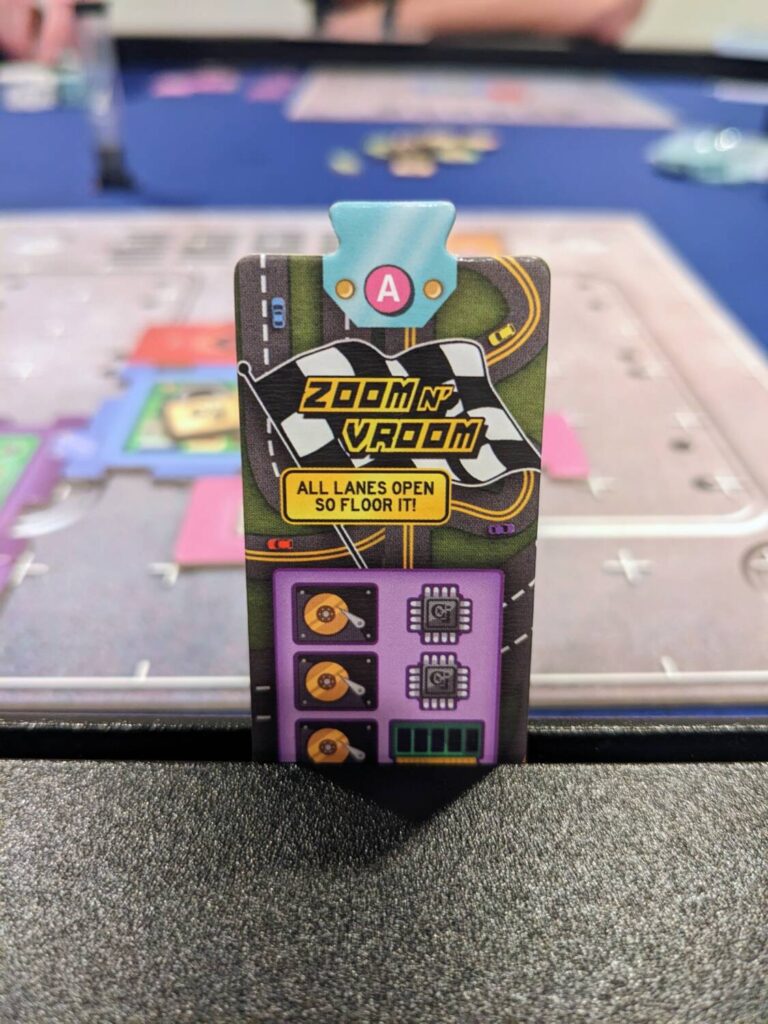
I still have no idea why one of the game’s mechanics is tied to stealing computer hardware from another player; thematically, this feels WAY off. It seems like the theft mechanic is here because the designers weren’t sure of any other way for players to solve the hardware scarcity problem, so we get a chance to disrupt another player’s plans.
Or something. The theft angle feels broken in Computer Junkyard because it is tied to a die roll. It also helps solve a problem two of our four players had in this second play: cash got very tight in the middle of our game, so stealing was the only way to acquire parts at all, slowing everything to a halt. Roll a seven or higher, and your theft attempt is successful. If not, I guess you are…bad at stealing computer parts from a neighbor’s house?
Computer Junkyard is bad, but the debugging mechanic is so much worse.
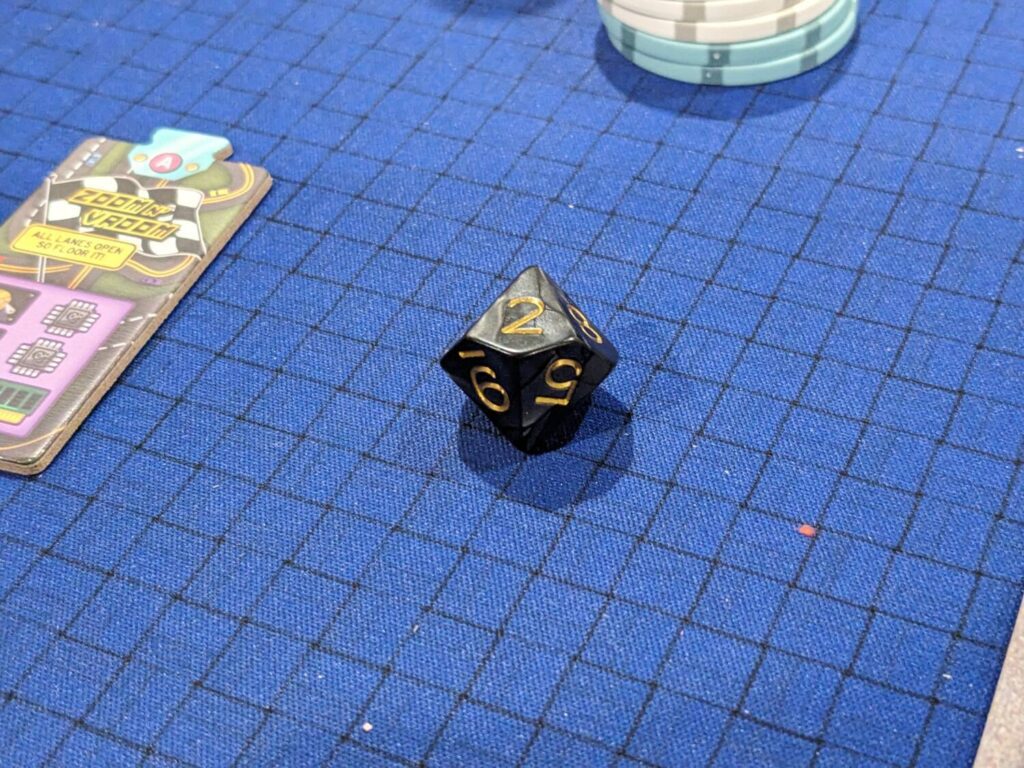
When a player begins their turn by drawing tiles from the bag and draws a bug, they get to place it on an opponent’s board. To get rid of that bug, you still have to start your turn by adding two tiles to the junkyard—yes, making it better for the next player to potentially buy cheaper parts—then roll the D10 and get a six or better to remove the bug. Fail, and you’ve just wasted your entire turn.
At one point, I had two bugs on my motherboard. Other players had one or none, so I knew I wasn’t winning at that point anyway. But on THREE CONSECUTIVE TURNS, I rolled a threshold lower than the success factor. (The game grants a loser like me “bug spray”, lowering the requirement for success by one on future debug rolls. But, wouldn’t you know it, I rolled a four, then a two, then a three, before getting out of debug jail on my fourth turn.)
That also means all the following:
- I added six tiles to the junkyard across those three turns and bought none of them, because you have to choose between the game’s three main actions: buy/sell, steal, or debug.
- Every other player was able to buy cheaper goods while I sat and wasted turns trying to debug my rig.
- Because I was not buying tiles, I didn’t need to bother doing any actions during the simultaneous second phase of each turn, where players mill around on their chassis board to build out their rig. Yes, this means I looked at my phone for the two-minute timer period where other players were…what’s the term I’m looking for here…PLAYING THE GAME.
- It took me three turns to remove the first bug, then only one turn to remove the second bug. Still, losing four full turns in a row meant that I was just sitting at the table, not participating in what I assume the designers were going for with the game. While you are allowed to buy/sell parts while bugs are in your computer, you can’t win until those are gone, so you’re going to have to waste turns eventually to get rid of the bugs.
- There are eight bug tiles in a four-player game, but four in a two-player game. That means that if one player is lucky enough to find all four bugs, they will be able to almost completely dominate another player based purely on the luck of the tile draw. Is that a game you want to play?
Computer Junkyard really shocked me. It is terrible in ways that I haven’t seen often in modern gaming, in a year where I’ve played a dozen of the worst games I have ever played as a member of the Meeple Mountain writing team.
Computer Junkyard is never fun, it provides players with way too much time to do something as simple as color-match puzzle pieces, and it turns into a race that limited players can win if parts are scarce. Buying low and selling high should be a critical part of this game, but the reality is that you could play a game of Computer Junkyard and never buy anything, if you are lucky enough to steal your way to victory.
Avoid this game at all costs. I would have rated this a zero out of five, but our rating scale gives credit for a game existing…so, 0.5 it is!!
Computer Junkyard details
- Designer: Allan Pincus, Jared Pincus
- Artists: Jordan Pincus
- Publishers: Dream Egg Games
- Release Date: 2026
- Player count : 2 - 4
- Age range : 14+
- Time range : 60 - 90 minutes
- Mechanism(s): Market, Take That, Tile Placement, Trading
- BGG Geek Rating: 7.4975 - converted to Meeple Mountain scale: 3.5.
- More articles about Computer Junkyard.