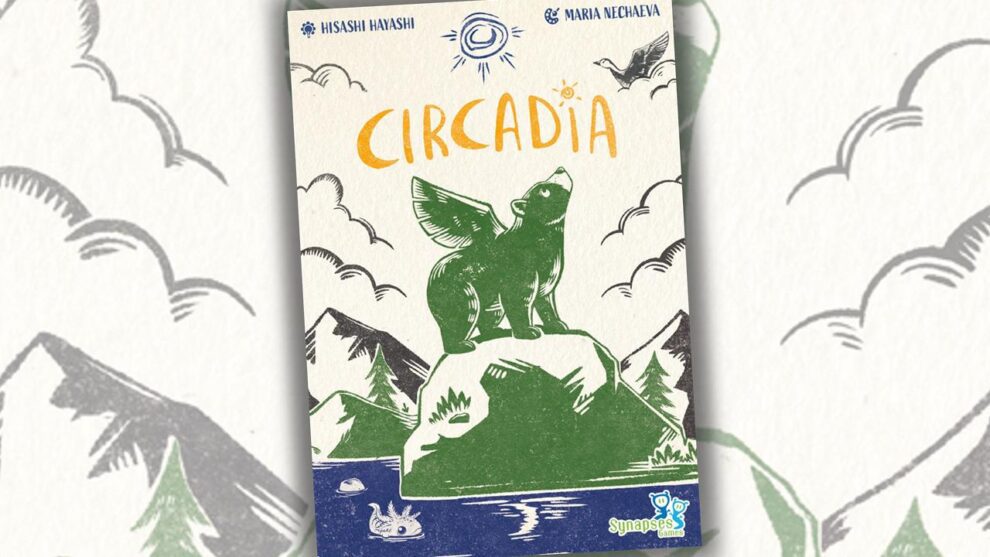

Disclosure: Meeple Mountain received a free copy of this product in exchange for an honest, unbiased review. This review is not intended to be an endorsement.

Hisashi Hayashi is the designer of a quick new card game called Circadia. I was initially interested because Hayashi has done some great work for the Bell household, namely in the form of Yokohama and Railway Boom, the latter of which was on my list of the top 10 games of 2025.
As you may know, lots of publishers are pushing out new card games, for the reasons one might expect: this is a much cheaper way to get a game to market, and it could satisfy the needs of many types of players in an environment where players are apparently spending less on their games.
Enter Circadia. There’s a theme loosely tied to Dreaming Paths, Spirit Creatures, and becoming the “Keeper of the Eternal Cycle” for the person lucky enough to win the game.
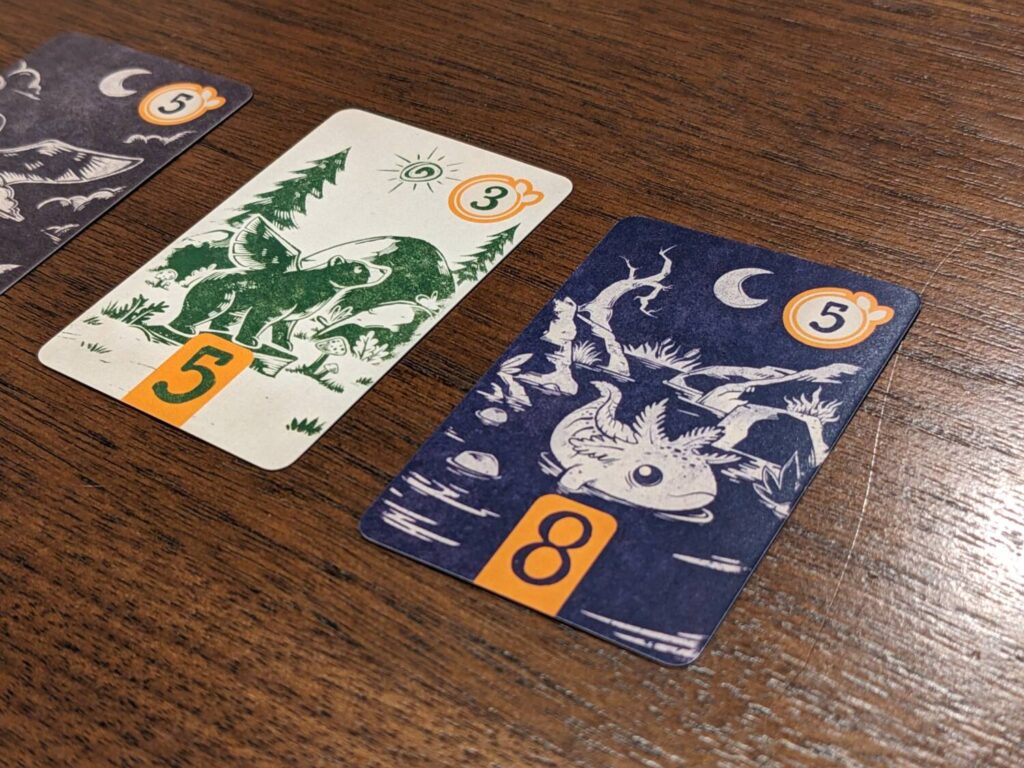
The reality is that Circadia is much, much simpler than even the loose framework. Setup only takes three steps. Players manage a hand of cards (never more than eight), trying to build up sets of cards across three types of Spirit Creatures: bear, axolotl, and goose.
Sets are played from hand based on the value of the cards, so a player who wants to play twos can play any card with a two on it, regardless of Spirit Creature type. Cards must be played to a player’s personal play area in ascending order, so if you start a set of geese with twos, you can only play more twos, or threes, fours, or fives into the current set…but not ones. (Thankfully, there are many more ones and twos in the 148-card Creature deck than threes, fours, or fives.)
Based on the size of a current set (in total cards played within a Creature set), a player can claim a contract—here known as a “Habitat”—by spending all the cards in an animal’s set. If a player had seven bear cards, with value one five times and value two twice, they could claim a size-7 Habitat and add it to their play area. Each Habitat is worth 1-5 points at the end of the game.
There’s one additional rule with those Habitat cards, though, because each card is shaded in either dark (night) or light (day) colors. Once a player starts their Habitat chain, the next card has to be the opposite color. Face-down draw cards from each Habitat deck (one deck for each Spirit Creature type) have both colors, so they can always fit…but they’re only worth one point each, and cost five cards to buy, making them very unattractive.
At the end of a player’s turn, they draw cards from a market based on the value of the cards played that turn. That means if a player plays two value-five cards, they can draw five cards from the market to refill their hand. But if they play a bunch of value-one cards? They only get to take one. (Strategy!!!)

Circadia never elicited the howls of joy I was expecting when the game arrived. It became clear quickly that building sets with ones to claim the best contracts was worth the wait, especially if a player could close out a set with a four or a five to ensure that they could draw a bunch of new cards from the market. But, in one of my games, I decided to try something different and basically play small sets and clear them to claim the lower-value contracts (ones that can be earned with just four, five, or six cards), in the hopes that I could clear a bunch of Habitats quickly.
That didn’t work out very well, but I was still encouraged about the varying ways a player could attack the game. Circadia ends when a player reaches 15 points, giving each other player one final turn. In my brief experience with Circadia (three plays), the player who reached 15 points first always won, especially because it seemed normal that a player was not one action away from taking a Habitat that could have won the game on the final turn. (I’m sure this would change with more plays, of course.)
The card art is beautiful here; for a fish, that’s a good-looking axolotl! But the color scheme from animal type to animal type is too similar, and the river/mist habitats (for axolotl/goose, respectively) is too similar on the night-side Habitat cards.
Circadia has some interesting decision points, but as a play experience, some players complained that the game was a bit bland. There’s really no talking during the game, as players quickly lay out their cards in their creature sets on a turn before drawing up again from the market. To spice things up a bit, I asked players to begin announcing their point totals after each Habitat was acquired, to try to ramp up the tension or generally make it seem like we were playing a game together, not just working on our own individual crossword puzzles.
Circadia is decent, and it might land best as a quick filler, particularly on a night where Hayashi’s other games are about to hit the table.
Circadia details
- Designer: Hisashi Hayashi
- Artists: Maria Nechaeva
- Publishers: Arclight Games, Devir, DSV Games, Elznir Games, Gémklub, Meeple On Board, REXhry, Synapses Games
- Release Date: 2026
- Player count : 2 - 5
- Age range : 8+
- Time range : 30 minutes
- Mechanism(s): Hand Management, Set Collection
- BGG Geek Rating: 7.06286 - converted to Meeple Mountain scale: 3.5.
- More articles about Circadia.