
Disclosure: Meeple Mountain received a free copy of this product in exchange for an honest, unbiased review. This review is not intended to be an endorsement.
It was easily the most shocking designer news I heard at last year’s SPIEL Essen event.
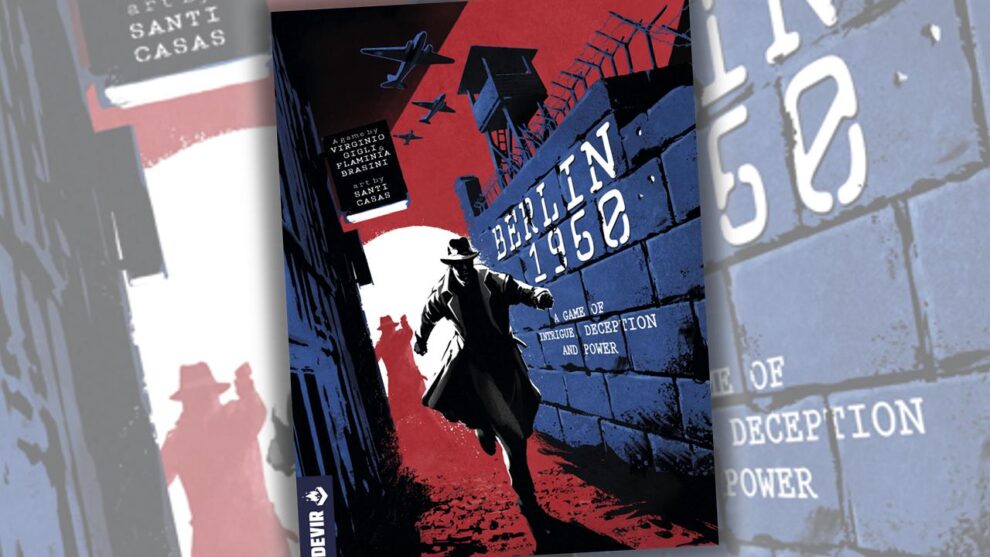
The designers of Devir’s new hidden role game, Berlin 1960—complete with cover art that made it look like a movie thriller combined with a wargame—were Flaminia Brasini & Virginio Gigli, co-designers of modern classics such as Coimbra and Lorenzo il Magnifico, some of the best medium-weight Euros of the last 20 years.
“The Lorenzo folks did a hidden role game?” I thought when I heard the overview. “This might be the biggest surprise of 2026!”
Berlin 1960 arrived at my house a few weeks ago, and I waited patiently for a game night when I had enough players to get a play rolling. That is a key component of this review…because the more players you can find, the better your experience will be. I’d frame it this way: Berlin 1960 is an eight-player game with variants that accommodate 4-7 players.
You should play this game at its maximum player count of eight…and, you should not play it with many less.

Gunshot Wound
Berlin 1960 is a hidden role game for 4-8 players. Players are individually assigned a role as a spymaster for either the KGB or the CIA, so when play begins, players do not know which players are on their side of the Cold War. Each player manages a network of 10-11 spies (represented by cards), and each spymaster’s deck is identical.
Turns are very fast. At the start of a round, each player has five spy cards. Simultaneously, each player picks one spy to be active for that round and places it face-down on their mat. Then, starting with the first player and proceeding clockwise, each player begins their turn by revealing their chosen spy, executes the action on their card, then has the chance to perform “counterintelligence” (gunfire!) on any other player who has played the same spy during the same round. Bullet wounds limit a player’s hand limit of mission cards, which are used to either score or detract from the score of the opposing agency.
Missions are a little weird in this game. There are two decks of mission cards, one for each agency. Players can draw from only one of the two decks on a turn (their choice, normally), and play cards to one agency or the other, with mission slots for facedown placement. All the missions fall into one of three categories: end-game scoring, end-of-semester scoring (triggered when a certain number of mission cards are played on one agency), or scoring cards, which can be cancelled based on other played cards on that agency’s side during the resolution step of a semester.
The missions sounded more exciting when I did a first pass of the rules, in part, because I was expecting the missions to create more intrigue, just like the box cover says. But in practice, players will play cards to try and throw teams off the scent—remember, at the start, players don’t know who their teammates are—but players can quickly suss out who works for which agency, especially at lower player counts.

This was so blatant in my four-player game of Berlin 1960 that our entire GAME only lasted three turns per player, with two completed semesters. By the second turn of the game, I knew who my two enemies were, based on how they played cards and a spy card, the Dancer, that revealed my neighbor “Derek” (his spymaster name) was almost certainly a KGB man. That’s because the Dancer allows the active player to hand a mission card to any other player, who must look at the card and then place it on one agency or the other.
I was a CIA man in that game. If “Derek” played my Politician card to the KGB side—which would nullify a chance for the CIA to score three points—I knew he was a rat. I watched his facial reaction when he looked at my mission card…and then he smiled, placed it on the KGB side, and watched as I made an accusation that he and “Andreas” (our man Joseph Buszek) were KGB.
Once per game, players can make an accusation to try and wrangle additional end-game points by guessing which players work for which teams. In a four-player game, that shouldn’t even be an option; it’s so easy to guess and be right (you already know who you work for, so even guessing one other person’s allegiance makes the entire exercise moot), and that could swing the game.
It also means a four-player game of Berlin 1960 will be over fast…our four-player game took less than 30 minutes, and that was a first play for the other three players at the table. If we ran it back, it would have easily been 20 minutes or less.
But, crucially, it would never be interesting.

Warmer
At six players, Berlin 1960 was a little better.
It wasn’t great, but there was a little more drama and a little more guessing at player allegiances based on who may or may not be on your side. Performing counterintelligence on another player might be a risk, because at the end of the game, players with gunshot wounds bring their overall team’s score down. Watching players draw from each deck, or playing missions on different sides of the board, is mysterious enough that players will have a harder time figuring out who’s who.
And making accusations at higher player counts is riskier. If you don’t get an accusation 100% right, your team will lose two victory points per incorrect accusation. Based on the scoring system, Berlin 1960 will usually be close, so getting accusations right becomes important. There was much more balance in placed missions during each round, and the overall game went a lot longer, clocking in at just over an hour with six players. (The game will end after three semester scoring rounds, or after all but one player has made an accusation.)
It’s clear to me that Berlin 1960 will live or die in a player’s collection as a max player count experience. All of us agreed at the end of our four-player game that Berlin 1960 would be better with more players.
But then, the game runs into a different problem: even Captain Sonar does a better job of keeping secrets between a group of eight players, with a much more satisfying arc than anything offered during Berlin 1960. (And, look, even people who joined me for plays of Berlin 1960 were openly talking about how much better games like The Resistance are in this category.)
There was no real variety between those first two plays of Berlin 1960, nor between players. By that, I mean that even after two plays, there isn’t a wide variety of mission cards. It becomes clear, quickly, that choosing to always play scoring cards to your agency is the right move, because there are also spy card powers that allow a player to remove cards from a mission area or ensure that your team can push any problematic cards to the discard pile or the opposing agency.
The bigger offender is the spy deck. A player will always have five cards to choose from at the start of their turn, and I wish there were more interesting powers on offer here. All spies can be played for an alternative action, to simply draw two cards from either mission deck without playing any. That’s worth doing at higher player counts, but there’s no time for that at lower player counts. Early in the game, some cards, such as the Sniper spy card, are completely worthless, and cards like the Doctor (or Nurse, a spy card that is only included at higher player counts) only have value if another player has taken a gunshot wound.
But what if players are too shy about shooting at their tablemates? That’s a real possibility in a hidden role game; you certainly don’t want to put a bullet in your neighbor if you aren’t sure about her allegiances.

Eight Isn’t Just Enough…It’s the Only Option
If you’ve got a steady diet of seven- or eight-player gaming groups, or a monthly game night with Werewolf/Blood on the Clocktower players, give Berlin 1960 a look. That’s important, because I had to pull some strings to even get the six-player game rolling with my play groups. (My review crew regularly has four, maybe five players, while some of my other groups have as many as 14 people on the distro, with most nights ending up in the 6-8 player range.)
With an odd number of players, Berlin 1960 might also be more interesting, because not knowing if your agency has, say, three players or four players (in a seven-player game) could make the accusation step a roll of the dice. (The game comes with a minority card that is used to balance out end-game scoring for the team with fewer players.)
If you are like most of my peers and you play games regularly with a max of four or five players, absolutely skip this game.
Almost none of the magic Gigli & Brasini injected into their previous designs is on display here, so while I think Berlin 1960 is stronger at higher player counts, it is still never special.