
Disclosure: Meeple Mountain received a free copy of this product in exchange for an honest, unbiased review. This review is not intended to be an endorsement.
A few months ago we received an email requesting a review of Bare Bones. It’s always a toss up when reviewing games from a publisher you’ve never worked with before, but I decided to dig a little deeper. I read the rules, and some other reviews, and as I found out more, I became more intrigued; ultimately deciding to take the plunge and get a copy sent to me. And boy, have I had a blast playing this. It’s equal parts Splendor (engine building), Dominion (deck building), and Roll for the Galaxy (dice rolling).
Join me as I walk you through the bones of Bare Bones.
Dem Bones, Dem Bones
In Bare Bones, players purchase cards of varying cost from the central market, each card providing either a special action or the option of rolling six-sided dice of varying colors and values. Blue dice are cheap, at only 4 coins, but only have the numbers 1, 1, 1, 2, 3, and 4 on them. White dice are middle of the road in cost, at 6 coins, and have the numbers 2, 3, 3, 3, 4, and 5. While black dice are expensive, costing 12 coins, but feature 5, 5, 6, 6, 6, and 6.
You might ask yourself, “Where do I get coins?” To answer that, let me rewind a bit. I mentioned Bare Bones is a deck-builder, and in true deck-building fashion each player begins with a starter deck: 3 blue cards, and 4 white cards. Players also get to pick 3 additional cards from the market to bring their personal deck up to 10 cards.
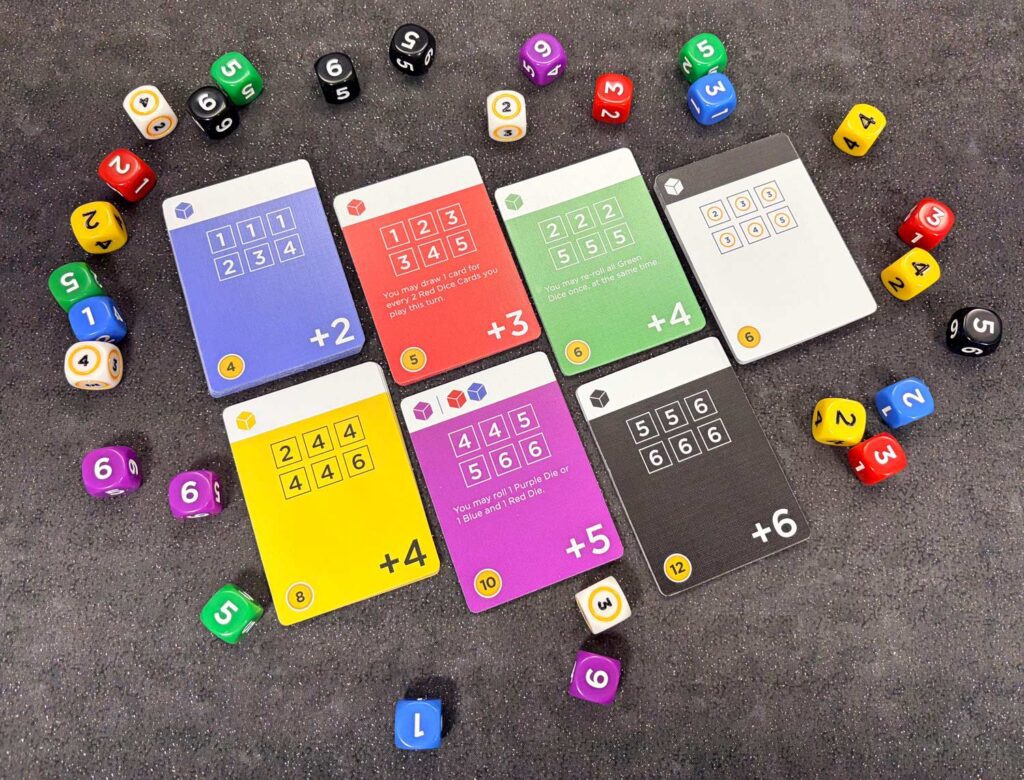
To play the game, start by shuffling your deck, then drawing 5 cards. Each die card gives you the option of rolling 1 die of the matching color. So, if on your first turn you drew 2 blue cards and 3 white cards, then you’d be able to roll 2 blue dice, and 3 white dice. Any pips you roll on colored dice earn you points, while pips on white dice earn you coins which must be spent on that turn to purchase new cards from the market.
Managing the probabilities of die faces would be interesting enough, but when you add in the action cards, Bare Bones really comes to life. The base game comes with 20 different action cards (and the two mini-expansions add even more). At the beginning of the game, players select 7 different action card stacks, similar to the setup of Dominion. The game even gives you a “randomizer” deck of cards to make it easy to select action cards.
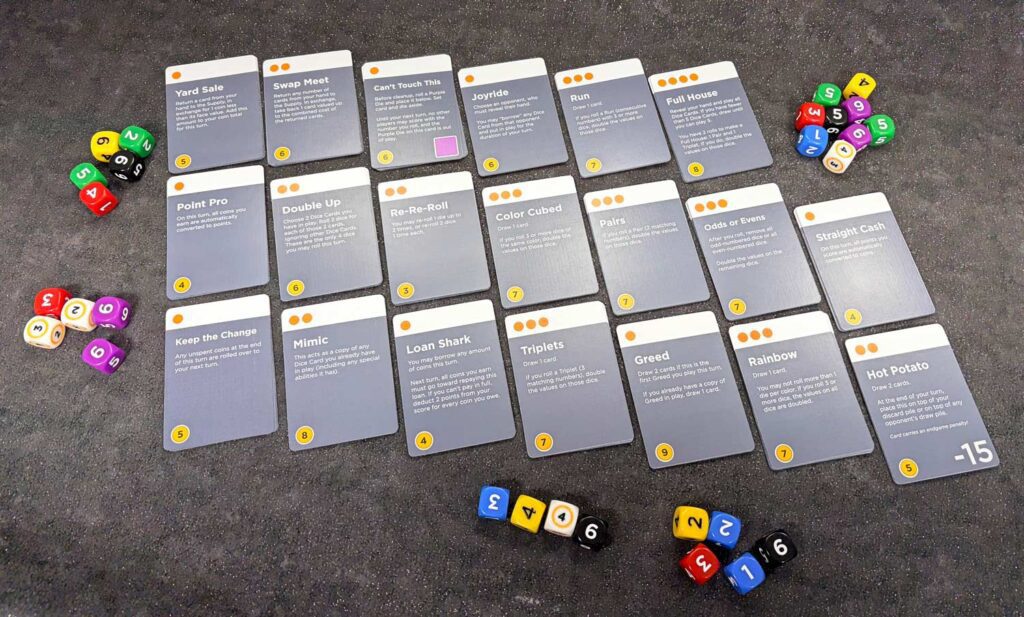
Most of the action cards give you ways to manipulate the dice you’re rolling. The Pairs action card says, “If you roll a Pair (2 matching numbers), double the value of those dice”. That’s great if one die is money, or a black 6. The Point Pro action card says, “On this turn, all coins you earn are automatically converted to points.” That’s great to have near the end of the game when coin dice become almost worthless because you just want points. The Keep the Change card says, “Any unspent coins at the end of the round are rolled over to your next turn.” This is great because you could choose not to spend any coins that turn and hope for a high income next round.
When selecting which dice you intend to roll, keep in mind that you may roll a maximum of 6 dice. And similarly, you can never spend more than 5 action points worth of action cards on a turn. Combining everything together makes for a fun and engaging experience, especially when some of the action cards allow for a bit of player interaction.
It’s Got Good Bones
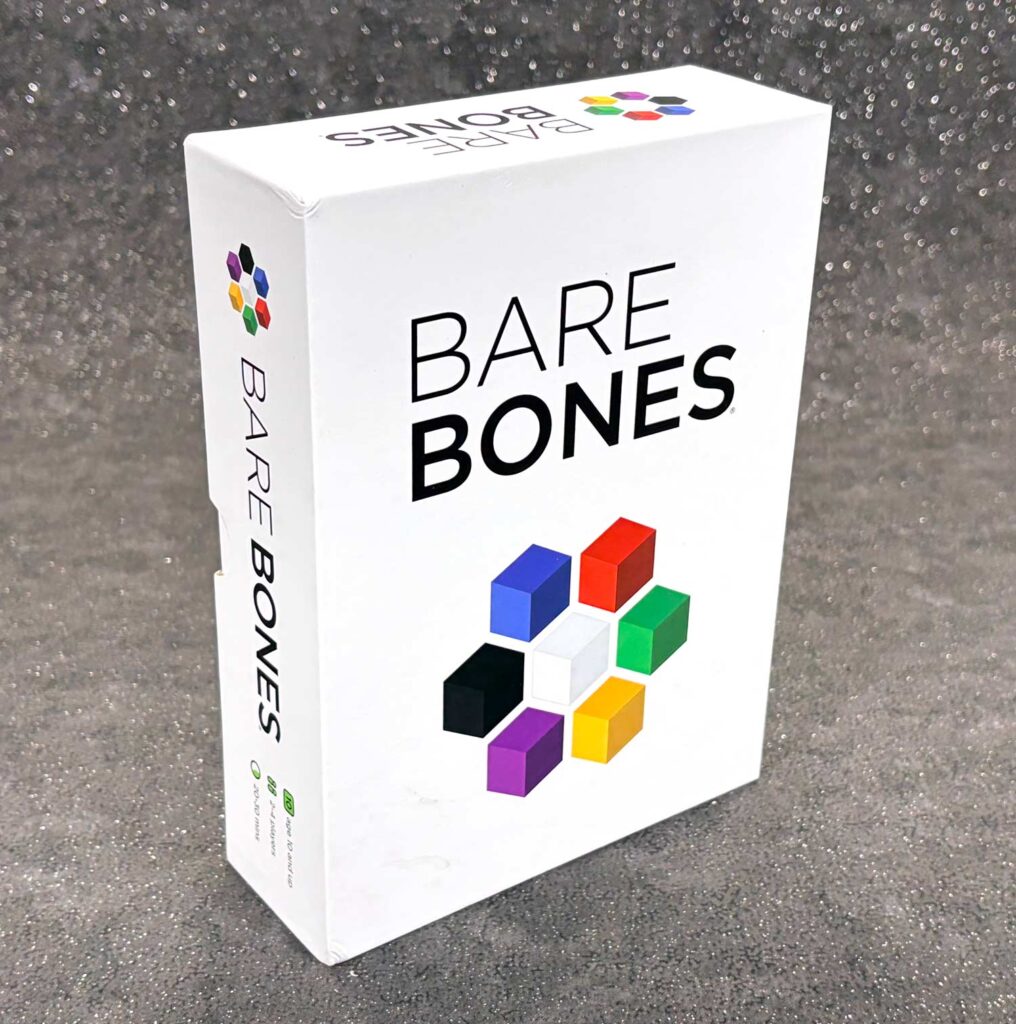
Even though the tagline at the top of this review says, ‘Bare” in production, but not in gameplay’, Bare Bones might be better called “Spartan in production”. There’s no artwork to speak of, but the graphic design in this game is excellent. The cards and rulebook are laid out with great attention to detail, with the text and colors chosen with care. Text on the cards, and the numbers on the dice are easy to read, even from across the table. Bare Bones’s packaging likely won’t win any awards, but you’ll also never hear anyone complaining about it either.
The gameplay is solid, with lots of “input randomness” thanks to the selection of different action cards—Google says there are over 77,000 combinations. And while many of them just change the value of the dice you’re rolling, some of them are really neat, and can break the rules of the game in interesting ways.
The game is played over 10 rounds, so there’s never a concern that it will outstay its welcome. Most games we played took around 60 minutes, and we often spent a few minutes afterwards chatting about great plays we made, or groaning about bad dice rolls. And the latter is the sole reason I didn’t rate this game more highly. At the end of the day, it’s still a dice game, and while the game gives you the ability to mitigate bad rolls by purchasing alternate cards, if you always roll poorly, you’re going to have a tough time.
So if you enjoy dice games mixed with some strategy and fun cardplay, make sure you check out Bare Bones.