
Disclosure: Meeple Mountain received a free copy of this product in exchange for an honest, unbiased review. This review is not intended to be an endorsement.
Rats of Wistar (2023, Cranio Creations) is a game that has slowly grown on me since my initial review plays. Designed by Simone Luciani and Danilo Sabia, Rats of Wistar has hit my table a few times since, but things really changed when the game appeared on Board Game Arena in April 2025. I was laid off from a corporate role that same month, and I found myself chock full of time on my hands to play it online…and play it, I did, to the tune of a top-20 ELO ranking and dozens of real-time and async plays.
At first blush, Rats of Wistar looked like a challenging worker placement game that featured a cool mechanic for not only choosing actions but anticipating ways to take the actions you needed as the game moved along. That’s because each action choice is then powered by the number of workers you have in the section where the game’s action wheel is currently located. Want to gather some wood? Sure, but you have to have workers in the area where the Gather Wood action is, and there has to be a worker placement spot left for you to choose.
Because each action had varying numbers of worker placement spots, and six wedges on its action wheel, plotting out the right order to take actions while also ensuring that other players would block you was a very tough puzzle as a new player. Playing Rats of Wistar online changed my perspective completely…because Rats of Wistar, like another Luciani title, is actually a card game and not a worker placement game, even though the worker placement figures heavily into the planning.
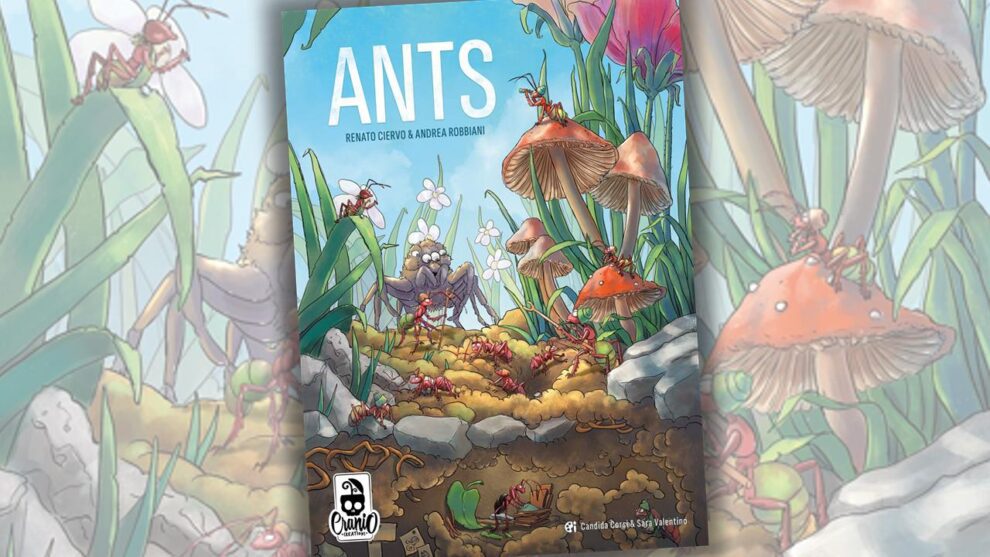
My BGA plays really brought the importance of card play to life. When Cranio announced ANTS earlier this year, I was immediately hooked because the ANTS cover absolutely uses the same art and calligraphy from Rats of Wistar—and Luciani is onboard here as the game’s developer. The cards looked different, but the tag system was similar to both Rats of Wistar as well as games like Terraforming Mars, so I rushed ANTS to the table when I brought a review copy home from SPIEL Essen 2025.
As it turns out, ANTS doesn’t even reference Rats of Wistar in its production; from the rulebook to the gameplay, ANTS is a different beast. It does a couple of things very well, but a few gameplay elements drag the overall experience down a notch.
Preach, Queen
ANTS is an action selection, hand management game for 2-4 players that plays in about 30 minutes per player. There are no rounds or phases; ANTS just runs until a number of personal goals are completed by the player collective, tied to player count. Surprisingly, there is no solo mode; for me, that surprise stems from the fact that Rats of Wistar has a solo mode and ANTS does not.
And this is where it’s important to call out, again, that ANTS has essentially nothing to do with Rats of Wistar. I’m still so confused by this that I’m going to use another whole paragraph to discuss this issue!
ANTS and Rats of Wistar look like they live in the same universe, thanks to the artwork from Candida Corsi and Sara Valentino, the people who illustrated the cards and cover for both games. The rulebooks use the same layout. Rats of Wistar had a much more detailed theme/backstory; ANTS appears to just be a game about ants vying for control of a small section of a local garden.
The tag system used in Rats of Wistar sort of appears in ANTS, with three of that game’s five tags carrying over. But there are eight different symbols here, and many of the ANTS cards require players to have certain tags to play other cards or take certain actions…I still can’t figure out why there are so many tags here.
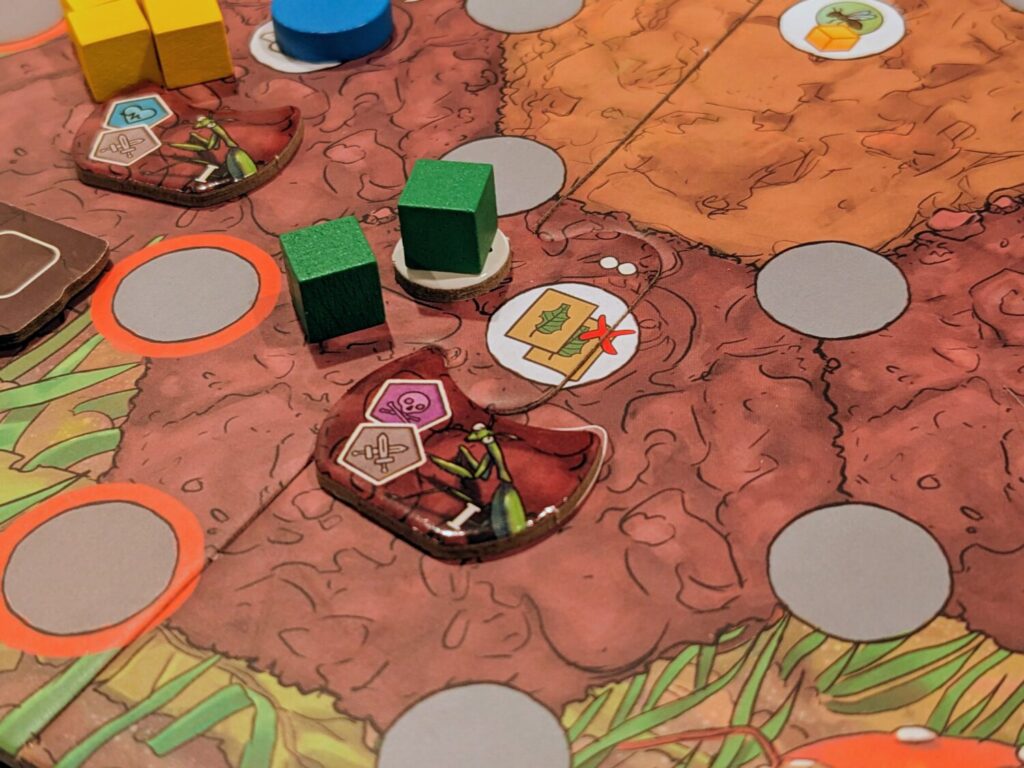
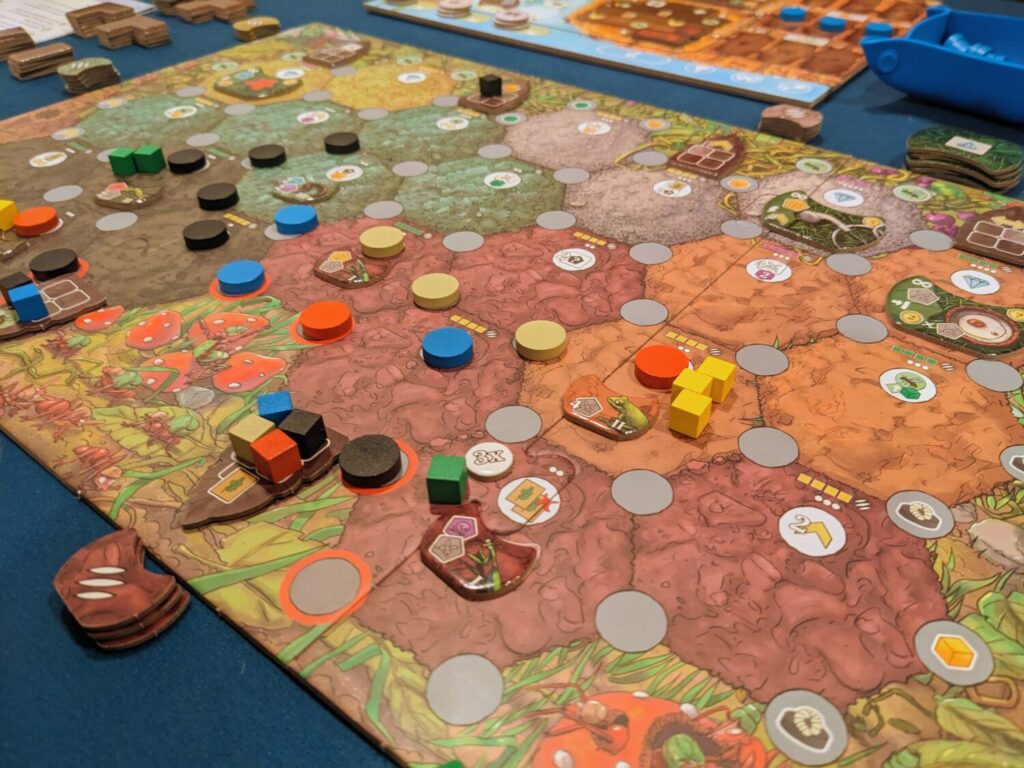
My big issue with ANTS is its production. Almost everything here feels a bit skimpy. That starts with the shocking scarcity of wooden cubes included in the game box. The main currency for buying cards in ANTS are leafs, represented by green wooden cubes. But there are only 20 green cubes in the box. In a four-player game, you might use up almost all of those cubes during the setup. Why did Cranio only provide 20 cubes? (There are five “3X” tokens, but they are the size of each cube…so when you place a cube on top of it, you actually can’t see the 3X token!)
Remember those rat tokens from Rats of Wistar, including the Chief pawns and the rat worker tokens that looked suspiciously like the Woodland Alliance tokens from Root? They really added something to the experience. In ANTS, there are no ant-shaped tokens. No ant queens. No fancy bits at all. I wasn’t looking for anything deluxe, but couldn’t we get something better than wooden discs to represent the ants?
The board uses a puzzle locking system; imagine a normal game board, but instead of one piece of cardboard that folds outwards, ANTS uses a board that jigsaws itself together, similar to how puzzle pieces interlock. Unfortunately, much like the board for last year’s economic Euro Asian Tigers: A Story of Prosperity, the ANTS board is a bit of a disaster. As someone who was critical of the Rats of Wistar board’s requirement that one had to screw in the action wheel each time the game is set up (!!!), it’s really surprising that the ANTS board is such a miss.
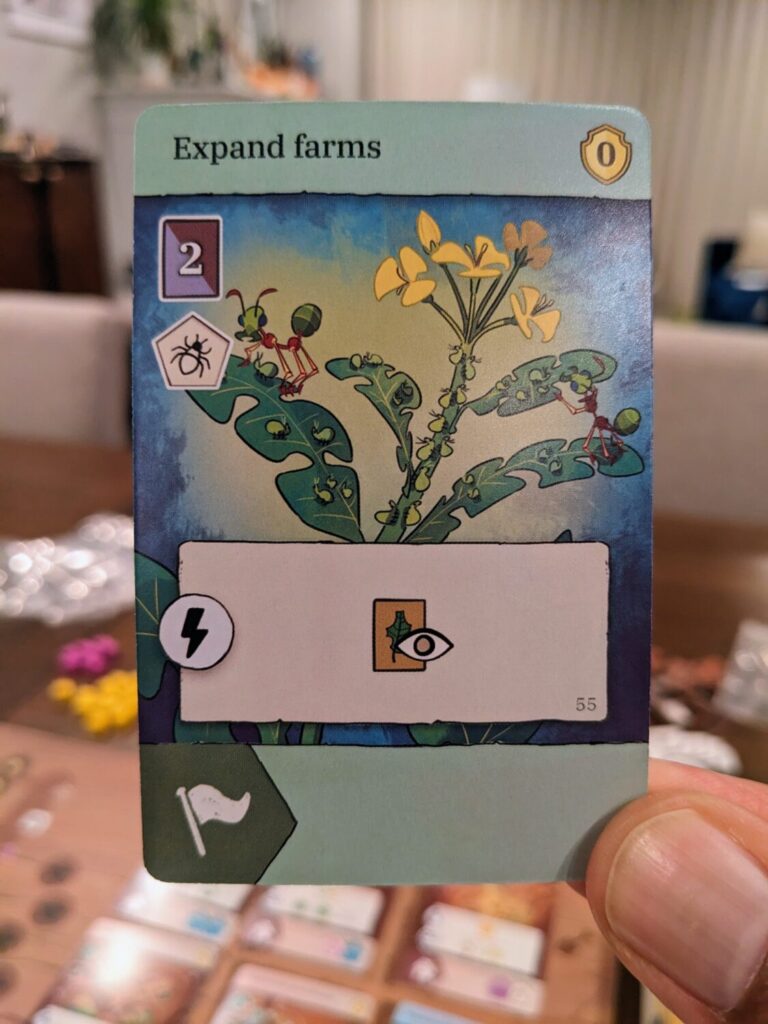
The game’s biggest production miss comes in the place that it needed to most importantly address: there are no player aids included in the box. This is made more shocking by the fact that ANTS has a two-page appendix with more than 50 unique icons and edge cases. You absolutely will spend your first few plays passing the rulebook around to players who need to study their cards to understand what they do, in a game where you will be drawing new cards on almost every single turn.
Clear the Hurdles
Once you get past some of these production elements, ANTS turns into a pretty interesting game, thanks to its recall system that triggers when players have to pass.
On a turn, players have the choice of one of six different actions. That sounded daunting at first, but in practice that wasn’t that big a deal. Players have a series of flat, round discs that serve as all-purpose tokens. On a player’s personal board, these discs take on the role of ants, larvae, and eggs, that graduate up a level during the game’s Incubation action, when a player essentially decides to pass. When they are ants placed on the game’s map, they become either forager ants, which help a player pick up resources, or explorer ants, used as hubs for new forager starting locations.
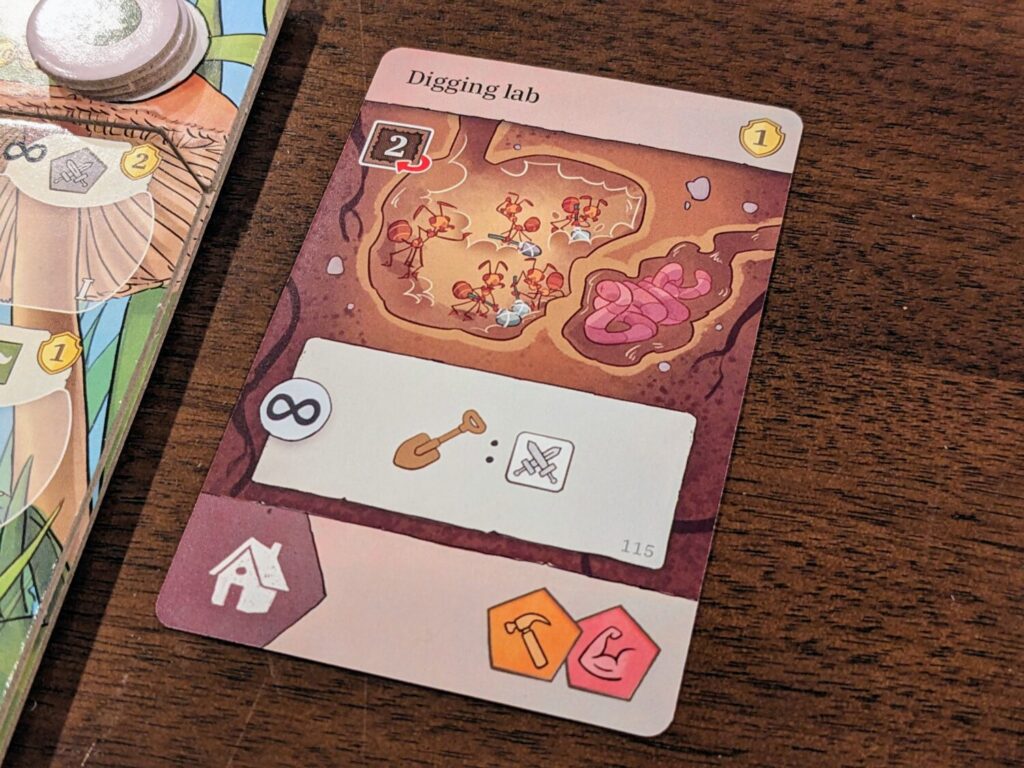
So players can use these discs to explore, forage, or dig, with the latter action used to create rooms on their player boards. Players can also choose to play one card and take out a creature on the main map (I hesitate to call this combat, because this is a simple order fulfillment exercise tied to the tags on a player’s played cards), or play two cards on a single turn. Otherwise, a player can Incubate to gain income and feed larvae before eggs evolve into larvae and larvae evolve into ants.
Like Rats of Wistar, ANTS pushes players to play a lot of cards, to both establish the tags they will need to fulfill the conditions of certain cards, but to also fight creatures using their explorer ants. In a strange twist, most of the cards in ANTS are actually worth zero points. Cards here are used mostly to grant the card’s owner a number of one-time bonuses, ongoing powers and, occasionally, end-game scoring options.
There are more than 150 unique cards; many cards are drafted when a player takes an ant action, with a card drafted from a market of three cards tied to the action type. That means players will spend a lot of time staring at the market to find the tags they need, so make sure to sit right in front of that market to focus on what you’ll need!
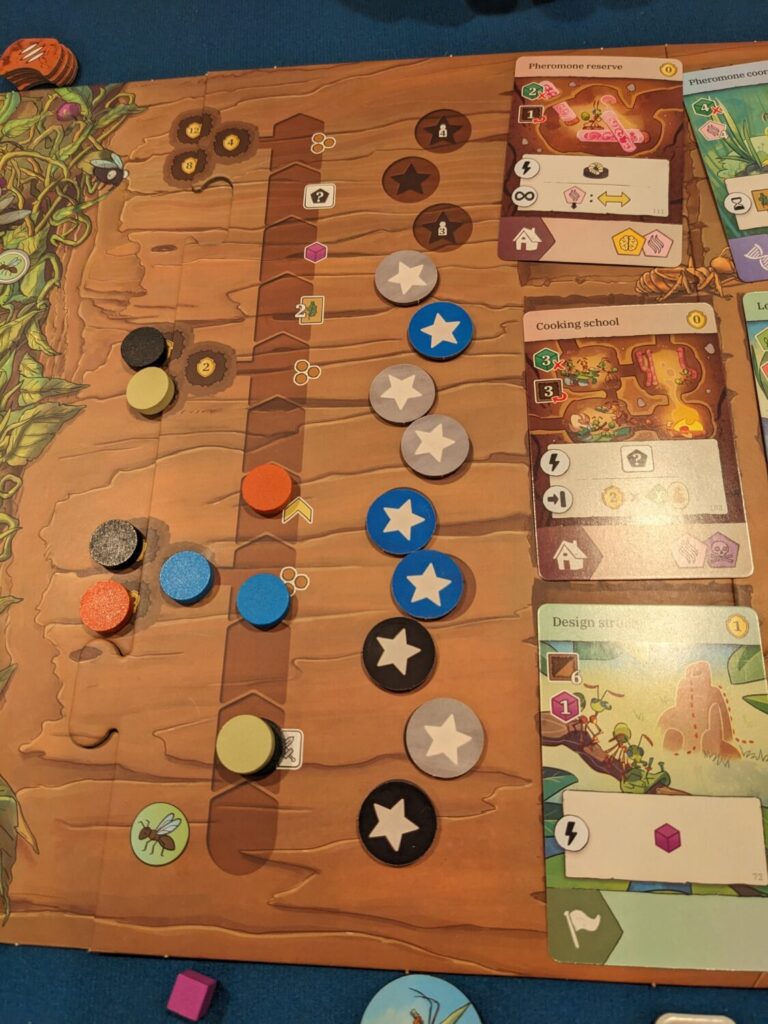
The game clock is tied to the completion of individual goals. When a player completes a row of their nest, they place a star token on a star track next to the card market. When they play a certain number of goal cards and/or other goal conditions, that pushes the star track up. When players empty hex spaces on the main map of resources as a result of foragers scooping up goodies, that also pushes the clock ahead.
In my experience, ANTS is a very slow starter and a very fast finisher. For 75% of the game, only a couple stars will come out…and then, suddenly, the clock becomes a river, and games wrap up faster than you expect. That loop is what has me both excited about future plays and somewhat torn on how I feel about my previous plays.
I Like What It’s Doing…Kinda
ANTS is a tricky one.
I like the game’s core mechanics, and for anyone who loves games like Terraforming Mars and extensive cardplay, ANTS is certainly worth a look. Playing into your cards, and building a strategy in real time based on your hand, is an interesting decision space and was the best part of my plays. ANTS doesn’t feel like many of the Euros I have played in 2025. There are essentially no tracks (with the single track included here offering very minimal bonuses but decent end-game scoring chances for players who push up the track quickly). There are no public milestones. Each player’s personal board has bonuses that are somewhat uniform across each supposedly asymmetric board.
There are unique powers allotted to each player during setup, but we found these powers very easy to manage and nothing that I would call gamebreaking. These powers, known as Queen tiles, are interesting—but not that interesting.
I really love the way games build towards their completion when it comes to egg/larvae/ant production. At the beginning of the game, you’ll find yourself taking a lot of one-power ant actions, similar to how games of Rats of Wistar sometimes start where you are taking less efficient versions of each action. By the end, it really scales up, with players taking big swings during latter stages. That was always a blast, and is the best reason to come back to this title over and over again.
Most of a game’s scoring will come from completing personal goals, and everyone is rushing to do the same three things (complete the nest, empty map spaces, and complete goal cards). Scores in my games have ranged from just nine points all the way up to 67 points, and I don’t think anyone has really cracked the code with ANTS just yet. That means that some players are going to really struggle to figure out efficient ways to score, possible if anyone gets caught up in only playing cards.
Overall, I like what ANTS is doing because I love hand management and tableau-building card games. There’s just barely enough Rats of Wistar in the ANTS design to make me happy, but throughout each of my ANTS plays, I found myself itching to kick up a game of Rats of Wistar on BGA to get a taste of what I love most. I’m glad to have made ANTS’ acquaintance, but I’m still not sure about its long-term viability in my collection.