During my time at Gen Con 2025, I set up some time to chat with one of the tabletop strategy world’s hottest designers, Tomáš Holek. Holek has his name on a raft of titles released over the last two years. In part, this was due to an interesting series of timed events based on Holek’s design work over the last few years.
Our chat took place at the Czech Games Edition booth, where Holek was helping to promote the upcoming SETI: Search for Extraterrestrial Intelligence expansion, Space Agencies. Read on to learn more about the top six things we discussed during our time together!

(The conversation below was recorded and is edited here for clarity.)
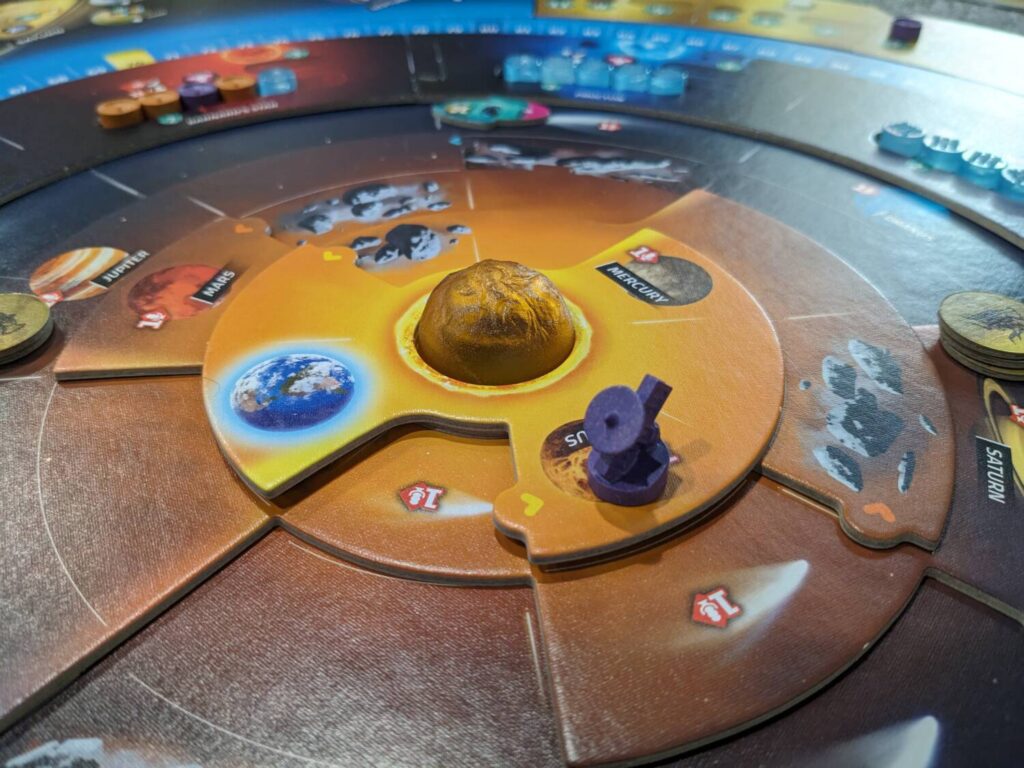
JB: Tell me about your excitement around the success of the SETI base game. I know you’re happy about it, but just in terms of developing the game and seeing it change over time.
TH: Yeah, for me, the excitement is…so big. It’s so big! I’ve never expected attention like this. I thought the game would be a success because people liked it when we tested it, but that’s it. I never expected a top 100 BGG [BoardGameGeek] ranking. It was so quick, and from every site, I heard how great the game is. So, yeah, it’s absolutely crazy for me.
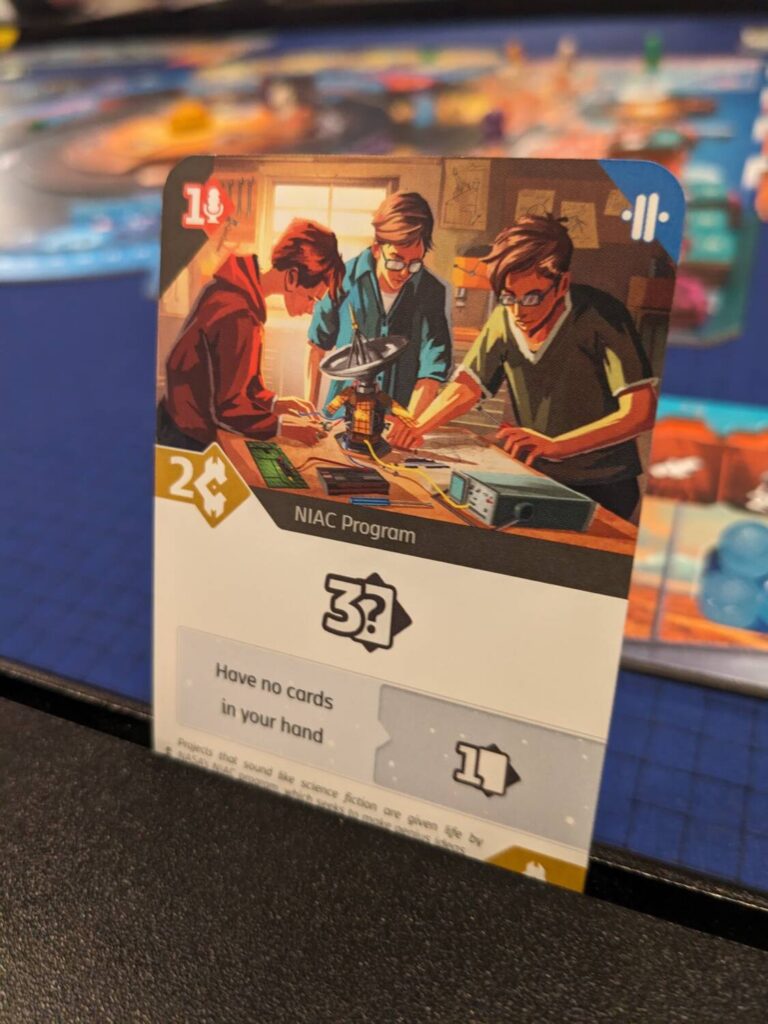
JB: A lot of my love for SETI is tied to the cards. The game has hundreds of them. How many cards were there when you first started building the base game?
TH: Well, it’s difficult because it took me more than six years to finish the game. At one point, I had like 20 versions of the cards during the design phase. [There are more than 200 cards in the final version of the game; for perspective, that might mean as many as four thousand different card iterations!]
And that means every two months there were different cards because the game works differently as the cards change. Yeah, so I redesigned the cards. Like, many, many times, and when I finished the final version of cards, I said, I hope this is for the last time. Knowing that it’s never over. It’s never over! [laughs] Every time we changed something in the game, especially the last year when I started to develop with the team at CGE, we had to change the cards. At one point, you have to decide—I don’t want to redesign all the cards again, and then, again and again. So once we locked in the mechanics of the main game—the way probes work, the way the other main game actions worked—that’s when we went back and built more cards. There were like 150 cards while we finalized the game, then added more cards later.

JB: I’m always curious with designers who design complex games: what kinds of games they like to play. What are some of your favorites?
TH: I like to play Ark Nova. Well, yeah, so much! That’s because I like to play a game when that game has many cards. I really like games with multi-use cards, and I really like games where the cards are unique—unique powers, unique pictures, unique effects.
When I started to design SETI—in 2018, 2019—I was really into astronomy and I had a new telescope. And I watched the Carl Sagan cosmos series many times. I liked how inspired he was to talk about the cosmos, and I thought about ways that I could popularize astronomy in a board game, through the game design. That’s why I said, OK, I need many cards with many space projects and through these cards, I can just tell a story.
Now, it’s a little bit weird, but my next favorite game is Nemesis. [Both of us had a great laugh at this transition.] I love the stories, the stories the game tells. But the game also creates a lot of interesting stories too. And the games are always different.
My very favorite game is Underwater Cities. [Tomáš has a new game coming out under the same publisher as Underwater Cities, called Aquaria.] I also like party games, which I know is funny because the other games here are very serious!

JB: With the success of your other games [Tea Garden, Galileo Galilei], I’m guessing that having conversations with other publishers is much easier now, right?
TH: Yes. Before I got to SETI, I did more than 100 prototypes, I would do a pitch, it would not work out. But now, I pitch one game to a publisher, and usually, they say yes. Like with Aquaria, I made the pitch, and they liked it, but they wanted to wait a bit since I had so many other games coming out at the same time.
I made a pitch for a game with Awaken Realms. I really liked Nemesis from Awaken Realms, so I wanted to pitch a more American style of game to them, this was at Essen last year. They wanted to play it first, ideally online, but I didn’t have it online, so I offered to drive to their headquarters, which is about 3.5 hours from my home.
So, after Essen last year, I drove to Awaken Realms’ headquarters, and I showed them the game. They had their whole team there; all of their developers were there, the CEO was there, everyone. I showed them the game, then the CEO marched in and offered me a contract. [This is the game now known as B.E.L.O.W: The Asylum, and it will be available through Awaken Realms in 2026 through a crowdfunding campaign.]
So, after the game was announced by Awaken Realms, there were a lot of people online who wrote comments about the game, like “how does this author make survival horror games when he is only a Euro game player?” And I said, no, no…I play every type of game. I play everything. So I’m hoping to design all kinds of games, like party games for kids and wargames and historical games. Everybody, everyone can learn something new.

JB: Let’s go back to SETI for a moment. One of the things I struggled with in the base game was scanning, particularly with lower player counts. It sounds like the expansion will address some of this?
TH: Well, with the expansion’s new corporations—and the main part for me, the best part for me, the thing that I will always play SETI with now when I play it—some of those scanning tokens seed the board with starting scan tokens already in place. But I want to talk about your point about the scan action and player count.
At first, when we had people testing the game, other people complained about that action too. But then we watched as players played SETI more times at two players, and later found that the action had more balance than was initially seen after just a few plays. Then we had people, nearly 20 plays in, talk about how scanning might even be overpowered, because the action is that good.
We know now that the game is out that a lot of newer players struggle with how to make the scanning action work in ways that can be productive. I have played SETI, I don’t know, 300, probably 400 times now, and the scanning action is very good at higher player counts, but not always as strong with new players at lower player counts.
And, look, scores can be very high in SETI. Players who play SETI a lot might regularly score 280 points or more! When I’ve scored 240 points, I have lost badly. You know the alien where you lose points at the end if you have the most of something on that species? I still remember a game where I had 285 points, but I was first with that alien’s power, so I lost like 28 points to come in second. I love that alien species so much for that reason, it changes the game so much. I know that some people love that one and I know others really hate it. That’s OK.

JB: One of my other things about SETI is that it can be a slow starter. The expansion changes some of that too, correct? I’m guessing these changes give SETI: Space Agencies a Terraforming Mars: Prelude feel with a kickstart to the initial stages of play.
TH: Definitely. Now, we skip the first round. You start the game with more cards, more income, a corporation that gives you bonuses, abilities, etc. Corporations have new dials you can flip and a lot more resources than the base game had. The game time is still the same, so this does not shorten the game, but the start now feels different.
There are eleven corporations in the game so there is a lot of variety. There are three new aliens. There are more cards, and remember that there are so many cards from the base game that now change the way the game with the expansion will play. Of course, we really feel like we have already put the very best project cards in the game, but we feel that more cards is good!
We have also added signal tokens, which can provide a big boost, a supercharge, to the scanning action. That will also change the way some of the cards will play out. And we had a lot of new aliens that we were trying out, 10, I think, and some worked with this expansion and some did not, so we ended up with only a few in the box.

After Tomáš and I finished our discussion, I stopped our recording to have a brief chat about what might be included in a second SETI expansion. I won’t include any of that discussion here, but while I can neither confirm nor deny that we are going to get more SETI in the future, I think we can all agree that it won’t be a surprise if more expansions hit the market in the years ahead.
A big thanks to Tomáš and the team at CGE for setting up our time together at the show!