
The guys in my Wednesday gaming group started a push to play more of the old, dust-covered games at the bottom and backs of our respective game closet shelves. The premise was simple: let’s try to remember why we keep all these old games when all we ever play now are the newest, shiniest things in shrink.
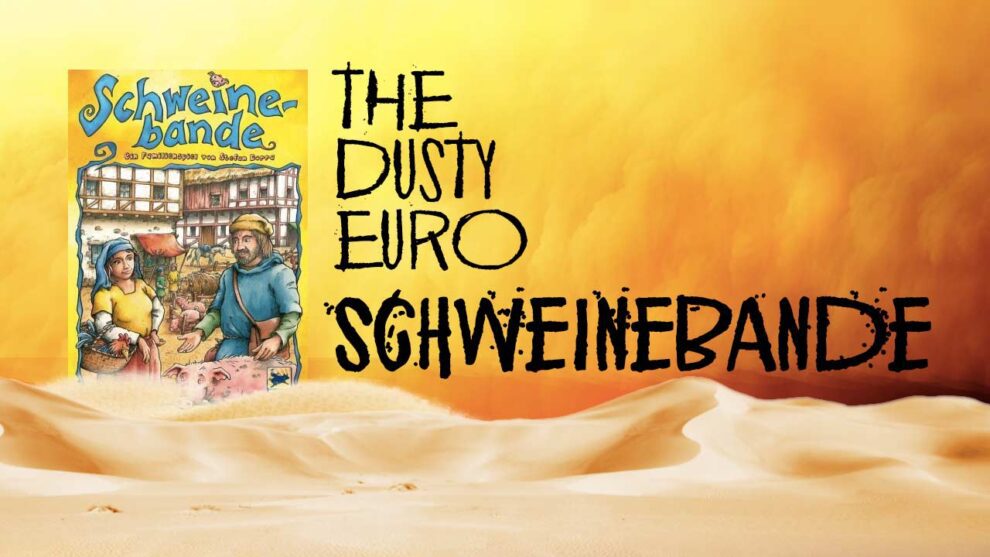
Right on the spot, the Dusty Euro Series was born, and I’ve enlisted multiple game groups to help me lead the charge on covering older games.
In order to share some of these experiences, I’ll be writing a piece from time to time about a game that is at least 10 years old that we haven’t already reviewed here at Meeple Mountain. In that way, these articles are not reviews. These pieces will not include a detailed rules explanation or a broad introduction to each game. All you get is what you need: my brief thoughts on what I think about each game right now, based on one or two fresh plays.
Schweinebande: What Is It?
Schweinebande (German for “gang of pigs”) is a set collection game featuring livestock for 2-5 players. Let’s put it out there right here: Schweinebande is a weird game, with a hilarious cover and a pig featured in the bottom right-hand corner of the box art that is just a little spooky.
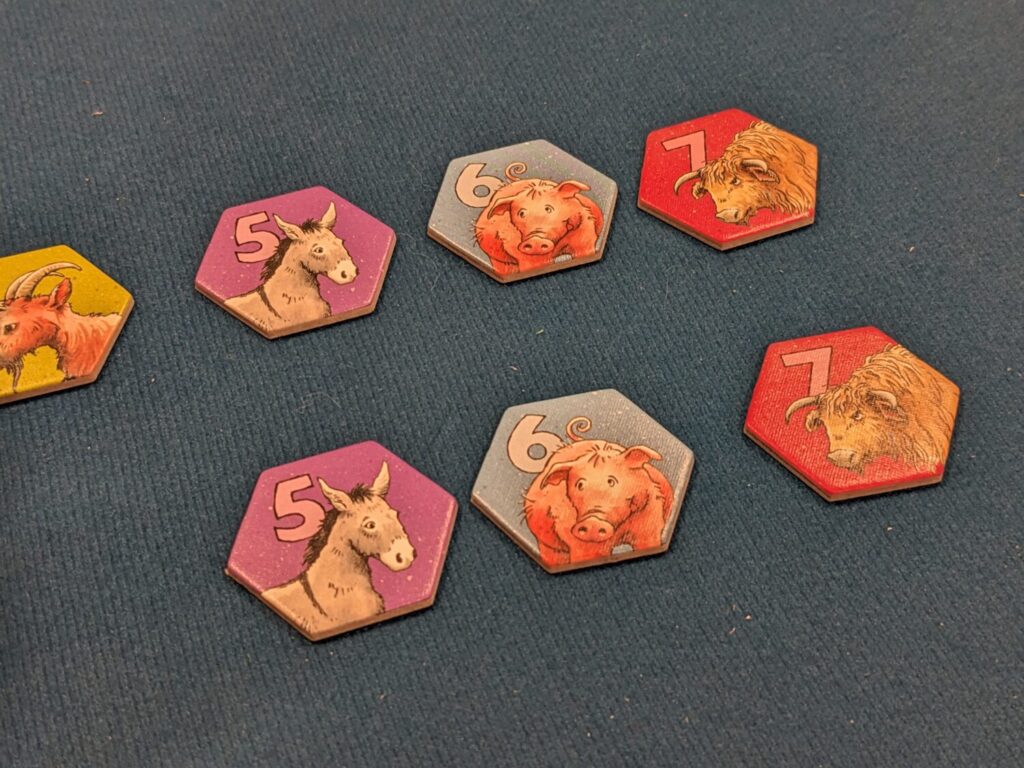
Luckily, the game is straightforward: players use three farmer meeples to secure spaces on a small diamond-shaped map of a cattle market where donkeys, chickens, goats, and (of course) pigs are slowly revealed as players flip tiles. The goal is to secure as many animal tiles as possible, so that sets can be secured and turned into scoring piles when a player gathers four of an animal to score end-game points. Animals also have to be fed, but in a fun twist, other animal tokens can be used as food for any other animal, so feeding isn’t too much of a concern. One of the animal token types is actually a feed bag, which can be burned to feed all unscored animals in a single round.
End-game scoring is quick: players add up the values of the tokens scored throughout the game, ranging from 2-7 points each (each farm animal has a value, ranging from lowly chickens up through the 7-point cows). If there’s a tie, the player with the most pig tokens wins…obviously.

Everything is An Auction
I’m not going to run out and tell everyone I know to hunt down a copy of Schweinebande on the secondary market; it was good, but not essential. Still, for a game that plays in about 30 minutes and has funny animal art, Schweinebande is worth a look.
The main draw here is the way tiles on the farm are revealed before players have to commit one of their meeples to a space that will grant capture of tiles in any one direction starting from the meeple to the end of the map. This can be further blocked by other players, and because tiles are running in a few different directions, it’s a blast watching players position their meeples just so, in order to hose their opponents while also chasing the tiles they need.
Another wrinkle: the player who places all their meeples first gets to remove one of their meeples first during the resolution phase, ensuring they can maximize the number of tiles they get. The downside? Committing workers too early lets other players flip more tiles, to more easily determine the best places to position their own meeples to grab the best tiles.
I did a three-player game of Schweinebande and liked what I saw. A couple of weeks later, the same friends hosted a game day where only Hans im Gluck games were tabled, so a five-player game of Schweinebande soon followed. I think the five-player game is probably where I would want to land because five players guarantees the kind of chaos appropriately aligned with a game where hauling in pig tokens is the best course of action!