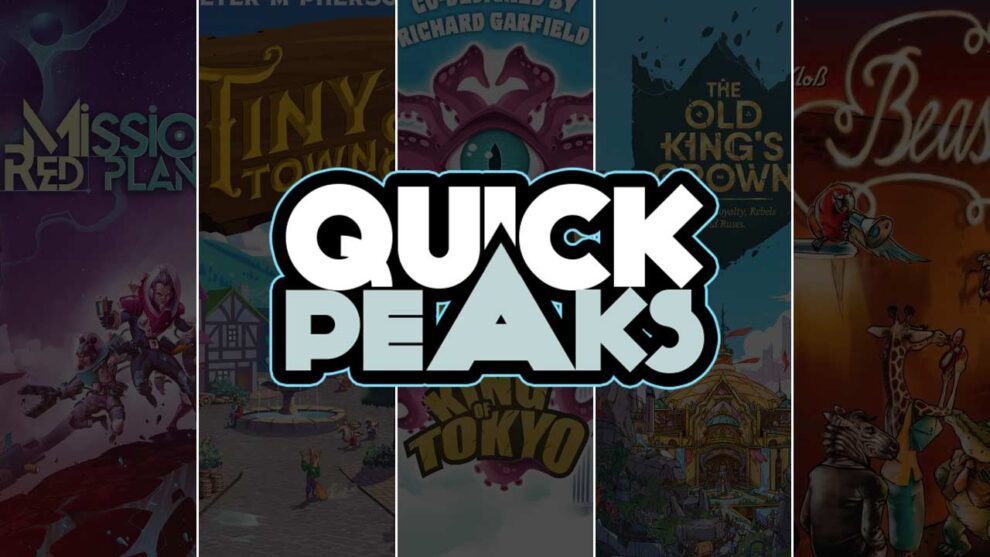


Mission: Red Planet – Andrew Lynch
The trick with Mission Red Planet, an area control game that comfortably sits 4-6 players and takes about 60-90 minutes, is to not take it too seriously. The good news there is that the game helps with that. You can’t take any of this too seriously. This isn’t El Grande. There’s no illusion of grand strategy. Mission Red Planet is a goofy, swingy, occasionally violent area control game in which a little too much is left up to chance. On the bright side, that makes it zippy. Nobody gets too bogged down in their decisions. The downside is that you can’t get particularly invested in your decisions either.
I like the minis, and I like the art. The docks for the space ships are both delightful and practical, the ideal combination. If I have a group of 6 who need to scratch an area control itch, I’m more than happy to bring Mission Red Planet back out onto the table. But that doesn’t happen too often.
Ease of entry?
★★★★☆ – The odd bump or two
Would I play it again?
★★★☆☆ – Wouldn’t suggest it, but would happily play it
Read more articles from Andrew Lynch.

Tiny Towns – K. David Ladage
In my most recent trip to Congress of Gamers (Jan 17-18, 2026), I managed to find a bunch of games that were new to me and pick them up relatively cheaply. One of these was Tiny Towns. I had seen the title a couple of times in my friendly local game stores, but nothing about it screamed “pick me up AND PLAY ME!” While I was playing some games in the open game room, the table next to me was playing this little gem. I watched, asked a couple of questions, then located a copy in the auction sales room for less than $20. When my wife and I got home, one of the first games we tried from our purchases was Tiny Towns.
First, each game always has the Cottage. There are six other building types, one of which is the source of food for the Cottage dwellers. Those six building types have four options each. This means you have 4^6 (or 4,096) possible ways this game can get set up. Each choice of building offers a different experience, with a different way of looking at the board and what you need to do in order to maximize your score. If you add in the Monuments, then each player has a possibility of one of 15 potential buildings being unique to them, increasing the possible puzzle to 61,440 possible puzzles to solve. There are two modes of play. One distributes the resources needed to build the buildings in a way that has every player acting as the Master Builder in rotation; the other hands them out in a way that is random 2/3rds of the time, and player’s choice 1/3rd of the time. Each of these methods has its own advantages and pitfalls.
Replayability? Dear lord, yes. All I can say is that you need to look over the buildings carefully and note what resources and shapes are involved. If you do not, you could end up like my second game where my wife had plenty of points in the end, and I was in negative territory.
Ease of entry?
★★★★☆ – The odd bump or two
Would I play it again?
★★★★★ – Will definitely play it again
Read more articles from K. David Ladage.

Mindbug x King of Tokyo – Kevin Brantley
A crossover of epic proportions that only seems natural, given that both Mindbug and King of Tokyo were designed by the legendary Richard Garfield. Don’t confuse this with the counterpart, King of Tokyo: Mindbug, which is King of Tokyo with Mindbug elements—where Mindbug x King of Tokyo is Mindbug with King of Tokyo elements. Confused yet?
This latest expansion brings all the familiar, lovable characters (shoutout Cyber Bunny!) of the King of Tokyo world, sized down from standee form into Mindbug monster cards. The expansion plays the exact same way as Mindbug in the past, but with the addition of the Power Card deck, you’ll recognize it from King of Tokyo.
The Mindbug creatures now include a die icon, which, when they attack, lets you either add the number value to the card’s attack, gain energy cubes, or cause the opponent to discard a card from hand. At the beginning of a player’s turn, energy cubes can be spent to buy a Power Card with an immediate effect.
Overall, I felt that the Power Cards add a bit more tactical play, sometimes teeing up combos that turn a single card play into multiple steps. The fact that this is also a free action only enhances the strategy and can absolutely sway the tide. One game had me down to only two cards, but I was able to squeak out a victory through some Power Card combos that let me snag extra monsters from my enemy’s discard pile.
I’d almost say I wouldn’t play Mindbug without this card market. It gives you more agency without adding much extra time. It’s nice having another option outside of the simple play-a-card-or-attack sequence—one that adds a dash more complexity to the streamlined system. One downside: there are only 16 Power Cards in the box, so you’ll likely see them all after a handful of games. Still, I think it’s a creative spin on an already clever system, and one I’d call a must-have for Mindbug fans on sheer extra possibility alone.
Ease of entry?
★★★★★ – No sweat
Would I play it again?
★★★☆☆ – Wouldn’t suggest it, but would happily play it
Read more articles from Kevin Brantley.
The Old King’s Crown – Justin Bell
The Old King’s Crown has been living on the BGG Hotness list for most of the last few months. Brought to us by first-time designer and artist Pablo Clark and hyped by nearly every outlet under the sun, I had to know: is The Old King’s Crown a good fit for me?
The answer landed early in the second round of my first play during a four-player game recently: no. Certainly, The Old King’s Crown is an A+ production, with a beautiful main board, spacious areas for cardplay during the game’s area control “Clash” battles, metal coins to track Influence points, well-drawn cards (illustrated by Clark) and well-crafted wooden tokens that clearly call out specific game elements for each player. The only black mark: somehow, this game comes with zero player aids. (Remember: every game needs a player aid!!) The Old King’s Crown is broadly a hand management game, with bluffing, face-down card area majority conflicts, bidding for new cards, and deck building.
Here’s my main issue with The Old King’s Crown: it is a terrible single-play product. This, of course, is not this game’s—or, any game’s—fault. The Old King’s Crown demands multiple plays, and our group thinks that players who commit to doing this 5-10 times are going to find a lot of joy in the systems here, especially if you come from a background in TCG/CCG-style games where knowing what’s possible in an opponent’s deck is the key to winning. As it is, The Old King’s Crown demands too much for a new player: what can all four asymmetric factions do with their cards? How many rules are going to change during the round? What powers do you have over there on your player board, that you just acquired for activation during the next season? Each player’s base deck has cards ranging in strength from 0-10 with limited powers, but each player can buy new cards from a personal supply that completely flip the script.
If The Old King’s Crown was my only focus for a few weeks, with the same playgroup, I could see where the hype comes from. The scoring chaos is bananas; in our game, the winner had a 10-influence lead after just two rounds and the final outcome (after five rounds) was never in doubt. My favorite element of my play: the guy who won his first play of The Old King’s Crown didn’t score a single point until the final round of his second game (and my first). I could absolutely imagine players who win this game just as often as they get blown out, because of the nature of the cardplay. As teammates here like to say often, your mileage may vary…and I think it will vary greatly in the case of this game.
Ease of entry?
★★☆☆☆ – Not an easy onboard
Would I play it again?
★★☆☆☆ – Would play again but would rather play something else
Read more articles from Justin Bell.
Beasty Bar – Andy Matthews
Back in the mid 2010s I came across a review of a light, take-that style card game called Beasty Bar. I was still young in my hobby board game journey but I remember being really fascinated by the theme of animals trying to get into a bar; pushing each other aside, eating each other, etc. Fast forward to literally yesterday when someone gave me a copy out of nowhere.
Beasty Bar definitely has the feel of a game that’s 10 years old (it was released in 2014 by Zoch Verlag). But that doesn’t mean that it’s bad, in fact I think that older games had a much better idea of themselves than some modern games. In this game players drop numbered animal cards at the “end” of a line to get into the bar. Then each animal performs its special action: lions jump to the front of the line automatically, crocodiles eat every animal in front of them that is a lower number, skunks drive away the two highest numbered cards, etc. After all the actions have been performed, if there are 5 cards in line, the first two animals make it into the bar (scoring points for that player), the last animal in line gets booted out, and play continues.
There’s a LOT of take that in this game, but because it plays so fast, and there’s SO much chaos, it’s hard to take it personally. Especially when each player starts with an identical deck, so you know that you’re going to wind up doing the exact same thing to the other players. My group had a blast playing this, and I’m already looking forward to my next game…I wonder what my kids would make of this one…?
Ease of entry?
★★★★☆ – The odd bump or two
Would I play it again?
★★★★★ – Will definitely play it again