

23 Knives – Kevin Brantley
This game was one of my top looks at Essen Spiele this year. Over the weekend, I attended a gaming Friendsgiving where I was hoping to break my copy out. To my surprise, two additional copies were brought in. Safe to say there was an appetite for some Caesar killing/saving.
23 Knives is more of a “social manipulation” game than a “social deduction” one. Players are Loyalists (want Caesar alive), Liberators (want Caesar killed), or Opportunists (want to change Caesar’s fate). Players start with characters tied to one of these three parties, and cards can be played with symbols that shift allegiances (whether you want to or not). Players win individually if they have the most symbols and their faction succeeds in its goal, while Opportunists win together if they can change Caesar’s fate (from death to life or life to death).
The concept is pretty interesting, and there’s a large amount of public information with just a small amount of private knowledge, which is enough to keep folks guessing. The Liberators want to sneak 23 knives into the Curia to pull off the murder, while the Loyalists want to sneak in doves to negate the knives. Since players “sway” others, your faction changes constantly. It becomes a revolving choice of whether to fight your way back to your side or pivot and start supporting the other.
Because gameplay centers on playing cards as actions, there’s less emphasis on deduction and accusation. It’s great for someone who doesn’t like social deduction games (like me), but it ultimately makes the game feel a bit stale.
The game can drag on if no one chooses to exile or the rotating agenda cards don’t show a needed symbol. It gets worse when players can intentionally (or unintentionally) prolong the game based on their votes. It feels routine to play an action, then sit and wait until your turn. The heat of suspense never really gets past lukewarm.
Conceptually, it’s a neat idea, but it narrowly misses the mark. I mildly enjoyed my first play, but I think Caesar’s fate is safely sealed with that one play.
Side note: I really enjoyed the historical flavor text and rulebook writeups, and I learned quite a bit about the Ides of March!
Ease of entry?
★★★☆☆ – There were a few questions
Would I play it again?
★★☆☆☆ – Would play again but would rather play something else
Read more articles from Kevin Brantley.
Codenames XXL – Justin Bell
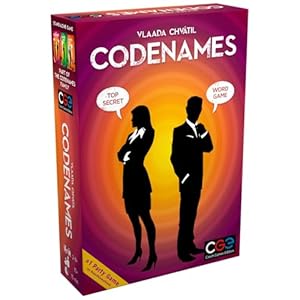
Czech Games Edition recently re-released four of the Codenames games to celebrate their tenth anniversary, complete with new cover art and updated rules. One of those is Codenames XXL, a Game We Love that is one of my go-to party games. Codenames XXL is so similar to the base Codenames that they share the same listing on BoardGameGeek, with the only change being that the cards are about three times the size of the word cards from the base game.
As a man of a certain age, this change is huge. On Thanksgiving, I broke out Codenames XXL with a group of six other players after dinner, all of whom had played the base game. “Man, these cards are HUGE!” one guy said as I was setting up the game, and he is right. In fact, the cards are so large that this friend, along with everyone else at the table, ended the night by saying the same thing: it’s much, much better to play Codenames with the larger cards, especially if you are playing with large groups on a large table.
I own both Codenames and Codenames XXL…and now that I have XXL, I’m never using the smaller cards ever again. Has anyone ever complained that the base game’s word cards are too big? Of course not. Even if you don’t struggle to see small words across a large space, I highly encourage you to pick up a copy of Codenames XXL if you love the base game and are looking to freshen up your copy!
Ease of entry?
★★★★★ – No sweat
Would I play it again?
★★★★★ – Will definitely play it again
Read more articles from Justin Bell.
Click A Tree – David McMillan
Anyone who knows me knows that I am a massive fan of Uwe Rosenberg. So, when I saw Click A Tree (the spiritual successor to Atiwa) pop up on Kickstarter earlier this year, I knew I had to have it, and it’s finally here.
From the Kickstarter: “In Click A Tree, players embody Ghanaian farmers. They have adapted to the climatic conditions and learned to make use of their surroundings. In the shade of the trees, they plant their crops. An initiative in Ghana is promoting this new, sustainable and culturally embedded method: syntropic agriculture. The name of the initiative is the name of our game – “Click A Tree”. “
At the start of the game, each player is given a player board which is divided into several sections, each of which are blocked using a random ‘task strip’. Each player also has a set of Fruit markers which are placed along the bottommost section. In the game, players are racing to move these markers up their player board in order to meet certain thresholds faster than their opponents. However, the movement of these markers is blocked by the presence of the task strips. So, these have to be moved in order to create room to grow.
The concept of syntropic agriculture is represented in the game thematically by the tiles the players will be drafting on their turns. Each tile bears the image of a tree in the middle of it (of which there are 4 types) as well as a field of fruit (of which there are 7 types). Completing tasks requires specific arrangements of trees. Moving the fruit markers is accomplished by harvesting fruits. The larger the clusters of specific fruits during harvesting, the more fruit the players receive, and the more they’re able to move their fruit markers for doing so.
When discussing the game with a friend of mine afterwards, he stated that “It feels a bit like Portals mixed with Applejack mixed with Framework”. That’s a pretty good assessment. Rosenberg excels at these kinds of puzzly games, and Click A Tree is no exception. The rulebook which references aspects of the game that are no longer part of the design, has multiple grammatical errors, and even has an example image with text that incorrectly describes what’s happening in the image leaves a lot to be desired. But, the gameplay is stellar once you get past the initial head scratching.
I’m excited for my next play!
Ease of entry?
★★★★☆ – The odd bump or two
Would I play it again?
★★★★★ – Will definitely play it again
Read more articles from David McMillan.
Löwenherz – Andy Matthews
My regular game group rotates between three “active” games—swapping out the oldest game every 2 months or so—with each person getting a chance to choose the newest entry. So when one guy said he was picking Löwenherz, everyone’s eyes went up because none of us had ever heard of it; even though it’s by the designer of Catan, the most popular hobby game in the world.
The lore goes that Catan was originally supposed to be a much more complex game, but was split into a trilogy: Entdecker (the discovery of an island), Catan (the colonization of the island), and Löwenherz (fighting for control of the island). In Löwenherz, the land is split into small kingdoms, each of which is trying to take control of larger and larger portions of the countryside. Inevitably players come into conflict with each other and must negotiate or outright combat each other to gain the upper hand.
Negotiation is a big part of Löwenherz, as is direct conflict, which is likely why I didn’t enjoy it as much as I would hope. I don’t really enjoy negotiation games, as I tend to just want to execute my desired action and finish my turn. It doesn’t help that in a 4 player game, players are all fighting over three available actions per turn. It’s almost a guarantee that there will be conflict over one of those actions, requiring players to negotiate. And in Löwenherz, negotiation always ends with one player losing their action in exchange for some cash. There are some interesting mechanisms in the game, but overall it’s just not something I care to play again.
Ease of entry?
★★★☆☆ – There were a few questions
Would I play it again?
★★☆☆☆ – Would play again but would rather play something else
Read more articles from Andy Matthews.

Cascadia: Rolling Hills – K. David Ladage
A while back, with some advice of our fearless leader (Andy Matthews), I was looking for gifts for my wife. She likes several of the roll-and-write games we have, so I was looking for a new one to spring on her. Andy is a fan of Cascadia, and suggested the two roll-and-write versions. So I picked them both up. Our lives promptly got complex and so those two languished on our shelf (shelves?) of shame. After recently playing Cascadia and loving it, my wife suggested we pull these out and see what they are like. We started with Rolling Hills. This was an interesting little excursion!
The tally sheet seemed a bit much when I first looked at it. But in practice, I cannot think of a better way of handling that part of the game. The four included “boards” make for a lot of potential variety! The central dice + personal dice aspect means that you are not both playing the same resources all the time (which was an early complaint with Welcome To before we discovered the Advanced Rules). All in all, I think this is a wonderful game and one that may cut into the number of plays our Welcome To sets get…
Everything I have seen suggests that Rolling Rivers is pretty much the same game with some new boards, completion bonuses, etc. to explore. Looking forward to getting out there!
Ease of entry?
★★★★★ – No sweat
Would I play it again?
★★★★★ – Will definitely play it again
Read more articles from K. David Ladage.