
Here’s a quick recap of Chapters One, Two, and Three:
Someone introduced me to Magic. Someone taught me how to play the wrong way. I sucked. Someone taught me the right rules and how to build a deck. I got good. I went broke. I got out. Then, Commander arrived. I got inspired by a Commander deck my wife bought me for Christmas and decided to build a deck of my own. I identified a potential commander amongst my plethora of cards. I made a few suppositions about what types of cards I might need in my deck. I realized the state of my card collection was in total disarray. So, I decided to get organized, and I did.
With my organizational woes out of the way, I can finally turn my attention to actually creating my deck.
But first, some ground rules.
Magic, as I’ve stated in previous articles in this series, is an absurdly expensive hobby. My intention with this deck is to only use whatever I already have at hand. I feel that, over the course of three decades, I have donated enough to the Magic coffers that I never want to spend another cent on this game ever again. That’s why I’m excited to build this deck. With access to over 8,000 cards, it seems like it should be feasible.
The Commander format gives me the ability to engage with the game in a meaningful way while also sticking to my guns. Of course, I will always accept advice, trades, and donations, as none of those require me to open my wallet and wave goodbye to even more of my money. So, just be aware: if you think there’s something I could be doing better, I’ll gladly listen. But, if it requires me to spend money to enact a change, as sound as the advice may be, it’s not going to happen. I’m still open to suggestions, though. Your recommendation may trigger a memory of a card I have lying around somewhere that does something similar. You never know.
Chapter Four: And We’re Off
The Part Where I Shamelessly Pirate a Gift That Was Given to Me
Years ago, my mother-in-law got into Magic and decided to gift my wife and I with a couple of Commander pre-cons (pre-constructed decks). It had been years since either of us had ever played aside from the occasional 3-player duel if my friend David happened to be in town on business. As it so happens, the pre-con that she sent to me is one called “Exquisite Invention”, a deck that uses red and blue as its color identity. Since I’ve decided on Niv-Mizzet, Parun as my commander, having this other red and blue Commander deck at my fingertips is extremely useful as there are myriad cards I can pirate from it for use in the deck I am creating.
One thing that red and blue struggles with (and most colors other than green) is the issue of mana acceleration. Normally, you’re only able to add a single land to your side of the table per turn. At that rate, in order to cast a spell with a converted mana cost (that is, the numbers in the grey circle plus the number of other symbols in the casting cost) of 6, it would take you six turns, at the minimum, assuming you’re able to place a land on each turn. Mana acceleration is the act of playing other cards that provide you sources of mana aside from the land you drop each turn. Red and blue just aren’t very good at this. Consider these facts:
Out of the entirety of Magic cards, at the time of this writing, only 8 blue cards contain the “islandcycling” keyword (which allows you to pay mana, discard the card, and search your library for an island), and there are only 7 which allow you to search your library for a basic land card. Red isn’t much better with only 9 “mountaincycling” cards and a total of 8 that allow you to search for a basic land card. Compare this with green, with 131 cards that allow you to search for basic lands, and you can see the imbalance. This means that, if I want to accelerate my mana production, I am going to need access to multi-colored non-basic lands, mana dorks (creatures which can be tapped for mana), or mana rocks (artifacts which can be tapped for mana).
When it comes to mana dorks, out of every red card that includes “add R” in its text, there are very few that are creatures, and even fewer of them that don’t have some condition attached to how you’re able to spend the mana. There are a few promising contenders, though. Sisters of the Flame allows you to add a red mana to your mana pool with the qualifier “Play this ability as an interrupt”. The concept of “interrupts” has been removed from the game and they’re just treated as instants now. Since instants can be played at any time, this really isn’t a qualifier at all. While I’m not 100% on this, I am fairly certain I have a few of these lying around. There are a few other options, but since I don’t own any of them, they don’t bear mentioning here.
As for blue, the only mana dork I see that I might own a copy of is Sea Scryer. Sea Scryer can be tapped for a colorless mana, or you can spend a colorless mana and tap it to generate a blue mana. This is also a contender, albeit not as strong a contender as Sisters of the Flame. That’s two cards out of 100. I’m almost tempted to not even put these into my deck as my chances of drawing them at a time when they would be of most use are relatively low.
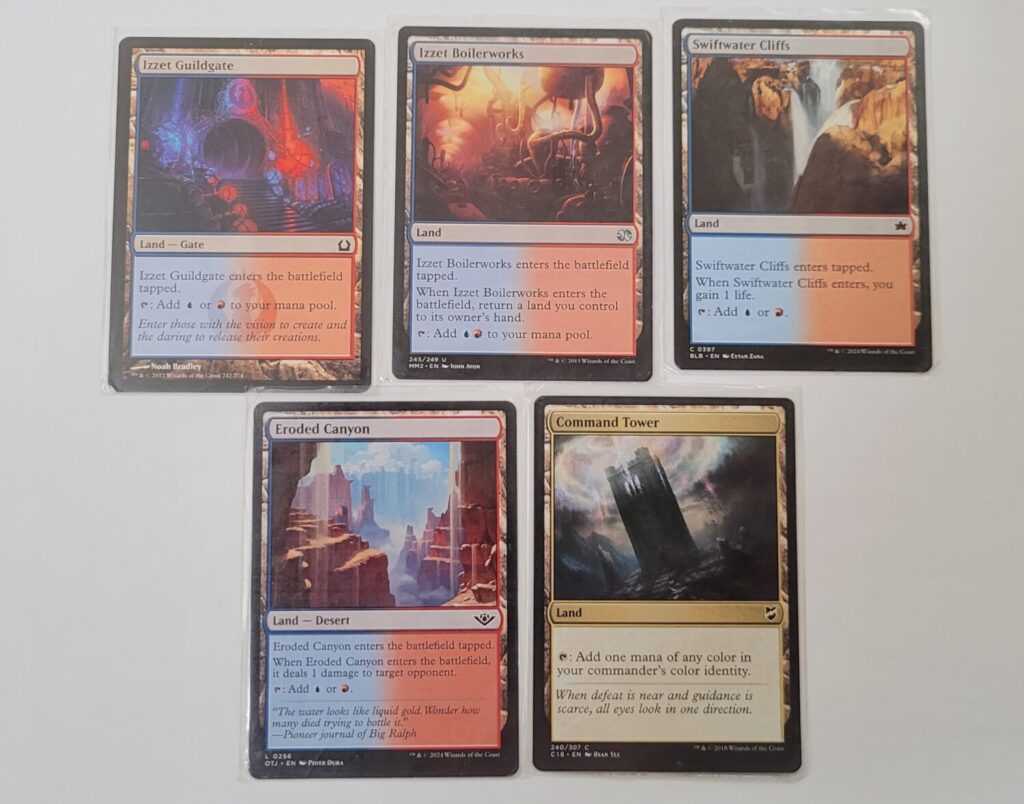
I think most of my focus needs to be on non-basic lands and mana rocks. Fortunately, this deck my mother-in-law bought for me is jam packed with them. For the lands, we have Command Tower, Eroded Canyon, Izzet Boilerworks, Izzet Guildgate, and Swiftwater Cliffs. Command Tower’s pretty good since it’s usable the moment it comes into play. The others are less so, but it’s nice to have lands that give me options. Izzet Boilerworks is the best out of the other four since it provides me with both R AND U as opposed to R OR U.
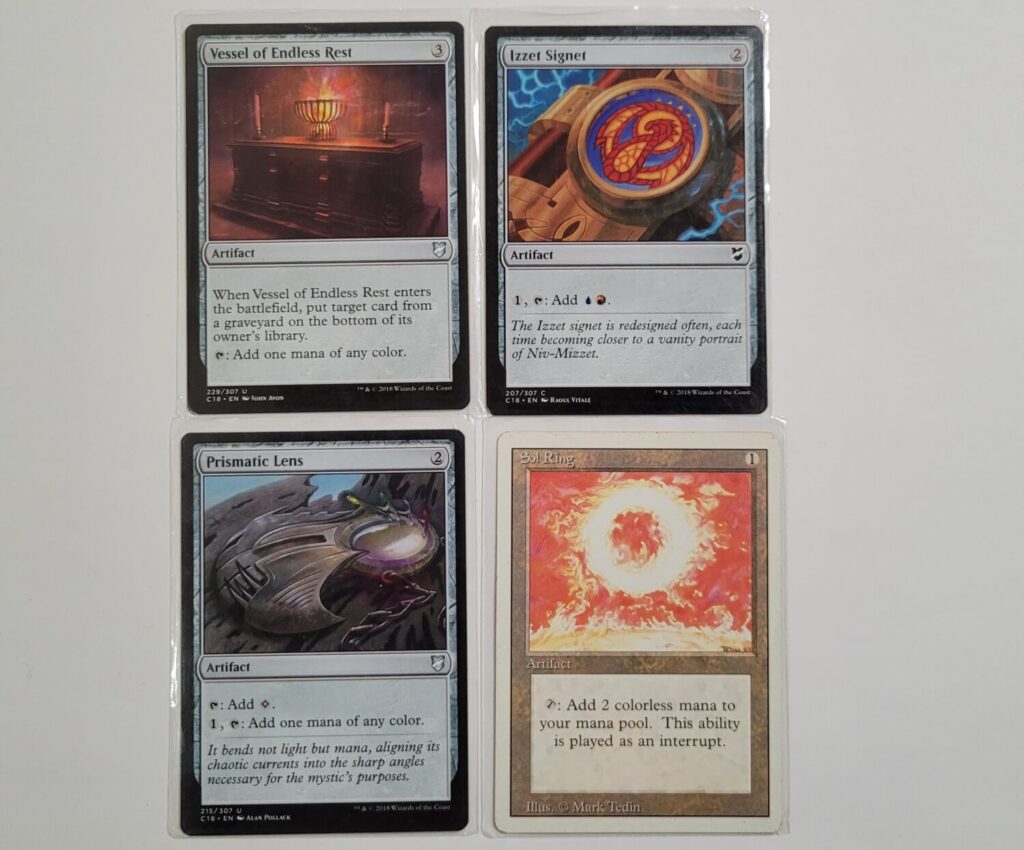
When it comes to mana rocks, the ones I opted to pirate from the commander deck are Vessel of Endless Rest, Izzet Signet, Prismatic Lens, and Sol Ring. Of the four, Vessel and Sol Ring are the best since they can be used the moment they enter play without needing to tap mana into them for their activated abilities (that is, an ability that requires some kind of input in order to obtain some kind of output). Sol Ring is a staple in pretty much every Commander deck. There’s no understating the power of being able to effectively double your mana if you’re holding Sol Ring in your hand during your initial draw. Drop a land. Play Sol Ring. Then, tap Sol Ring for 2. If you’re holding another mana rock like Izzet Boilerworks or Prismatic Lens in your hand, then you can use the 2 from Sol Ring to cast one of them. On your second turn, after dropping a land, you’ll effectively have a total of 5-6 mana at your disposal on turn two. That’s an enormous advantage. I had an older version of Sol Ring in another deck, so I have opted to swap the two so that the older version now lives in my Commander deck. Functionally, they’re exactly the same, but I just like the old artwork better. It’s nostalgic.
There are other mana rocks in the other Commander deck, but I don’t want to overload this Commander deck I’m building with them. This may wind up being a mistake. Only time will tell.
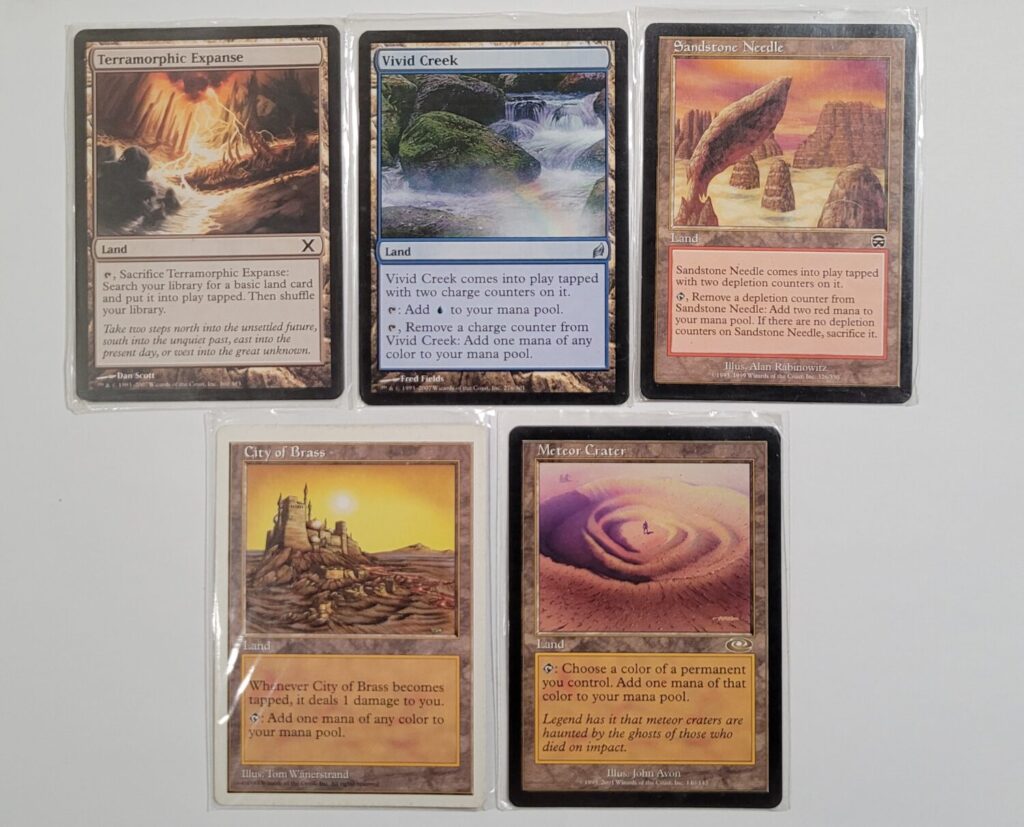
From my own personal supply, I was able to scrounge up another few non-basic lands that could work in my deck: Terramorphic Expanse, Vivid Creek, Sandstone Needle, City of Brass, and Meteor Crater. All have their weaknesses. Terramorphic Expanse lets you dig through your library to find a basic land of your choice, but that land comes in tapped, unusable until the next turn. Vivid Creek and Sandstone Needle enter play tapped, produce a decent chunk of mana once they’re untapped, but eventually disappear. City of Brass gives me exactly what I need at the cost of my own health. And, Meteor Crater requires me to have another colored permanent in play in order for it to be useful. Of those, I predict City of Brass will be the most useful in almost any given situation.
I’m worried this may not be enough. I worry that I’ll find myself with a handful of cards, struggling for mana. I’ve been playing Magic off and on for three decades now. So, this worry is nothing new to me. Even when you’ve spent hundreds of dollars building a deck, you’re never going to shake the feeling that you could be doing something better. Card games, by their nature, are fickle. A good draw is just as likely as a bad one. As long as luck is a factor, you’re never going to achieve perfection. So, don’t sweat it. Just start playing and do the best you can.
That’s what I have to remind myself. If I keep worrying about which lands to use, I’ll never get around to constructing the rest of the deck. Continuing with the theme of pirating the other Commander deck, there are another seven cards I see that I immediately think would work well with what I’m building.
As an aside here: as I was working on this deck, my best friend, BJ, made me aware of a website called Moxfield where you can construct a virtual deck using their database, receive data about the breakdown of various aspects of the deck, draw sample hands, and even perform some one-sided playtesting. Rather than flood you with non-stop images of cards taken with my phone’s camera, I encourage you to go check out my deck and click on each of the various cards as I mention them in this article.
From the other Commander deck, I snag: Psychosis Crawler, Endless Atlas, Magmaquake, Skyfire Phoenix, Loyal Apprentice, Loyal Drake, and Inkwell Leviathan. Thus far, my deck is very creature-light, and I feel I am going to need to have creatures on the table if I want to have any hope of surviving long enough for Niz-Mizzet to really start popping off. Since Niv-Mizzet’s ability is hyper-focused on card drawing, Psychosis Crawler seems like a natural fit. Its reliance on me having cards in hand in order for it to stay alive is a wee bit worrisome, but its ability to double the pain dished out when I draw cards (assuming both it and Niv-Mizzet are in play) makes its inclusion a no-brainer.
Loyal Drake and Loyal Apprentice add some bodies to my deck with useful benefits if they happen to be in play while my commander is also in play. Particularly Loyal Apprentice which has the potential to produce even more creatures with which to harry my opponents or protect myself from things my opponents may throw at me. Skyfire Phoenix offers me some recurring firepower with its ability to re-enter the field from my graveyard whenever I cast my commander. And, Inkwell Leviathan… well, it’s just a great big, mean, stompy creature whose sole purpose is to dish out and/or absorb a lot of damage. It’s super expensive to cast, but I like it. So, in it goes.
The last two cards, Endless Atlas and Magmaquake have their uses. Endless Atlas is an artifact that allows me to draw cards. More cards equals more options. And more card drawing with Niz-Mizzet in play means more pain for my opponents. Magmaquake is a potential board wipe. If I cast it with enough mana behind it, it will indiscriminately kill every creature on the table that doesn’t have flying and every planeswalker. Since many people in the Commander environment use planeswalkers as their commanders, there’s a lot of potential there to throw many wrenches into many works. Plus, Magmaquake is an instant, meaning it can be cast even when it isn’t my turn. This is huge since red spells of this sort are typically sorceries. So, these cards go in as well.
The Part Where the Rest of the Deck Comes Together Practically Overnight
A week before Martin Luther King, Jr. Day, my cousin Mischelle, who lives in Memphis, messaged me out of the blue and invited my wife and I to her place for a three-day board gaming weekend. Of course, we accepted the invitation. As that Friday approached, we gathered up all the games we were going to take with us. Since I’d recently been talking to Kevin, a long-time friend of mine from Memphis, about my hopes and dreams for this Commander deck, I decided to go ahead and toss my Doctor Who pre-con in there just in case I was able to break away for a few hours to go visit with him. This got me thinking about my friend David, whom I mentioned earlier in this article, and I messaged him to see if he might be up for a visit as well. He readily agreed. I hadn’t seen him in years, so it would be good to hang out again. I told him about my Commander deck and mentioned that I had been scrounging around trying to find a copy of Curiosity in my collection. He mentioned that he might have a copy and said he’d take a look. The stage was set.
The drive down to Memphis was relatively uneventful aside from our car doing some scary hydroplaining on the wet interstate exiting out of Nashville. After that brief excitement, the rest of the drive was spent listening to various things on the radio and talking with my wife about everything and nothing all at once. By the time we reached Mischelle’s, it was too late to get a game going, so we went straight to bed.
The next morning, after breakfast, we set up and played two new Uwe Rosenberg games, Garden Lake and Click A Tree, before it was time for me to leave for my visit with David. The drive to David’s served as a stark reminder that Memphis has changed a lot since I last lived there, and it also served to highlight just how much I’ve forgotten about the city map over the years. I blindly followed the GPS to David’s new house, driving along vaguely familiar streets, but having no idea where I was at any given time.
I first met David way back in 1996 or 1997 when we were both working at a tech support call center in Memphis. David sat in the cubicle next to me and, as luck would have it, we discovered we had a mutual fascination with Magic. It didn’t take long for us to begin playing against each other at work. As our friendship grew, it turned into Magic over lunch as well and, eventually, at David’s place after work.
Aside from our address and places of employment, not much has changed over the ensuing decades. Regardless of where we meet, when David and I get together, you can almost guarantee that Magic is going to hit the table at some point. It was no different this time. After visiting with him and his wife for a bit, David and I sat down to play a couple of games, he with his Lord of the Rings precon one game and a self-made Commander deck the second. I played both with my Doctor Who precon. We won one game apiece and, afterwards, he brought out his boxes of unused cards and let me go through them to see if there was anything that could be used in my deck.
Sadly, Curiosity was nowhere to be found, but I did leave with something in the range of 20 new cards for my deck which David donated gladly. Of particular note are Skarrgan Firebird and Hammer of Bogardan.
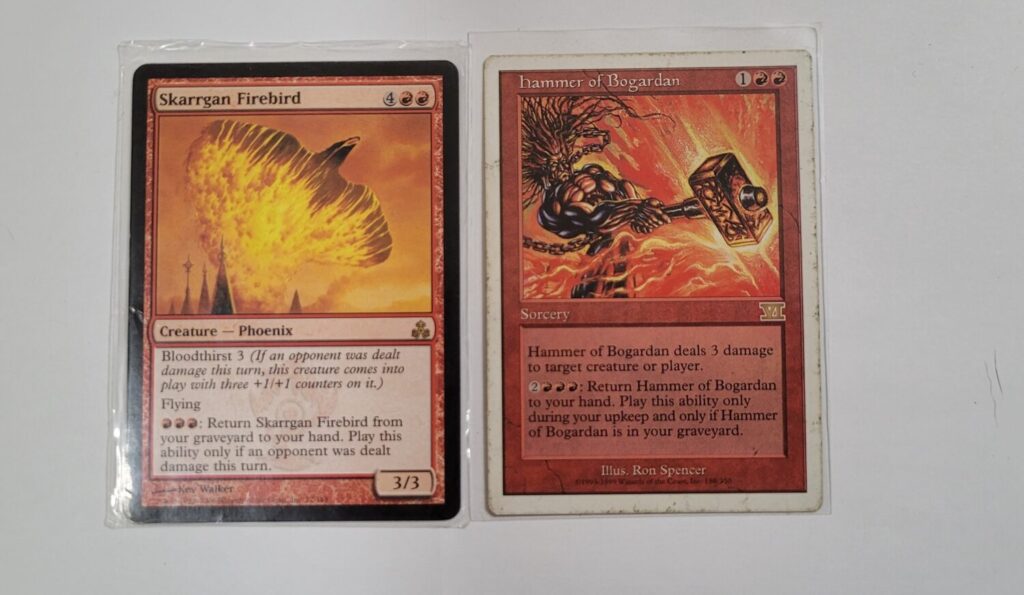
One is a 3/3 creature with flying, and the other is a direct damage spell. While the two may seem dissimilar at first glance, they share one special feature that makes them particularly appealing to me for the purposes of this deck: graveyard recursion. Graveyard recursion is when a card has a built-in feature which allows that card to return from the graveyard to wreak havoc upon the game over and over again. In addition to these, David gave me a few cards that have the ‘flashback’ keyword, which is a type of graveyard recursion, allowing you to recast an already cast spell. The difference is, after recasting a card with flashback, that card is then exiled (i.e. removed from the game). David had a lot of good recommendations and everything I walked away from his home with that day went straight into the deck when I returned home to Nashville.
My visit with David was a very enjoyable and highly productive visit. I left his home with a light heart and a smile on my face. Returning to my cousin’s house a few hours later, we closed out the evening with more board games before getting some rest.
The next morning began differently. My good friend Kevin, who I’d met at the Cafe Apocalypse in the early 2000s, and I met up to get breakfast together. I’m not sure how Kevin got into Magic. Whether he was introduced to it by myself or someone else, I couldn’t tell you. But Magic, in addition to Everquest, became the cornerstone of our friendship early on. Many games were played around his sitting room table (the same table where we divided up the cards we’d bought secondhand). When I moved away from Memphis, my interest in the game may have waned, but Kevin’s never did. He kept right on playing.
After we finished breakfast, we headed back over to Kevin’s place where we sat around talking about Magic, going through his mountain of cards, and reliving old memories. Like David, Kevin was happy to donate to the Commander deckbuilding effort, and I left his house with another 20 cards or so. Of particular note are these: Freed From the Real, Jace’s Erasure, and Beacon of Destruction.
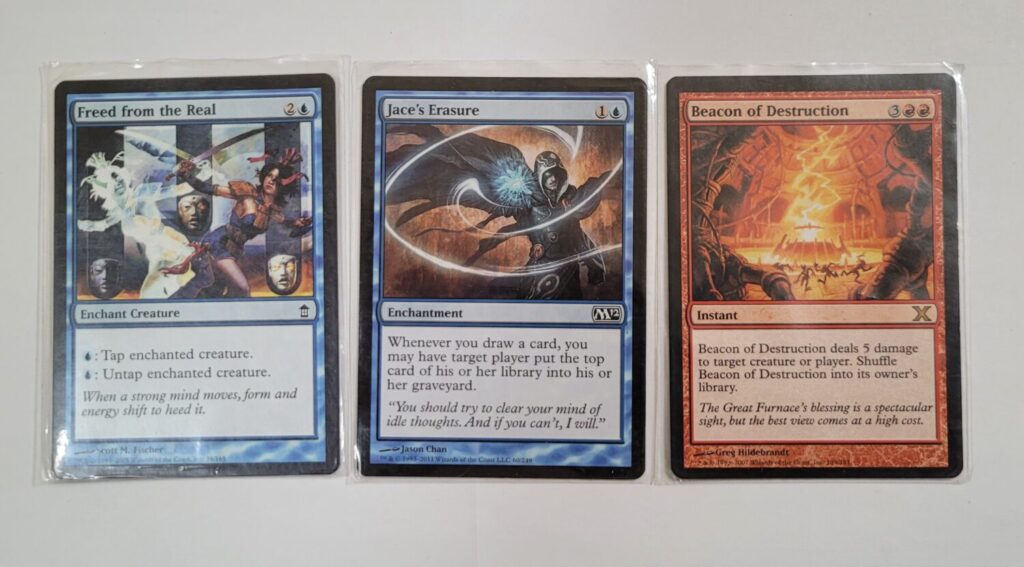
Freed From the Real, I must confess, is a little bit of me planning for the future. There are several creatures that exist which have activated abilities that allow them to untap permanents (this is, any card or token you place onto the battlefield that sticks around). If one of those is enchanted with Freed From the Real, then I could tap a permanent that gives me two mana (one of which must be U), use a U to untap the creature Freed From the Real enchants, tap that creature to untap the permanent that gives me mana, rinse and repeat, netting me an infinite amount of mana to work with. But, Freed From the Real can also be used defensively. Nothing says I have to enchant one of my own creatures. If I’m facing down a creature that’s giving me problems, then for the cost of a single blue mana, I can lock it down and keep it from untapping. With so many useful possibilities, it’s now living in my deck.
Jace’s Erasure punishes my opponents each time I draw cards by forcing them to mill cards from their deck. Milling, in Magic terminology, is the act of placing cards from a player’s library directly into their graveyard. The term originated with an old card called Millstone. As mentioned in my first article, one of the ways in which you can win is for your opponent to be forced to draw a card and for there to be no card for them to draw. Milling their cards is an excellent way to accomplish this objective. Lastly, Beacon of Destruction is another recursion-type card. Except, instead of it returning from my graveyard, as soon as I cast it, it goes straight back into my library. Plus, it’s an instant which provides even more flexibility. Both of these now live in my deck as well.
Alas, Kevin also did not have a copy of Curiosity.
As I left Kevin’s that day and headed back to my cousin’s for one last evening of boardgaming, I did a quick count in my head and realized that, minus basic lands, when I combined everything I’d already picked out while sorting through my cards and everything David and Kevin had donated, I was only a few cards away from having a legitimate, playable deck.
The next evening, after returning home, I excitedly showed my brother-in-law, Chad, all the new cards I’d acquired. While he was looking them over, I got distracted by moving stuff from the car into the house and getting set to eat some dinner. At some point during all that, Chad disappeared into his room. Emerging a few minutes later, he handed me several cards that he thought might work well with my deck. Only one of them really captured my attention.
Chad had just handed me a copy of Curiosity. And just like that, my deck was complete.
The only thing left was to get someone to sit down with me to test it out.