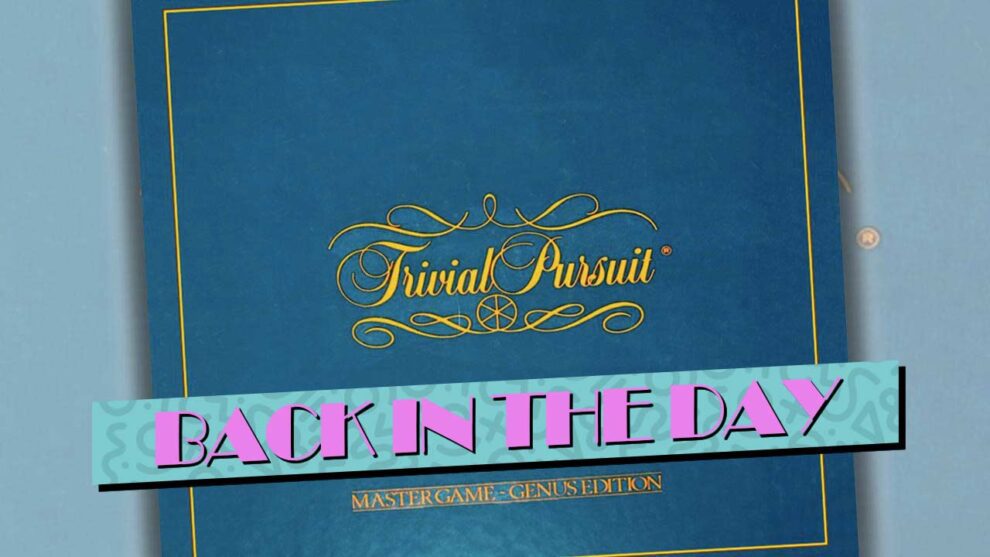


The first line in the description of Trivial Pursuit on BoardGameGeek reads: “Trivial Pursuit is the original trivia game that started it all.” It is really difficult to get your head wrapped around that line when you realize that this game originated in 1981. When a game is the original in a genre that seems as ubiquitous as trivia, being less than 50 years old does not seem right. Consider that this means that Trivial Pursuit is only 12 years older than Magic: The Gathering.
Coincidentally, both Trivial Pursuit and Magic: The Gathering are games that started their respective classification (e.g., trivia games and collectable card games) and seem to have nailed it on the initial outing. Many, many companies have tried to catch the lightning in a bottle both of these games represent and have come up short. Some have come close (e.g., Pokemon). Few seem to have the lasting power of these two. Usually, it has to do with a fundamental misunderstanding of what makes the originals work. So let’s look at Trivial Pursuit and see if we can identify what that is.
In our Back in the Day articles revisiting classic experiences, we won’t discuss how to play these games…they are old, and if you want to learn how to play, feel free to search the ‘net for answers. We’ll instead focus on what still works, and what doesn’t, while making a recommendation on whether you need to dig this one out of your attic or not!
Understanding Probability
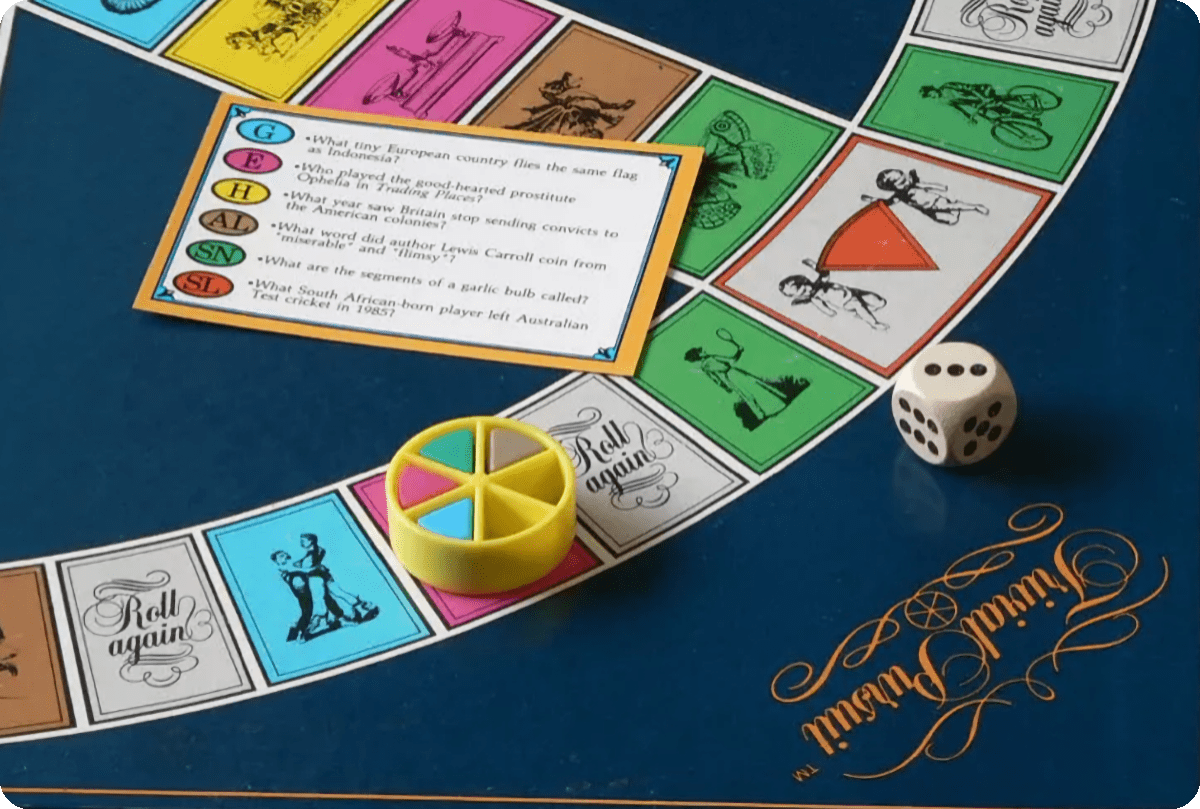
One of the things I have always loved about Trivial Pursuit is the way the questions and answers are presented. The cards in the game each have a question for each of the six categories on one side and the answers on the other side. This seems like a small thing, but I can assure you it is not. It is a surprisingly simple choice that has ensured that this game runs well. Allow me to explain:
Back in the early 1980s, there were many games that came out trying to ride the coattails of Trivial Pursuit. Most of those games were just flashes in the pan. The reason? They tried to segregate the categories into separate decks. In several games I owned in those days, they had multiple decks (usually six) of smaller color-coded cards. Each card had a single question in the color-coded topic. What this meant was that each card, when it came around, ensured that you would get a repeat question. If the same card comes up in Trivial Pursuit, there is a one-in-six chance you will be looking at a repeat question. In those other games, each deck needed to be segregated while all the cards can be shuffled together in Trivial Pursuit – again, may seem small, but the increased simplicity for the player is not to be overlooked.
Some of the games in those days had the answers (and sometimes the questions) obscured by red-colored marks that required that the cards be placed into an envelope with a red-tinted window in order to read them. This was tedious and the envelopes often fell apart after a few plays. Sure, one has to obscure the answers when they grab a card from the deck in Trivial Pursuit, but there is not a part that can be lost rendering the game unplayable.
Another thing I have always liked is how the game had a simple “answer correctly to get another turn” mechanic that allowed a good player to continue moving about the board as long as they could keep giving correct answers. The mitigation for this mechanic is the die (which can limit the topic in which the question will be asked) and the fact that only specific spaces allow you to get the all important pie for your player piece. Not everyone agrees with me on this, such as my colleague Andrew Lynch who feels this can lead to too much time between turns and perhaps a runaway leader. Since the rules are written so that you need to get a correct answer in each of the six categories while on the specific space for that specific category to get the pie, it is true a turn can take some time. Still, once you have all six pie pieces, you need to maneuver to the center of the board and answer a question in a category of your opponents’ choosing to win the game.
If you overcomplicate this you get things like Stage II, a trivia game from 1985 with Gabriel Kaplan as its spokesperson. The game is not great. The selling point is that when a card is chosen, there are six questions of various categories the acting player needs to receive and answer. Based on the answers to those questions, they need to figure out what the common theme involved in those answers would be. For this mechanic (taken from such classic game shows as Password) to work, the board needs to be eliminated, and a single questioner (the Moderator) needs to be selected. In the end, the cards are enormous, they use the red-colored marks and red-tinted window, and the game is mostly removed from the game. The cards, questions, and themes are fun to deal with while on a long car ride, but not so much as a game.
Trivial Pursuit kept things simple and it works.
Adjusting the Themes
Because of the simplicity baked into the game’s design, Trivial Pursuit has released over a hundred specialized and themed editions, as well as multiple Genus (general knowledge) editions over the years. From the All American edition to the World of Dinosaurs edition, there are many specialized and themed versions of the game to choose from. Since the categories are color-coded, each edition can shift the meaning of the colors. In the original Genus edition, the categories were Geography, Entertainment, History, Art & Literature, Science & Nature, and Sports & Leisure. In the 2003 Lord of the Rings edition, the categories became Good Characters, Evil Characters, Things, Places & History, Warfare, and Making Movies.
The way the game was designed, one could fairly easily mix cards from various sets, be that multiple Genus editions or various specialized editions with little effort. There is a small issue with this (see below), and that is one of my only complaints.
What Works
Trivial Pursuit was, and remains, a game design to be envied. Many have tried to imitate this design, but unless they do it in a way that is dangerously close to copyright and trademark infringement, they are not going to be as good. The design is just that solid. This is a classic for a reason: the game has no issues in its design. Read that last statement again and know that this is my opinion. My colleague, Andrew Lynch (as mentioned above), strenuously disagrees. I get his point of view and can understand, even if my thoughts lie elsewhere. In my opinion, the only thing holding Trivial Pursuit back is the fact that you need a group that loves trivia in order to enjoy it.
What Doesn’t Work
Above I said there was an element of the game where I have a small issue. The issue is that they did not stay true to the colors on the board for every edition. I seriously believe that had they stuck with the blue, pink, yellow, brown, green, and orange designations, things would be nearly flawless. But the many sets (e.g., the Junior sets, the 25th Anniversary edition, and so on) take out brown and replace it with purple; the Lord of the Rings edition removed the colors all-together and replaced these with symbols (e.g., leaf, badge, tree, ring, sword, and cross-hairs). If they could have kept the colors exactly the same throughout the editions, the intermixing of cards would be flawless. It can still be done, but they made this less than ideal.

Yea or Nay?
It should come as no surprise that this is a “Yea” from me. There are no games that can touch Trivial Pursuit within its niche. If trivia is your thing, either go order a copy of one of the many editions available, or go dust off your old copy today! It is waiting for you.