
Disclosure: Meeple Mountain received a free copy of this product in exchange for an honest, unbiased review. This review is not intended to be an endorsement.

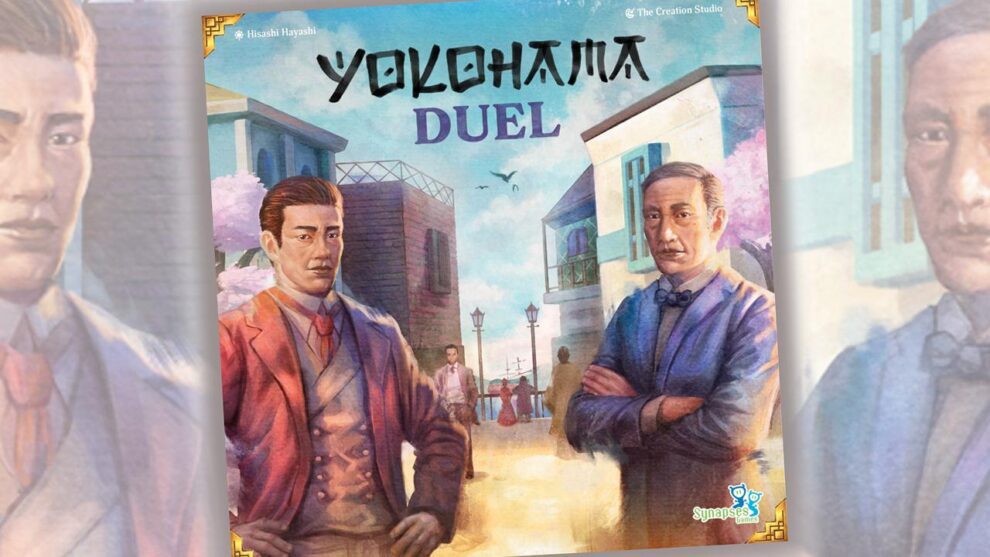
I first saw Yokohama at Gen Con in 2024 when it was reprinted with updated art and dual-layered boards. My main turnoff was that it seemed quite fiddly with the smaller meeples and felt generally busy with the various worker placement locations. Enter Yokohama Duel which eliminates those issues and presents a similar gameplay wrapped in a convenient two-player package. The question remained: does it stand on its own merits amidst the evergrowing list of ‘duel’ games? I aim to find out.
Yokohama Duel Overview
Each player in Yokohama Duel assumes the role of a prominent merchant in the Meiji era of Japan, pushing themselves towards prosperity for themselves and the burgeoning port town. Through the acquisition of goods, fulfillment of orders, adoption of technology, and culturally mindful practices over four rounds, players compete to see who will come out on top.
The core of the game is the placement of ‘workers’ in the form of Power cards. At the start of the game, each player receives a set of Power cards valued 1 to 4. On their turn, a player selects the lowest remaining Power card in their hand and plays it to an unused location on the board. The value of the card played gives an increasing benefit such as more resources, a higher valued Technology card, more yen, etc. Since cards must be played lowest to highest, it creates a natural sense of progression each round and a tension regarding what your opponent might be saving their heavy-hitting cards for as the available options dwindle.
Power can also be adjusted by playing one-time-use Extra Power cards, or by having a Shop or Trading House on the location being played to. Shops and Trading Houses can only be built if you’ve taken that location’s action with at least 4 Power that turn. Each grants +1 Power to your Power played to that location in subsequent rounds, with the Trading House granting an extra benefit of providing ¥1 to its owner anytime that action is taken.
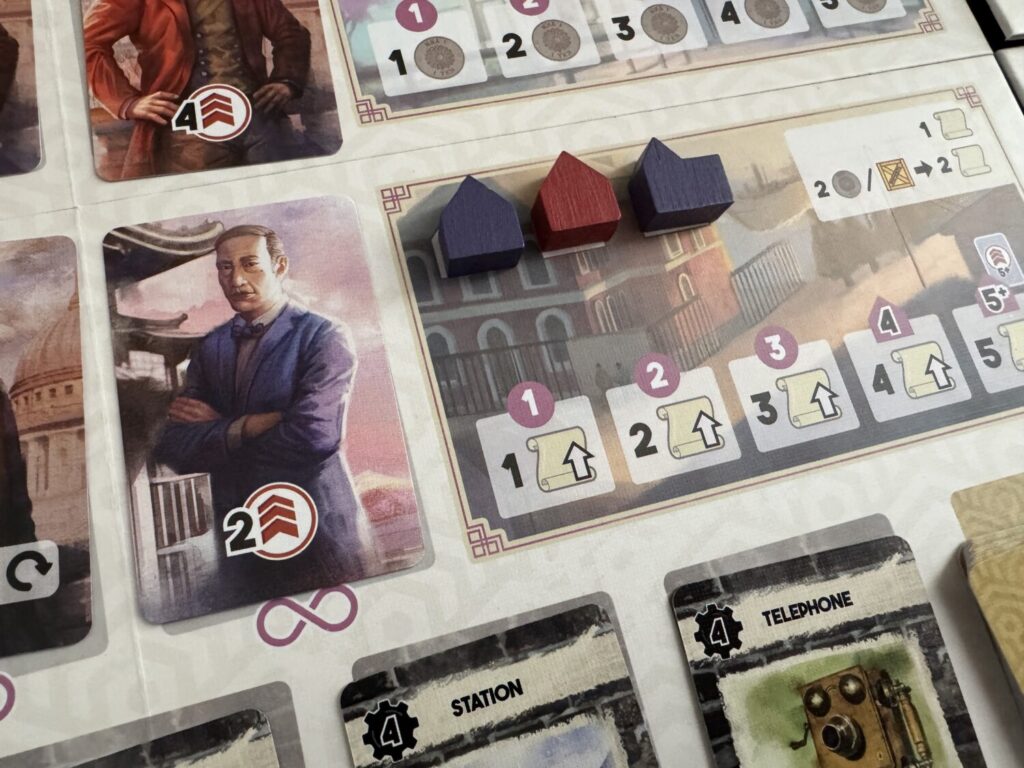
Playing an action with at least 5 Power grants an additional benefit, granting a choice from the three face-up Power Bonus cards’ benefits. These add stacking bonuses from 5, 6, and 7+ Power, offering a very enticing proposition towards focusing one’s efforts on specific locations each Round.
The crux of the game revolves around the fulfillment of Orders. During your turn, you can spend the required resources listed on the Order card to fulfill it, gaining the points and the benefit at the bottom. Sometimes these will yield Imported Goods tokens. By themselves, these crates are worth a single point, but if you can manage to flip them over via the Customs location or through another means, they’ll ring in at the tune of 4 points a pop.
The Technology space grants an associated Technology card depending on the Power played. These bonuses range widely from once-per-Round abilities, endgame scoring modifiers, or benefits for performing certain activities like building a Shop. It always feels good to take one of these early to get the most benefit, while also planning to snag one in the third or final Round that gives you some extra points.
Perhaps the most difficult location to score on is the Church. Playing a Power card here sets your base Faith value, which can then be modified through the usual means to gain a Church card. These offer a one-time bonus along with a bevy of points, especially as you get into the higher tiers. But these cards are never replenished, so it’s possible for your opponent to scoop up the lower-Power Church cards early, leaving you with nothing.
At the end of each Round, players can spend yen to upgrade one of their Power cards, flipping it permanently over and increasing its power by 1. This allows you more reliably reach that magic 5 Power threshold and earn those bonuses more frequently.
Scoring occurs at the end of the fourth Round, where the same Yokohama point salad rules apply. You get points seemingly for everything you’ve done during the game — fulfilling Orders, fulfilling the most Orders, Technology cards, having the most Technology, Church cards, Trading Houses, Shops, Imported Goods, and any leftover yen or resources. Highest score wins.
Yokohama Duel: Trading Spaces
Yokohama Duel is tight and tenuous, where every action feels monumentally important. Each Round you are being squeezed by yourself and your opponent, potentially forcing you into a nonoptimal action that still results in a decent payoff. It leads to mind games and bluffing in a game that I really didn’t expect to have any of that.
Despite the constricting feeling, the game itself feels very forgiving. It’s not difficult to be swimming in a particular resource thanks to a well-placed Power card. In fact, I found that the difficult choices come from the early rounds, when you place 1 or 2 Power actions and have to struggle with the limited return. To stymie the blow, I consider those to be instrumental in blocking my opponent, since you can’t place Power cards in used areas.
Unless, of course, you have a Foreign Agent.
Every time that a player either has 3 completed Orders, at least 3 Technology cards, at least 2 Church cards, or at least two face-down Imported Goods, they earn a Foreign Agent. These rule-breakers give you a Free action on your turn to play them as a 3 Power card and take the associated action of any space. This is in addition to the Power card you play on that turn, making it the perfect way to circumvent blocking shenanigans or double up on an important action.
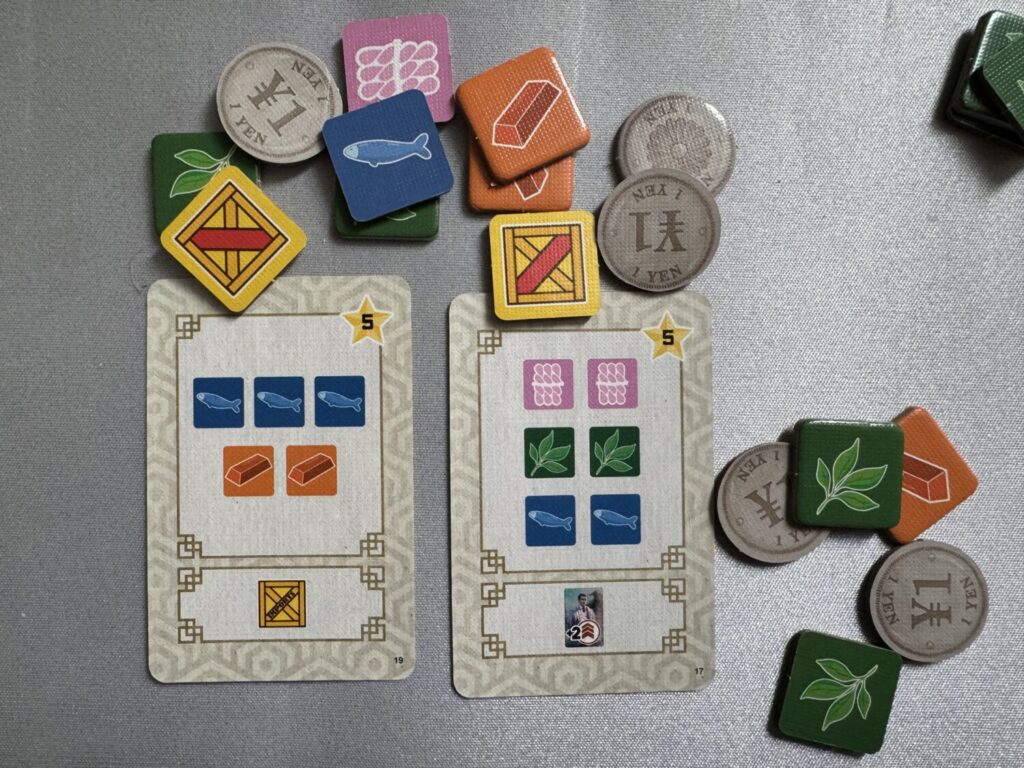
What impressed me most is that there doesn’t seem to be a single, strong strategy to win the game. I’ve had games where someone mostly focused on fulfilling Orders and flipping Imported Goods that barely squeaked out against the mass acquisition of Technology cards. Banking on Church cards seems the most difficult, even though you can spend resources essentially as offerings to increase your Faith value. That might be a strategy that’s slept on.
The designer certainly knows that it feels good to “get stuff”. Getting 5 Power Bonuses and seeing the Power progression through Shops and Trading Houses really helps you feel like you’re building up a budding mercantile empire. And just like a lot of progression games, this one ends right at the moment when your empire is on the precipice of greatness. You will be constantly taking tokens and giving them up for Orders, almost making me wish that each player had a resource tracker instead of fiddling around with all of the tokens. Although the tokens make the exchange feel that much more thematic.
Yokohama Duel impressed me with its restrictive gameplay, which seems like a sleight but I assure you it isn’t. It forces you to be reactive and proactive, sometimes gambling on acquiring resources in the hopes that a future Order card will make use of them. It’s quick enough to not overstay its welcome, but long enough to sink your teeth into strategically.
And the game has the added benefit of making me want to revisit Yokohama and compare them with fresh eyes.
Yokohama Duel details
- Designer: Hisashi Hayashi
- Artists: Adam P. McIver, Hisashi Hayashi, Ryo Nyamo, Scott Hartman, The Creation Studio
- Publishers: Arclight Games, Elznir Games, Maldito Games, MTS Games, OKAZU Brand, Synapses Games, Tasty Minstrel Games
- Release Date: 2018
- Player count : 2
- Age range : 12+
- Time range : 45 minutes
- Mechanism(s): Set Collection, Worker Placement
- BGG Geek Rating: 7.48428 - converted to Meeple Mountain scale: 3.5.
- More articles about Yokohama Duel.