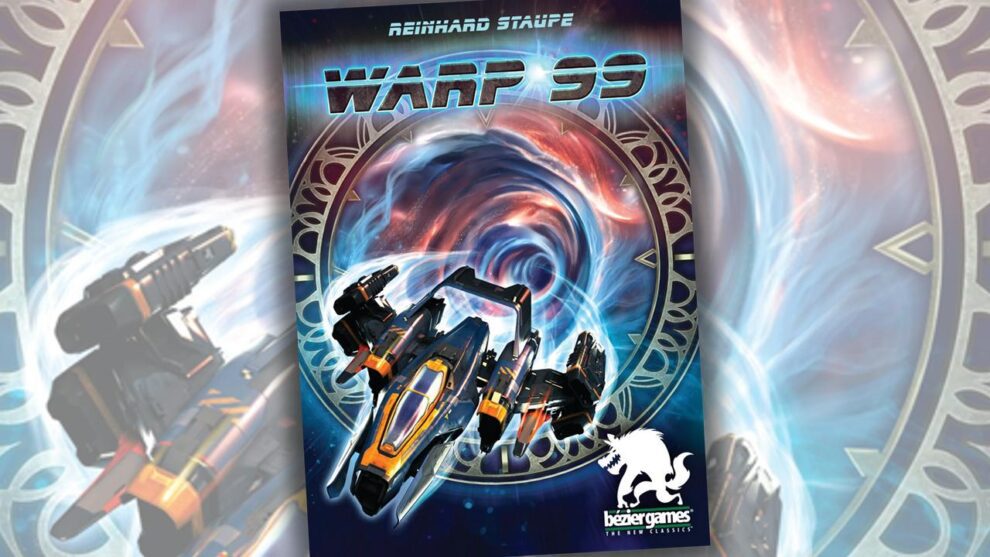

Disclosure: Meeple Mountain received a free copy of this product in exchange for an honest, unbiased review. This review is not intended to be an endorsement.

Man, I love doing demo plays of games at shows. I love them because I get to play with random strangers to take in differing opinions on games I’m about to review.
Warp 99 is a new card game from Bezier, a publisher quickly becoming a major distributor of card games in the US. Over the last three years, Bezier has brought so many titles to the market that I had to go to their website to remember them all: Xylotar, Cat in the Box, Seers Catalog, Sandbag, and the best of the bunch, Rebel Princess Deluxe Edition.
A couple of those are now at the top of my all-time favorite trick-taking games, so now I will table anything from Bezier to see if they’ve struck gold. Warp 99 has its moments, and when the player count stays low, there’s something here. In the wrong hands, Warp 99’s biggest issue is its playtime; 30 minutes is too long for a game that is a simple race to get to 99 points before other players.

Warp Speed?
Warp 99 is a hand management game for 2-4 players. While it is not a traditional shedding game, Warp 99 is a game about emptying your hand, then your 15-card deck, as many times as you can to score the 99 points you need to win.
The game’s 110-card deck has 11 cards per suit across 10 suits, numbered 0-10 in each suit. A player has six hand cards, from a personal deck of 15 cards. On a turn, the active player first has to play one card into a personal scoring pile with cards that must be played in ascending order. That means, ideally, you’ll want to play your lowest card into that pile, but you may not always have a card that can legally be played.
That personal scoring pile is important; when redeemed, this pile is scored as the square of its total card count. So, one card scores one point; two cards score four points, while three cards score nine points, etc. The pile can be scored any time, but must be scored when no more cards can be added.
This choice is more interesting than I first gave the mechanic credit for, because my mind initially went to always playing my lowest card into the personal scoring pile. During my second play—even late in my first play—I found myself using different cards to play there, especially when I had a hand of five cards I could play to completion during the second part of my turn.
That second portion is why I recommend giving Warp 99 a look.

After playing into the personal scoring pile, the player has a handsome buffet of options. There are two discard piles to play cards into, and there are three rules that must be followed when discarding from hand. The three rule cards are double-sided. One allows a player to discard a card valued one higher or one lower than a face-up discard. Another rules card lets a player discard a matching color card or to a matching number card. The last rules card allows a player to discard if they play a number that, when combined with the discard being covered, equals exactly 10; the flip side of that rules card allows a player to burn a card that is exactly half of a face-up discard or is double the face-up discard.
Finding a way to dump all five cards is quite a treat. Additionally, if a player burns a card that meets at least two of the current rules, they get to draw a card while continuing to play their turn. And if a player can’t play any of their cards, they can show their hand to the table (proving that they truly cannot play) before flipping one of the current rules cards to its opposite side to play their turn.
Each time a player empties their personal draw pile, they score 15 points. They also score points each time they redeem their personal scoring pile. That turns Warp 99 into quite a race…as long as the player count is low and players move quickly.

Impulse Power
This also means that Warp 99 isn’t as interesting when you are watching other players move through their turns, or when slow play gets in the way of a good time. I think that means Warp 99 isn’t as strong at four players, but at two or three players, you can get around this issue.
Also, the rules cards don’t flip as often as you think they will, meaning that during my three review plays, the rules cards that are established at the start of each game (randomly selected) remained in place for the majority of the game. That is not necessarily a bad thing, but my mind was always wanting the rules cards to be a bit more dynamic.
One production issue: the game does not come with point counters, meaning that everyone has to keep track of their points using something like a score pad. The folks at Bezier did me a solid and mailed score counters that were an excellent way to track the game’s scores for each individual, in a public way that makes it easy for everyone to know who’s in the lead. Before those trackers arrived, I used my Iron Clays poker chip set to keep score, which works just fine, particularly when reading the stack of chips a player has from across the table.
But I am surprised nothing else was included to keep score. That certainly helps keep the price down, but it’s a lot less practical.
Warp 99 was a minor surprise; it’s not a banger like Xylotar or Rebel Princess, but it’s a solid addition to the Bezier catalog. Here’s what IS a big surprise: Warp 99 was designed by the same man who gave us Edel, Stein & Reich, Reinhard Staupe. Warp 99 is not the complete opposite of that earlier title, but it is close!
Warp 99 details
- Designer: Reinhard Staupe
- Artists: Matt Paquette & Co., Viktoriya Fajardo
- Publishers: Bezier Games
- Release Date: 2026
- Player count : 2 - 4
- Age range : 10+
- Time range : 30 minutes
- Mechanism(s): Hand Management, Set Collection
- BGG Geek Rating: 7.6 - converted to Meeple Mountain scale: 4.0.
- More articles about Warp 99.