
Disclosure: Meeple Mountain received a free copy of this product in exchange for an honest, unbiased review. This review is not intended to be an endorsement.

War, Trade, and Extremely Long Evenings
For some board gamers, Twilight Imperium (TI4) is a bucket list game. Not because it’s rare or expensive, but because reliably gathering six busy, willing, and able adults for 9 to 12 uninterrupted hours already feels like an achievement. Add in a sprawling space opera full of political intrigue, shifting alliances, and the occasional spectacular betrayal, and you start to understand the mystique.
I had been in the board game hobby for years before a friend invited me to play TI4 for his birthday. I was giddy at the chance to sit down with the behemoth finally, and I’ve been lucky enough to get it back on the table many times since. I enjoy Twilight Imperium a lot, but I don’t live and breathe it. There’s another kind of TI4 player: the kind who plays in rated leagues, travels for tournaments, and can recite every faction’s abilities and tech paths from memory. That’s not me, and that’s not the perspective this review is written from.
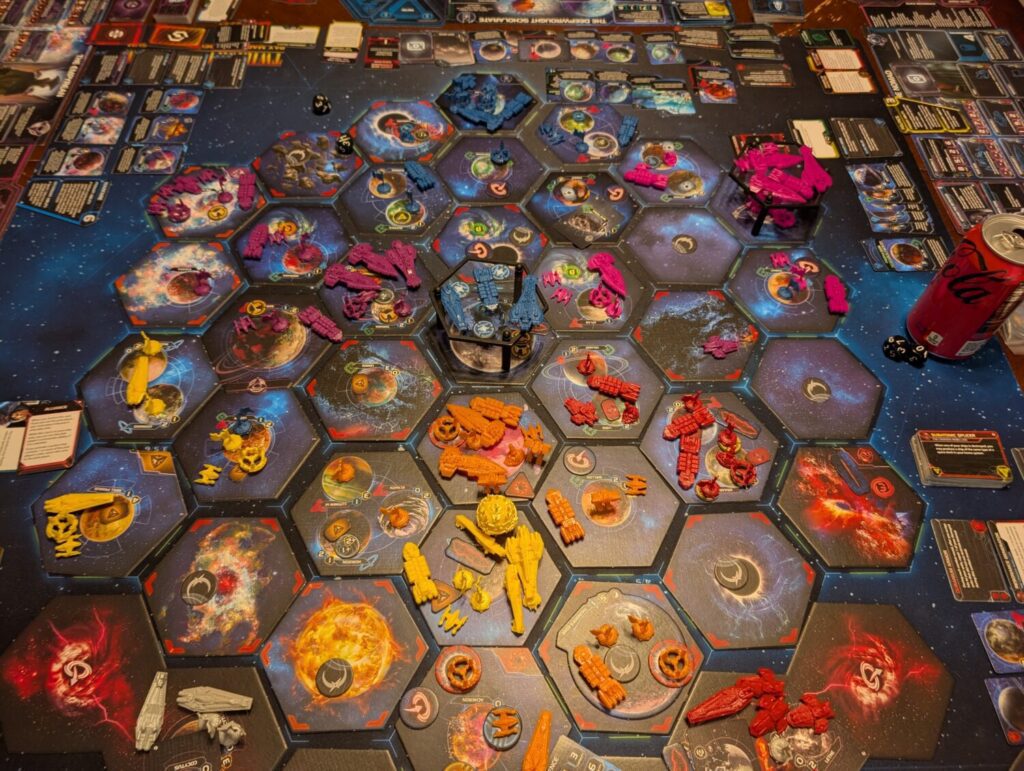
With the Prophecy of Kings expansion, Twilight Imperium already feels remarkably complete. It’s one of the best examples I can think of of a lavish expansion retroactively improving a base game. The expansion smooths rough edges, adds meaningful systems, and gives the game more texture without losing its identity. If you bounced off TI4 initially, Prophecy of Kings might genuinely change your mind—unless your dealbreaker is the length, because it absolutely does not fix that.
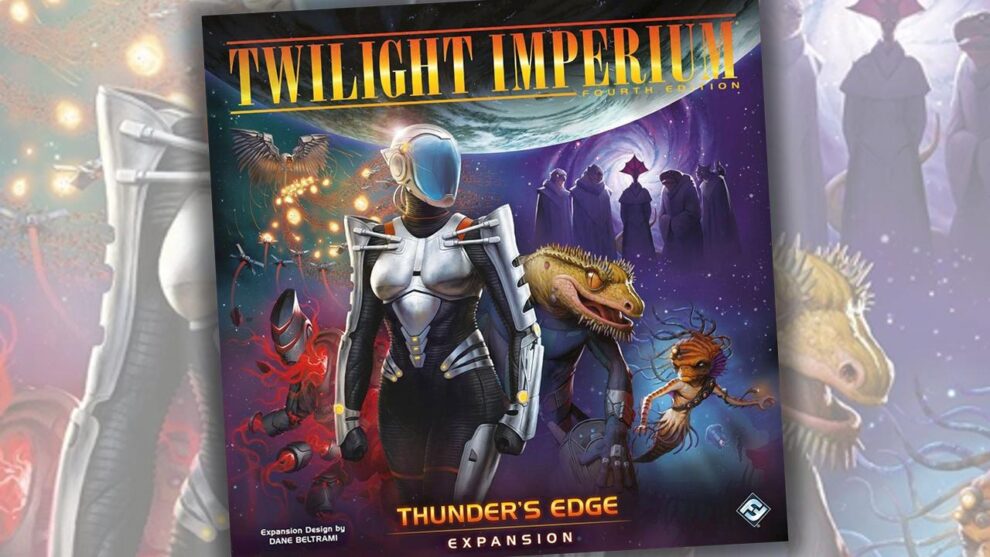
Thunder’s Edge, by comparison, adds a lot of stuff. New factions. New options. New possibilities. Longtime fans will (and already did) devour it; many of them preordered the expansion and theorycrafted weeks before it hit shelves. These players don’t need this review. So the real question is for everyone else: if TI4 plus Prophecy of Kings already feels complete, what does Thunder’s Edge actually add? And more importantly, does it add anything that matters?
Let’s dive in.
These Knobs Go to Eleven
If there’s one word that best captures Thunder’s Edge’s design philosophy, it’s more. More normal planets. More legendary planets. More tiles, cards, tokens, and side systems. More places to visit and more factions to visit them. This expansion doesn’t so much refine Twilight Imperium as it gleefully piles additional levers onto an already crowded control panel.
The most prominent of these additions is the Thunder’s Edge Expedition, a flashy, high-concept mechanic that sounds more impactful than it ultimately feels. At the start of the game, the planet Thunder’s Edge isn’t on the board at all. Instead, players can invest resources and cards at the end of their turns to place tokens on the expedition track, unlocking their faction’s “breakthrough” (more on that shortly). Once all six expedition slots are filled, the tile flips, and the player with the most influence over the expedition claims Thunder’s Edge and drops it into a space on the galaxy map, provided it isn’t already occupied by a planet, supernova, or wormhole, along with a contingent of units. Thunder’s Edge itself is a legendary planet, allowing its owner to exhaust it for an extra action during their turn. That extra action can occasionally be useful, but in practice, its biggest draw is much simpler: it’s worth five resources. In one game I played, Thunder’s Edge was dropped into an asteroid field, making it nearly untouchable in the early game. It was neat. It was cool. And after the initial spectacle, it mostly settled into the background as just another very good planet on the board.
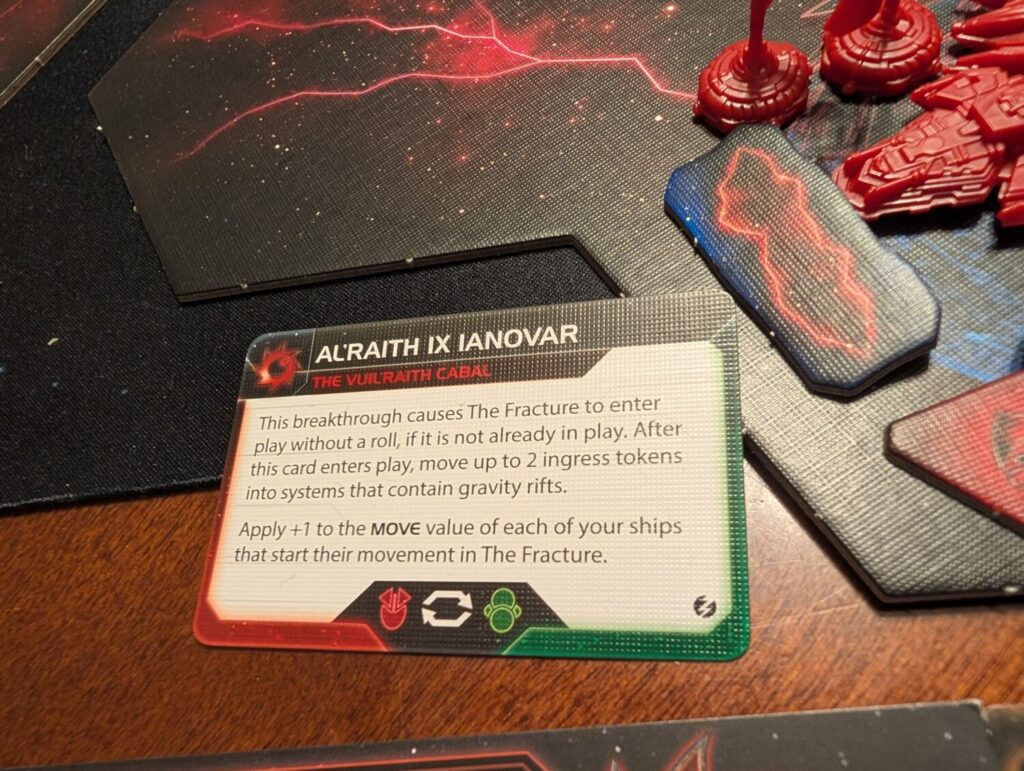
The expedition’s real mechanical purpose is unlocking breakthroughs, which is the closest Thunder’s Edge comes to doing something genuinely new. Each faction gains a unique breakthrough ability that grants a special power alongside a novel technology-color synergy, allowing one tech color to be treated as another. On paper, this is exciting. In practice, the execution is wildly uneven. Some breakthroughs are genuinely game-changing. The Emirates of Hacan, for example, gain free fleet pool tokens when producing multiple ships, a powerful economic boost that meaningfully alters how they play. Others feel shockingly minor. The Ral Nel Consortium’s breakthrough grants a single additional action card per round, one that is also public knowledge. These abilities span a spectrum from transformative to barely noticeable, and the result is that your experience with breakthroughs depends almost entirely on which faction you are playing. Compared to Prophecy of Kings, where nearly every faction gained at least one leader that felt impactful or interesting, some of these breakthroughs just kind of whiff.
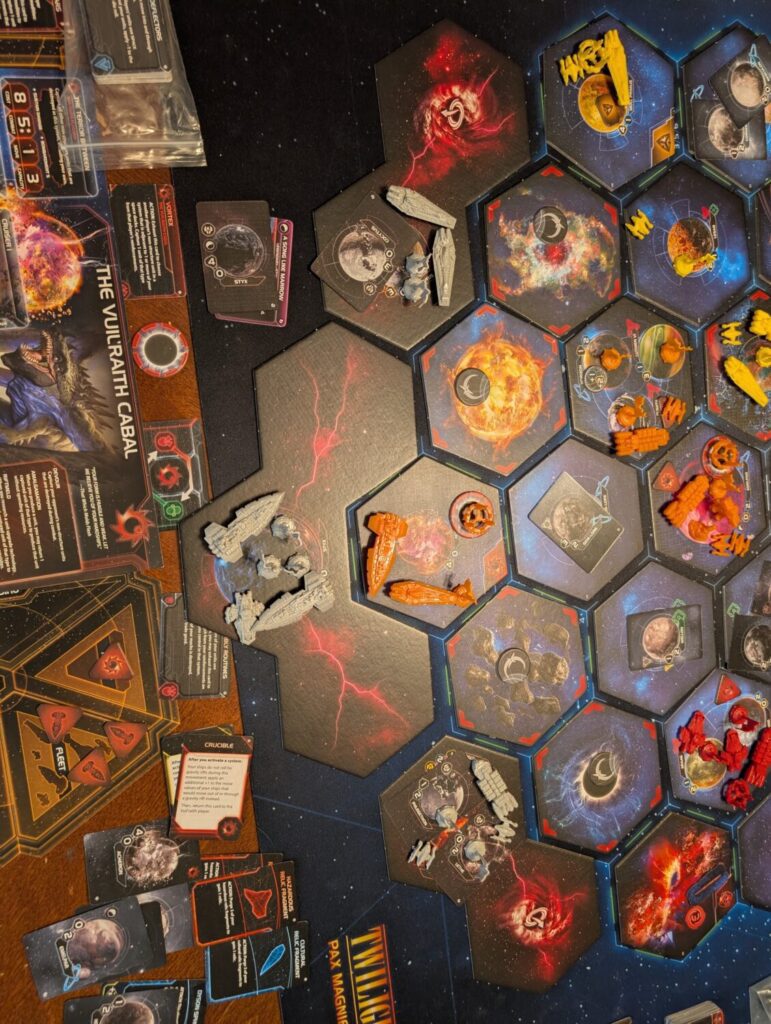
Then there’s The Fracture. At setup, the Fracture tiles are set aside, potentially never entering the game at all. Whenever a player gains their breakthrough, they roll a die, and on a 1 or a 10, The Fracture erupts into play. Rather than being adjacent to existing edge tiles, The Fracture sits apart from the main galaxy, accessible only through ingress tokens that appear across the board once it’s revealed. The planets in this region are highly desirable, offering relics for conquest and, in the case of the central planet, a victory point as well. They’re also heavily defended by neutral fleets, ensuring that claiming them is anything but easy. It’s a compelling idea that creates a sudden shift in priorities and incentives, though I’ll admit that the moment anyone starts explaining the lore behind why these planets are guarded, I begin disassociating.
Entropic scars, on the other hand, are less subtle and far more alarming. These new anomalies disable unit abilities within them but reward players who occupy them at the end of the round by allowing the discard of a strategy token to gain one of their faction-specific technologies. For some factions, this is merely strong. For others, it’s completely unhinged. The Embers of Muatt, for instance, can realistically have Prototype War Sun II online by the second round of the game. That is bananas. And they’re far from the only faction capable of unlocking absurd power spikes far earlier than intended. In the hands of skilled players, entropic scars don’t just accelerate progress; they risk outright warping the game around whoever exploits them first.
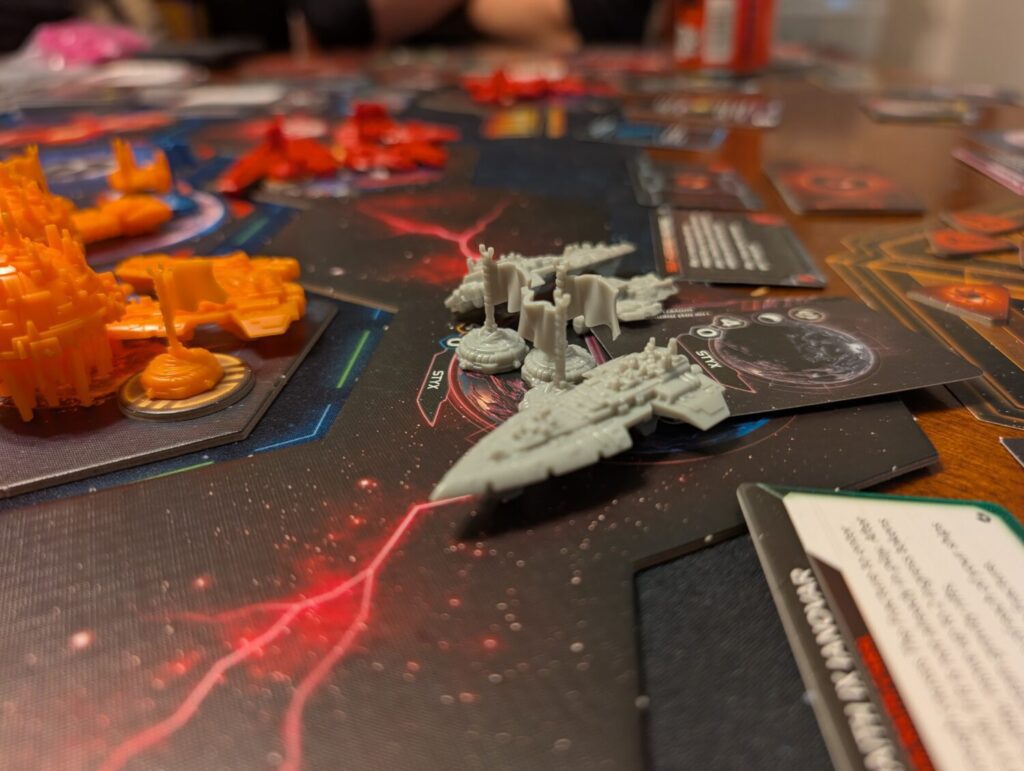
Beyond all that, Thunder’s Edge continues to shovel content into the box. Space stations act as planet-like tiles you can’t actually land on! Five new factions arrive, each doing their own thing! Several older factions receive tweaks! Seven new legendary planets and over a dozen standard planets expand the map pool! A handful of strategy cards are adjusted! New relics and action cards are added! There are even new setup events that can fundamentally alter the game before the first round begins! More. More. More.
And finally, there’s the biggest system of them all. The one that demands the deepest rules knowledge, the most buy-in, and the highest tolerance for complexity. The one I didn’t play.
Twilight’s Fall.
Expert Mode: Enabled
I mentioned earlier that this review comes from the perspective of someone who enjoys Twilight Imperium but does not treat it as a lifestyle choice. That distinction matters most when talking about Twilight’s Fall, a completely separate game mode that feels explicitly designed for people who already know this game inside and out.
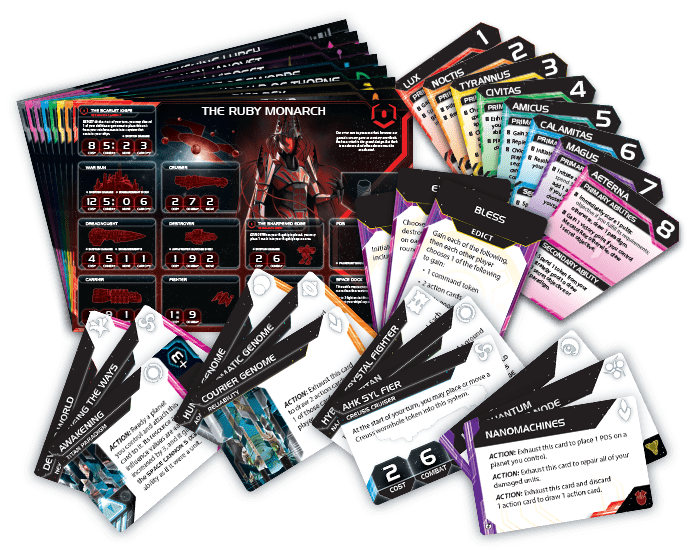
Twilight’s Fall takes place in an alternate future where each player becomes a mad Mahact king, stitching together a custom faction from the wreckage of the galaxy. You don’t pick a faction. You build one. Each king starts with a unique flagship and mech, and everything else is up for grabs. Abilities, unit upgrades, agents, and commanders are all spliced together from the game’s thirty factions to create a bespoke, Frankenstein’s monster faction sheet. Paradigms replace heroes as powerful one-shot effects. The agenda phase is tossed out in favor of an edict phase, where a single tyrant simply decides what happens. Research as you know it? Gone.
It sounds wild. It is wild. And it’s absolutely not for me.
I didn’t play Twilight’s Fall, and I don’t pretend to fully understand every interaction. Not because it’s poorly designed, but because it leans hard into what I consider Twilight Imperium’s biggest barrier to entry: the sheer, oppressive amount of game knowledge it expects from its players. TI4 already asks you to be at least vaguely aware of thirty factions, each with multiple abilities, unique technologies, leaders, alliances, promissory notes, and now breakthroughs. That’s hundreds of moving parts before you even start accounting for objectives, action cards, or agendas. Twilight’s Fall cranks that to maximum.
Veteran players will argue that you don’t need encyclopedic knowledge to enjoy Twilight Imperium. But enjoyment and competitiveness are two very different things. I’ve been blindsided often enough by rules and card interactions I didn’t know existed to recognize the pattern. While testing Thunder’s Edge, I once moved to take a player’s home system to block their scoring, only to immediately lose the game because they held a secret objective that rewarded losing it. I didn’t misplay the board. I misplayed the encyclopedia. How many more ten-hour days do I need to endure to learn it all? I’d wager I don’t have enough free Saturdays before shuffling off this mortal coil to make it happen.
Twilight’s Fall is a mode that turns that knowledge gap into the main event. If you already know every faction, every trick, and every edge case, it probably rules. If you don’t, it’s a brutal reminder of just how wide the gulf between “experienced” and “expert” can be. I chose not to play it, and I don’t regret that decision. It’s not a mode designed for me or, I suspect, for most people.
More Galaxy, Same Imperium
Thunder’s Edge is a good expansion. A solid one. In some places, even a very exciting one. It introduces new factions, systems to engage with, and new ways for experienced players to showcase their knowledge of Twilight Imperium. If you already love TI4, especially if you’re already a fan of Prophecy of Kings, there is a lot here to enjoy.
What it doesn’t do is change what Twilight Imperium fundamentally is.
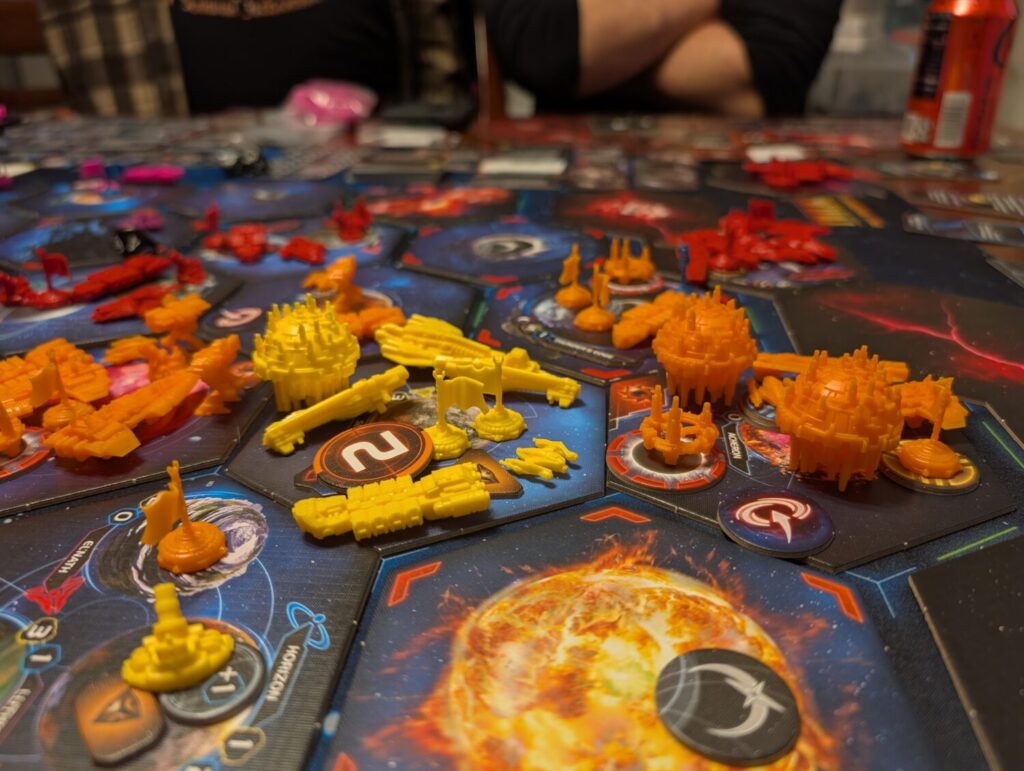
This expansion doesn’t make the game shorter. It doesn’t meaningfully lower the barrier to entry. It doesn’t smooth over the knowledge gaps that can turn a single mistake into a lost game. Instead, Thunder’s Edge embraces the existing complexity of TI4 and builds upwards, rewarding players who already know the galaxy inside and out with even more tools, options, and edge cases to master. The new mechanics range from clever to uneven, with moments of genuine brilliance sitting alongside ideas that feel either undercooked or dangerously swingy. And Twilight’s Fall, while fascinating, is a clear signal of who this expansion is for and who it very much is not.
If you own Twilight Imperium and Prophecy of Kings, and you’re still hungry for more galaxy, more systems, and more ways to express mastery at the table, Thunder’s Edge is an easy recommendation. If you’re hoping for an expansion that fixes what you don’t like about TI4 or fundamentally reshapes the core gameplay loop, this won’t be it.
Thunder’s Edge isn’t transformational, but it is additive. If you just want more stuff and enjoy the core experience, then you’ll find this worth grabbing. For me, I think the existing experience is already complete, and I’d prefer to play with that content only.
Check out Tyler’s video for his review on Twilight Imperium: Thunder’s Edge.
Twilight Imperium: Fourth Edition – Thunder's Edge details
- Designer: Dane Beltrami, James Kniffen
- Artists: Anders Finér, Mauro dal Bo, Pixoloid Studios, Stephen Somers
- Publishers: Fantasy Flight Games, Galakta, Hobby World
- Release Date: 2025
- Player count : 3 - 8
- Age range : 14+
- Time range : 240 - 480 minutes
- Mechanism(s):
- BGG Geek Rating: 8.9682 - converted to Meeple Mountain scale: 4.5.
- More articles about Twilight Imperium: Fourth Edition – Thunder's Edge.