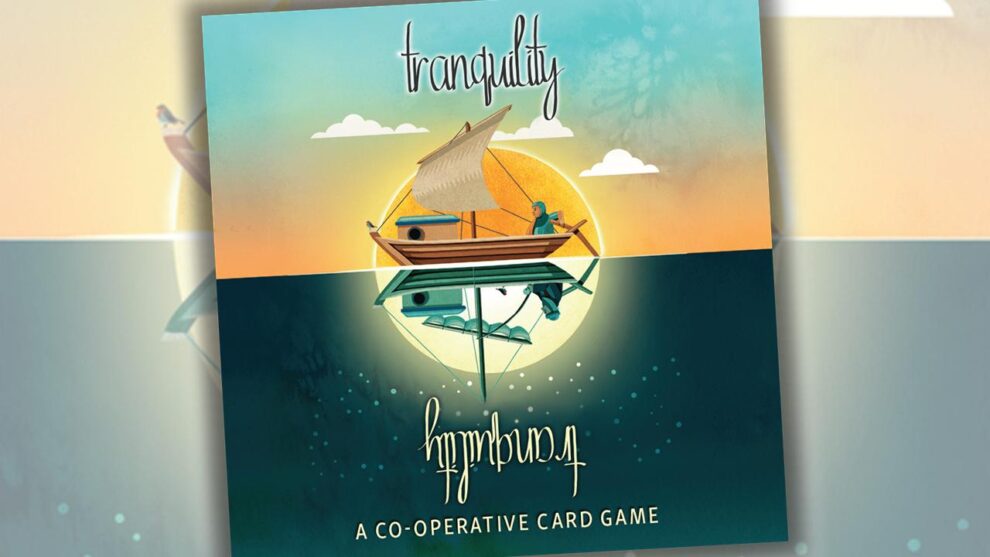


Imagine you are on the sea. The ocean before you is liberally dotted with various inhabited islands. The sea is calm and the wind is fair. You want to sail from your home island to another, some distance away. The journey will take some time, enough so that this beautiful dawn will have passed into dusk by the time you arrive. There are no pirates or shark-infested waters along your way, just a need to plot a proper course. And for that, all you need is a tall ship and a star to sail her by…

Thomas Wells wrote a very good review of this game several years ago. His take (from my reading) is that this is more of an art-project, an activity, than truly a game. Some might see it that way. After exploring this little gem, I (and several in my group) see it as more a game than an art-project. Certainly not just an activity. Read on and let me know what you think.
Tranquility is not always Silent…
My wife loves cooperative games. On a recent weekend, our normal game group could not all get together online, so it was just three of us. My friend, Mike, suggested a cooperative game we had not played before: Tranquility.
The game is one where the players are dealt all of the cards from a deck having the numbers 1–80 inclusively (each depicting a sunlight and a moonlight image in the same manner as the box cover; this has no impact on the standard game). Also within this deck are five ‘finish’ cards, so nobody knows who will get how many of those. Each player is given a ‘start’ card to shuffle into the cards they have. The first thing to note is that this means that there are 85 (80 + 5) cards dealt; depending upon the number of players, not everyone is getting the same number of cards.
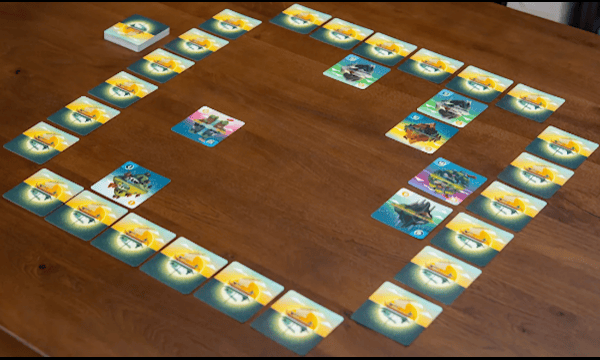
In the center of the play area, there is a 6×6 grid. At the lower left corner, just off the grid, is a space for a ‘start’ card to go; at the upper right corner, just off the grid, is a space for a ‘finish’ card to go. Once the first player has been chosen and the cards are dealt, the game is ready to begin. Each player takes the top five cards from their personal deck as their hand, and the game is off and running.
The goal is to place the cards, one at a time, into the grid in such a way that they start with the lowest card in the lower left and the highest card in the upper right. If you do not have a playable card, or do not want to play a card, you can discard two cards from your hand. At the end of your turn, draw from your personal deck until you have five cards in hand again, or your personal deck is empty.
If a player cannot play because they do not have two cards in hand to discard: the game is lost.
If a player’s turn comes up, and the grid is full, and they have a ‘finish’ card in their hand: they play the finish card and the game is won.
Given that you have 80 cards to work with and 36 spaces, this might seem trivial. I assure you, it is not.
- The first thing you need to know is that the game is meant to be played in silence. You cannot share any information about the cards in your hand. You cannot tell the other players that a specific card needs to be played if you are to be able to play on your turn. Nothing.
- The second thing you need to know is that if, on your turn, you have a ‘start’ card in your hand and there is no ‘start’ card already in play, you must play that ‘start’ card. This triggers a round of discards. In total, all players must discard a total of 8 cards. You all need to discard them, without being able to tell others anything other than ‘I cannot discard any others’ or ‘I can discard no more than X more cards.’ The round of discards ends once 8 cards have been discarded.
- The third thing you need to know about is adjacency. Anytime you place a card in the grid adjacent to another card already on the board, you need to discard a number of cards equal to the difference between the two cards. If you place a card between two cards such that your card is adjacent to both, you need to discard a number of cards equal to the lower of the two differences.If you do not have enough cards in your hand to fulfil this requirement, the card cannot be played.
- The fourth thing you need to know is that a ‘finish’ card cannot be played until the grid has been filled. Each player may or may not have one or more of these cards in their deck. When a ‘finish’ card is in your hand, you are down to a maximum of four cards to choose from each turn. If you have more than one ‘finish’ card in your hand, you may have fewer choices. Granted, when needed, these cards can be discarded… but you have no idea if anyone else has one, if you have another in your deck somewhere, or… well, anything other than this card (or these cards) are in your hand. Leaving one in your hand is safe, but restricting.
- Finally, the fifth thing you need to know is that a grid is not always a grid. The game is played on a 6×6 grid, true. But this is just to conserve space. What you are actually looking at is a line of 36 spaces. The bottom row of the grid? That 6th space is actually adjacent to the 1st space of the 5th row. The 6th space on the 5th row is actually adjacent to the 1st space on the 4th row. And so on. This means that if you play a card on the 1st space of a row, you need to check the 6th space on the row below it to see if you are adjacent to a card there.
Since we were learning the game from BoardGameArena, the rules in the summary were not as clear as I have just described them. If the bullet-list of items above had been properly explained up front (or, I suppose, if we had managed to guess that these items were the case), it might have made things a little easier to grasp.
As it was, our game was not always silent. The grunts and various sounds of frustration made those first few games of Tranquility less than tranquil. Quite frustrating, even.
…Silence is not always Simple…
So… 80 number cards. 36 spaces. Constant discarding (because of a ‘start’ card being played, or the difference between the values of adjacent cards). No communication. The silence of Tranquility—that lack of communication—is what makes the task before you not as simple as it seems.
If a player discarded the 56 card earlier, and another player plays the 55 card two spaces from the 57 card… the game is lost, but it is quite possible that nobody knows that.
- The player who discarded the 56 card may not recall that was the value they got rid of several turns ago.
- The 55 card might be on the 5th space on one row, and the 57 card is on the 1st space of the row above it, so the person who discarded the 56 card might not even notice the conundrum.
But the fact remains that the gap between the 55 card and the 57 card can only be filled with the 56 card. And so the group continues to play until they reach the end of a game they lost quite some time ago. That silence is the key to the game. It turns the trivial into a game of observation.

…Simplicity is not always Tranquil
Despite the frustrations of our first few games, the game does live up to its name once you get the hang of what you are doing. In fact, after playing the game with player counts from 1 (it has a solo mode) to 5, I would say that there does exist something else you need to know:
- The sixth thing you need to know is that, in multi-player games, as the player count rises so does the difficulty. More cards are out and about, but the same lack of information is hindering you more than ever.
The difference is how much the board changes from your turn to your next. Cards that you apprised as excellent at the end of your turn could all become worthless by the time your turn rolls around. The others did not make bad plays in the game, they just made plays that were bad for you. Just remember this is a cooperative experience, and working together in silence is the point.
Setting the (anti-) Tranquility Dial to 11
There are several options if you want to raise the difficulty of the game. These are all included in the base game:
Jagged Rocks
(adds a small amount of difficulty) at the start of the game, a Jagged Rocks card is placed on the left-hand border card of a random row. This row is impenetrable, so no cards can be played here. At the end of each player’s turn, before they draw their hand back up to five cards, they must move the Jagged Rocks card to any row with at least one open spot, or discard two cards from their hand.
Sea Monsters
(adds a moderate or large amount of difficulty) depending upon the level of difficulty you wish to add, shuffle in 3–5 Sea Monster cards into the deck prior to dealing out the cards. A Sea Monster can never be discarded. As an action, a Sea Monster can be played on top of a card already in the grid, destroying it and the Sea Monster (i.e., both are removed). If the grid is complete, all players with Sea Monster cards must reveal that they have them. The ‘finish’ card cannot be played until all Sea Monsters are gone.
Storm and Compass
(adds a large amount of difficulty) add the six Storm cards to the deck prior to dealing out the cards. Place the six Compass cards off the side. When a Storm is drawn, it is handled immediately, then (possibly) replaced back into the player’s hand. It all depends upon which storm came up:
- Yellow Storm—the player who drew this places the storm in front of them and now has a hand size of 3 cards. If a player has a Yellow Storm card when the ‘start’ card is played, they may discard the top two cards from their personal deck (unseen) to remove the storm. Otherwise, they must use a Compass card (see below).
- Purple Storm—the player who drew this places the storm on one of the left-hand border cards. This row is impenetrable, so no cards can be played here. Unlike Jagged Rocks (above), this does not move and can only be removed with a Compass card (see below).
- Orange Storm—the player who drew this places the storm in front of them and now may only play cards adjacent to other cards in the grid (discarding as per the normal rules). They still have the option of not playing a card, and discarding two cards instead. This may only be removed with a Compass Card (see below).
Compass cards are played to help navigate the storms. Compass cards are acquired in three ways:
- When the ‘start’ card is played, the players gain one Compass card.
- If a row is completed with consecutive cards (i.e., 8, 9, 10, 11, 12, and 13), the players gain one Compass card.
- If a player chooses to discard their entire hand (even if that hand has been reduced to 3 cards due to a Yellow Storm), the players gain one Compass card.
The rules are not clear on whether a particular player is in charge of a Compass card, or if these are community property. It does state that a Compass card may be played at any time, even to stop a storm from taking effect, just as it is drawn. My personal view is that these are community cards, since the expansion explicitly states that these cards defy the silence rule, allowing players to discuss which storms to remove.
…and so on…
There are more mini-expansions and variants to choose from. Wild Cards adds cards that can be played as any number, making the game easier (more tranquil?). There are options to remove between 4 and 12 cards from the deck (unseen) prior to starting the game such that nobody is sure if a given card is even available. There are options for changing the shape of the grid and putting in restrictions as to which portions can be completed before others. There is even a variant that makes the orientation of the cards a part of the decision process.
Whatever level of stress or tranquility you are looking for, the base game has you covered!

Final Thoughts
My first thoughts after the first game were not all positive! I was stressing out over a game that calls itself Tranquility! How can this be? It turns out that nearly all of my issues with the game stemmed from the five (or six) things I needed to know prior to playing. And now, if you have read this review, you know those things and this can be a smooth start to what might become a staple in your household!
My wife and I still play this regularly as a two-player game on BGA. We are looking forward to getting our physical copy. I truly want to try the variants and expansions–she is not as excited for that. She likes the calm of the game.
So… Is this a Game? Is it an Art-project? Could it be just an Activity? I suppose it all depends upon your outlook as you engage with it.
It could be just an activity. This is especially true if you throw in the Wild Cards and nothing else. The game will likely go quite smoothly. This is a wonderful option for the children in your circle.
It could be an art-project. The board and the components, despite being very simple, are all quite striking and beautiful. In that way, it reminds me of the feelings I have when I play Canvas. Then again my colleague, Bob Pazehoski, Jr., saw this one as not much above luke-warm, while I find the game to be a beautiful and fun experience each time I play it.
It could truly be a game. Granted, it is a game with a relatively low baseline difficulty. Even then, it has its moments—especially with more players. Choose to add in one of the difficulty-enhancing options and you might just find yourself playing a brain burner!
In the end, despite my stormy start (see what I did there?), I have grown to like this game a lot (my wife was sold after just a couple of plays; she is much smarter than I). We have played two-player games of this online every day since we discovered it. Personally, I am really wanting to see how far the options go! Do they provide the good kind of stress that makes for a great game? Or do they just make things more stressful? We shall see!
If you have played with any of the variations or expansions, let me know in the comments!
Tranquility details
- Designer: James Emmerson
- Artists: Tristam Rossin
- Publishers: Board Game Hub, Gém Klub Kft., Hobby World, Lucky Duck Games, Maldito Games, White Goblin Games
- Release Date: 2020
- Player count : 1 - 5
- Age range : 8+
- Time range : 15 - 20 minutes
- Mechanism(s): Communication Limits, Cooperative Game, Hand Management, Solo / Solitaire Game, Tile Placement
- BGG Geek Rating: - converted to Meeple Mountain scale: .
- More articles about Tranquility.