Disclosure: Meeple Mountain received a free copy of this product in exchange for an honest, unbiased review. This review is not intended to be an endorsement.

Totally Human, from designer Kasper Lapp and publisher Bitewing Games, is a bit of an odd one. The idea draws from the same well as A Fake Artist Goes to New York and The Chameleon, social deduction games that use a secondary activity to make people try to blend in or suss one another out. A Fake Artist has everyone add one line to a shared drawing, but the faker doesn’t know what the drawing is. The Chameleon uses a word game to similar effect. The first smart choice for both was the decision to center their games around activities that are already fun on their own. People love collaborative drawings and word association. For its central activity, Totally Human employs everyone’s favorite style of exam, the multiple choice question.
At the beginning of the game, which lasts a breezy 10-20 minutes at most, everyone is dealt three cards. For most players, these cards will be irrelevant. They only matter to you if you receive one or more of the cards that designate you as an alien. Once everyone has had a moment to look at their cards, the first of three multiple choice questions is revealed to the table. The questions themselves are benign, broad, uninteresting in the way that these sorts of games’s questions often are: “What would be hardest to break?” “What’s the biggest waste of money?” “Who would be the worst president?”
Then five answers are revealed, made by combining the adjective side of one card with the noun side of another. Which is the biggest waste of money: A rough pillow, a gloomy door, a fluffy couch, a twinkling refrigerator, or a crumbly lamp? This spread of answers is representative. Each combination is as inane as the last, though a simple series of icons is used to make sure the question you draw and the nouns you end up with are broadly compatible. A lamp will never come up as a choice for “Who would be the worst president.” Thank goodness. We wouldn’t want this to be absurd.
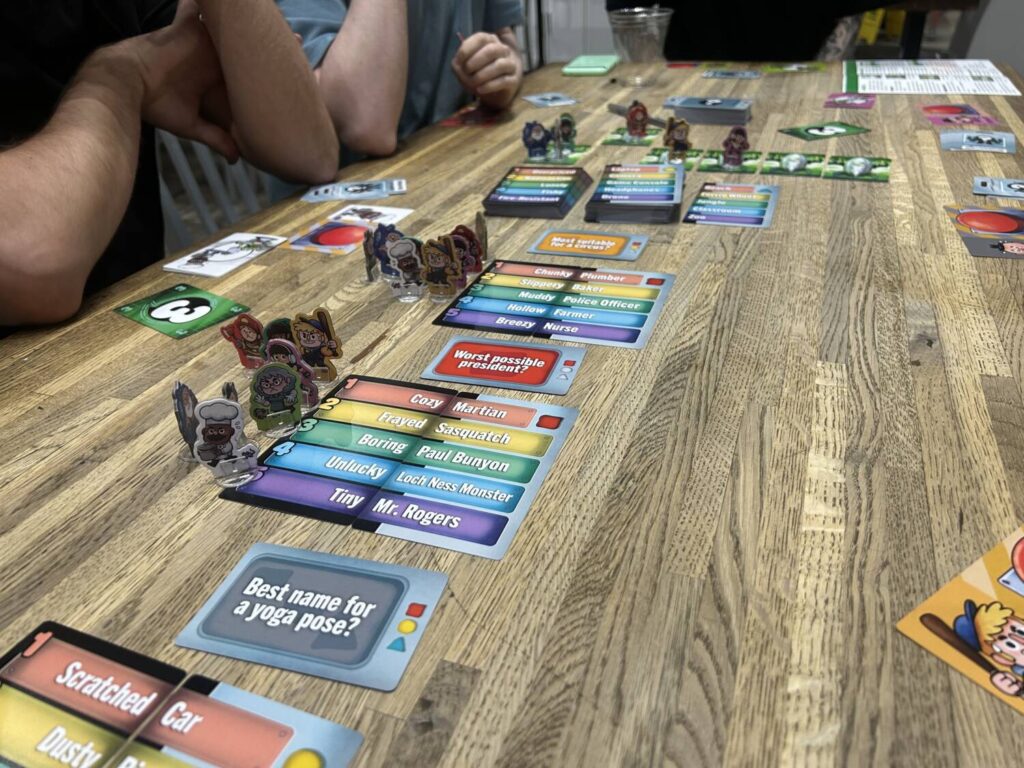
Players then choose an answer, from 1 to 5, and place one of their standees next to it. This is where the cards matter for the aliens. While human players are free to make any choice they want, the aliens have to pick an answer that corresponds to the number on one of their cards. This is intended, over the course of three questions, to provide players with a sense of distrust at repeated answers. “I don’t know about that, you picked number 2 last time.”
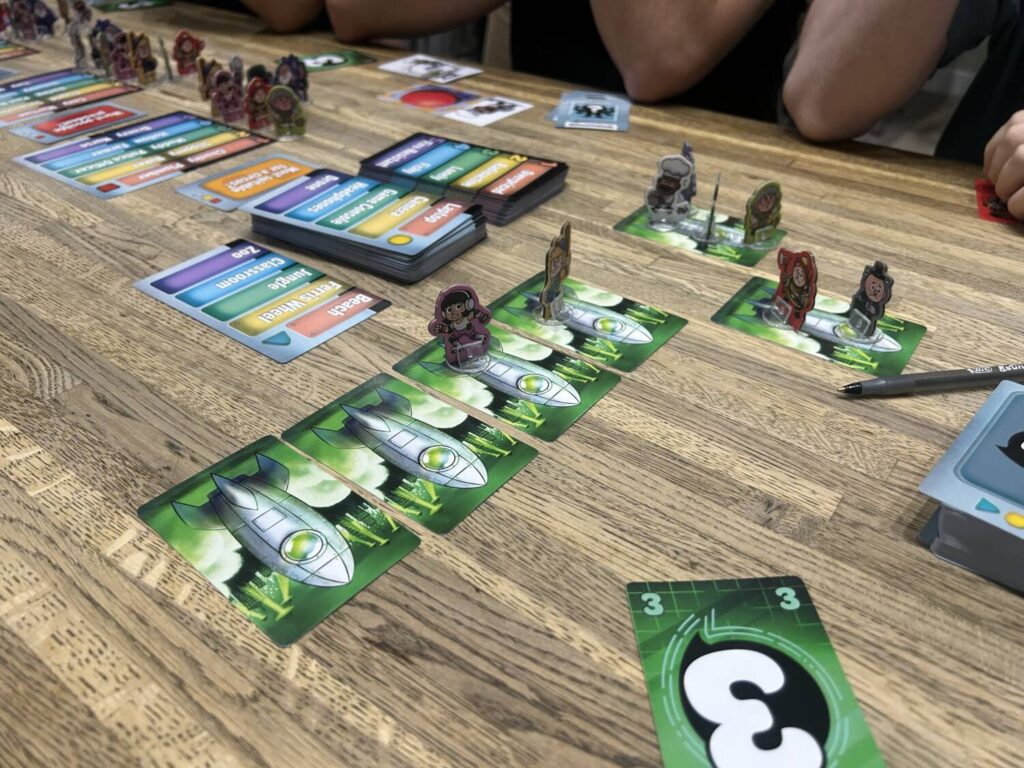
Once three questions have been answered, the evacuation phase begins. There are enough rocket cards on the table for the number of players, and every player has their own evacuation button. In real time, players can move from the starting rocket to any of the empty ones, so long as they remain empty. If you want to join an occupied rocket, you have to ask the permission of all the other players already safely ensconced inside. If at any point all the players inside a rocket press their buttons, that rocket takes off, and nobody else can join them.
If you’re a human, you win by being in the rocket (or one of the rockets) with the most humans and no aliens. If you’re an alien, you win by sharing your rocket with one or more humans. You need a snack, the manual explains. This means it is possible to end up with a game in which most of the players at the table win, which is nice.
Here’s where I struggle with Totally Human: I like the game this wants to be. I love it, in fact. Spend five or so minutes quietly sowing the seeds of mistrust, then uncork it all in a madcap burst of frenzied activity. That’s good. That’s comedy. I can see the cartoon in my mind’s eye.
Sadly, the game that Totally Human wants to be is a far cry from the game that it is. Nothing about it works consistently, but the whole collapses under the weight of a single and enormous issue: the answers to the questions are usually too bizarre to serve as a basis for deciding who to trust and who to doubt. It’s a bit like if there were exterior stakes to answering a prompt in Cards Against Humanity, and in many ways the experiences of both games end up being similar. It’s mostly boring, with the odd spot of color.
Because the answers are so silly—silly enough that I did make a point of playing this with younger kids to make sure they couldn’t unlock any latent potential, which they could not—the rest of the game means very little. The answer restrictions placed on aliens don’t do anything, because there are no good answers they’re being kept from. The negotiations surrounding evacuation don’t have enough information or doubt to fuel them. The only time the game has ever made an impression on a group was when there ended up being no aliens at all, and that would have been so much more satisfying if there had been any serious suspicion amongst the players to prove unfounded.
If there were clouds of even vague suspicions floating around, Totally Human would be a slam-dunk personal favorite. I don’t know how to fix it so there would be. I don’t design the things, I just take ‘em out for a few laps and tell you how they run. All I know is, the next time someone suggests Totally Human, I’ll be the first player to push the evacuation button, and I’ll be doing it before they even open the box.
Totally Human details
- Designer: Kasper Lapp
- Artists: Dominique Ferland
- Publishers: Bitewing Games
- Release Date: 2026
- Player count : 3 - 8
- Age range : 8+
- Time range : 15 minutes
- Mechanism(s): Hidden Roles, Negotiation, Traitor Game, Voting
- BGG Geek Rating: 7.10478 - converted to Meeple Mountain scale: 3.5.
- More articles about Totally Human.