
Disclosure: Meeple Mountain received a free copy of this product in exchange for an honest, unbiased review. This review is not intended to be an endorsement.
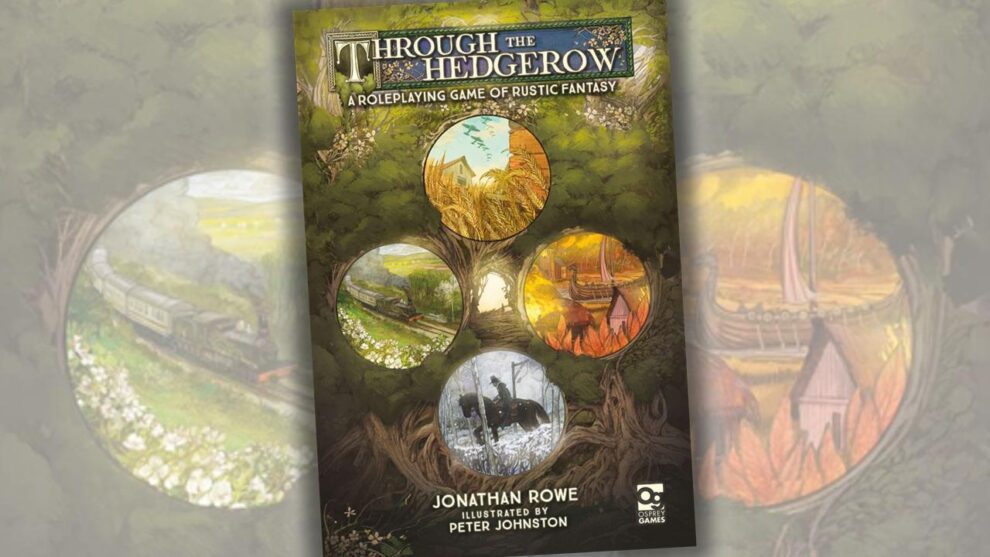
Presentation is half the battle when it comes to tabletop gaming; I never follow the adage of ‘don’t judge a book by its cover’ because it goes against the grain of any marketing textbook. Through the Hedgerow immediately draws attention thanks to its evocative, pseudo-woodcut artstyle, imparting its promise of rustic fantasy upon prospective readers. Will it stand the test of time like it requires of its characters? Let’s find out.
Through the Hedgerow Overview
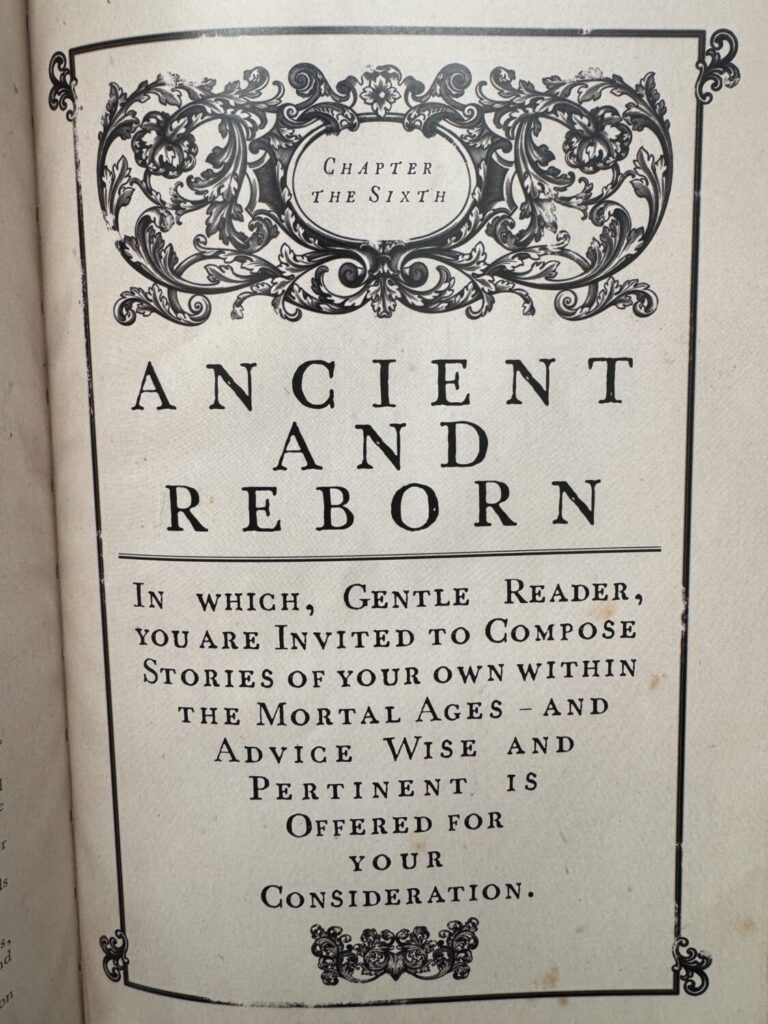
Information comes flying at you right from the jump when you open up Through the Hedgerow. Flavorful vignettes separate the mechanical rules so that you are constantly reminded of the setting. The game takes place over four Ages, starting with the Dark Ages and ending during WWII. Much of the game is centered around a singular location during one (or more) of these epochs, setting the table for your characters to watch how history and the magical world of Fay shape it.
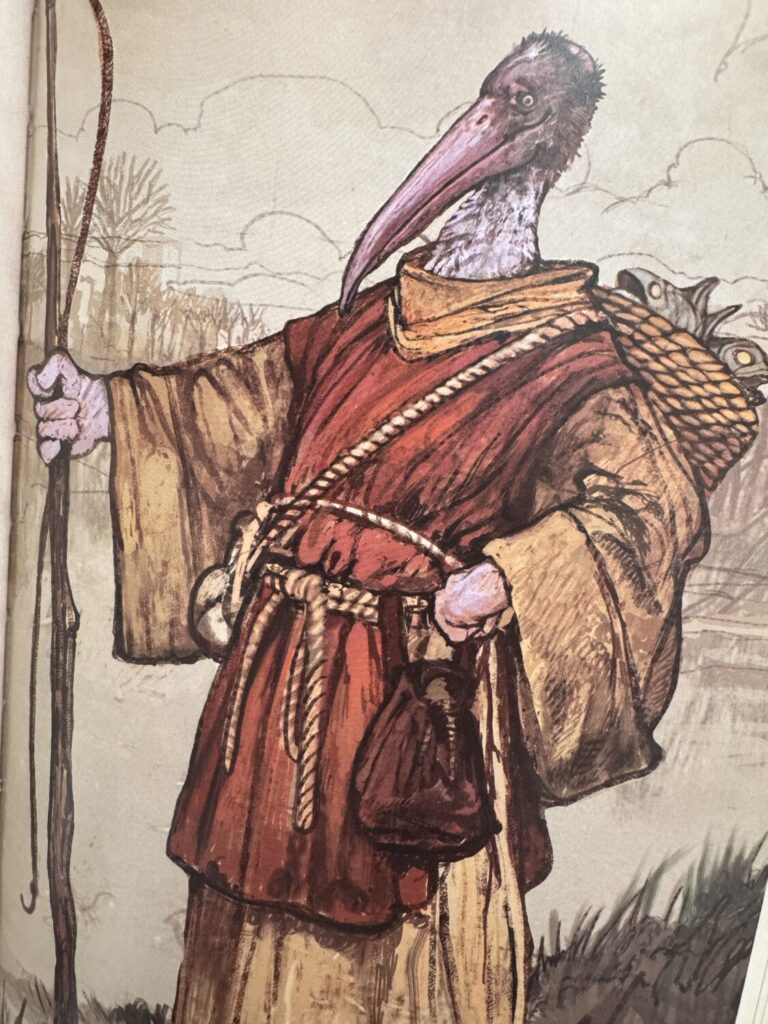
Players have an array of Gentries to choose from when building their character: the headless, turnip-wearing Buggeber Fay, scarecrow-adjacent Flayboglin Fay, Light-driven Heathen Clerks, champions of the Light known as Hodkins, the Mortal Motley entertainers, bird-faced Ouzels, humanoid spiders called Tomnoddins, Mortal children protected through innocence known as Waifs, or Warlockes, Mortal wizards who internally struggle with their magic.
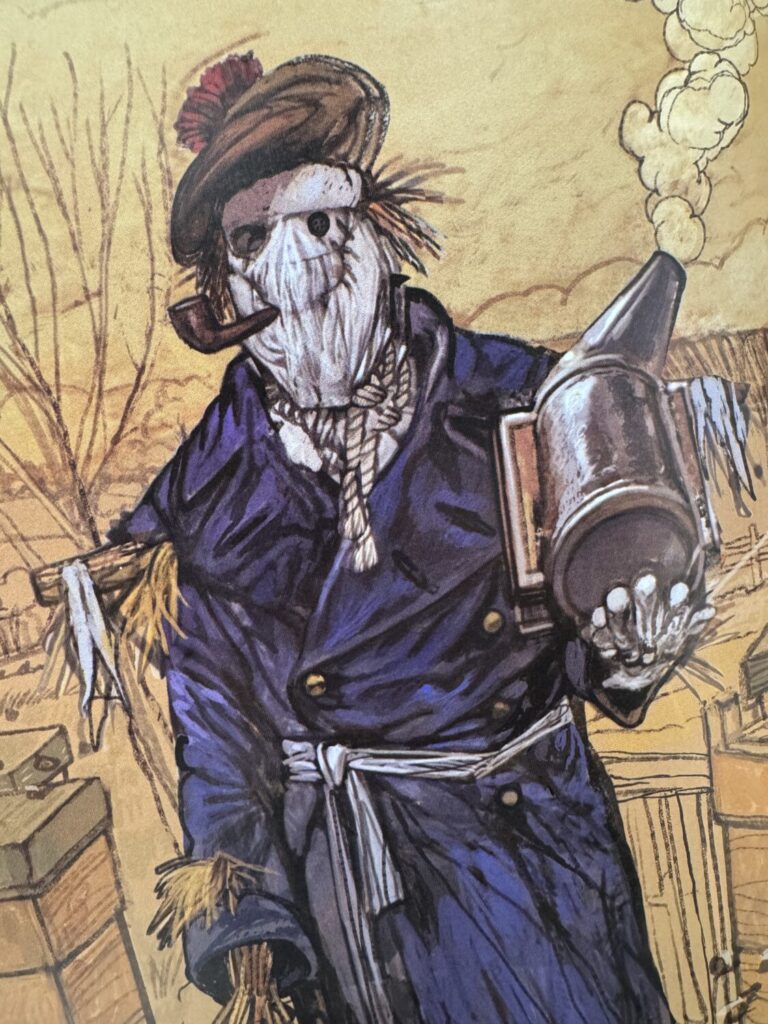
The game features major theming around the ephemeral concepts of Light versus Darkness, capitalizing on the classic tropes that revolve around the struggle. Players will also encounter agents of the Nemesis, an organization aligned with Darkness that can sense when the Briar Knights of Light appear in the mortal ages. There’s even a mechanical representation of the Nemesis threat in the form of a die that gets larger the longer each adventure goes.
Core gameplay involves the Judge (read: Gamemaster) setting up Checks and Challenges for the characters. Checks are shorter, one-time rolls to overcome an obstacle, while Challenges require multiple rolls to find out what happens to impact the Drama (read: story). In either case, the goal is to roll higher than the Peril die, but Challenges additionally have a Threat Level that indicates how many times the Peril die has to be overcome. The added involvement of Challenges generates degrees of success or failure where Checks are either a pass or a fail.
Through the Hedgerow also sets expectations early with the concept of Doom and the Doom die. This special die can be used for any Check or Challenge. If you roll its highest roll, the Doom die Advances — a four-sided (d4) increases to a six-sided (d6), for example — and if the die would ever Advance past a d12 then your Character has reached the end of the road. To soften the blow and breathe life into the world ala a rogue-like game, losing a Character offers a choice of a Consolation for the next one you build. This might be a Mythic Site at the place your Character met their Doom, a return of that Character as a minor Old God NPC, an extra Quality for your next Character, or the memory of your Character becomes a piece of Elder Lore in the world. Regardless of terminology, this approach keeps the memory of their exploits alive in one way or another.
Breaks in the action during an adventure, players partake in varying levels of Rest. Breathers only last a handful of minutes and regain some of their dice for later use. Respites are roughly a half hour and explicitly involve making tea and engaging in discussion along with additional benefits around performing a Glee for future bonuses, Foraging, or Scheming ahead of a future Challenge. The Nemesis also has potential to Advance unless players spend Free Respites to prevent it. Interludes are the longest form of rest and allow carrying out of a Chore but the Nemesis also always Advances. Time is always pressuring the Drama.
Before every Adventure, the Light provides a Conundrum, which is a device for the Judge to foreshadow and offer insights into what the upcoming adventure might entail. This is a precursor to locating a key NPC to guide them in their adventure and point them towards big confrontations. Again, these all have special names — head to the Armiger who directs them to the Rebus.
Through the Hedgerow: A Bramble Scramble
On its face, Through the Hedgerow seems like a cozy time-travel jaunt through English history, especially since taking tea is a poignant part of every adventure. Coupled with the gorgeous art of Peter Johnston, I’m reminded of games like Wanderhome, the Root RPG, or even something like The Quiet Year. Dispatch a couple of foes, solve a problem, and be back before the cakes have had proper time to cool.
As you get into the rules, however, it feels more like somebody has overmixed the batter and kept adding flour with how deceptively dense the game is. Everything has its own proper name, so you had better like capital letters. It’s very difficult to read initially — and difficult to write the overview to explain the terminology — and leads to a constant state of flipping back and forth to remind yourself of what everything stands for. Plus, the dice are all abbreviated. Take this quote from the Example of Play:
“Karl rolls a 3. He loses 1 RSV and suffers the Hazard — he is now WQd4.”
Whenever this happens in a system, I find there to be a necessary balance between absorption and world-building. Having unique names for everything does wonders for making a world feel immersive, but in complex systems you can no longer rely on easy adoption. The building blocks and shared language between games create shortcuts for experienced players to fasttrack their understanding. Even with my exposure to lots of different games, I was stymied by the language in the book.
Don’t get me wrong — the game oozes with passion and designer Jonathan Rowe has created a unique game that is thematically beautiful. The Fay creatures are a delicate combination of creepy and intriguing, the time travel aspect opens the doors for near unlimited shenanigans reminiscent of a game like Timewatch, and the incorporation of Glamours, Glees, and English folklore makes the world feel like something that stands on its own.
But the weight of the game feels at odds with the world. Take the generation of a Challenge’s Scope. As the Judge, I would set the Threat Level and the Peril Die. Now, assuming there aren’t any Hazards or Enemy Humours (modifiers), now I can adjust based on the Scope. I have to go over to a table to match up the number of people in the party compared to the general size of the area in question, and use that to adjust the Threat Level accordingly. It makes generation of Challenges on the fly prohibitively difficult and a much more involved process than a ‘rustic fantasy’ game should.
If you like sinking your teeth into rules and terminology, Through the Hedgerow offers that experience on a fine china tea saucer. I would like to say there is flexibility to simplify some of the rules to adapt to the level of crunch that you prefer, but everything is so thoughtfully and intricately intertwined that I can’t say that it’s easy with any sort of confidence.
While the Briar Knights set out to solve their Conundrum, Through the Hedgerow wrestles with a conundrum of its own identity despite the clear love and thought that’s gone into its pages.