Disclosure: Meeple Mountain received a free copy of this product in exchange for an honest, unbiased review. This review is not intended to be an endorsement.
Threaded is a game about sewing Bargello-patterned tapestries. Well, sort of. You are using cubes as thread, after all. You may not come out of this game with a new afghan, but you will come out of it with your brain slightly aching from the puzzle you must solve.
I grew up in the 1970’s, seeing these groovy geometric patterns everywhere. My grandmother was a whiz with a needle and made all kinds of textiles featuring these stripy, blazing patterns, but I just figured it was a trend of the times. Little did I know that they were called Bargello, or that their origin dates back to the 17th century in the Bargello Palace in Florence, Italy. Right out of the gate, Threaded taught me something.
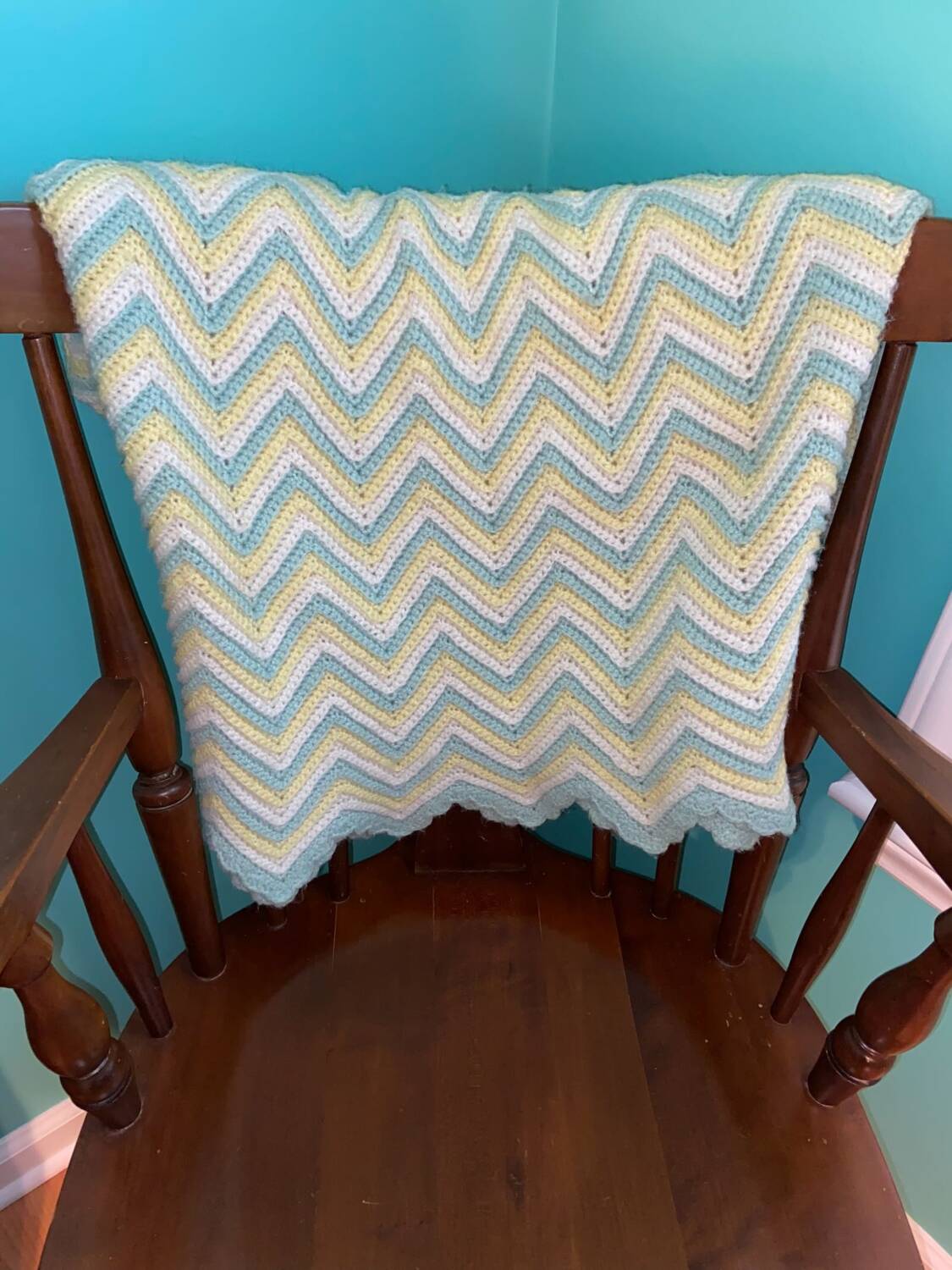
Between having a strong nostalgic pull toward Bargello patterns and enjoying all kinds of needlecraft myself, it was a no-brainer for me to agree to review Threaded. It doesn’t hurt that other needlecraft-themed games like Patchwork, Knitting Circle, and Calico have been big hits in my house. So does Threaded compete? Let’s see.
As I was reading the instructions, Threaded reminded me of Istanbul, and not in a bad way. They share a similar idea of sending your assistants out into the marketplace to accomplish actions, while frustrating you because you don’t have enough assistants to do everything you need to do. They diverge, however, in the puzzle you must solve. Istanbul requires you to carefully plan a path through the marketplace so you can reclaim your assistants and keep progressing in the game. Threaded asks you to collect and convert resources into Tapestries which score victory points.
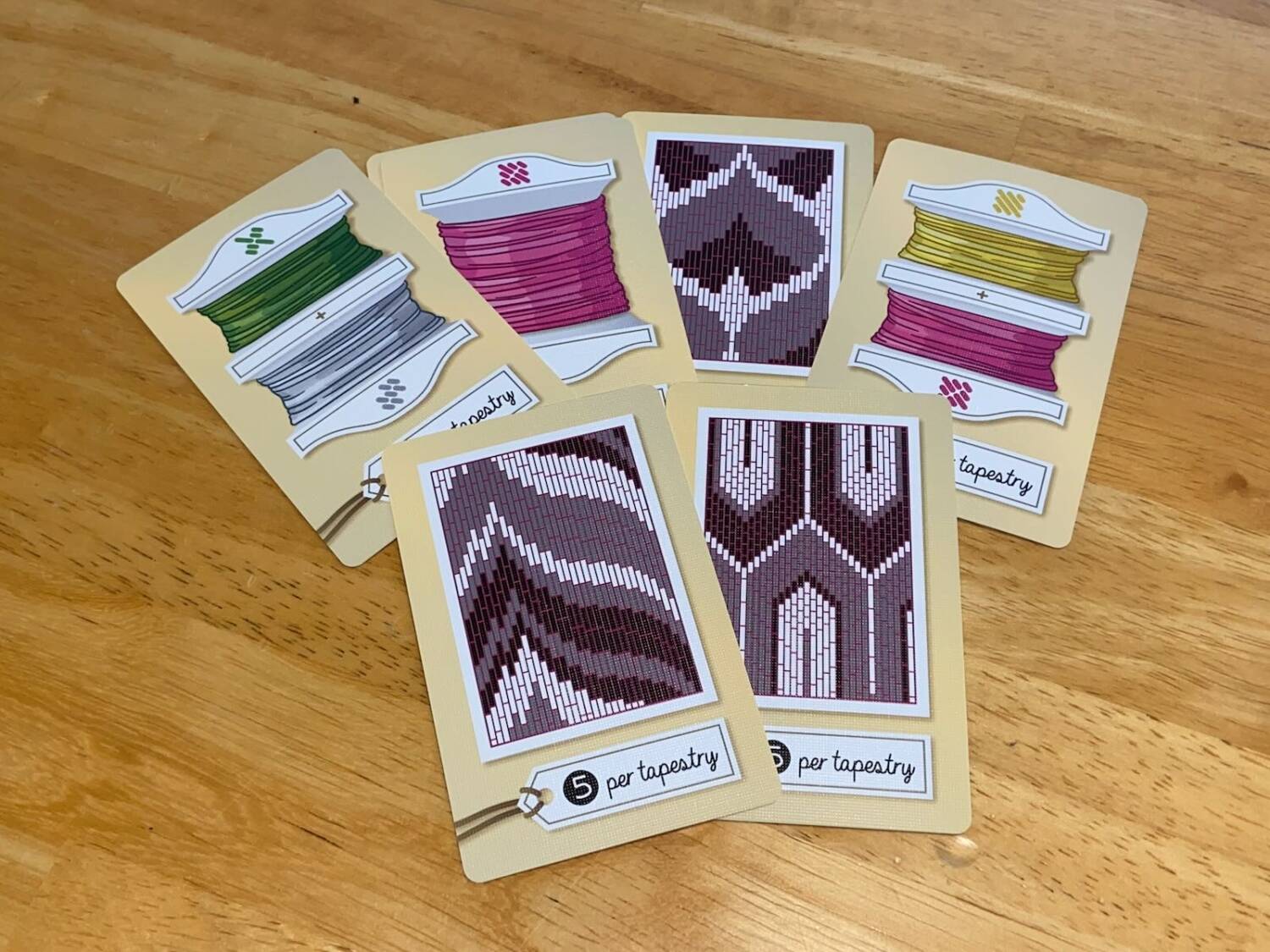
Simple, right? Wrong. If all you had to do was collect Threads and sew up your Tapestries, this wouldn’t be much of a game. The trick here is that you can collect all the Tapestry cards you want, and you can turn in the required Threads to construct them, but if you don’t have the matching Commission cards in your hand, those Tapestries won’t score at the end of the game. Then you’re stuck with a lot of pretty artwork that does nothing!
As I played through this game and unpacked the puzzle before me, I found myself lighting up. This is exactly the sort of game that my brain adores. Frustrating without being overly punishing, a dash of luck to keep things feeling fair, and a puzzle that requires me to think in several directions at once.
Each round is played in three phases, and the game ends after one player completes their fifth Tapestry and the final Visit phase is completed. The first two phases are where the game happens, as the last phase is simply restocking all the supplies for the next round. Let’s take a look at how these phases construct the puzzle you’ll be solving.
Let’s Go Shopping!
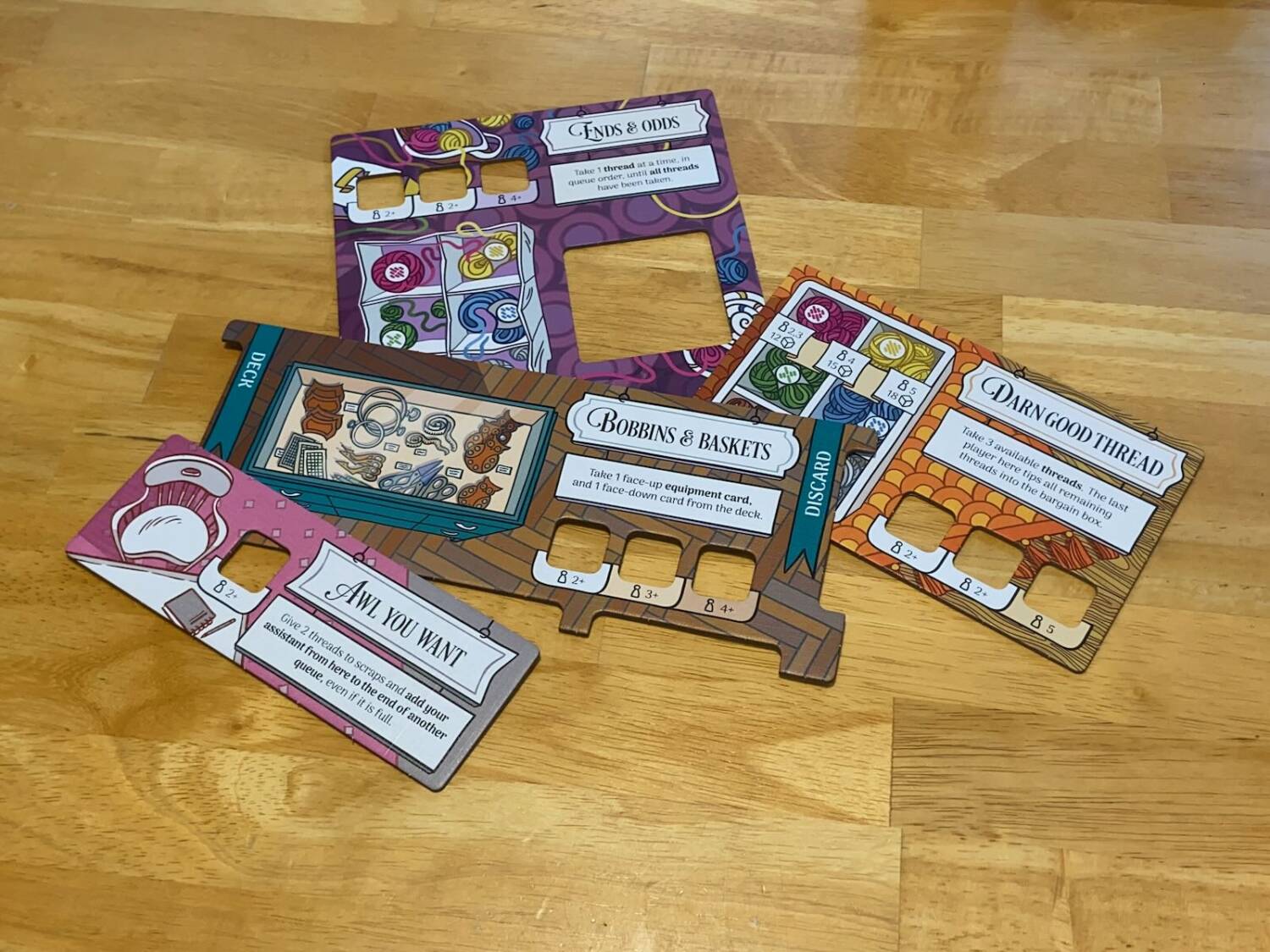
In the first phase (called Plan), players take turns sending their assistants to the various shops. In order to occupy a shop, there must be an available spot for your assistant, or you must have visited “Awl You Want” which will allow you to place an assistant in a full queue. You can have multiple assistants visit the same shop, as long as there is room. The first player to place an assistant gets to go first during the Visit phase, and so will get first choice of any actions or materials on offer.
After all players have placed their assistants, each shop resolves during the Visit phase. Shops are resolved in alphabetical order, beginning with Awl You Want and ending with Finishes. If there are multiple assistants at a shop, they resolve from left to right, first placement to last.
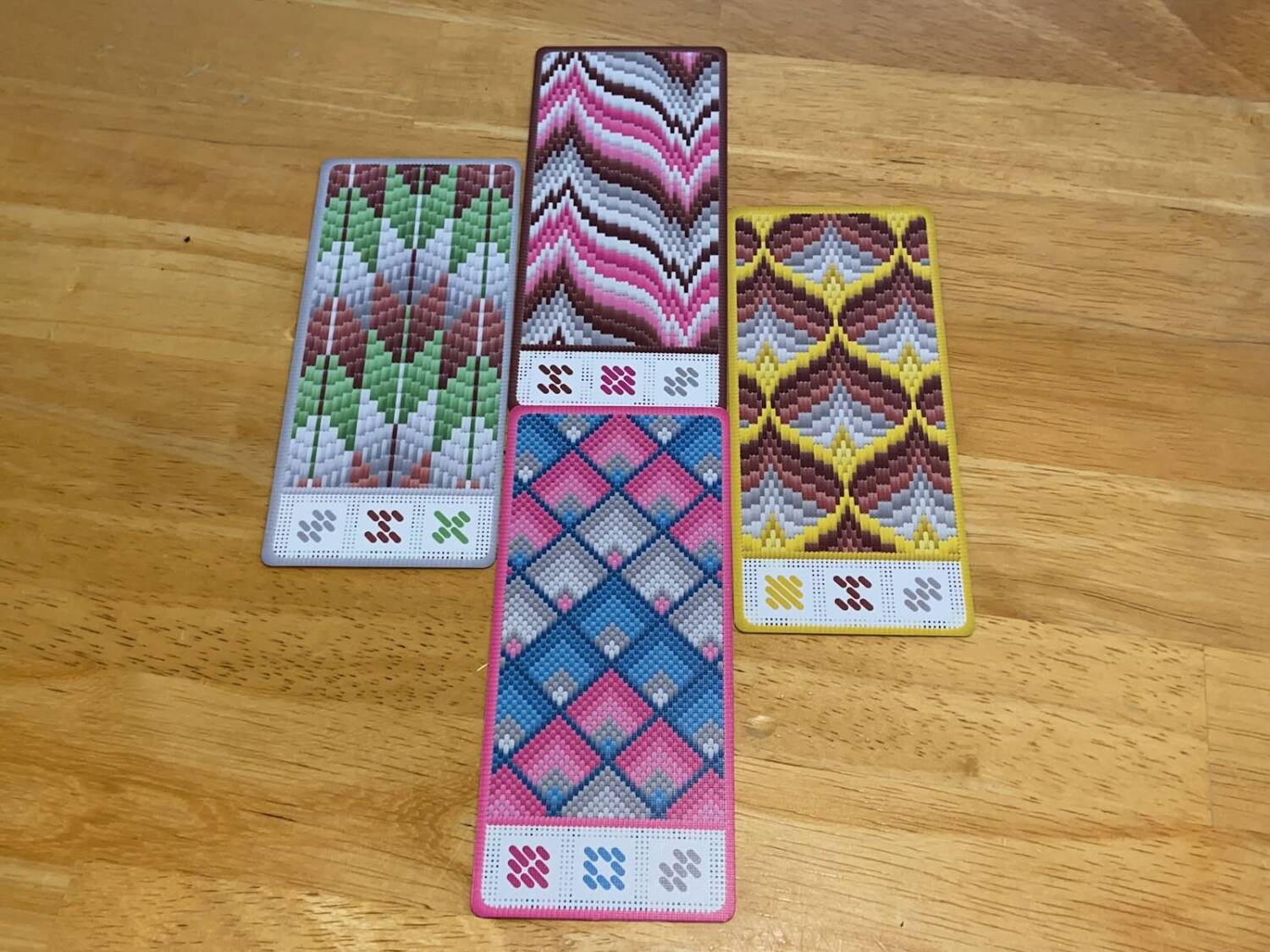
The shops are where you gather Threads, Equipment, Commissions and Tapestries. You need a successful combination of Commissions and Tapestries in order to score at the end of the game. Commission cards show either a pattern or thread color(s), as well as a point value. Each Tapestry in your hand will score those points if it matches a pattern or thread color(s) shown on a Commission card in your hand. The highest scores happen when you have Commissions that do double duty, scoring on multiple Tapestries in your hand.
The trick here is that you can only hold four Commission cards at one time. You can’t just scoop up cards and hang on to them hoping for a matching Tapestry to become available. And cards aren’t easy to come by. If you need cards, you must send an assistant to the Custom Creations shop, meaning that assistant isn’t available to do other things.
Even if you get Commission cards that seem promising to score a Tapestry, you have to have the Threads to make the Tapestry. Tapestries show three thread colors, and you must acquire all three in order to score the card.
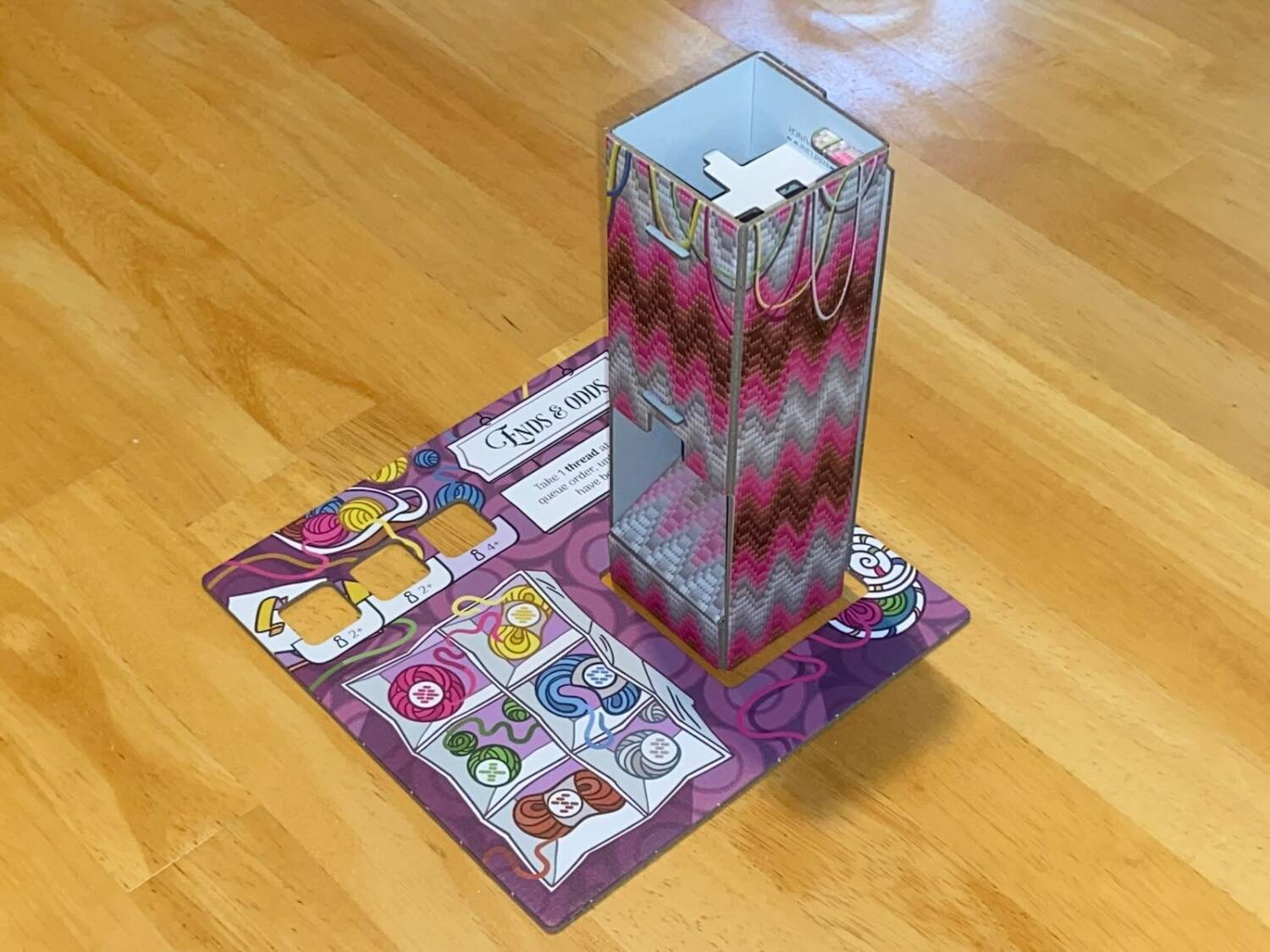
Threads are gained either by placing an assistant at Darn Good Thread, by claiming scraps from Finishes, or hoping that the Bargain Box cube tower at Ends & Odds spits out something you need. In either case, you aren’t guaranteed to get what you need because these are all randomly stocked either by other players’ castoffs, or by random draw. Plus, if you’re not first in line at the shop, you don’t get the first pick of what is available. As with the Commission cards, you are limited in the number of threads you can have, so you can’t just hoard thread.
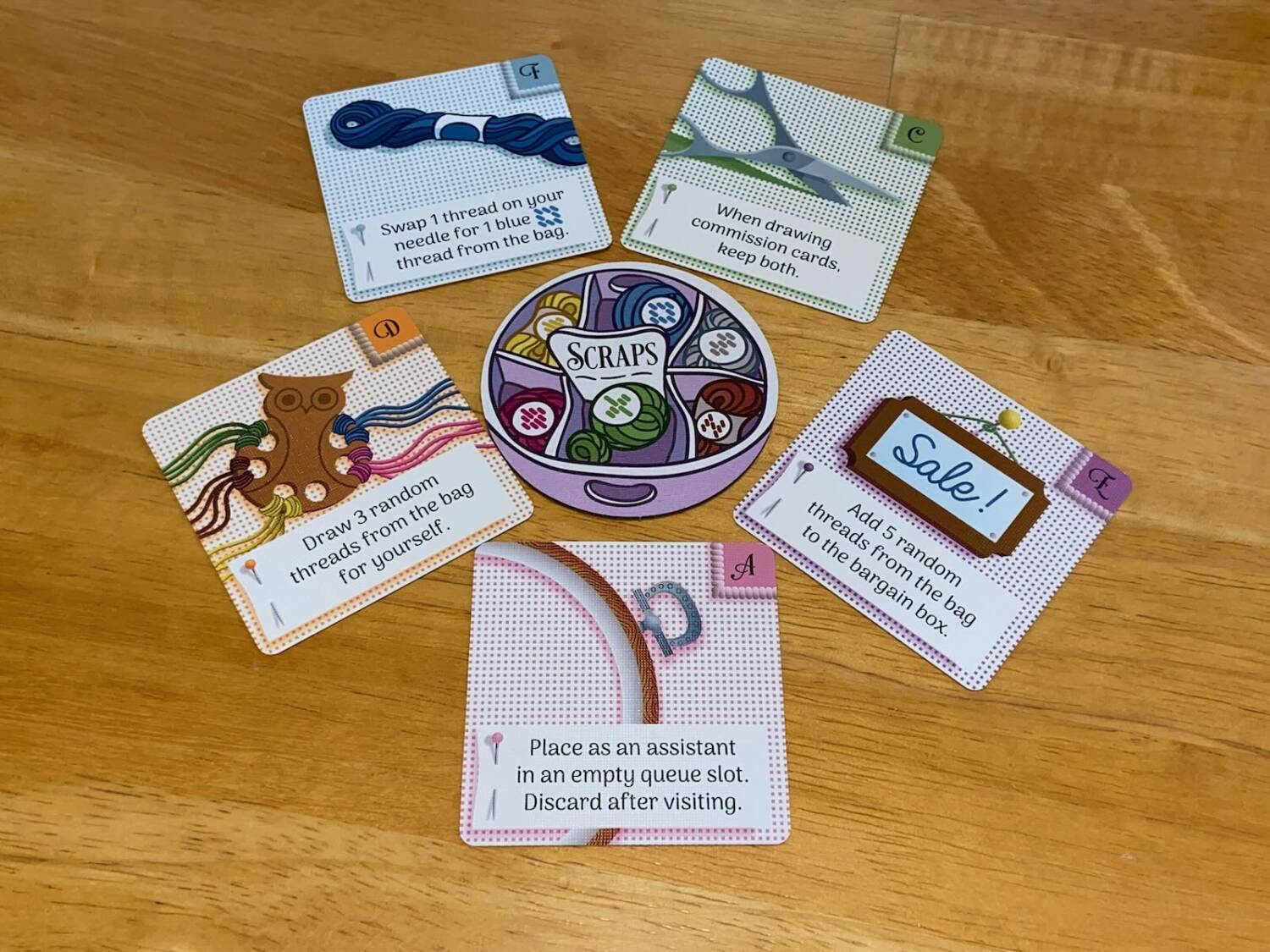
While all of this is a lot and seems very tight (and it is!), you do get a little help in the game. If you visit Bobbins and Baskets, you can claim Equipment cards. Equipment lets you break or stretch the rules of the game in some way. Keeping with the scarcity of the game, you can only have two cards at one time, and they are all single-use. And, of course, you have to use an assistant to get them, so you have to decide how badly you need help.
Wait. There’s Something Needling the Back of My Brain
Whew. See all the puzzle pieces you’re trying to slot together? By this point my brain was already burning, but when we got to the Needle, my brain really exploded. This is really the slick trick of the game and what differentiates it from other worker placement/resource conversion games.
The Needle is an open slot on your personal Studio board that can hold six Thread cubes. In order to complete a Tapestry, you must move the matching thread from your Needle to the Tapestry in the order that the thread colors are shown on the card. However, you can only move thread off the end of your Needle, not from the middle.
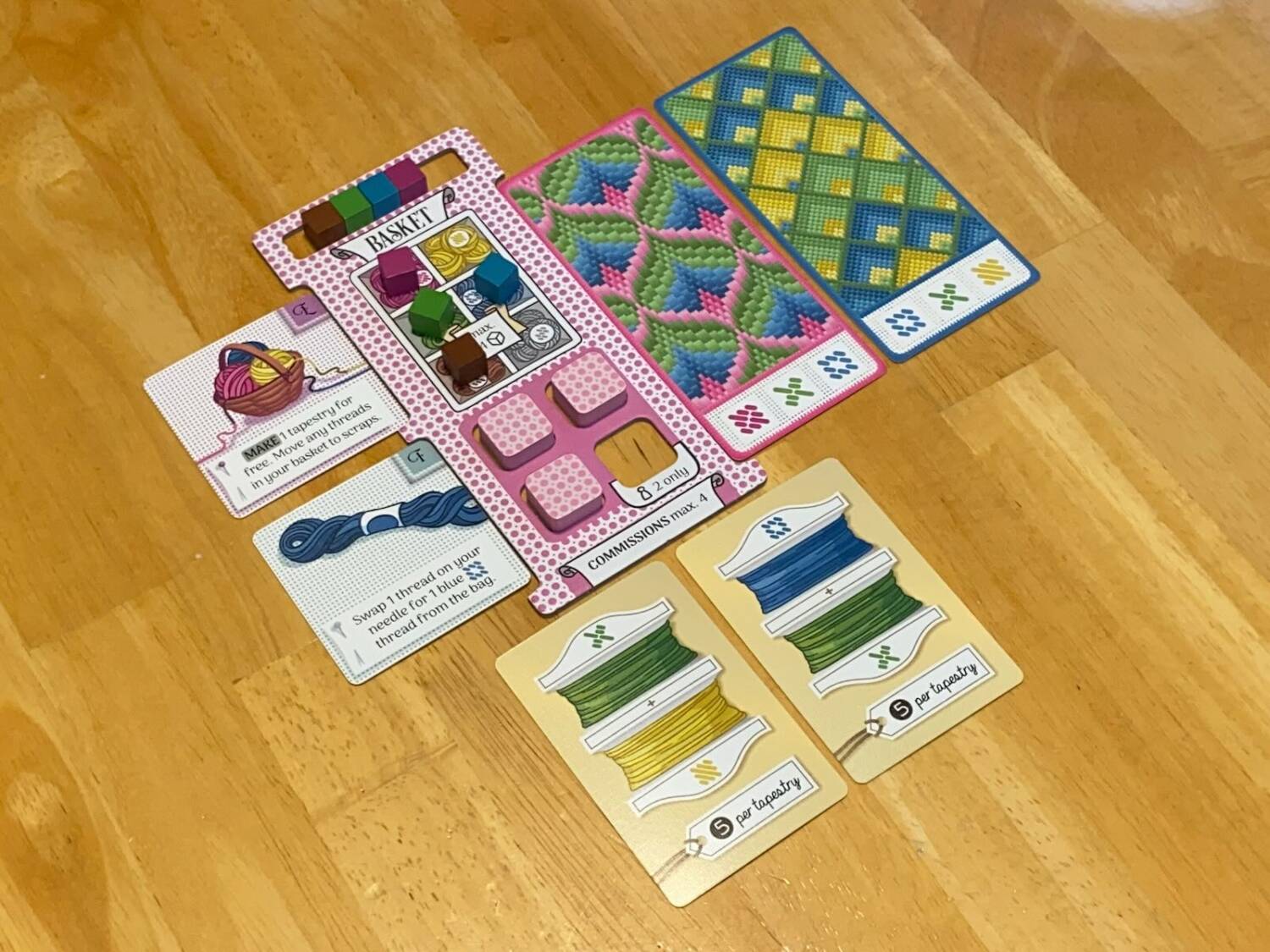
So if you have all six slots on your Needle filled and you want to complete a Tapestry that requires, from left to right, brown, blue and silver thread, you must have those colors lined up on your Needle so that they come off in that exact order, beginning with the end of your Needle. It does you no good if you have those colors, but they aren’t in the exact order, or if they are hemmed in by other colors.
As with everything in this game, loading your Needle isn’t a simple thing. You can only move threads when you gain new Thread, or if you get an Equipment card that allows you to do so. You can move Thread from your Basket, where you’re only allowed to keep four thread cubes at a time, to your Needle. Or you can move Thread from your Basket to Scraps to make room for more.
Once a Thread is on your Needle, its position is fixed. The only way to get it off or move it further to the left or right is to either spend it to construct a Tapestry, to push it off by using new Thread to push cubes off either end of your full Needle, or to give Thread to Scraps when you visit Finishes. And even then, any you give away must come from the end of your Needle. Get this wrong and you could end up wasting turns trying to get your Needle in the proper order.
Think You’re Ready to Make a Tapestry?
So after all of this, you think you’re ready to complete a Tapestry? Not so fast. You have to send an assistant to Finishes in order to do so. Finishes offers four actions, and you can choose two. You can bring a Tapestry card into your hand, make a Tapestry by spending the matching Threads from your Needle, refresh the entire Tapestry display by giving Thread to Scraps, or give a Thread to Scraps in exchange for any other three Threads in Scraps.
If you choose to make a Tapestry, you may also have to pay for it. The Tapestry card that’s immediately next to the Finishes board in the display can be taken for free. But if you want one further down the line, you have to pay one thread for each card you skip.
Here’s where your opponents can ruin all of your careful planning. As you’re loading your Needle, it becomes obvious which Tapestry you’re likely targeting. If an opponent is targeting the same one, it becomes a race to gather the required resources and secure the first spot at Finishes in order to claim the card. An aggressive opponent may take the card before they’re fully ready to make it, just to keep you from getting there first. (This may or may not work out for them if they don’t manage to finish gathering the needed resources. You’re still out of luck regardless; you just get to snicker at the end of the game if they can’t pull it off.)
And this hammers home the point that this is a game about being efficient and strategically planning your moves, yes, but also being willing to take some risks. You can’t visit every shop each round, and when you do visit a shop, you may not get exactly what you need. You may have to be willing to take Tapestries that don’t match your current Commissions and hope that you can make something work later on. Or vice versa. You may have to give up a few Threads that you might need later, hoping to get more Thread that you can use right now. Getting too attached to one plan can be fatal because if that plan doesn’t work and you fall behind, it can be very difficult to recover. Juggling multiple possibilities and pulling the trigger at the right moment is key.
Even if you get to five completed Tapestries and force the end of the game, you haven’t necessarily won. Scores are calculated by multiplying the value of your Commission cards by the number of Tapestries you have in hand that match them. Plus, you get a few extra points for extra Thread remaining on your Studio. If you don’t have the cards needed to score high (remember I mentioned that the best hope is to get Commissions that can score on multiple Tapestries), you can be left with a lot of Tapestries and a low score.
There is luck in Threaded, so if you prefer a luck-free experience, you’ve been warned. You have very little control over which Threads become available at any of the shops. Neither do you control which Tapestries or Commission cards are available. Equipment can possibly help you out here, but you also need the right Equipment cards to turn up. This means that you may end up with Commissions that don’t match any available Tapestries, or that the Threads you need just aren’t showing up. This can be frustrating, but the nature of this game is that you have to make the most out of what you do get. The luck feels fair for all players. Maybe we’re all just out of good karma, but we never had a game where someone had everything break their way. We all took our lumps from Lady Luck.
Component Praise Incoming
As far as the components are concerned, they’re very good. (I’m gonna gush a little in this section.) The boards are thick and durable. I had my doubts when I saw the Bargain Box cube tower, but it, too, is thick and there’s a snug compartment where it fits fully assembled in the box insert. You aren’t assembling and reassembling it every game, and it’s not getting beaten up by the boards when you’re carrying the game around, so it should last a long time.
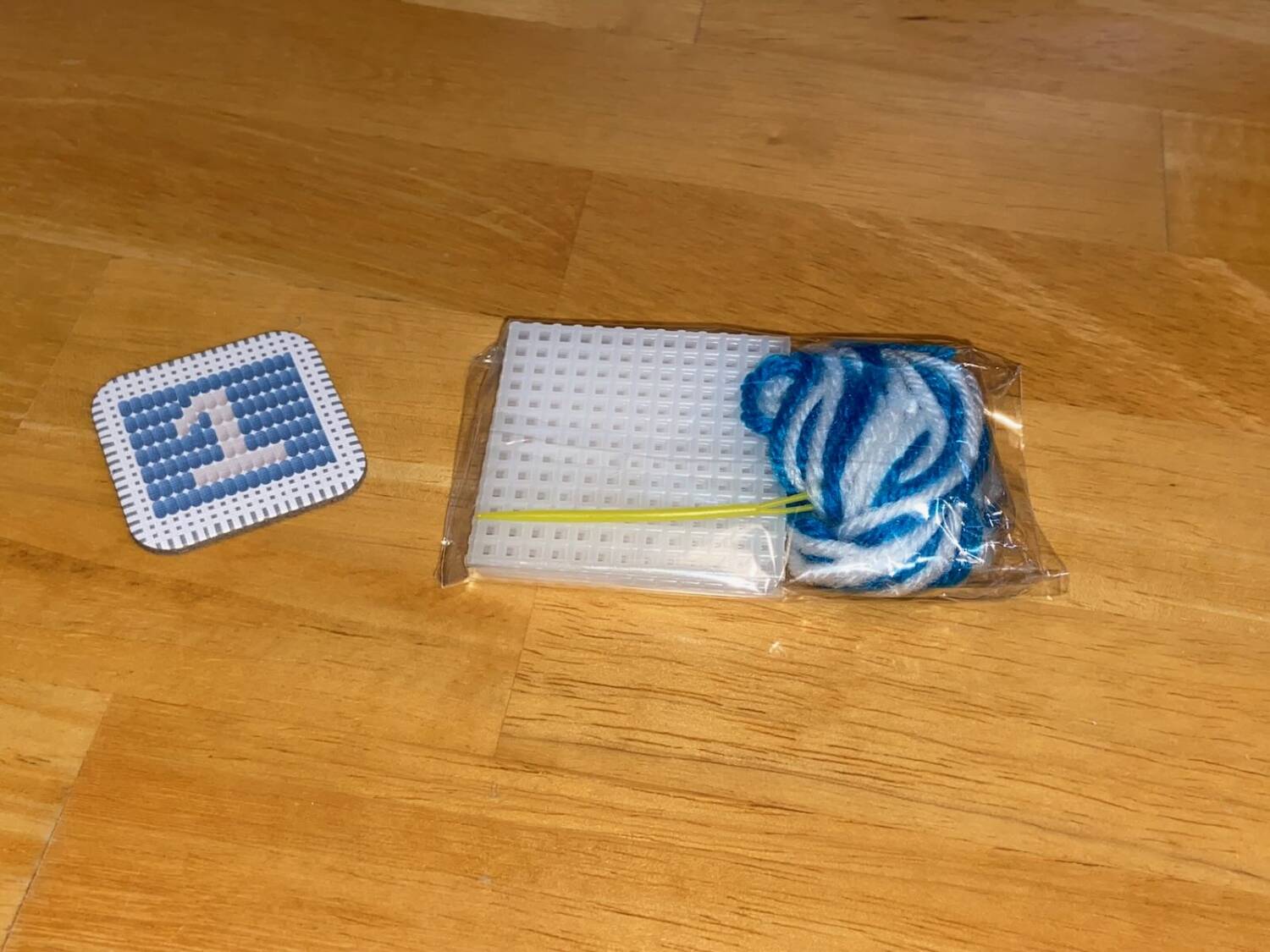
Four praise-worthy things really stand out about the components. First, you’re given a cardboard first player marker, but some thread and a plastic canvas are also included so you can sew your own. How fun and fitting for a sewing game!
Second, they give you a ton of stickers that you can put on the thread cubes. Honestly, my first thought upon seeing all those tiny stickers was, “Seriously?” But then I realized they are purely optional. I believe they serve as a way of double-coding the cubes for colorblind players, so if you don’t need them, you don’t have to. My clumsy fingers are happy! It’s a nice touch, though.
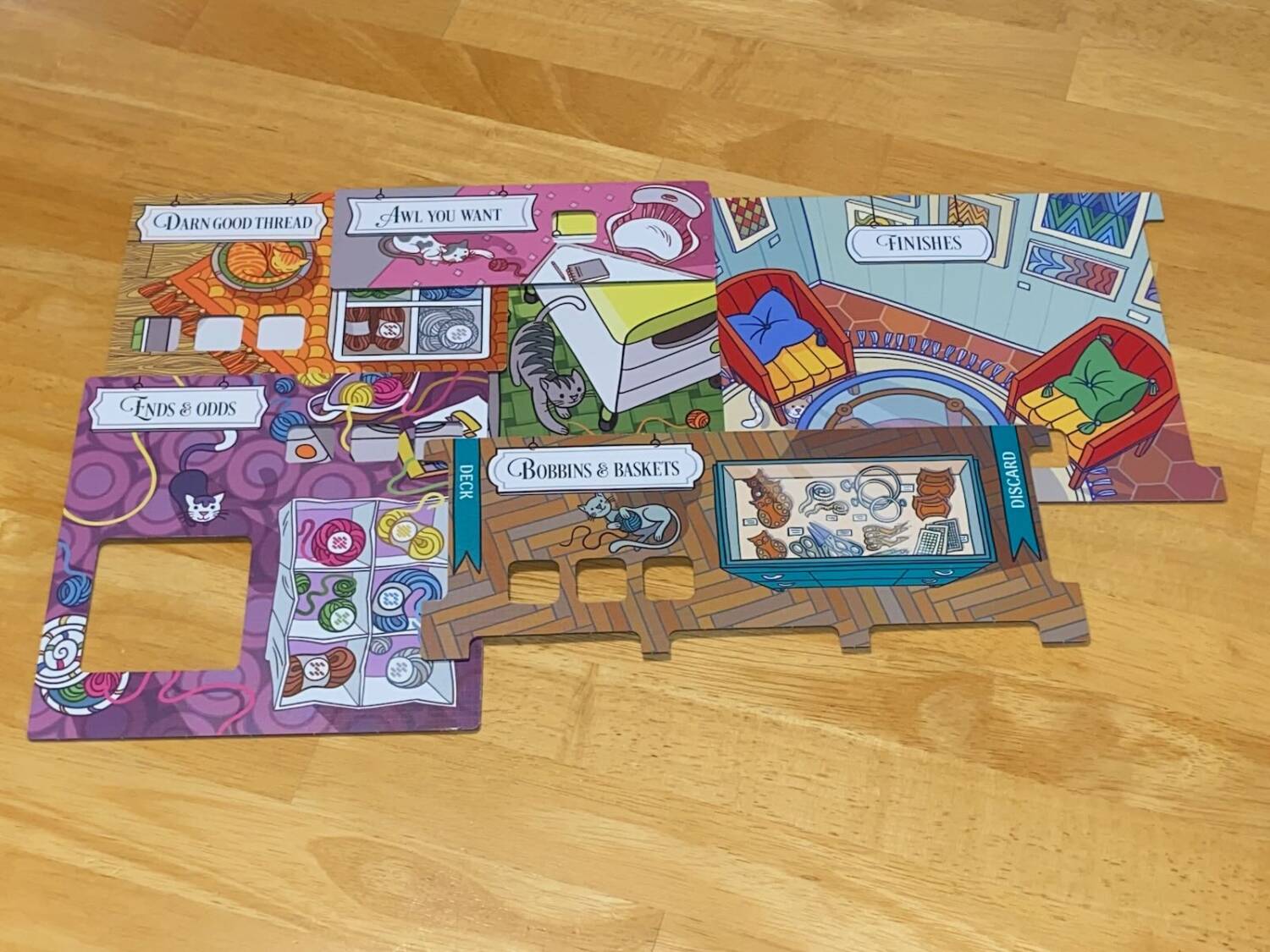
Third, everything in this game has its place. There are a lot of parts to put out on the table, so it is a bit of a table hog. However, it’s not a messy, fiddly table hog. The Commission card deck goes on the Custom Creations shop board, and there are cutouts on their respective shops for the Equipment and Tapestry cards. Threads go on the relevant shops or on the Scraps tile. Your Studio board has cutouts for your assistants, as well as cutouts for your Equipment and Tapestry cards. There’s also a space for your Commission cards. The Ends & Odds shop board has a cutout in which to place the cube tower, and when cubes come out, they largely land on the shop board.
Fourth, kudos to the rulebook writers as well as the game designers. The rulebook is one of the clearest and cleanest I’ve ever seen. It’s laid out well with lots of pictures to illustrate the actions. It’s easy on the eyes, yet thorough, and makes looking up a particular point very easy. Which is kind of sad, because once you’ve read through it once, you’ll probably never need to reference it again.
Everything is explained on the components themselves. The shop boards clearly list the actions available. The assistant spaces available at each shop per player count are clearly marked (and you’re given blockers to block off any extra spaces so you don’t inadvertently screw up). Your personal Studio board reminds you to keep a maximum of four commission cards and four threads on it. The Needle slot is sized for exactly six cubes. The Equipment cards clearly reference at which shop you can use them. The only time we needed to reference the rulebook after the first read-through was to remind ourselves of a few points during setup for the next game.
(Easter egg alert: If you get so good at the game that you no longer need the shop board reminder text, you can flip the boards over and play with the side featuring the cute cats.)
Let’s Sew This Review Up
All in all, it’s obvious that a lot of thought and care went into not just the mechanics of the game, but the overall player experience. The theme is supposed to be cozy and calming, and everything about the presentation supports that feeling. There’s nothing about the rules or components that stresses me out. That’s something I appreciate more and more these days, as games get more unwieldy and the constant churn seems to result in more half-baked games coming to market.
Threaded scales well at different player counts (although we did not get to play with the maximum of five) because you get extra assistants and more open spaces on the shop boards with more players. Still not enough to make it easy, though, because resources remain just as scarce.
Despite all the thinking and planning involved in order to play well, Threaded remains a medium-light game that’s suitable for families, inexperienced gamers, and experienced gamers alike. Everything is so well explained and proceeds so logically that a gaming novice can understand the requirements, while experienced gamers can try to wring every bit of efficiency out of the puzzle. The luck means that both audiences will probably have a decent chance of winning.
So what’s the verdict here? I really enjoy Threaded, and it has currently moved into my Top 10. It hits the sweet spot for me of presenting a challenging puzzle without being too long or difficult. It never feels like it drags, even though there’s a lot to work through each round. Things move along at a brisk pace, and with two players we can finish a game in thirty minutes. That’s a good length for playing a couple of games back to back, or being able to fit in a different game on a weeknight. Because it’s so well designed, it’s the kind of game I can come back to after some time away and still remember the rules.
I can see that people who want absolute control, or a more punishing style of game, won’t be happy with Threaded. I am not those people, though, so hand over that needle and those cubes, and I’ll happily make tapestries any time.