Disclosure: Meeple Mountain received a free copy of this product in exchange for an honest, unbiased review. This review is not intended to be an endorsement.
There are times, engaging with this hobby of games, when one is confronted with the very real possibility, regardless of one’s self-esteem, that one is in fact stumbling through this harrowing and at times magnificent experience we call life with a dearth of cognitive capacity.
Put another way, there are games that make you wonder, “Am I a dumdum?”
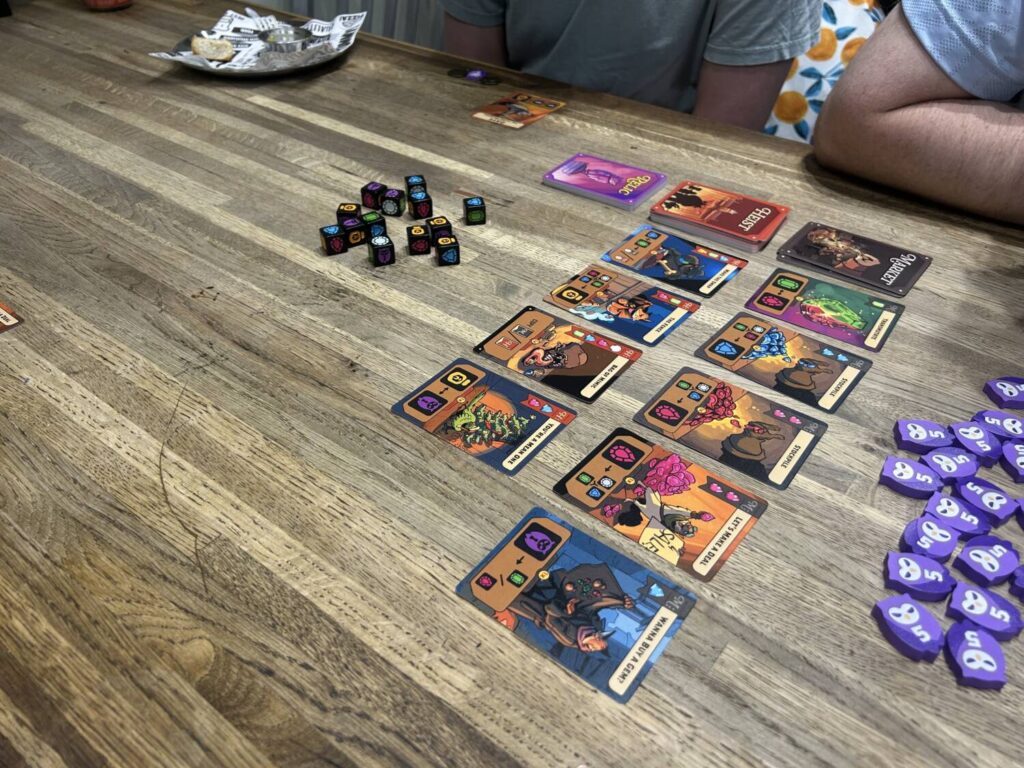 Thief’s Market, from publisher PickPocket Games and designer Dave Chalker, is just such a game. This is surprising for a few reasons, not least of which is because Thief’s Market is, mechanically, a breeze. It’s a challenge to think of something simpler without tipping over into party games. Each round is divided into two phases: grab some loot, then spend said loot on resource conversion powers and points until someone wins. This is not, in theory, the stuff analytical types tend to lose much sleep over.
The starting player rolls all the dice, which are then placed in the middle of the table along with the first player token. Players take turns drafting dice by either staking a claim from that middle or picking the pocket of a fellow player. If you take from the middle, you can take any number of dice you want. If you take from another player, you take all their dice, save for one of your choice, which gets put back in the middle. Round and round this process goes until at last every player has something in front of them.
When I read the rulebook, my eyes shone like the facets of a well-cut sapphire. Chalker’s variation on I Split, You Choose is exactly the kind of thing I enjoy. It creates a dynamic in which nobody wins, one where the players who take the most coveted resources first will almost certainly not end up with them, one in which the greedy players end up with very little. It should, in theory, generate the sort of raucous social atmosphere that I love.
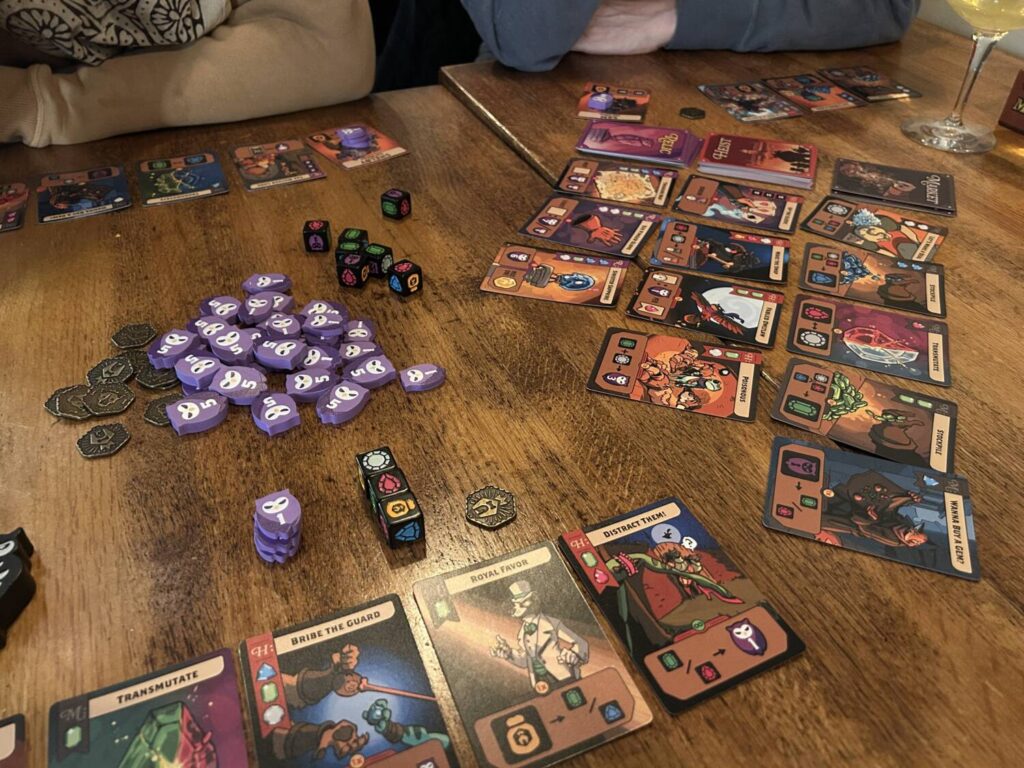
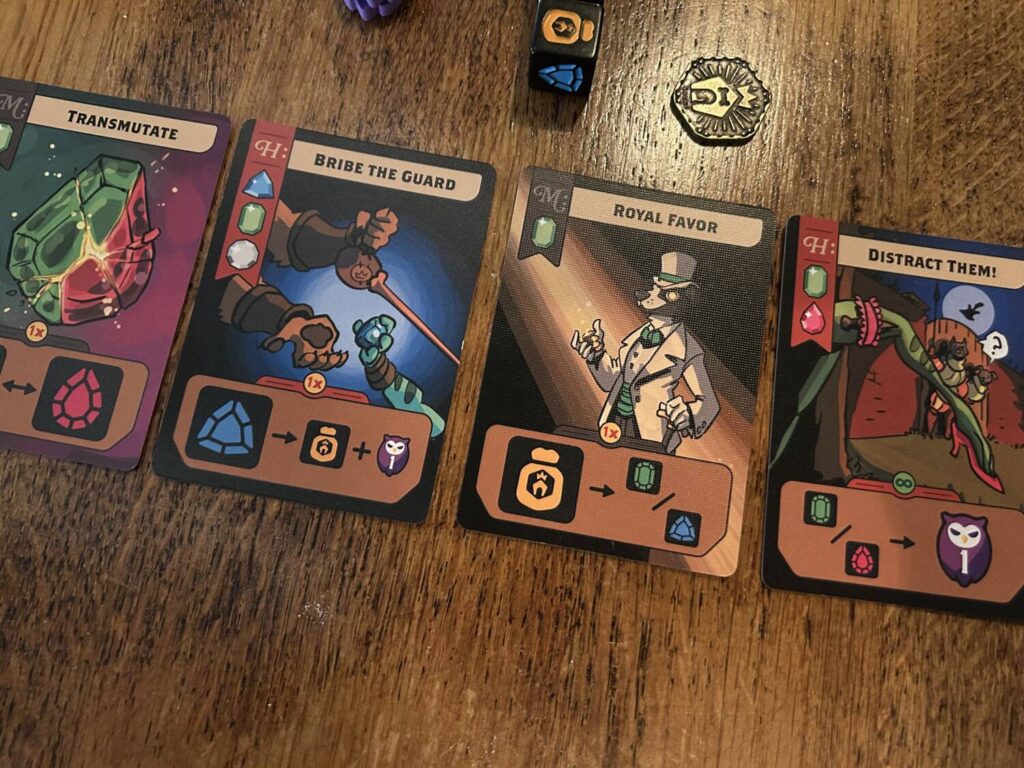
Would that it were so simple. The reality is that Thief’s Market feels a bit like getting mugged by a copy of Splendor high on amphetamines. The first round or two move along at a good clip, with everyone trying to eke out some path forward through the card market, some way of getting an engine going that will give them a leg up for the rest of the game. The cards you can buy are not in and of themselves particularly complicated, allowing you to do things like turn an emerald into a sapphire or vice versa, or change a diamond into any other gem, but the accumulation of these cards, combined with the haphazard method of resource collection? Bizarrely dense.
It’s a bit too much. To play well, if that’s your goal, you have to draft dice thinking not only about what you’re going to get, but what the other players’ dice get them. Doing either of those things requires you to think through all the available conversions. Nobody is going to do this, of course, and you shouldn’t, so the player interaction largely boils down to successfully masking what it is your dice will allow you to do. Thief’s Market could also have been called I’m Just a Little Guy: The Board Game. “What? These three dice? This diamond and these two money bags? I mean, I can’t hardly do nothing with those. Hardly worth your time. Don’t worry about it.”
That would be a lot of fun if the game moved at a clip, but it doesn’t. It grinds. It moves in fits and starts. It never develops a comfortable rhythm, or, if it does, it requires several games with the same group to get there. With mechanics like this, that doesn’t make sense. Nothing here is that sophisticated. It should be a ball, and it’s a drag.
It’s worth noting at this time that I am tremendously bad at Thief’s Market. Unprecedentedly bad. I don’t know that I’ve ever been so obviously Not Good at a board game. I have enjoyed a comfortable last place position for the duration every time I’ve played. I am so badly matched with Thief’s Market that I do not entirely trust my own opinions; my observations on the game and its shortcomings are mostly based on the comments of others at the table who have fared better.
It may be that deep down underneath it all, Thief’s Market is actually a dumber game than I want it to be. I started one round by taking every single die from the middle of the table, all thirteen of them. I had no intention of keeping them, of course. The structure of the game is such that that’s impossible. I wasn’t even operating under the delusion that I’d end up with most of them. But by that point, my engine was starting to hum—too late, of course—and it ran on pure garbage. My plan? Take everything, wait patiently while people pass the bolus of gems around and slough off the less valuable dice into the middle of the table, then, once that middle stack gets stinky enough, grab it.
It worked! I scored 7 points that round. Unfortunately, they were my first points of the game; somebody else had 30, and it was the end of the game. On the bright side, everyone at the table agreed that that was the best round. It may be that the people I’ve played with are taking the whole thing too seriously. I don’t know. I don’t think they are.
Thief’s Market reliably goes longer than you want it to while also feeling too short. Your decisions around the card market don’t get to pop off much. Perhaps the game is simply uneven. Cute as hell, though. Vittoria Pompolani nailed the art. I love Todd. He’s the best of us. This is a tough case. I want Thief’s Market to be good. Hell, I want it to be great. But I can’t shake the feeling that I’m on the losing side of this deal.