Disclosure: Meeple Mountain received a free copy of this product in exchange for an honest, unbiased review. This review is not intended to be an endorsement.
Disclosure: Meeple Mountain was provided a pre-production copy of the game. It is this copy of the game that this review is based upon. As such, this review is not necessarily representative of the final product. All photographs, components, and rules described herein are subject to change.
When I first got into hobby gaming, Sushi Go was a hot new release, and it became a quick favorite. In the subsequent decade and change, I and millions of others have spent hours planning the perfect sushi plate. The game for which Philip Walker-Harding will be remembered is an easy game to love, especially for individuals to whom the frontiers of modern gaming are all but unknown. Sushi Go is just hooky enough to get people in, but simple enough that they can chat, smack-talk, and perform. Though I and many other hobbyists feel that we have moved beyond that game, it remains a dominant commercial force for a reason.
Be honest with me, my fellow hobbyists; don’t you miss it? Don’t you find yourself wishing you could get that same early buzz back, to revisit the times when something as simple as Sushi Go could set your brain alight? I do. I loved loving Sushi Go. I loved having that quick and reliable source of dopamine.
Personal Demons, from designer Judson Cowan of Deep Regrets fame, won’t quite take you back to those days, but it’ll get you close. The frictionless drafting of Sushi Go and its numerous imitators has been swapped out for something a little grittier, something gnarlier. Or maybe that’s just the illustrations?
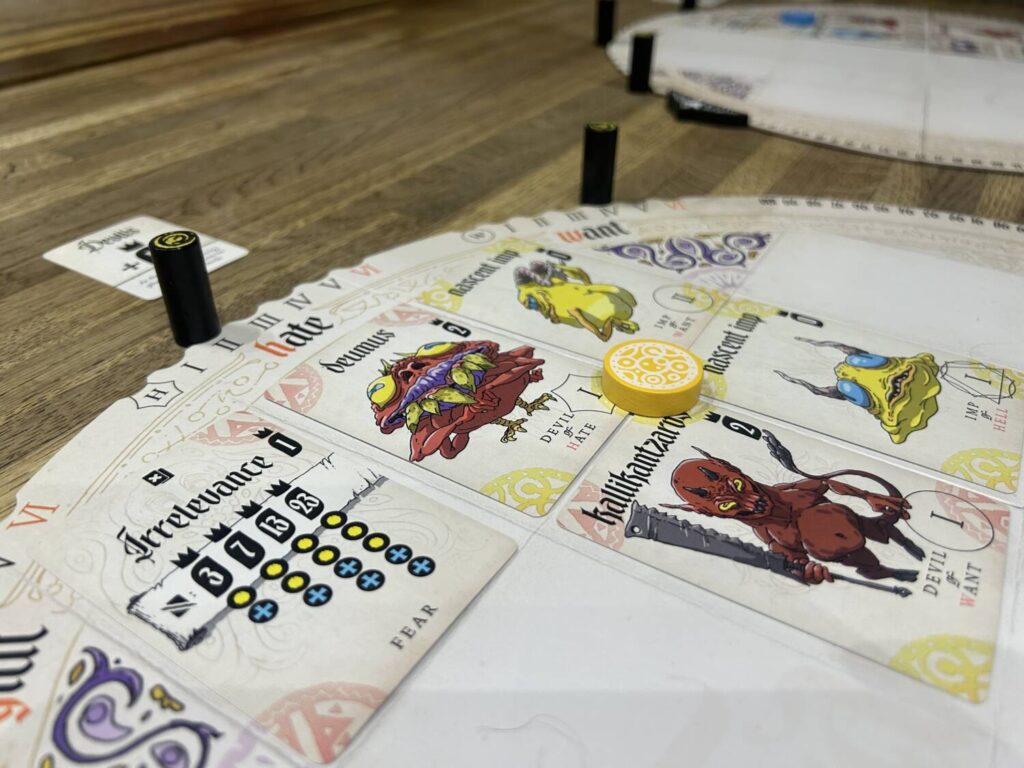
It’s time to roll up your sleeves, put on your cloak, and summon some demons. These little and not-so-little creeps are charmers. The cards are a matte finish, or at least they were in my preproduction copy, but Cowan’s strong illustrations feel glossed with slime. You can hear the sound of these guys walking, leaving a trail behind them wherever they go.
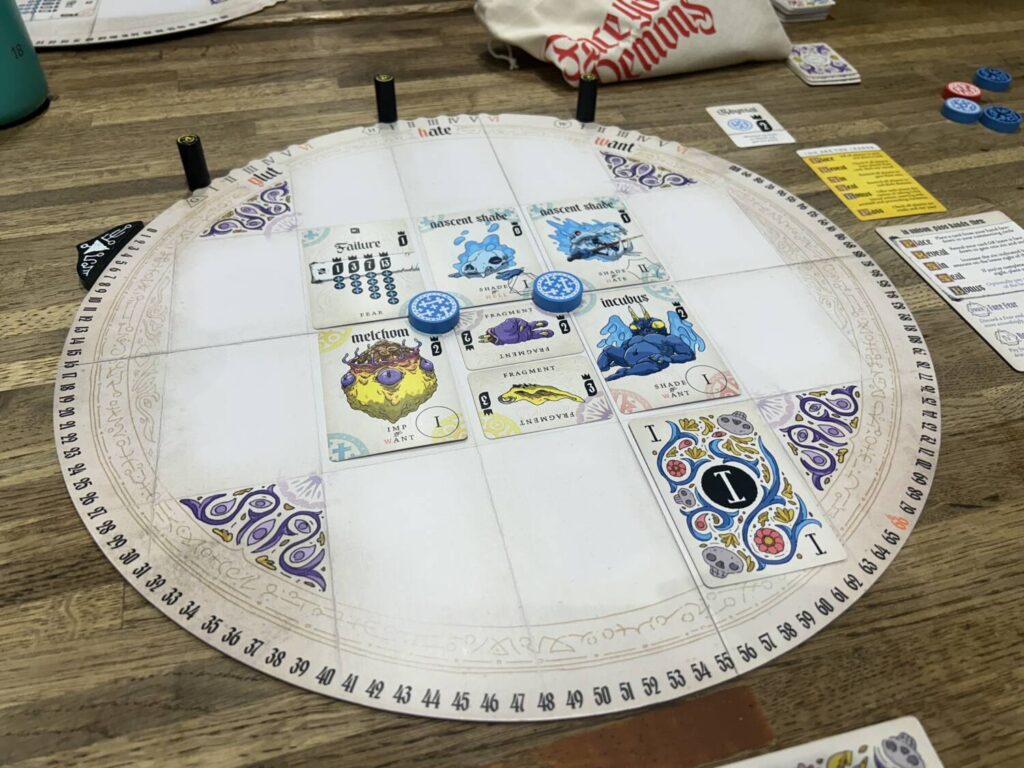
Each player starts with a hand and a summoning circle. Working simultaneously, players pick a demon to add to their individual board, then pass the hand to the left. You have to pay careful attention to the quarter seals in the card corners. Many demons, especially as you get into the second and third rounds of the game, require you to have seals on your board in order to be summoned. The only way to get those seals is to place your demons so they form cohesive circles, a combination of either yellow, red, or blue and the wild purples. These seals provide the resources you’ll need, and score you points. Every seal on your board at the end of a round scores all of the cards it touches.
Drafting games that require resources can drive players into unpleasant corners, and Personal Demons’s solution works well enough. If you ever find yourself in a jam, which you will, you can always play a demon face-down, which gives you a less-powerful and non-scoring seal with which to summon for that round. Given that each demon can contribute to up to four seals, that’s not ideal, but it is often necessary.
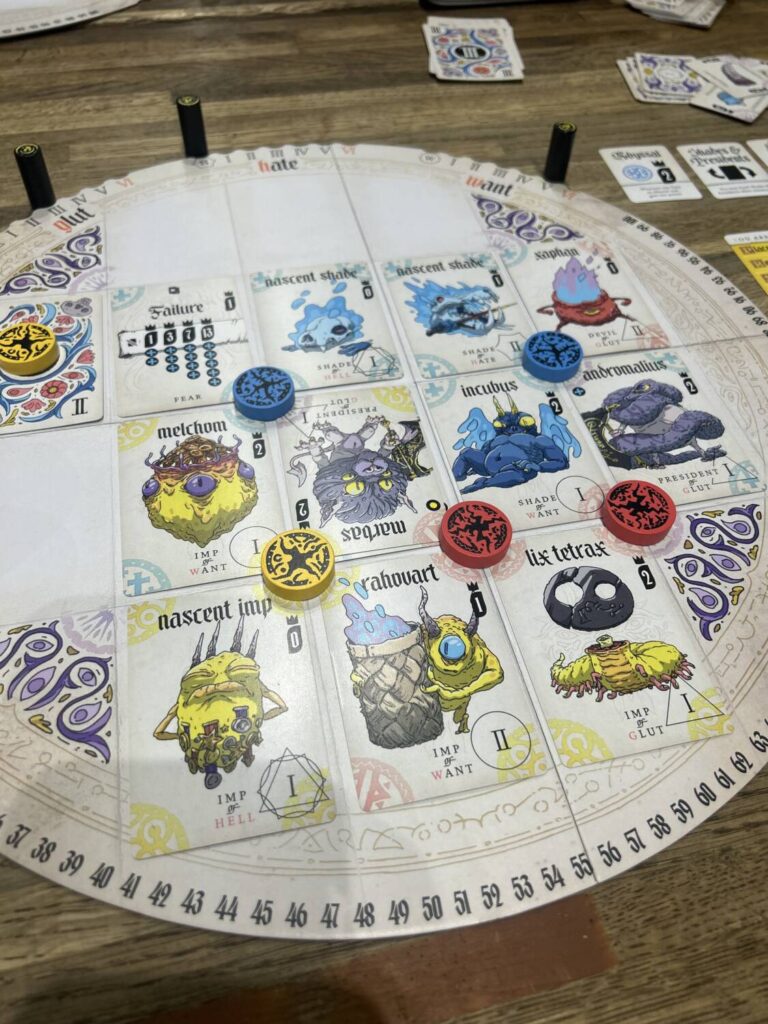
Long-term strategy is shepherded by the medium-sized and ginormous-sized demons each player draws at the beginning of the game. They require significant prior investment to summon, as well as a sacrifice: these large cards must get placed over cards that are already on your board. They’re worth the trouble, especially if you’re able to place them well. Getting your big guy out with the right setup for scoring can feel like hitting three cherries at the slots.
When Personal Demons goes well, it’s a hoot. Your points rack up higher and higher, your player powers start to synergize, and the puzzle of placing demons for maximum return is enjoyable. When it doesn’t goes well, which can and does happen, it’s a bit of a grind. There’s more mitigation available to you here than there is in most drafting games, but you can still only do so much. At higher player counts, the cards get too spread out. At lower player counts, you don’t see enough cards. The upside of something light and fluffy like Sushi Go is that it’s an ad-hoc affair. You’re just making the most of what’s around. When you marry a similar system to a somewhat more demanding decision space, fickle fate has more of an impact not just on your score but on your experience.
That said, for at least a little while, Personal Demons will scratch that old itch. It’ll take you back to the days when Sushi Go and 7 Wonders were as good as games got. Whether or not that’s a good thing, and whether or not that’s enough for you? That’s entirely up to you.