Disclosure: Meeple Mountain received a free copy of this product in exchange for an honest, unbiased review. This review is not intended to be an endorsement.
Disclosure: Meeple Mountain was provided a pre-production copy of the game. It is this copy of the game that this review is based upon. As such, this review is not necessarily representative of the final product. All photographs, components, and rules described herein are subject to change.
Being relatively new to the world of modern board games (since around 2022), I’m still regularly amazed by the various elements of games that I play. While artwork and components are often the first thing to grab my attention, I usually leave the table most impressed and surprised by the ways in which a designer implements a game’s mechanics.
When I come across a brand new (to me) game mechanic, my interest is heightened to another level. This is exactly what happened after I played The Seekers, designed by Jay Cormier & Sen-Foong Lim, and published by Off the Page Games. For those familiar with Jay and Sen or Off the Page Games, The Seekers is actually a reimplementation of one of their previous games, Mind MGMT, which Andrew Lynch reviewed for Meeple Mountain back in 2023.
The mechanism in question, in The Seekers, was Hidden Movement, and after four review plays, I’m eager to explore other games in the genre; perhaps even the very first Hidden Movement game, Scotland Yard, which Meeple Mountain reviewed back in 2018. My only fear is that The Seekers set the bar too high for other hidden movement games.
A Twist on a Classic
At its core, The Seekers is a tabletop version of Hide and Seek. One player is the Mushroom (the hider) and records their movements and move-by-move behind a screen, while the others play as the less subtly named Seekers and document their moves on a larger board, available for everyone to see.
The end goal for the Seekers isn’t surprising: Find and catch the Mushroom. Part of the Mushroom’s goal also shouldn’t come as a shock: Avoid being found by the Seekers. However, this is where the similarities with a classic game of Hide and Seek end.
In addition to evading capture during the game, the Mushroom must also collect eight of an available twelve crystals by the end of their 15th step (more on steps in a moment). Likewise, the Seekers are also up against the same 15 step timer to find the Mushroom.
While traditional hide and seek doesn’t have a timer (at least how my family plays it), the step tracker adds a tense turn-by-turn pressure on each side and turns the game into a race in the best way possible.

Variety is the Spice of Life
Before moving on to the actual gameplay, it’s worth noting the excellent randomization elements that level the playing field for the Seekers and the Mushroom.
The aforementioned crystals that the Mushroom needs to collect are randomly placed at the beginning of each game via the 12 animals represented on the board.
At the beginning of the game, four of these animals are secretly viewed by the Mushroom and are designated as the crystal holders for that particular game and are marked on their board. While the frequency of each animal is the same (three of each), the placement on the board differs for each one.
Each side, Seekers and the Mushroom, also receive randomized ‘special abilities’ at the start of the game.
The Mushroom receives two ‘Sneaky Steps’ to use. These are one-time per game step abilities that break the Mushroom’s standard movement rule of one space per turn. One of these steps, ‘Jump’ allows the Mushroom to step to a space with a matching animal. This has the potential to allow the Mushroom to jump to the complete opposite side of the board, throwing a tricky wrench into the Seekers’ plan.

Likewise, the Seekers receive three Badge Cards that are also each available once per game. The Badge Cards provide critical information that isn’t normally available through the regular course of the game. For example, one badge card ‘Perfect Planner’ allows the Seekers to identify how many spaces are on the shortest path from the current Seeker to the Mushroom’s starting space; Determining the Mushroom’s starting space is a key piece of information.
Thanks to the Sneaky Steps, Badge Cards, and animal/crystal randomization, each of my four review plays felt uniquely different from one another.
I Know What You Did Last Turn
While I acknowledge that I’m a noob to the Hidden Movement mechanic in games, after playing The Seekers, I can already see how important information sharing is to the overall success of the genre. Sharing too much or not enough information about the Mushroom’s movement would tip the scales unevenly in one team’s favor.
Thankfully, The Seekers does an outstanding job of doling out just the right amount of information. As an added bonus, it’s divvied out at a perfect pace so that each game is built to come down to the wire.
Gameplay consists of the Mushroom and the Seekers (between one and three) alternating turns.
On the Mushroom’s turn, unless they use one of their previously mentioned Sneaky Steps, they can move only one space on their board.
However, there are a couple of rules in place that the Mushroom needs to abide by:
- The Mushroom can never step on the same space more than once during the game
- When the Mushroom steps onto a space with an animal that has a crystal, they must collect it.
In addition to the second rule above, the Mushroom’s steps and collected crystals are tracked on a counter along the bottom of the larger board that’s visible to the Seekers. This counter is a critical piece of information for the Seekers as it shows how many turns are left in the game, as well as which turns the Mushroom collected a crystal.

Finally, for every other crystal that the Mushroom collects, an animal card is revealed, which shows the Seekers that these animals are not one of the four holding the crystals. This detail creates a fun scenario where the closer the Mushroom gets to winning the game, the more information they provide to the Seekers, also helping them.
Unlike the Mushroom, the Seekers have a few more actions available on their turns.
On the Seekers’ turn, they can do any of the following actions in any order:
- Move up to two spaces (three spaces in a two player game)
- Search or Catch (More on this in a moment)
- Use one of the previously mentioned badge cards
- Use the individual Seekers’ special power; Each of the four included seekers has their own special ability such as moving a seeker one space, or asking the Mushroom if they’re currently in their row
The search action is the core tool that Seekers will use to ultimately track down the Mushroom. When players ‘search’, the Mushroom must place step tokens on the three matching animal spaces on the board on either a green side or red side.
The green side is used if the Mushroom has stepped on that space between turn one and the current turn, while the red side shows they haven’t stepped on that space. After a few turns, with enough step tokens out on the board, the Seekers will usually have enough information to start putting together some solid guesses on the Mushrooms’ path.
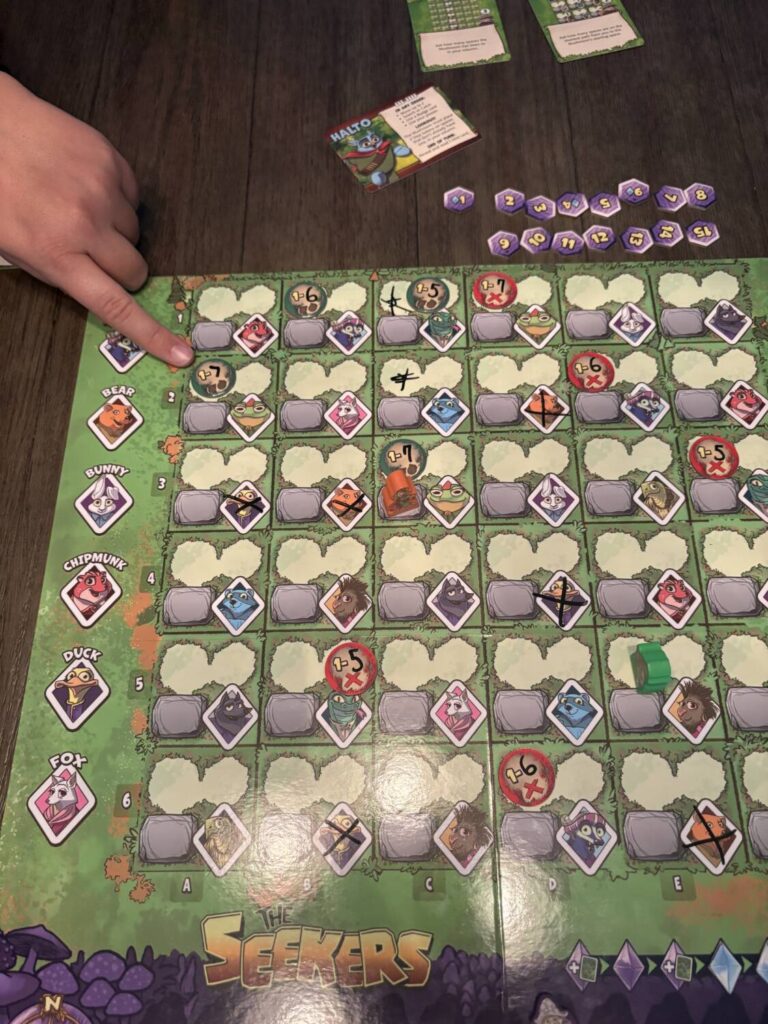
For the Seekers, this made the game remind me of Sudoku. Once a few tokens have been placed, the Seekers will get to the point where, like Sudoku, there are certain spaces that logically, the Mushroom must have been to.
Opposite of search, the catch action is straightforward. When using catch, if the current Seeker is in the same space as the Mushroom, the Seekers win the game.
Forcing the Seekers to choose between searching or catching is a fun and strategic decision. You really don’t want to use catch unless you’re fairly confident that you’re going to catch the Mushroom. If you’re wrong, you miss out on the valuable information gathered from the search action.
Sharing is Caring
Across my four playthroughs, I quickly realized there’s an ideal way to play. My first game was a two player match where I played as the Mushroom, and was ultimately caught by the lone Seeker. I had a fun time in this game, but I didn’t realize how much more fun the game could be with more than one seeker.
My other three playthroughs were all three player matches with the same three players, where each person took a turn at being the Mushroom. Playing as both the Seekers and the Mushroom are equally fun, in my opinion. Giving each person an opportunity as the Seeker though, allows everyone to get the full experience.
One of the must fun parts of playing as the Mushroom in the three player matchups was listening to the Seekers discussion. These conversations often led to multiple bouts of laughter as the Seekers argued about the path the Mushroom had taken so far and/or which animals held the crystals.

As the Mushroom, you can sit back and enjoy the show or make sly comments like ‘Oh. That’s an interesting thought’ or ‘Wow. You really think the turtles have the crystals?’ There’s nothing in the rulebook that says you can’t try to mislead your opponents, so we took full advantage and turned an already fun experience into a raucously good time.
It was also fun as the Mushroom to try and keep a poker face as the Seekers closed in on you. In three of my four games, the Mushroom ended up on the same space as the current Seeker, but the Seeker didn’t use the catch action.
Plenty to Play
In addition to the base game, two modular expansions are available to add even more variety.
The Fun Gals module adds new Fun Gal tokens to the board that are usable by both the Seekers and the Mushroom and provide some unique twists to the standard gameplay.
In the Shiny Stuff expansion, special items are available to the Seekers and the search action is changed. The Mushroom or Seekers can choose to receive/give fewer step tokens during the search action, and instead provide an item that can be used on a future turn by the Seekers. This added another interesting decision point during the game in terms of how much information each side wants to give/receive at the cost of unknown item advantages. As a surprise bonus, the version of the game I was able to play added mini plushes for each Seeker and the Shiny Stuff items were magnetic and connected to the Seekers!

The game also includes optional Shift cards for both the Seekers and the Mushroom, which serve as a boost of sorts to help players in their respective roles. These are a welcome inclusion to support younger players that might struggle in a logic and deduction based game.
Altogether, The Seekers feels like Hide and Seek and Sudoku magically mashed together into a tense, hilarious, and approachable experience that I’m eager to get to the table many more times.