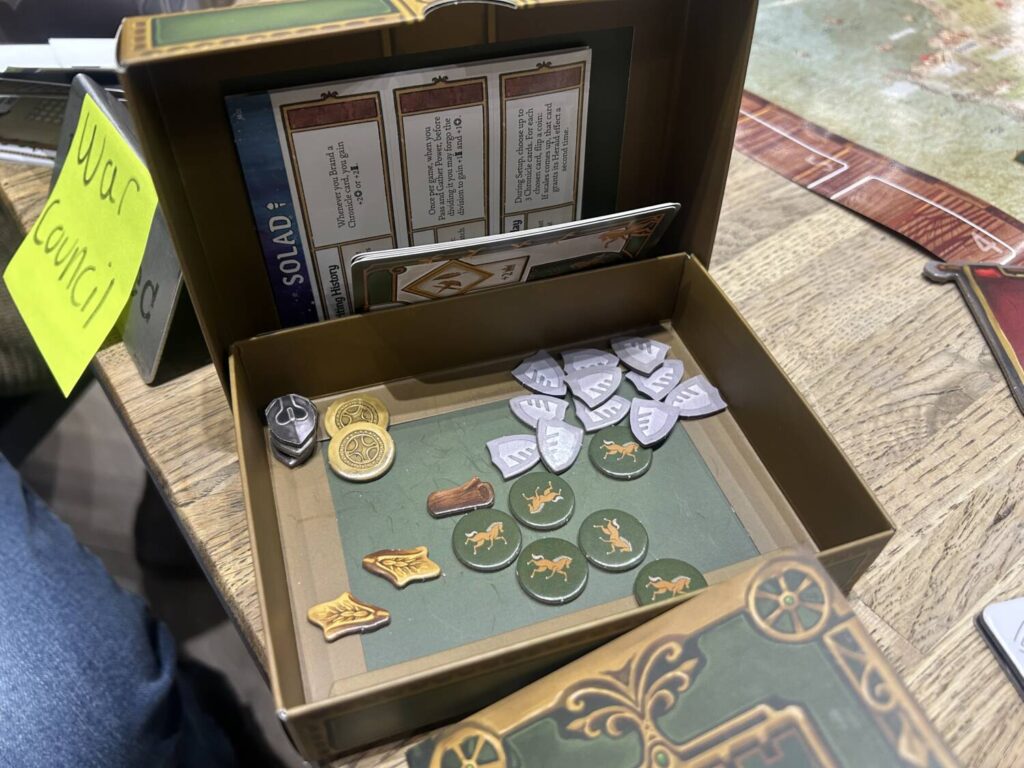
Disclosure: Meeple Mountain received a free copy of this product in exchange for an honest, unbiased review. This review is not intended to be an endorsement.
We did it.
On June 4th, 2026, despite the considerable difficulty of coordinating regular play sessions with a group of six, I was part of a group that successfully completed a campaign of The Queen’s Dilemma. For 15 sessions over the course of about three months, we were the six nobles ruling in the queen’s stead. For 30-35 hours, we dealt with famine, a new religion, an influx of migrants, a religious schism, and put the matter to a vote.
It was time well spent. I was hanging out with five of my friends, doing what we do best: cracking jokes and selling one another up the river. It was easy to forget sometimes that we were playing a game. The Queen’s Dilemma, like The King’s Dilemma before it, is deeply social. The game melts away while you’re playing. That’s key to its magic. All games exist to engender some sort of social dynamic, but the more involved a game is, the more the game itself tends to insist on its own presence. You can’t play Agricola and forget there’s a rulebook. The Queen’s Dilemma is the world’s most involved party game; it wants to vanish. You spend so much of each session staring into the eyes of the other players and asking them what they’re thinking that you can forget in some ways that the game is there at all.
That is primarily a tribute to the perfection of the core mechanic. Voting on dilemmas uses an auction system, with players either passing or committing Power tokens to either side of the current issue. Voting priorities are driven by a combination of factors, including Ideologies—three tug-of-war tracks in which, for example, Tradition and Progress are diametrically opposed—and narrative. The front of each Dilemma, the part you read out before voting, tells you what Ideologies will be affected by the council’s verdict. A serial killer seems to be running loose, say, and we have to decide whether or not to create modern policing to try to catch them. How do I vote?
If I want Liberty to do well this game, I probably want to vote against the motion. Liberty—which seems in The Queen’s Dilemma to exist mostly in a Libertarian sense—would certainly be curtailed by the creation of a surveillance state. On the other hand, this serial killer is running wild in a city under my family’s control. I don’t have to be Machiavelli to understand that this may have a negative impact on my reputation.
This soup of impetuses is further complicated by the ancillary details of voting; the player with the most committed Power on the winning side gets to be Leader. The Leader takes responsibility for the outcome of the vote, whatever that may be. Responsibility often translates to long-term benefits. You may find yourself affixing your house crest to a Chronicle Card, which may give you a little bonus at the start of future games. It’s equally possible that being leader will be held culpable rather than responsible. The Chronicle Cards are not all good news.
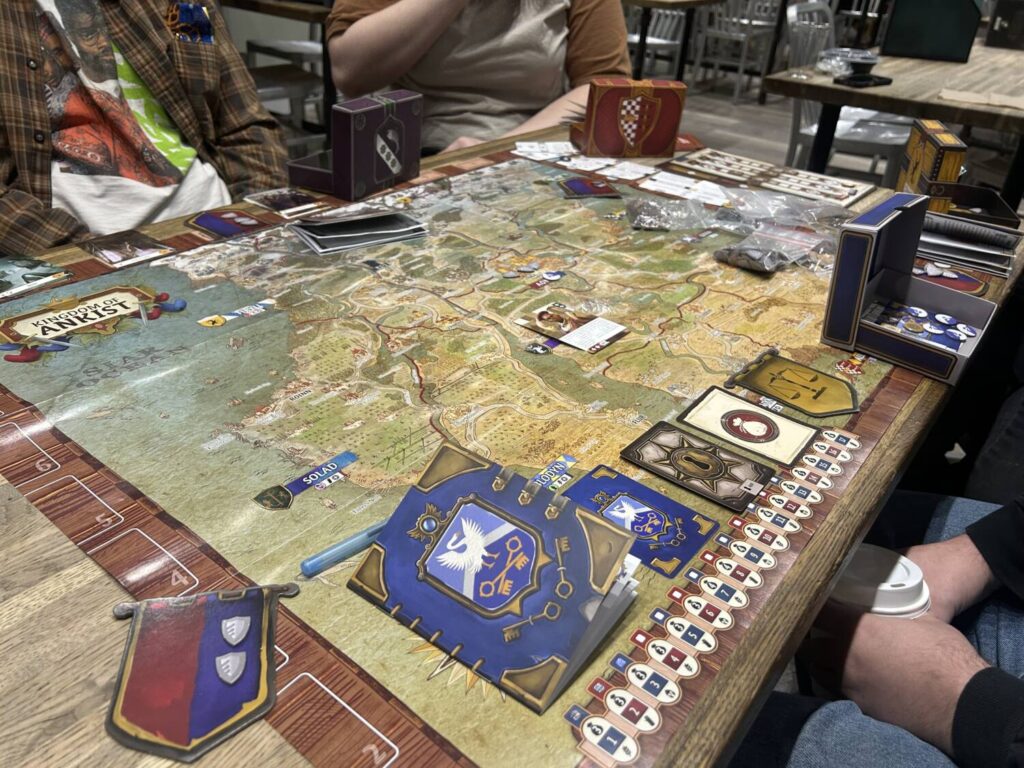
Across sessions, you gain resources that can be spent on buildings, abilities, and advancing your individual story. Resources are hard to come by, especially early in the game, but that’s where negotiation comes in. The oil that greases the gears of The Queen’s Dilemma is bartering, trading tit for tat. If you don’t feel strongly about an issue, you can farm out your vote. I’m trying to build a stronghold, so Military in exchange for a bit of Power sounds good to me. These deals can easily become multivalent, with several players on the same side chipping in to make some sort of magic happen. It can often become tense with offers and counter-offers, as the player in the middle tries to work their advantage. The ways in which you can screw someone over in this game defy the limits of the human imagination.
The Queen’s Dilemma is a significant leap in ambition from The King’s Dilemma, which is to be commended, but there are occasional growing pains. There are so many stories here that it can be hard to keep track of everything. Even playing with as aggressive a schedule as we did, mostly managing two sessions a week, there was a good amount of, “Wait, who’s that? I don’t remember that,” as we went along. A small number of side quests are introduced, and it was unanimous among the group members that the game would have been better without them. Trim the fat. It is important to note that this was not helped by the fact that all our events ended up coming out within two or three games of one another. Had they been a bit more spread out—this is entirely down to the luck of the draw—we would have likely had a more positive opinion of them.
Unlike King’s, in which you play as different members of the same family across generations, Queen’s Dilemma has you play as the same person the whole time. This allows for more of a sense of ownership, for a more defined sense of progression, but I miss the dynamism of the old system. The same player could go from passionately arguing against slavery in one game to desperately trying to convince everyone to sell orphans to workhouses the next. It was fun, never knowing what your position would be. In The Queen’s Dilemma, you’ll find yourself on the same side of issues consistently. You align with the same players over and over again. Your priorities are relatively stable from game to game. It still works, and it works well, but. It was fun in the first game to change from sensible to bananas and back again from session to session.
One of the biggest difficulties with a campaign game—with any narrative form, really—is the ending. If you keep doing the same thing over and over again up until the end, it will likely feel to the players as though the game has simply stopped rather than ended, as though the campaign had dissolved into the same pregnant and unsatisfying silence that follows the final measure of Die Kunst der Fugue. The Queen’s Dilemma navigates this beautifully, opting for a barn-burner of a finale. It was so unexpected, so excellent, that I only wish our group hadn’t had a runaway leader. I was the only player who hadn’t missed a single session, and I was well ahead of everyone else. This was aberrant, I suspect. With a more even game, that ending would have been astonishing. Instead, it had to settle for merely being superb.
The Queen’s Dilemma can be thought of as an RPG for the non-RPG crowd, a more rigorously structured campaign of D&D where the story is all there is and the combat doesn’t drag. Six months from now, I won’t remember who won or who lost, but I’ll remember those 30-35 hours. To surrender yourself to the joy and absurdity and gruesomeness and misfortune of The Queen’s Dilemma is to reward yourself with an incomparable experience.