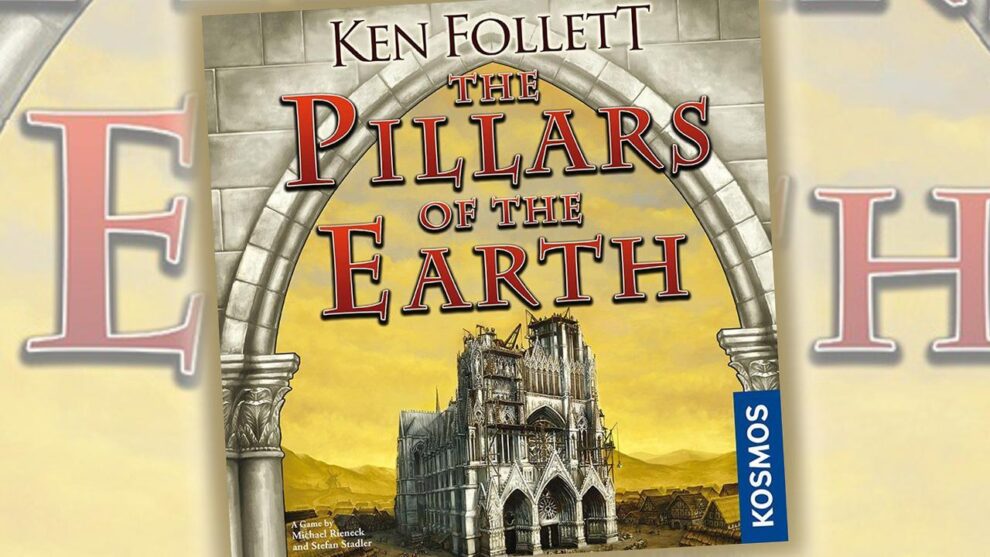


Just because a game is old doesn’t mean that we should overlook it. Thanks to a new gaming group, I’m getting some exposure to lots of older games that I normally wouldn’t even think twice about. Our most recent foray was a five-player jaunt through The Pillars of the Earth, a worker placement euro that wasn’t as stuffy as my initial cover-based assessment gave it. Together we built the fictional Kingsbridge Cathedral from Ken Follett’s novel of the same name, although the process wasn’t free from cutthroat resource battles. With twenty years of board game innovation between its release and the present, does The Pillars of the Earth still stand firm?
The Pillars of the Earth Overview
Over the course of the game, players assemble big, blocky, wooden pieces to form a central cathedral, which serves as a glorified round marker. During that time, they balance the need for employing Craftsmen and utilizing their talents to convert resources into victory points. Whoever has the most victory points at the end of the sixth round wins the game.
After setting up The Pillars of the Earth—which involves a great deal of shuffling and deck-stacking—the game begins in earnest. In the first phase, players use their pool of workers and gold to send laborers out to gather resources or to hire better Craftsmen. Each player can only employ five Craftsmen and acquiring a sixth requires one of the others to be terminated. Their employment!
Starting Craftsmen also have to be employed to perform certain actions. For example, without a Woodcutter, one cannot buy Wood from the market space. Without a Mortar Mixer, a player cannot gain any points from Masons Craftsmen. Succeeding in the game, however, generally requires you to get rid of at least one of these starting Craftsmen in favor of more optimal points-for-resources ratios.
Once all the players have passed or used up all their workers, the game proceeds to the second phase. The starting player draws Master Builder pawns out of a common bag, determining the order of placement across the game board. Nothing is built for free, however, and placing first requires a payment of 7 gold. If a player doesn’t wish to pay that exorbitant fee, they can decline, forcing them to wait on placement of that builder until after the initial spots are filled. Subsequent builders cost six, five, four and so on, eventually becoming free. At that point, any builders still remaining on the track are then placed on the board in corresponding order on the various benefit spaces.
With the Master Builders on the board, the spaces are carried out in numerical order. First comes an Event, which could be a blessing or a curse, followed by a space that would allow a player to ignore its effects. Without going through every single location, there are victory points, a market for buying and selling resources, a place to generate extra resources, Craftsmen, taxation, and even a spot to choose the starting player for the next round.
Finally, it’s time to put those Craftsmen to work. Before heading into the next round, players assign resources to their Craftsmen and generate their victory points. Up to five resources can be carried between rounds, so it can be useful to save an overabundance of resources instead of selling them for gold in the market. A piece gets added to the Cathedral, and play continues until six rounds have been played.
The Pillars of the Earth: Working on Up
As with many worker placement games of this era, the sepia-tinged board and wooden resource cubes promise that the next few hours will be filled with material attrition over resources and placement spaces. I was originally daunted by the number of locations to place a worker, especially since we were playing with the expansion that allowed for all five of us to participate at the cost of introducing additional spaces.
It didn’t take long for me to wish there were even more.
The board fills up very quickly, and there are usually only a few preferred spaces that people are fighting over. For the first couple rounds, I was near the end of the turn order, meaning that I was desperate for acquiring additional Craftsmen to make me more efficient with my resource spending. But there are only two Craftsmen on the board to choose from after the initial buys, and spending six or seven gold for the luxury when your Master Builder is pulled early is quite expensive.
There’s a beautiful push-and-pull created between the gold and victory point dynamic. You absolutely need gold to have flexibility on your turn through purchasing goods, Craftsmen, and paying taxes, but there’s no endgame benefit to having money. You could be topped off at the cap of 30 gold at the end of the game, and it gets you nothing. Victory points are where it’s at.
The Pillars of the Earth ramps up quite nicely thanks to the deck-stacking in the beginning of the game, offering more efficient workers as the game progresses. This, along with the idea of the firing up of the Craftsmen at the end of the round, is very reminiscent of another of my favorite games, Power Grid. You always feel as though you are making more with less, which is a good feeling when other players are beating you to specific spaces with their workers, buying up all the stones, and denying you general happiness.
What impressed me most is that there were multiple ways to be successful in the game. I largely focused on generating victory points with my workers through the Priory space and crusades, generally getting around three points each round through those means on top of resource generation. At the other end of the table, the eventual winner had a strategy that revolved around generating a mountain of gold and converting that gold into points with Craftsmen. And the second place player was constantly acquiring metal, a scarce and rare resource that helped secure an extra six points in the final round with the Organ Builder Craftsman. We all finished within four points of each other.
Worker placement games have evolved since 2006, but The Pillars of the Earth shows why it’s popular and why designers keep coming back to the well. The randomness of pulling Master Builders from the bag to determine placement order had us on the edge of our seats. Getting an early pull can completely change the trajectory of your strategy if you’re willing to pay for it. At the same time, you might not have your other Master Builder pulled until much later, leaving you to wallow as the rest of the table gobbles up the board.
Every player at the table felt ‘in it’ for the entire game, although it did require us to be more aware of what everyone else was doing. There’s a specific card that allows you to copy another player’s Craftsman in the five-player game, and if you want to use that you’ll need to be acutely aware of who has what. Based on the board orientation, players looking at the board upside down will be at a general disadvantage initially, at least until they get into the habit of reviewing each round’s cards as they are revealed. I also felt like the game ran rather long—three hours for us—but I can chalk that up to learning a new game collectively, the increased player count, and some analysis paralysis that is natural in these kinds of games.
The Pillars of the Earth felt surprisingly contemporary given its release date. Constant weighing opportunity cost, and determining the relative value of each victory point. What’s worth paying for? Will you risk paying high taxes to place your worker in a more optimal position? Will being second in line at the Market stall be good enough to get you the resources you need? So many things to consider, but there was never a question of imbalance.
Oftentimes, hobby gamers get caught up in the cult of the new. Take this as your sign to give some love to those older games to find that good games have always been around. New games are just built atop the pillars of those that came before.
The Pillars of the Earth details
- Designer: Michael Rieneck, Stefan Stadler
- Artists: Anke Pohl, Michael Menzel, Thilo Rick
- Publishers: 999 Games, Albi, Cappelen Damm AS, Competo / Marektoy, Devir, Filosofia Éditions, Galakta, IELLO, Kaissa Chess & Games, KOSMOS, Mayfair Games, Stupor Mundi, Thames & Kosmos
- Release Date: 2006
- Player count : 2 - 4
- Age range : 12+
- Time range : 90 - 120 minutes
- Mechanism(s): Events, Market, Turn Order: Claim Action, Turn Order: Random, Worker Placement, Worker Placement, Different Worker Types
- BGG Geek Rating: 7.25722 - converted to Meeple Mountain scale: 3.5.
- More articles about The Pillars of the Earth.