Disclosure: Meeple Mountain received a free copy of this product in exchange for an honest, unbiased review. This review is not intended to be an endorsement.
We did it, folks. Humanity has invented—nay, perfected—time travel. They said it couldn’t be done. They were wrong. The scientists at publisher Plaid Hat Games figured it out. It’s less complicated than I’d have expected time travel to be, requiring only that you set up a copy of The Monolith and sit down. The technology also seems to be fairly limited in its applications, since The Monolith only has the ability to transport players back to the summer of 1993.
Picture it: Fireball Island is in the rearview mirror, the Euro revolution is but a faint glimmer on the horizon, and sweet sweet Ameritrash rules the roost. There’s wood panelling on the walls, left over from when your parents had the basement finished in ’86. Breathe in the aroma of freshly-toasted Bagel Bites, taste the corona of blue Squeezeit around your lips. Hear the faint sounds of “I’ve Been Thinking About You” and Mary Chapin Carpenter’s cover of “Passionate Kisses” waft in from a nearby radio. That’s The Monolith.
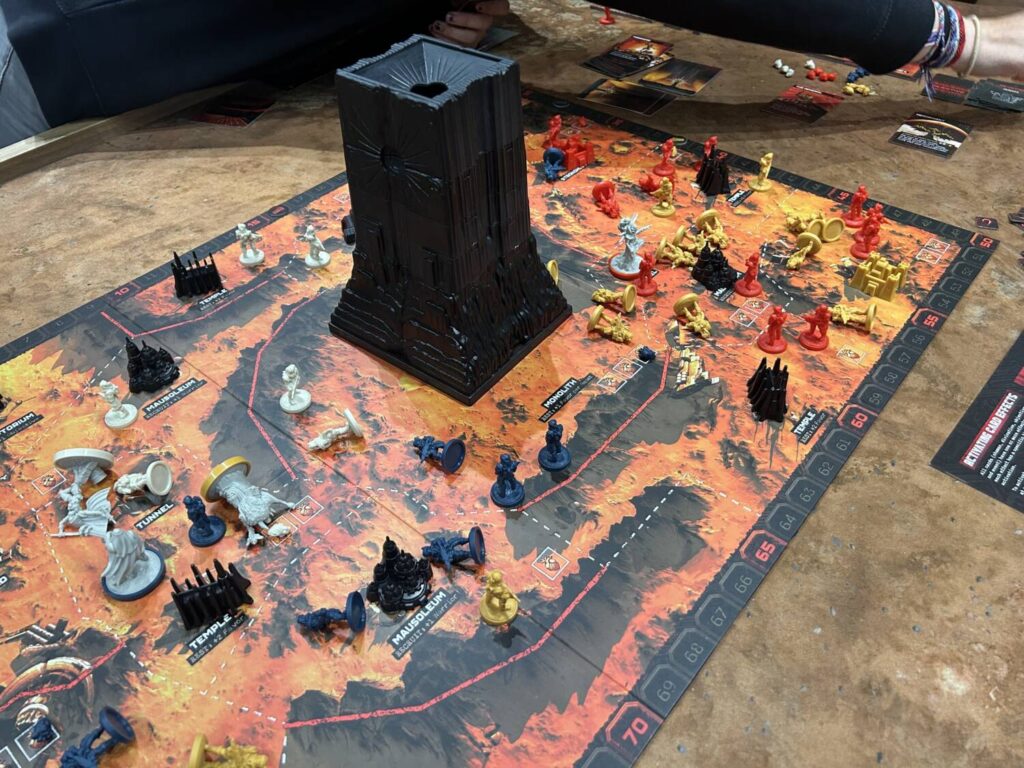
Everything about The Monolith as an object was seemingly designed to evoke a previous era, if not always the same one. The table presence is the maximalism of early 90s board games like Forbidden Bridge. The box cover, which artist Calder Moore knocked all the way out of the park, brings to mind the glory days of Heavy Metal magazine, of early Judge Dredd. The design itself, however, this bloody and enthralling troops-on-a-map game, is modern as could be.
The closest reference point I have is the magisterial Kemet, the greatest Dumb Game of them all. I don’t think I’m off base in assuming that designer Phil Gross has played his fair share of Kemet, and he has learnt well the lessons Jacques Bariot and Guillaume Montiage have to teach. Like Kemet, which forces players to move around and fight by focusing on a few hotly contested areas, The Monolith is designed to encourage interaction, and lots of it. Unlike Kemet, there is no need to control certain spaces, but you cannot score meaningful points without getting in other people’s business. Turtling—the act of shoring up in one or two positions and merely fighting off aggressors, which has been the inert downfall of many a troops-on-a-map game—is not a viable option.
Now that I think about it, most points don’t come from controlling anything. Temples score you points when you control them, sure, but most of your points come from Boasting, which requires only that one or more living members of your army share a space with one or more members of an opponent’s army. Please note that I did not say the opponents have to be alive. This creates an unusual and refreshing dynamic. The Monolith is the unusual troops-on-a-map game in which a swarming unit of eight Warriors is no better—in some senses—than roving bands of two. A snowball’s as good as an avalanche if you aim it right.
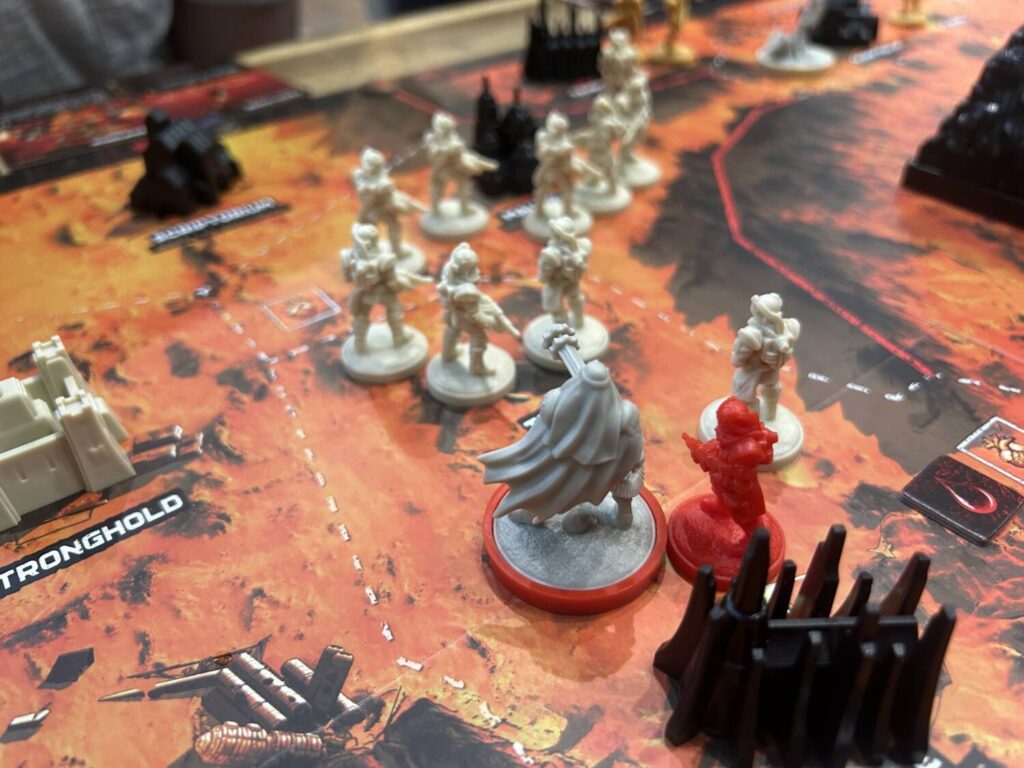
In some ways, I think I might even prefer The Monolith to Kemet. It creates an equally satisfying and interactive experience without the use of all those special power tiles that can bog Kemet down. Each player’s Shaman, the leader of their respective army, has a special power just strong enough and singular enough to suggest long-term strategies without being so complicated that your opponents need to be constantly reminded of what you’re up to. That’s a huge quality of life improvement.
Maybe the only thing I miss from Kemet is the drama of the combat. Combat in The Monolith is entirely determinative: if I shoot, you die. There are no dramatic card reveals, no clever and unexpected reversals. On the other hand, combat in The Monolith is also optional. It doesn’t automatically trigger when two players share a space. When it does happen, though, it’s more about subtle shifts in dynamics than big swings. This allows player interaction to spool out across entire rounds, rather than coming in bursts. That’s a worthwhile trade.
The result is a great troops-on-a-map game for 3-4 players that plays in exactly the two hours listed on the box, rarely drags, and manages the genuinely impressive trick of being both tense and wholly transparent. The only hidden information in this game relates to scoring objectives.
Well. The only hidden information that any one player knows that the others don’t. The Monolith does include some things no players know.
The Monolith itself is not just an accessory. It’s functional. Throughout the first half of each of the game’s four Days, players take turns performing one action at a time, and paying for each of those actions with little anatomically correct Hearts. When a player passes, they scoop up whatever unspent Hearts they have left and drop them into a hole in the top of the Monolith. Once all players have done so, the Monolith is removed, revealing a base divided into three sections. Each of those sections corresponds to an action, and each Heart in each section allows the corresponding player to perform that action once.
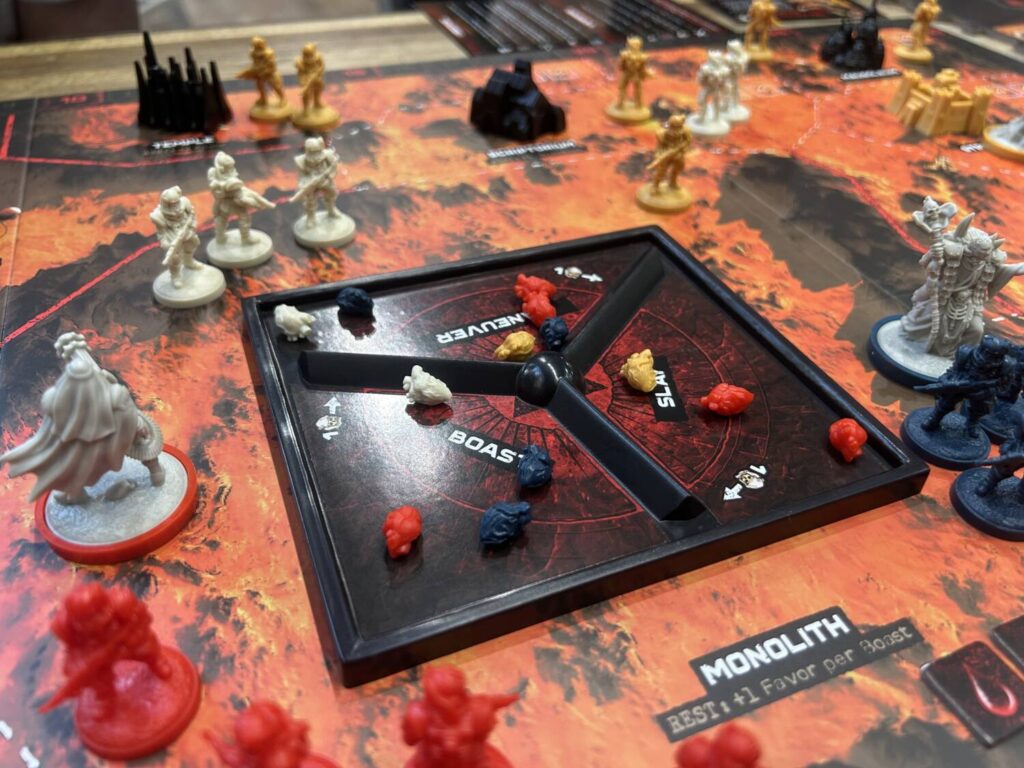
Unlike the first half of each Day, during which players perform one action at a time, the second half is spent performing these new actions in pairs. The first player to Commit their Hearts to the Monolith—what a sentence—gets to start off this second phase by taking four actions in a row, which can be incredibly powerful in the right hands. We love a good tempo consideration.
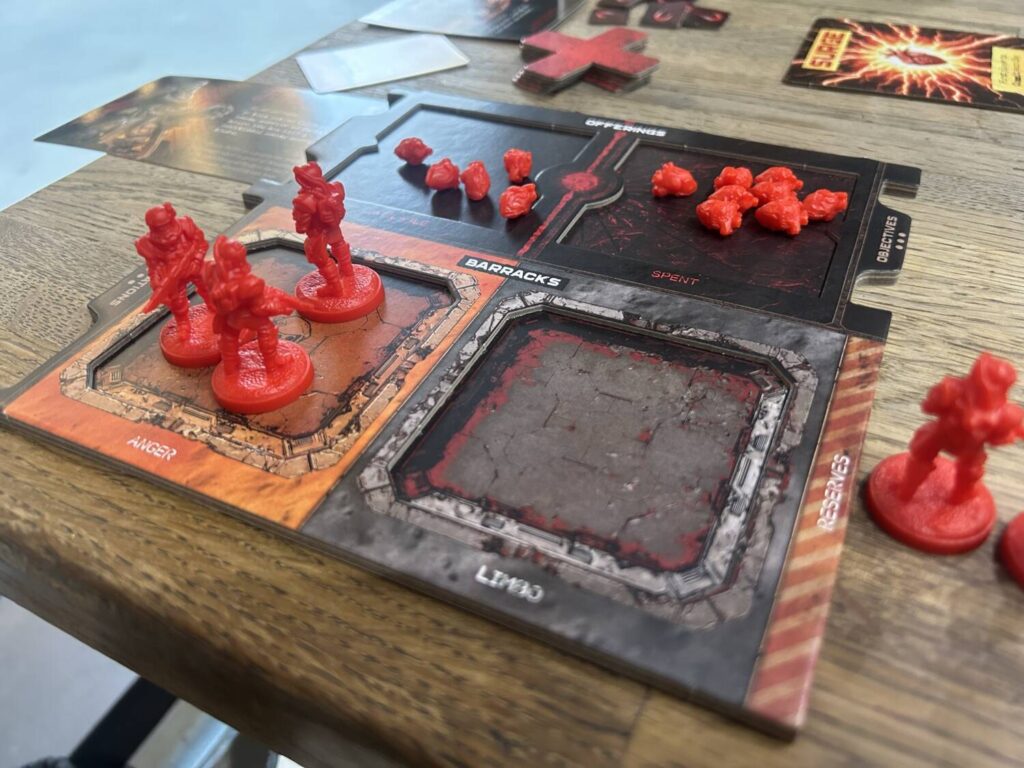
It may be purely an argument of aesthetics, but there’s a lot to be said for the experience of dumping your Hearts into the Monolith, for the sound they make as they drop through the irregular grating inside, and for the quick thrill of revealing the outcome to the table. And lest you feel like this sounds too chaotic for your determinative preferences, you do have some amount of control over all this. Provided you’ve picked up your dead from the board, they provide you with Anger, which can be spent to move Hearts one spot in a clockwise direction. Intentionally positioning yourself so you get mowed down has its advantages.
I’ll admit that the presentation for The Monolith, impressive and nostalgic as it is, made me skeptical. It felt like over-compensation. I am suspicious of nostalgia. I wasn’t excited to sit down to my first game, compelled as I was by my reviewerly feelings of obligation. But then, for starters, the rulebook was excellent. The teach was, for the amount that’s going on here, nice and breezy, even straight from the page. The gameplay was immediately satisfying while constantly providing hints of what I could do better next time. The mechanics were straightforward, but interacted in clever ways. The Monolith proved, to my surprise, to be something close to the ideal experience for this kind of game. So throw on an episode of The X Files, get in early on Beanie Babies, and dig in to The Monolith. There’s a lot to enjoy.