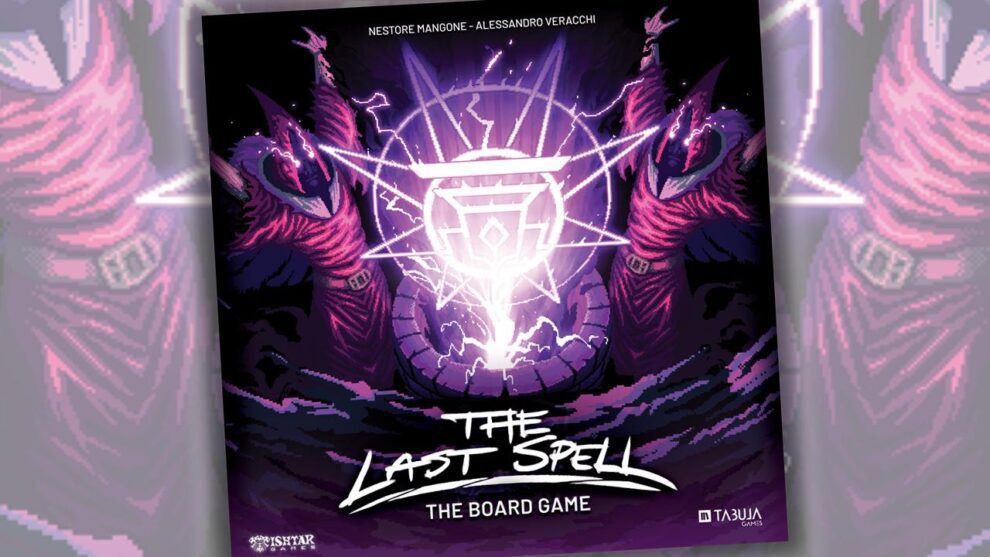

The Last Spell: The Board Game is one of those rare games that I can be unapologetically negative about. Contrary to what you might think reading some of my reviews, while I can be critical, I generally try to understand what the design was attempting to accomplish and if it accomplished that goal.
The Last Spell: The Board Game successfully accomplishes the aim of adapting a video game into a board game at what appears to be a 1:1 level of fidelity. Unfortunately, because of this, there is almost zero reason to play the board game adaptation.
This game is a waste of time.
Is there a good thing, Thomas?
Well, the aesthetics are kinda cool. I guess?
The premise of the game is that some wizards cast a big spell that killed nearly everything in the world, and the remnants group together in small towns bravely defending themselves against the dying of the light or some such thing. There’s purple mist. There’s a pixel art style that is very Dark Super Nintendo. Reminds me a bit of Super Boss Monster, and the text is reasonably easy to read. The miniatures for the player heroes are cool.
Unfortunately, beyond that, everything else is a travesty.
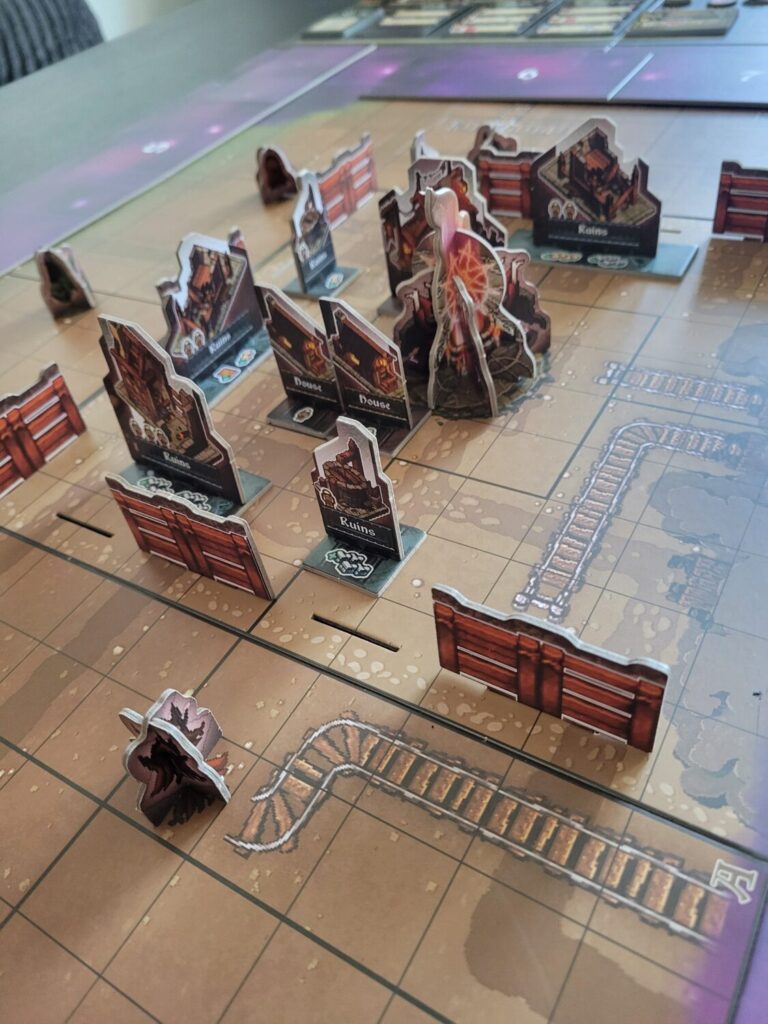
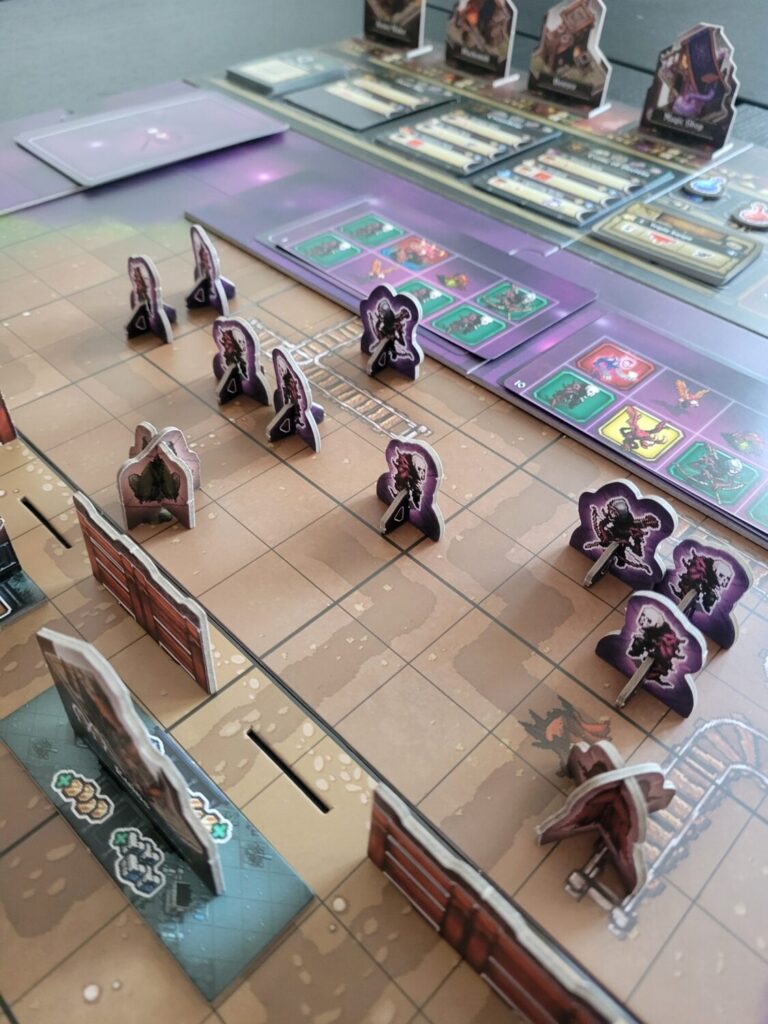
The game is a positional combat skirmish game where hordes of monsters attack your little town and you and your friends cooperatively fight back. Unfortunately for you and your friends, your town is a zillion cardboard standees with varying degrees of stability and visibility, and there’s about 200 more standees that make up the monsters that are attacking the town. Aesthetically cool, but reading is nearly impossible. There isn’t an angle from which you can view the board that you have a great vantage point to even play the damn thing from, which is just a failure in visual design.
But what about the gameplay?
Surely, it has something redeeming, yes?
Let me ask you a question first. Do you love procedural bookkeeping? Because man is this ever the game for you.
The game is separated into Day and Night Phases. In the Day Phase, you build your town, repair it if it’s broken, and buy equipment for heroes. This is simultaneous and cooperative and is blissfully frictionless. You just talk with your friends, decide what to do with your resources, and do it. It’s fine. It’s nothing you’ve never seen before. Turn two bricks into a gold mine. Buy a sword from the sword pile with the gold. This is essentially a cooperative equipment screen that you’d see in an isometric cRPG. That might sound cool, but there’s essentially no design work required to make what is essentially a spreadsheet menu of options to buy. Even the town building is incredibly uninteresting, because in the Night Phase, the monsters are just going to run in a straight line at your town (with some exceptions), so does it really matter that much where you position things? No.
Night Man
The Night Phase is where the game really takes you to the dentist. Basically, the monsters rush at you in a straight line (with some exceptions for different monster types and if they run into an obstacle) and damage everything they touch. You move 16+ standees forward, and then a player takes a full turn, followed by another player. Then the monsters move forward again, damage things they touch, and you go back and forth until there are fewer monsters or monster HP than players, and then it’s time for another Day Phase. Beat the boss on the third night and you win.
But, it’s very likely that you’ll have thrown the box in the garbage before then. I almost did.
I suffer for my art.
Part of what is wild about The Last Spell: The Board Game, is that it managed to learn nothing at all from twenty years of skirmish game innovation. Player characters are not class-based, but have pieces of equipment (cards) and skills (also cards) that determine how they can attack and what special powers they have. I’m extremely proficient in board game icon-fu, and I was completely floored by how counterintuitive the symbols for doing something as simple as hitting a monster with a sword were. A mere slice with a sword has five different icons and no textual explanation of how it works, and two of the icons are superfluous, explaining that “You can attack something adjacent to you” with pixel symbols that convey anything but that. There’s bizarro-world rules for ranged attacks where you can shoot all the way across the board but not hit something on an adjacent board, spells that require a master’s degree in semiotics to understand, and on top of all of it, you don’t even get to do cool power turns, thanks to some baffling limitations on how heroes can behave on a given turn.
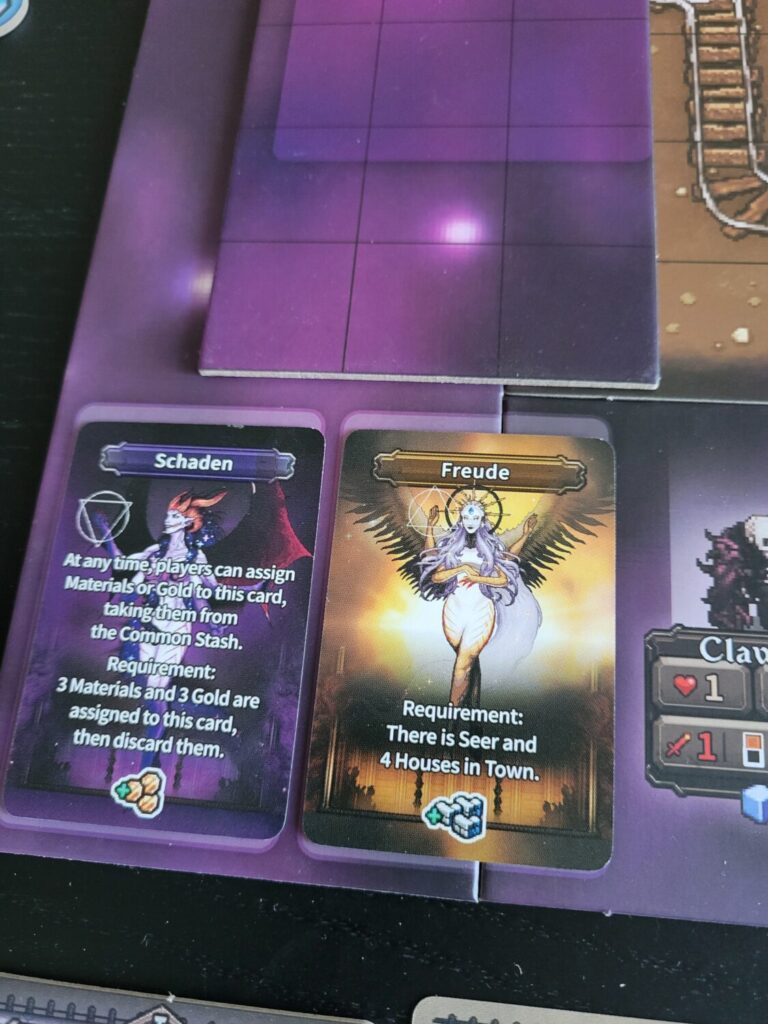
It’s not what I would expect from Nestore Mangone, who has worked on some games that I’ve really loved (Newton, Shackleton Base), but here he must have been working for a paycheck, because this is the dictionary definition of a paycheck game.
Again, being as generous as possible, it seems like they just ripped the exact mechanics from the video game and transposed them into a board game, without the comprehension that part of what makes video games work is that the computer is doing a ton of the work for you behind the scenes. Add to this that the game is cooperative, and the only innovation it is adding to the space is that the more people you add as interpreters of the byzantine and poorly written rules, the longer and more difficult to play the game becomes. There’s nothing interesting about the cooperative play, no fun communication limitations, no interesting plays on turn order, nothing. It’s just shared pain.
One more thing
Before I received a review copy of this game, I should have taken a look at the rulebook, rather than going based on the pedigree of the designer. Without the Esoteric Order of Gamers’ rules reference, I would have been unable to actually play the game. The volume of errata (go check out the publisher’s website) is staggering, necessitating a complete rewrite. Items as simple as defining adjacency are baffling, with the rules defining “horizontal” and “orthogonal” as items that are at odds with one another.
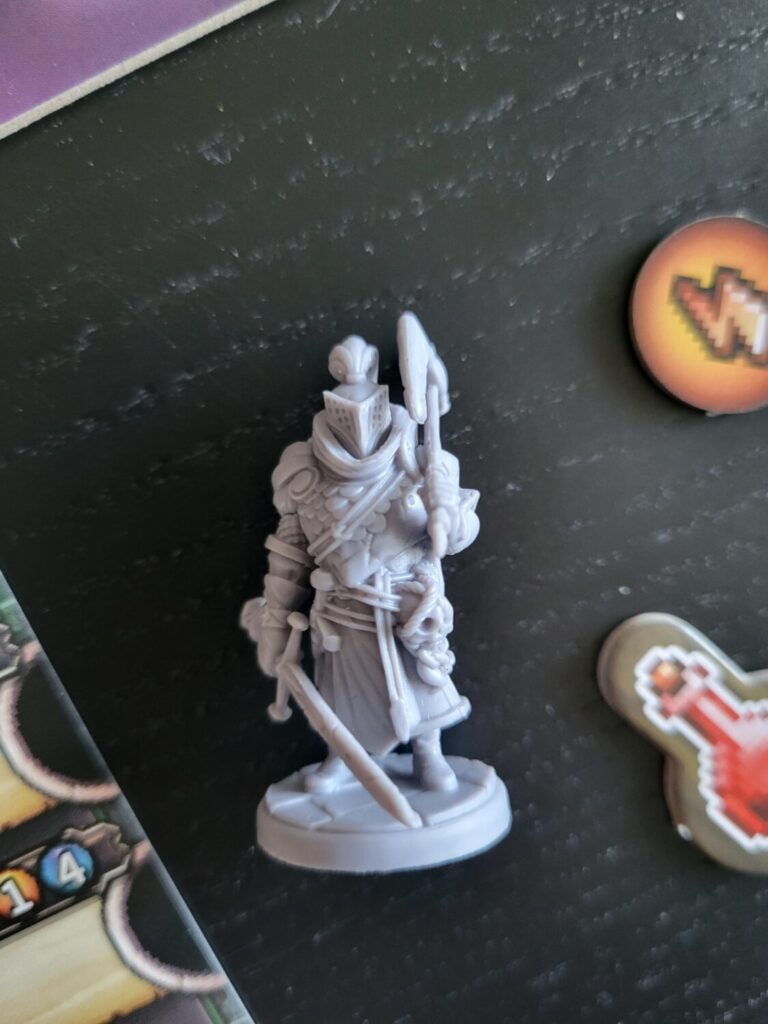
What about the line of sight rules, you ask? What if you had to use two comically bad rulers, get down level with the table, and look and see if you can make them see each other across the board? What if you had to do that with the 80 million pieces of cardboard I described earlier? Sounds fun!
This is the kind of game that makes me feel bad. Bad because there was enough money behind this to produce it, bad because people bought it, bad because it was a waste of my time and the time of the people who created it. If you want to play something like this, just play the video game; it’s cheaper and has low system requirements. If you want to play a cooperative skirmish game, go play Gloomhaven or one of about a billion other games that do a better job. If you want a competitive skirmish game, Imperial Assault, Earth Reborn, or golly, Wiz-War are infinitely better choices.
I need to go lie down.