
Disclosure: Meeple Mountain received a free copy of this product in exchange for an honest, unbiased review. This review is not intended to be an endorsement.
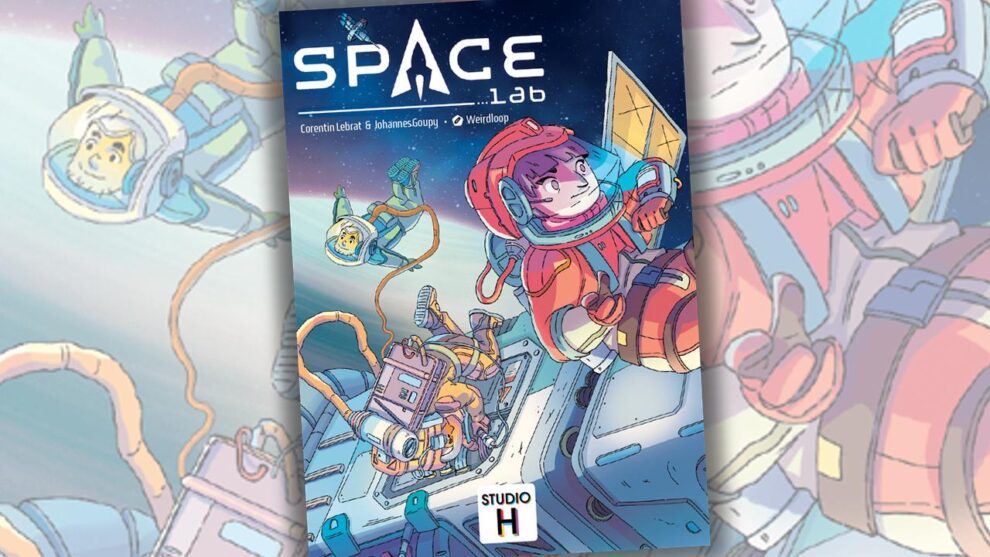
When I chatted with the team at Studio H during last year’s SPIEL Essen show in Germany, I was surprised when we ended the conversation with a throw-in game called Space Lab. The look, the feel, the pitch…all of it screamed “average fare.” (Maybe “screamed” is the wrong word there.) I took a copy, had a lovely conversation about Studio H’s stellar two-player abstract Leaders, then went on my way to the next meeting.
Just before I got Space Lab to the table, the game also appeared in alpha on Board Game Arena. This gave me the chance to load up a couple of async games with strangers (all of whom, like Studio H, were based in France) while also doing two plays of the game with my team in Chicago.
Across four plays (solo, two, and four-player counts), I know this much: Space Lab is at least average fare. It’s actually better than all right. The solo puzzle is something I enjoyed quite a bit, and the puzzle is just addictive enough to keep players coming back thanks to the very short run time.
Mission: Possible
Space Lab is a set collection, hand management, tableau building game for 1-4 players. Players are racing to complete three missions or place 10 cards in their space station first. When anyone does one of those two things, players get an equal number of turns to wrap up the proceedings.
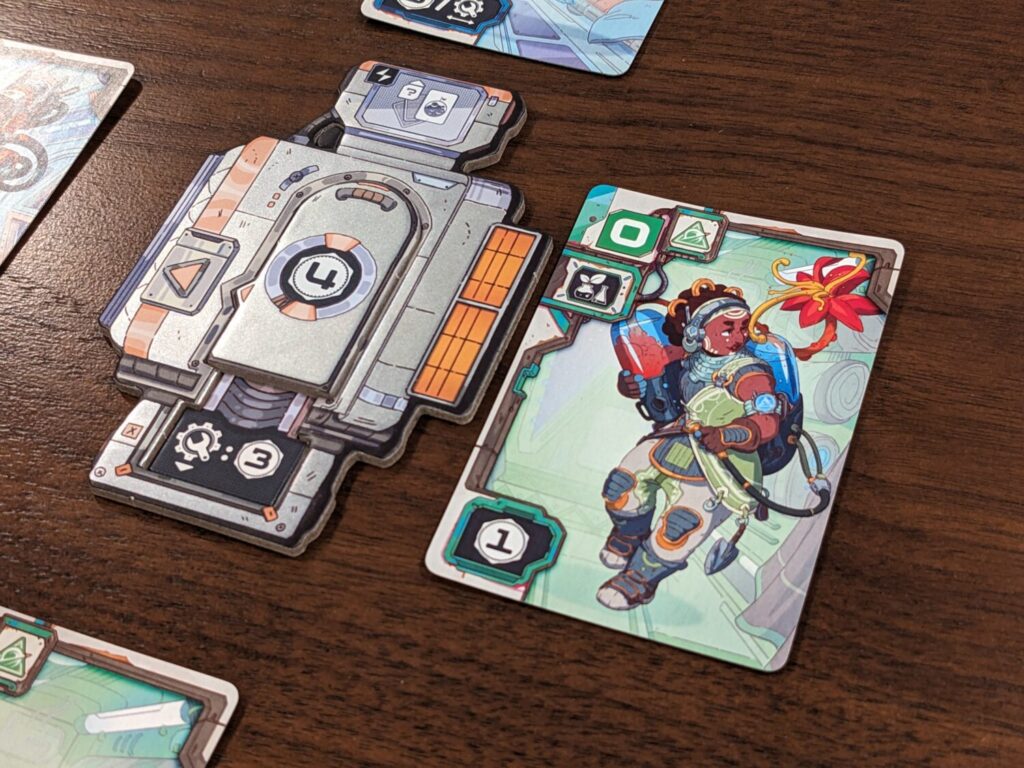
The hook with Space Lab is the missions. Before play begins, players draft three objective tiles that are inserted into these cute little capsules. These capsules are laid out so that there’s one on the left, one in the middle and one on the right. Cards will slowly build up a player’s station (tableau) so that cards will surround each capsule, with 10 slots in total.
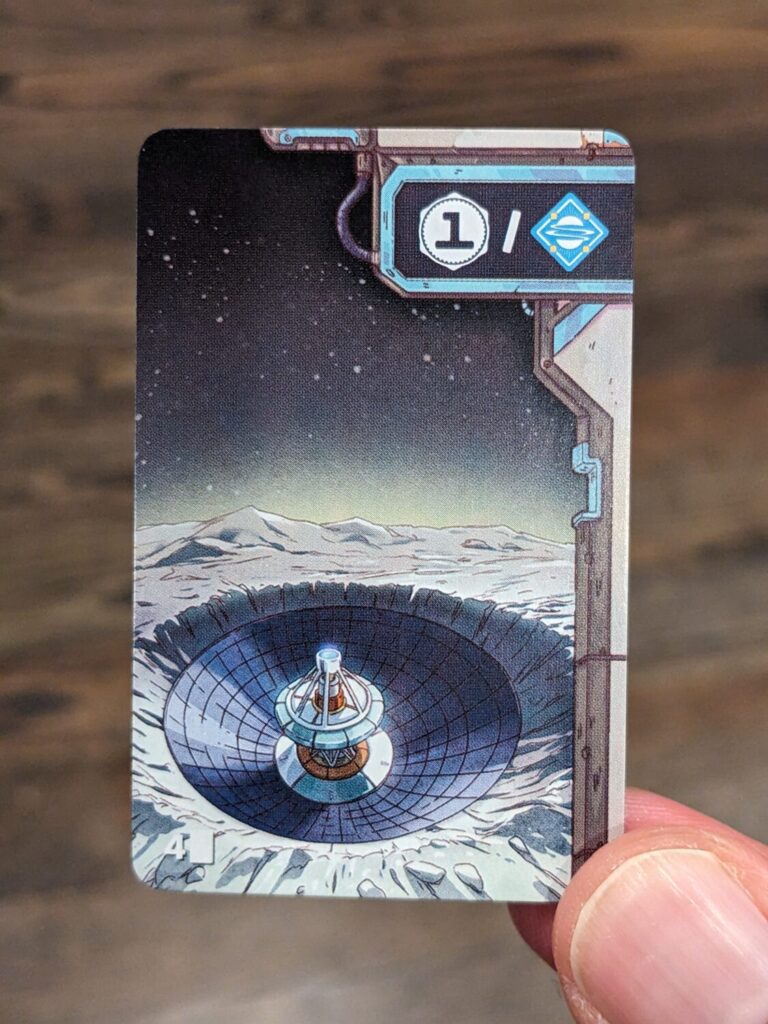
Turns are very fast. Players have three choices on a turn: draw three cards, play a card into the station, or pick up previously discarded cards from the “recruitment center”, a market that holds cards separated by the four color suits. When players draw their cards, they show those cards to the table, then keep all cards in a single color, discarding the rest to the recruitment center. When drawing cards from the recruitment center, a player can take all the cards of one color. Throughout the game, a player can never end a turn with more than five cards in hand…and if they begin a turn with five cards in hand, they must play a card to their tableau.
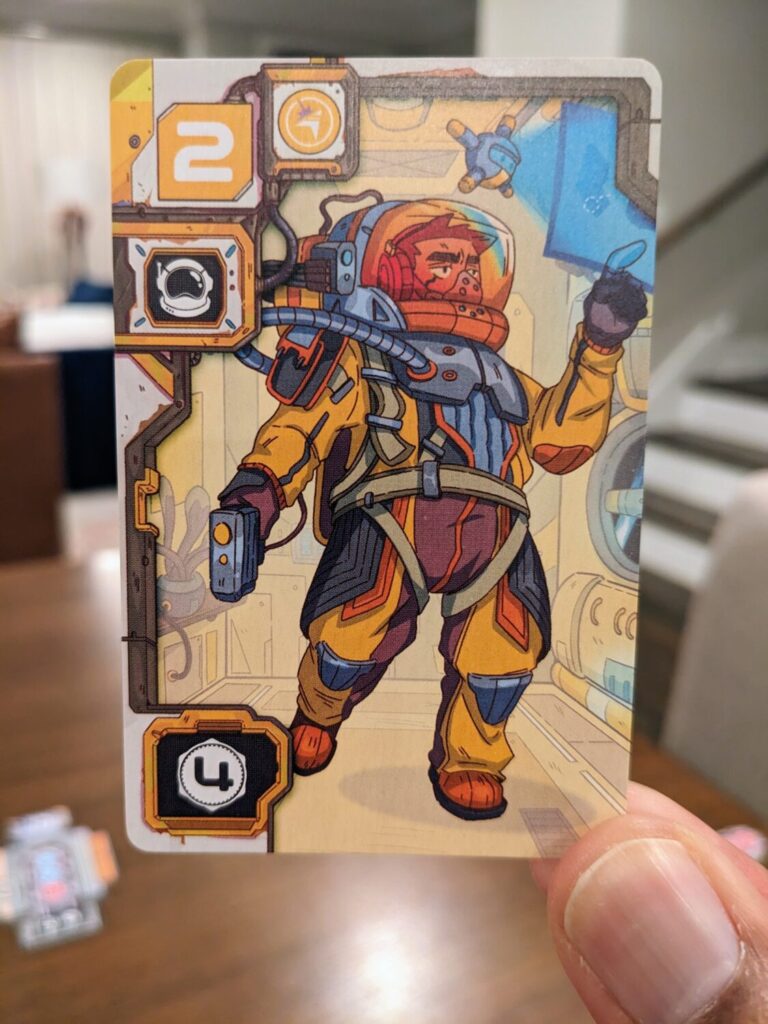
Space Lab borrows the card cost element that makes games like Race for the Galaxy and San Juan shine: the cost of a card is listed as a number in the upper-left corner, and the cost is other cards from a player’s hand. A two-cost card means I’ve got to shed two other cards that I might really want to play later from the game, so tough choices surface consistently.
So, choices are narrow. Slotting cards in certain spots is aligned with the objective tiles—the best way to score points in Space Lab is to surround each capsule with the cards that will eventually complete its embedded objective tile. That also streamlines play while also offering just enough choices for the game to be both juicy and quick. Space Lab is the kind of game where just one pass of the rules is enough to internalize what the game is trying to achieve.
Additional spice comes in the form of project cards. These are earned by either placing a card above a capsule or through some in-game effects. But my favorite part of the project cards is how they are acquired: project cards are drawn based on the cost of the card that was used to get those project cards, then from that batch, only one can be selected. So putting a zero-cost card above a capsule generates zero project cards, while placing a two-cost card allows a player to draw two project cards, keeping one.
Project cards are all conditionally tied to sets, with more matching cards leading to more end-game points for the holder. Basic cards score in a variety of ways—some with straight-up points, some that trigger based on the color or profession of other cards in the same row or the station as a whole.
Longevity is the Question
I had a game in my collection called Wild Space for years. Wild Space is another in this very long line of simple tableau builders with fun art, easy scoring conditions, a simple teach and a wicked fast play time. Wild Space used an action selection mechanic to get cards and trigger combos, but the point was the same: Wild Space, like Space Lab, rewards players who find the best ways to play the right cards at the right time as quickly as possible.
Space Lab is fun, and for players who love a simple tableau builder, the game checks most boxes. I liked the recruitment center option to pick up the scraps left behind by other players. The interaction here is low, so I think it works best as a solo puzzle or at low player counts, so the two-player game was my favorite play.
However, I was surprised how quickly I moved on from Space Lab after doing my plays. It didn’t tug at me the way other games in this category have, like the titles mentioned above, or recent card-placement conditional scoring games such as Tenby.
Space Lab was designed by Johannes Goupy and Corentin Lebrat, the award-winning designers of another well-regarded tableau builder, Faraway. Space Lab never reaches those heights, but as a pleasant 30-minute card game, Space Lab is an easy recommendation.