Disclosure: Meeple Mountain received a free copy of this product in exchange for an honest, unbiased review. This review is not intended to be an endorsement.
Disclosure: Meeple Mountain was provided a pre-production copy of the game. It is this copy of the game that this review is based upon. As such, this review is not necessarily representative of the final product. All photographs, components, and rules described herein are subject to change.
Several years ago, my friend Nathan introduced our group to Tyrants of the Underdark, a deck-building game that used Dungeons & Dragons lore for its setting. My initial response was dubious, as often happens with licensed product. The art, which Nathan had warned us about in advance, didn’t help. Dozens of artists are credited on the game, and many of their illustrations are not…good. The hodgepodge of styles did not promise a robust play experience.
Fortunately, first impressions can be wrong. Tyrants of the Underdark is an excellent, taut marriage of deck-building and area-control. It is wonderfully interactive, encouraging players to step on one another’s toes at every turn. The modular deck system, which changes the cards in play from game to game, ensures a good amount of variety. The game is both immediate in its pleasures and rewards deeper exploration.
Tyrants of the Underdark is exactly the kind of game that I would expect to be a cornerstone of The Hobby™. And yet. Despite the quality of its reputation amongst those who’ve played, Tyrants remains somewhat obscure. I can’t even tell if it’s currently in print or not. It is often hard to find. It begs for expansions, but it only has one, which is both long out of print and heinously expensive. For a game that threatens the top 150 on BGG, Tyrants might as well not exist.
It is only natural, then, that when I first heard about designer Tahsin Shamma’s Solarion: Foundation of Empires, which acknowledges Tyrants as an influence, I was delighted. Please! Yes! Absolutely! Let’s do it. Let’s tap that well. Not only is Shamma drawing from Tyrants, he has welded that system to an admirable attempt at boiling 4X games down to 80-90 minutes of relatively low-density gameplay.
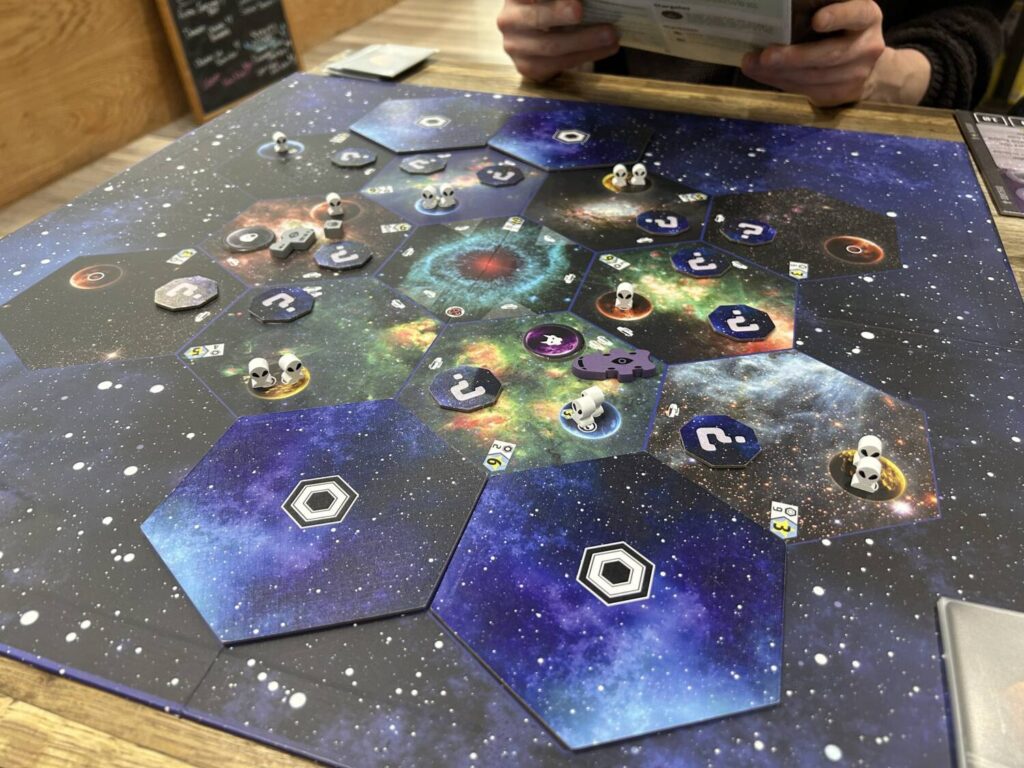
Shamma’s attempts at negotiating that marriage are where Solarion proves most interesting, though I will admit that what interest I draw from the game is academic. As a game, as an experience, Solarion is a bit too familiar and a bit too dry. Big though Shamma’s ambitions may be, the game itself doesn’t leave much of an impression.
The flow of Solarion is comfortable. Draw five cards, play as many of those five cards as you want, buy cards from the market. Some of your cards give you the money necessary to make purchases; some let you thin your deck; some let you draw cards; and some interact with the board, allowing you to move space ships, settle planets, explore space, and attack other players. The board itself constitutes randomized hexagons, each containing some number of planets to settle and technologies to discover.
The risk of making a 4X game card-driven is that players will find themselves unable to do anything on their turn, or unable to chain actions together in the right order. You need to move your ships to new areas before you can settle, so there’s not much you can do if you keep drawing the cards that allow those actions in the wrong order. Shamma gets around this with an action point system. Many cards give you Command Points that can be spent to move, build, and settle on your turn. It’s a smart idea, but this clever solution quickly bumps into some issues.
Bookkeeping around the Command marker quickly becomes tedious. There’s something about doing one thing (playing a card) to do another thing (moving the marker) to do another thing (moving the marker back several times as you complete various actions) that wears you down. “I’d rather the cards just let me do things,” one player said, which is probably not a good sign when discussing the game’s core mechanic.
The cards themselves are strangely flat. I don’t know why, exactly. It’s a hard thing to dissect. Even the strongest cards are not exciting to play, and though the numbers you generate over the course of each turn certainly go up, you don’t feel the accelerationism. The idea of making an intentional, surgical deck-builder that never goes off the rails is interesting in the abstract, and I’d play it, but that’s a different game than this. The pallid nature of the cards hobbles the game, as it would any deck-builder. It is a particular shame in this case, because the ideas behind the card market itself are probably my favorite part of the design.
The deck is made up of cards that belong to each faction in play, a smart and natural evolution of Tyrants of the Underdark’s modular system. If I choose the Ersaliens, I take their starting cards to form my deck, and the rest get shuffled up into the market deck along with the cards from other factions in the game. Six cards get revealed off the top, and there’s your market.
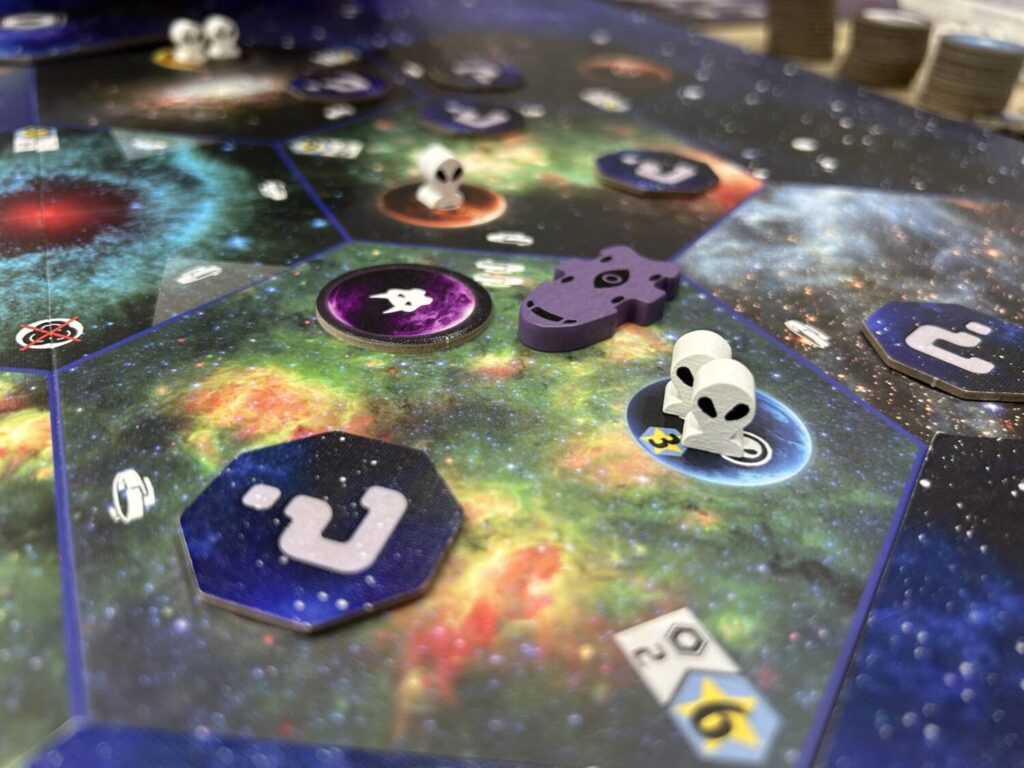
When purchasing from the market, you can buy any card you want. It does not have to belong to your faction. You do, however, get a slight discount on your own cards. That is a great way to suggest asymmetries while leaving players open to explore the kind of game they want. It’s also a great way for emergent narrative to take hold. In theory, with carefully calibrated factions and the kind of development work that goes into something like Dávid Turczi and Nigel Buckle’s Imperium, a card market system like the one found in Solarion could result in something truly tremendous. But that is not the case here. The cards between factions are largely the same. They don’t impart a unique texture to the game state. Any group of factions will feel no different from another. There is a massive promise of variety without the follow-through.
There are some great ideas in this box, but they don’t cohere. The area control is cleanly implemented and encourages a climactic final battle over the center of the board. The presentation is solid, with all the player ships adding a particular amount of charm. The three scoring phases are easily resolved. I’m impressed by how slim and chic the rules are, though I can’t help but wonder if Solarion: Foundation of Empires would be stronger if it were a bit more jagged. Sometimes you need those edges.
This leads me to an unexpected conclusion: Solarion: Foundation of Empires would benefit from being less indebted to Tyrants. Tyrants of the Underdark is an impeccable commercial product, a smooth-running machine that generates joy. Solarion follows that model to a strange state of anonymity. The makings of a fabulous board game are in this box, though the game itself is nowhere to be found.