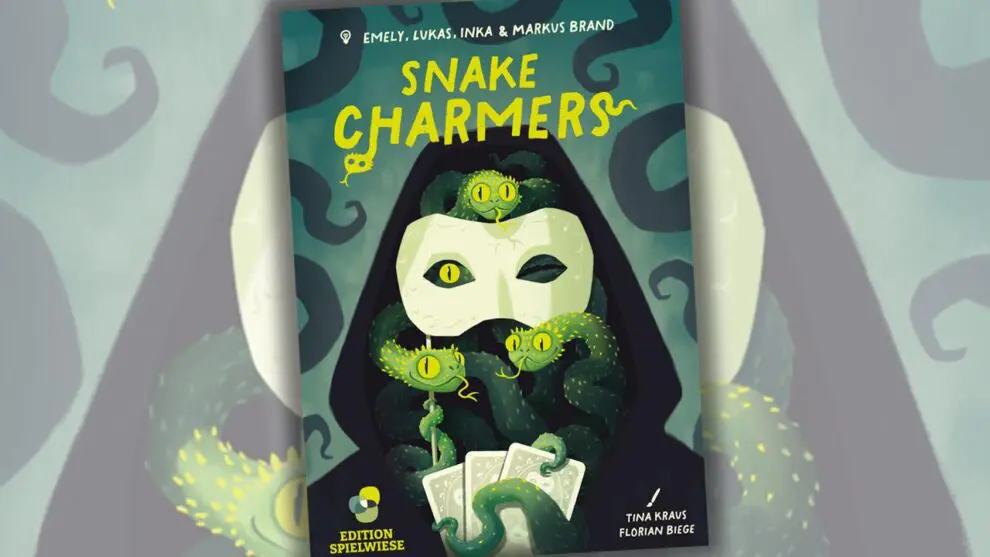

Disclosure: Meeple Mountain received a free copy of this product in exchange for an honest, unbiased review. This review is not intended to be an endorsement.

My cutesy observation about Snake Charmers is that games with simple rulesets are the hardest to explain. The game is basically Flip Cards: The Card Game—how exciting could that be?
For your flipping card money, though, this is one of the best in the biz—I’ve been enjoying the heck out of this quasi-social-deduction game in the vein of Cockroach Poker and Skull.
The flippening
To simplify the explanation, I’ll explain the game as if we had 4 players around the table. You shuffle a deck of 9 chunky “mask” cards, that are individually numbered 0-6 plus two cards that have snakes on them, dealing them out to the players at the table. One player will end up with 3 cards, making them the start player. Each player receives a double-sided door card with an open door on one side and closed on the other. In a common display, 6 cards numbered 1-6 sit.
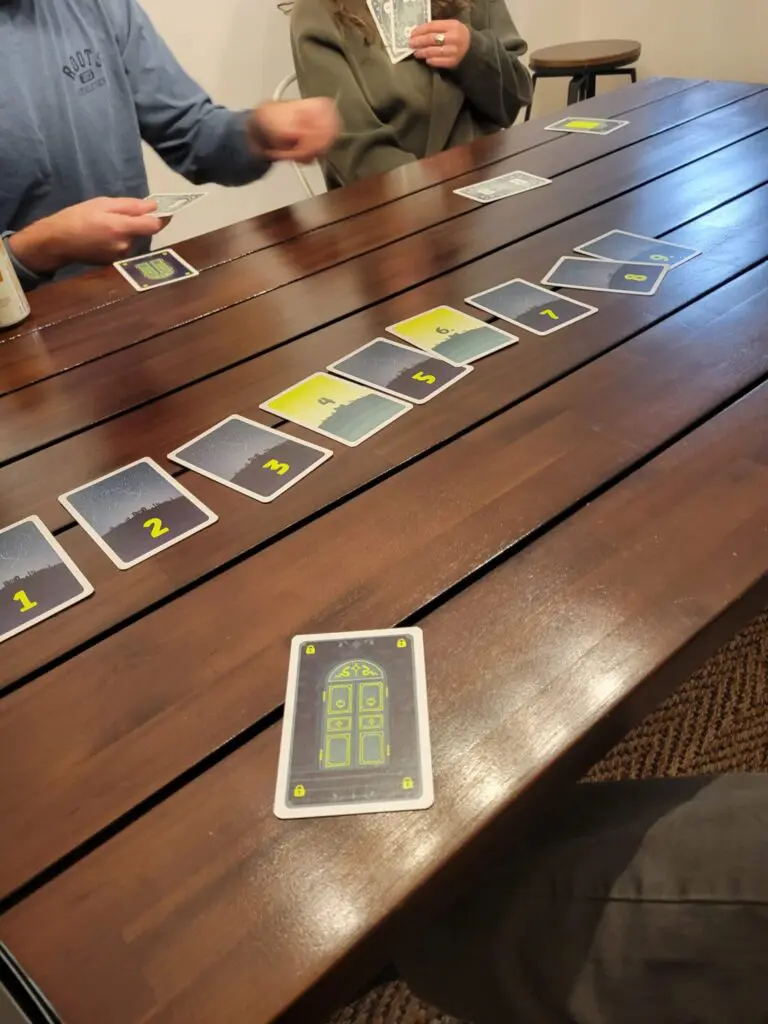
Starting with the player with 3 cards, they choose another player and offer them a card. They can say (truthfully or as a liar) that it’s a number from 0-6 or a snake. They choose to refuse or take the card without looking at it. If they refuse, the offerer tries another of their 3 (not the same one). If the card is refused a second time, they repeat the process, but the receiver must take the final card.
The person who received the card looks at it, then must give the group information by flipping or not flipping one of the cards in the central display. If, for example, they were handed a 1, they flip the 1 card to its daytime side. If on a future passing round, they received a 1 again, they would remove the 1 card from central display from the game. The person passing cards may lie, but the receiver must always flip or remove a card if possible. If they receive a card that has been removed, a zero, or a snake, they do nothing.
The receiver will then have three cards, and they’ll select a new victim to pass cards to, but only ones who haven’t been passed to this round (that’s what the door cards are for).
If you’ve played Cockroach Poker, this is a sort of modification of the bluffing rules. But, I haven’t explained how you win, or why you’re passing cards around.
*snake sounds*
There are two teams in Snake Charmers: those who have snakes in their hands, and those who do not. The non-snake holders want to have all the central cards flipped to the day side. When this happens, they win. If there’s only one card left, and it is on its night side, the snake holders win.
So, the object of the game is to try to correctly determine what team you’re on and win with the team, or change teams and go with the (current) tide of victory. But, as is the complication with these games, it is less about successfully lying or telling the truth—rather, it’s about managing how the group perceives you. You can be a bumbling idiot, an honest truth teller, or somewhere in between.
I don’t like being forced to lie in games, and this is one where you don’t have to do that to win. It’s more important to create partnerships with your limited information than to dogpile or punish another player. That said, you can do that too if that tickles your fancy. And it plays in less time than it took me to explain it.
It’s a great evolution of a game I already love, and it’s a great one to start or end an evening of gaming and get people warmed up socially. I recommend the variant that speeds the game up (you remove the lowest day card at the end of a round), and before long, you and a group of 3-5 other strangers will be wheeling and dealing, trying to banish or attract the snakes. It’s a good game, as abruptly over as this review, and you might need a second once-over to see its positive qualities.
Snake Charmers details
- Designer: Emely Brand, Inka Brand, Lukas Brand, Markus Brand
- Artists: Florian Biege, Tina Kraus
- Publishers: Edition Spielwiese
- Release Date: 2025
- Player count : 3 - 6
- Age range : 8+
- Time range : 15 - 20 minutes
- Mechanism(s): Deduction, Hidden Roles, Hot Potato, Semi-Cooperative Game, Traitor Game
- BGG Geek Rating: 6.60355 - converted to Meeple Mountain scale: 3.5.
- More articles about Snake Charmers.