
Disclosure: Meeple Mountain received a free copy of this product in exchange for an honest, unbiased review. This review is not intended to be an endorsement.
I’ve been struggling to poke holes in the design of the new game Size Wise, designed by Scott Brady and published by GameHead. And, here’s what I have got:
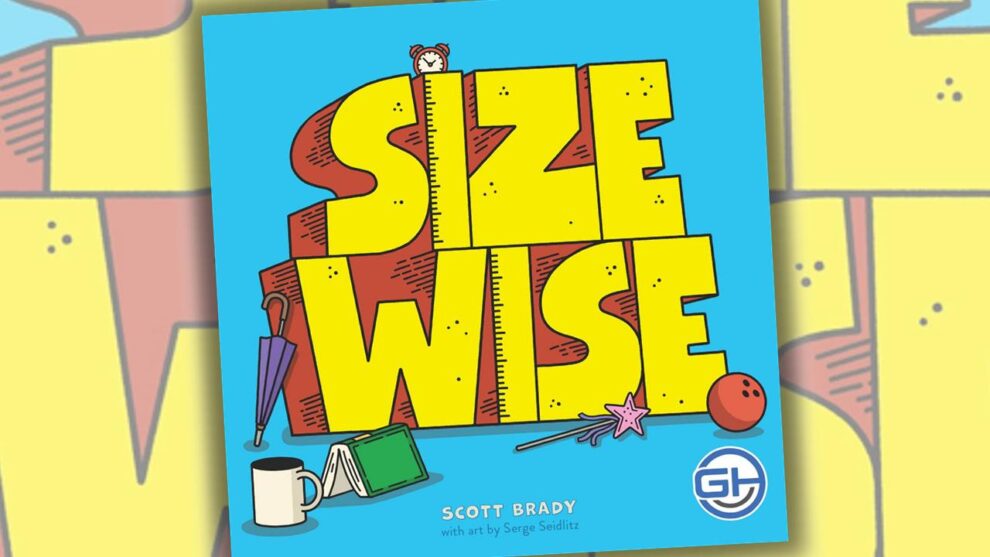
The people who made those old Tootsie Roll ads from the 1970s should feel burned that artist Serge Seidlitz made an owl for Size Wise’s box and tokens that looks a heck of a lot like the one who knows how many licks it takes to get to the Tootsie Roll center of a Tootsie Pop. Like, everyone of a certain age who has seen the rulebook and the tokens has commented that the owl looks exactly like the one from those old commercials! (I haven’t reached out to GameHead for comment…but, they know. I KNOW they know.)
Size Wise is a party game for 3-8 players that plays in about 20 minutes. I tried Size Wise three times at different player counts: four, seven, and eight players.
Everyone loved it.
Across a series of turns, players collectively flip a card from a deck, with six different items on each card numbered from 1-6. The backs of the cards are also numbered from 1-6, so when a player flips a card, they then look at the top card of the draw deck to see which number the table is forced to use for this turn.

Then, each player, armed with a string in their selected color, measures out the length of the selected item for this turn by moving a slider ring to the length they think that object is. Once everyone has done this, everyone places the ring on a small wooden stand, then someone lifts the stand sideways so that all players can see what everyone used for their guess this turn.
It’s important to note here that the item selected for that turn cannot be discussed. That means players also can’t discuss what angle they might be going for with an item…so, if “book” was the item in question, no one can blurt out questions—“Are we talking the WIDTH or the LENGTH of the book? or “What kind of book?”—because everyone needs to use their imagination to come up with the answer in string length form.
When player strings are compared, the player who had the shortest and longest answers lose a wisdom token, then play continues to another word. When one player is out of wisdom tokens (tokens that were distributed during setup, scaled to player count), tied players with the most leftover wisdom tokens win the game.
As I noted in a recent BGG article, Size Wise doesn’t sound like much on paper. But when “alligator’s mouth” is the active word for a turn, the game’s sneaky magic surfaces in a way that I didn’t initially think would amount to much. I was wrong.

I can still hear howls of laughter as players tried to figure out the size of things ranging from traffic cones to the size of an elf’s shoe to a wizard’s beard to more mundane items like a corkscrew. During a play with my family, one child started to ask a question because the word “hubcap” was foreign to them.
“No talking!” was the response. So, that child did their best to guess the size of a hubcap, having no idea what that was. Because there are no right answers, all that matters each turn is the same thing: are you wise enough to fall within the average of what everyone else thinks, without straying too far?
That’s Size Wise. It’s incredibly quick. It comes in a very tidy box, perfect for a purse haul to your next game night. You will laugh, and even the person who goes out first will find themselves laughing right along with the chaos. You can teach it to a nine-year-old, which I know because I taught it to my nine-year-old.
There will be debates. The game’s deck has unlimited potential, and it wouldn’t shock me if another deck of cards comes along to spice things up in a year or two. And, unlike some of the other party games I have tabled this year, I don’t own anything comparable to the style of gameplay that Size Wise offers, meaning it will earn itself a permanent spot in my party game collection.
Buy a copy of Size Wise, stat!