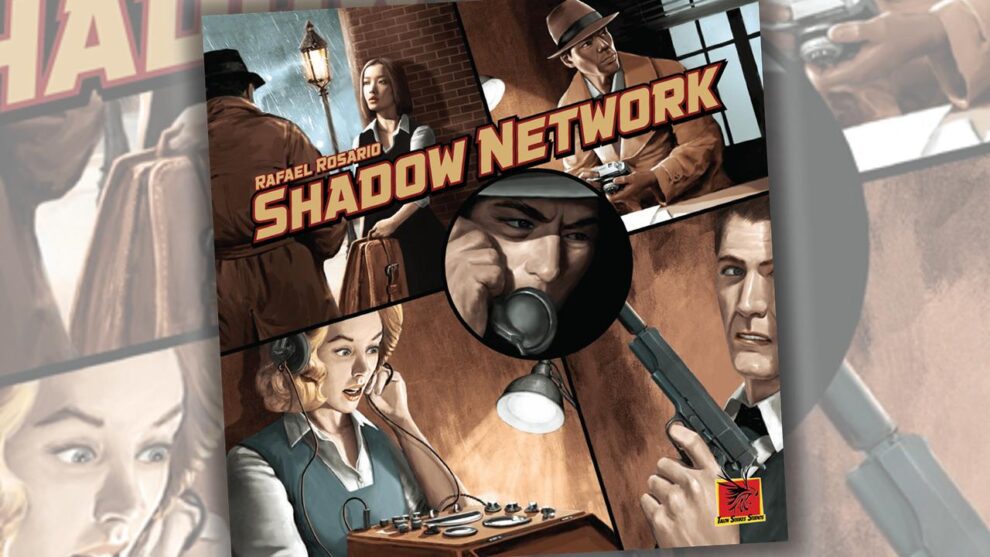

Disclosure: Meeple Mountain received a free copy of this product in exchange for an honest, unbiased review. This review is not intended to be an endorsement.
Opening the Dossier
The year is 1960. Well, no, it’s 2025, but play with me in this space. Spies and secret agents are gathering intelligence on heads of state, technology, military operations, and anything else of value. However, as is the case with most spy stories, the risk of intel leaks runs high, and all one agency needs to get a leg up is the right piece of information. This sets the stage for Shadow Network, a 1-5 player worker placement game from the team at Talon Strikes Studios. Each player will take turns deploying their workers around the world to various sites to collect intel pieces, which can be combined to create cases against high-profile targets and earn influence. It’s all dripping in sexy spy novel pastiche, which makes for an alluring theme.
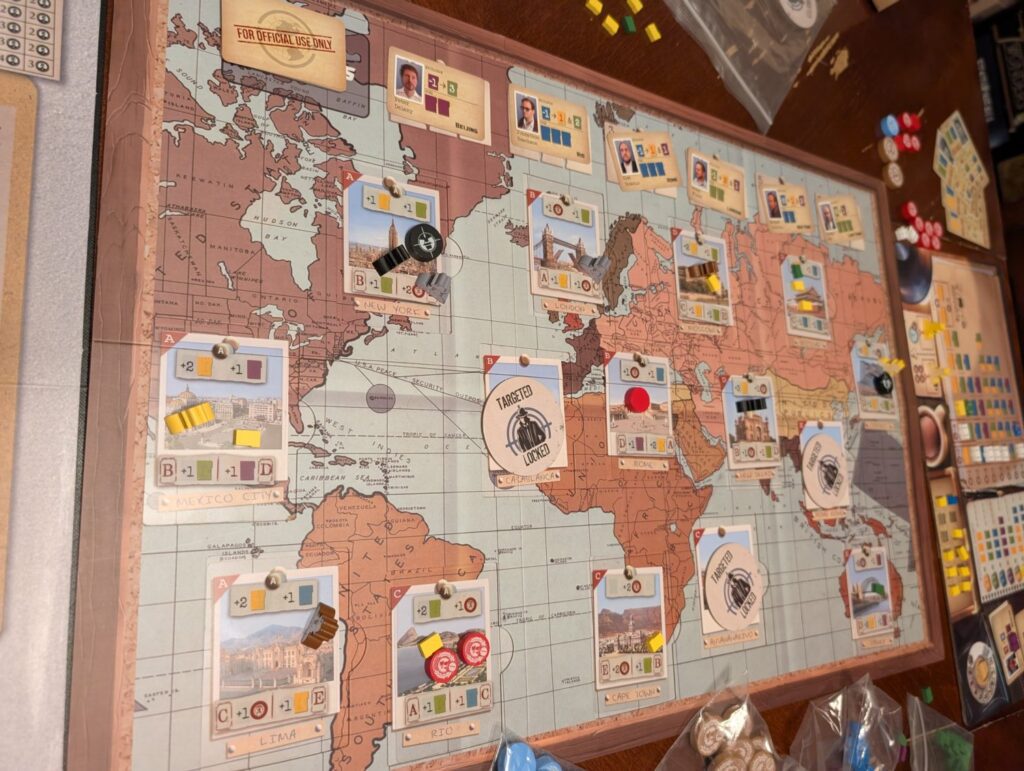
On your turn, you will send one of your four agents to a location where you do not already have an agent. You’ll have your choice between your two on-call agents, who must be deployed each round, and two optional agents who can be deployed, but can also be saved for end-of-round bonuses. Then, your agents will collect any data at the location where they’ve been deployed. Every time an agent moves to a location to collect data, extra data will “leak” across the map. During setup, each location is dealt a clear overlay card that determines what type of data it produces. When information “leaks”, the active player gets to choose from a pool of other locations on which to place data. Then, the next time an agent goes to that location, that player will collect the printed default data plus any “leaked” data placed on the location. In theory, this creates tough decisions, where your preferred location might lose out in value versus a location where your opponents are stacking leaked data. The value of each of the four colors of data varies by rarity.
During this time, you’re using your accrued data to complete contracts, earning you influence you can spend on the black market or to hire analysts, who let you convert your data on the cheap. This continues for four rounds. At the end of the game, you gain influence for each completed contract and lose influence for any contracts that weren’t completed.
Cover Story
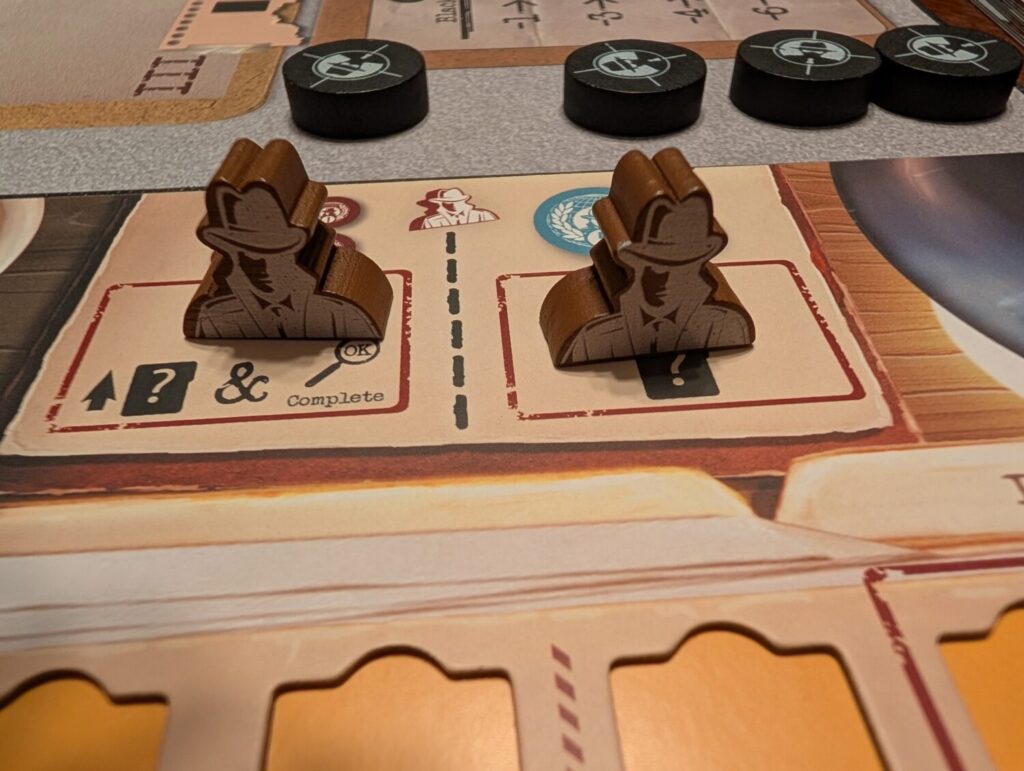
The game has a unique thematic visual style. If there’s one thing that designer Ralph Rosario prioritized, it was maintaining the distinct 1960’s Cold War aesthetic throughout. The main board looks like an old corkboard with thumbtacks holding Polaroid photos in place at each location. The player boards are filled with thematic flourishes like a rotary phone and coffee mug, and the wooden tokens are hefty and colorful, though I will forever implore designers not to use both blue and green because under certain lighting, those tokens wind up looking too similar. All the boards included with the game are double-layered, ensuring your tokens rest nicely in the slots and don’t get knocked around everywhere.
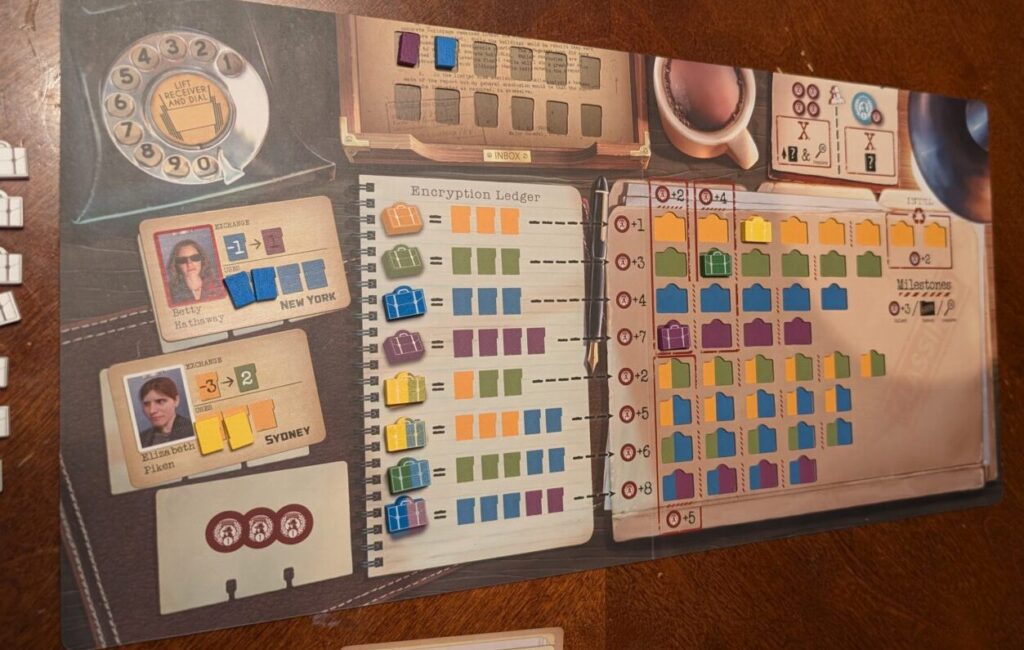
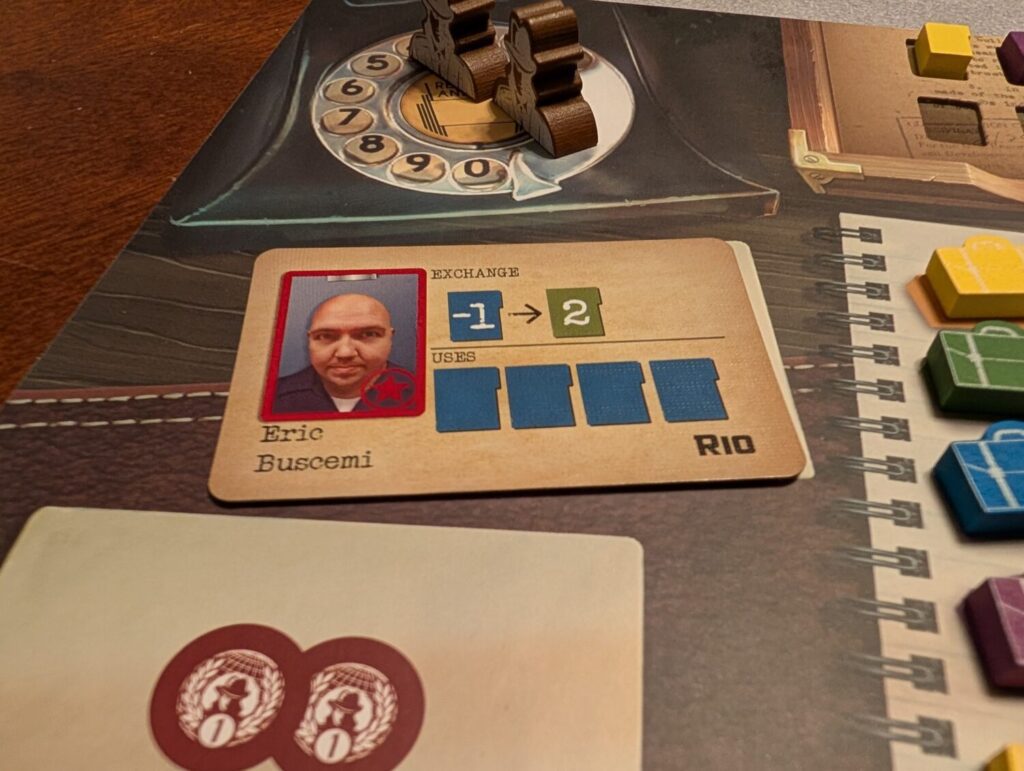
However, there are some areas where the game missed the mark with presentation. First of all, the character photographs of each of the handlers and contracts are repetitive, with the same people photographed from slightly different angles. I assume this was a cost-saving measure, but it certainly breaks the immersion of the theme. Secondly, and perhaps most annoyingly to people like me, the wooden intel tokens aren’t of a uniform size! This is most likely a factory error, but if you are borderline OCD about things like that, once you notice it, it will continue to bug you. Finally, there was clearly an idea to infuse the theme into the components by having four different types of intel, but not once at the table did we remember that yellow was political intelligence, or purple was top secret intelligence. We just referred to them as blue, green, yellow, and purple files, which removed us another step further from the game’s theme and immersion.
There are also areas where perhaps a tradeoff of theme for functionality would’ve improved the experience. For example, the Secret Data cards are cool, transparent overlays that slot into the various city locations on the map. However, we found the process of using them annoying, because they stick together easily, and because they are transparent, it is borderline impossible to tell where the missing cards have gone. The Target Contracts include photos of each target along with short biographies, including where they’re from; however, this information is mechanically useless, and only serves to clutter up a card that can already be slightly confusing to read.
Closing the File
Overall, after our experiences with the game were done, we all walked away shrugging. It has some cool components and an interesting theme, but it never feels like Shadow Network’s whole becomes greater than the sum of its parts. There are plenty of cool ideas simmering beneath the surface that I genuinely love. There’s very little downtime in between turns, as you’re encouraged to do all your exchanges and contract completions while other people are taking their turns. The transparent overlay cards changing up the board state, keep each game feeling fresh and unique. The theme is obviously great, and I love the idea that leaking intel gives players influence over which spots become more valuable over time.
I think the reason this missed for me is partially because the theme brings along a ton of promise. I’m a sucker for a good spy theme, especially since I spent the better part of elementary school marathoning every James Bond movie in my friend’s theater room. I’ve been to the theater to see every Mission: Impossible film. For those of you looking for more spy media, I can’t get enough of Gary Oldman in Slow Horses on Apple TV+. All of this is to say if there’s someone who was primed to really devour a good spy theme, it’s me.
But here, the theme sort of fades away into the background as the disparate mechanics take the foreground. It never feels like you’re doing any real spying. Honestly, it feels a bit like an accounting simulator, where you spend the bulk of your time converting one currency into another into another, so you can track your totals on a completely separate board. The way all the parts interact just feels like it never quite clicks, which is a shame, because it feels close to being something great.