
Disclosure: Meeple Mountain received a free copy of this product in exchange for an honest, unbiased review. This review is not intended to be an endorsement.
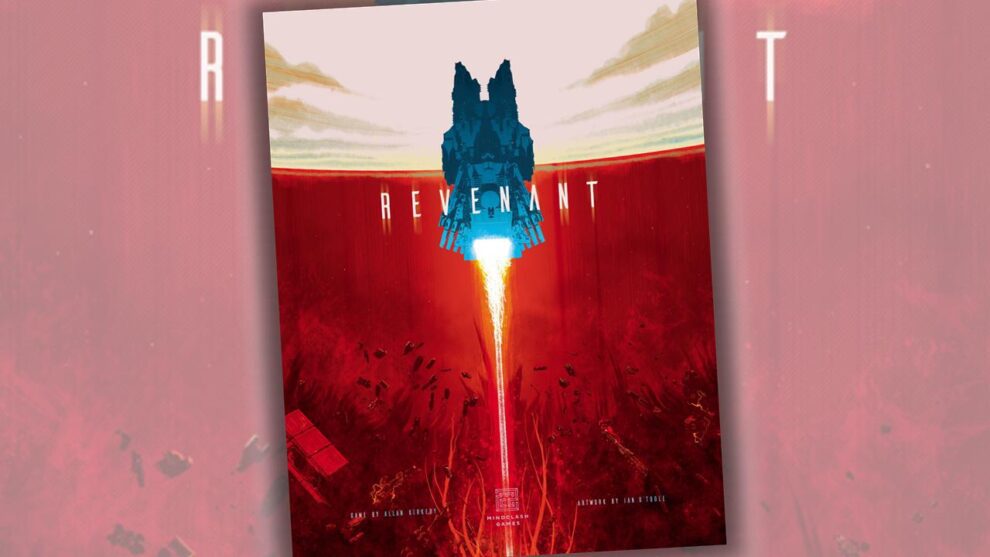
The new game Revenant (2026, Mindclash Games) arrived about a month ago, and it took me a couple weeks to get the game to the table for my review plays. Between the ruleset (complex) and the playtime (substantial), tabling any game from Mindclash is typically a big endeavor.
Now that I’ve finished four plays—once at three players, twice at four players, then once solo—I have a lot of thoughts. For those on a time budget, I’ll say that Revenant is worth a look, particularly for fans of worker placement games where the options for players truly change over the course of the play experience. I’m also surprised to share how many factors of the Revenant experience align with other classic market manipulation games I love, from Acquire (or games that use an Acquire framework, such as Dawn of Ulos) to 18xx games to any games you know that feature hidden shares.
One thing that Revenant is NOT, though, is a Voidfall game. Let me explain.

Stellar Ventures
Revenant is a worker placement game for 1-4 players. The game is set in the Voidfall universe, so it uses some of the House factions from Voidfall as well as their matching illustrations to illuminate its world-building, and Revenant does a great job of creating a setting from the chaos referred to in Voidfall.
The evil Voidborn forces are on the attack, and the House factions featured here are doing their best to fight off the Voidborn while using a capital ship known as the Revenant to drag a host of Arkships, Fighters, Frigates, and Fighters through hyperspace to temporarily ward off the Voidborn.
Across four rounds and a total of 12 turns, players take on the role of “rival admirals coordinating the defense of a fleeing starfleet and competing to earn influence with the factions that stand to survive the journey”, per the manual. Apparently, the Revenant is carrying the data that contains the legacy of all of civilization. Sounds like a tall task!
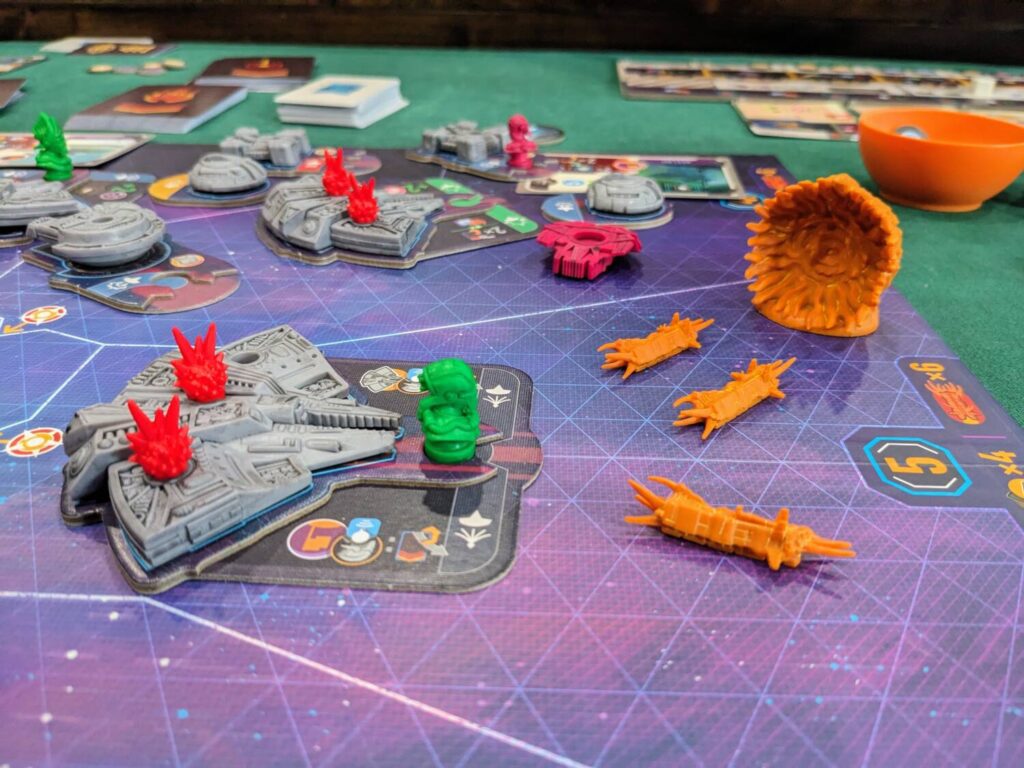
Revenant, the game, positions itself in a way that players try their best to gain influence with some or all of the seven available Houses in the game by taking actions from the ships currently on the map board of space. I say “currently” because House ships do a lot of dying here, so your choice of worker placement locations are absolutely the definition of “shifting sands.”

There are three types of House ships with action abilities, one of each from each House: a Fighter for battling, a Dropship for visiting planets, and an Arkship for taking major actions. When the game begins, players start a turn by using one of their three crew members to pilot these ships and take actions that align with the ship type.
There is a LOT going on in Revenant, particularly for a game that features some very short turns. In that way, I’m thankful that I never had to teach this game myself; the official teach video from Gaming Rules does a great job of that, but even that excellently edited video takes 40 minutes to work through. Teaching this at a table to other players would take at least 45-60 minutes, and that’s before we talk about the graphic design and the iconography, much of which is new even to Voidfall veterans like myself.
I’m surprised to say that my Revenant onboarding was not as easy as I had hoped when the game arrived. Even during my third play, I constantly referred to the game’s icon legend and card index located in the back of the solo rulebook. That’s because the game features 90 Operation cards that are used to push a few different areas of the game.
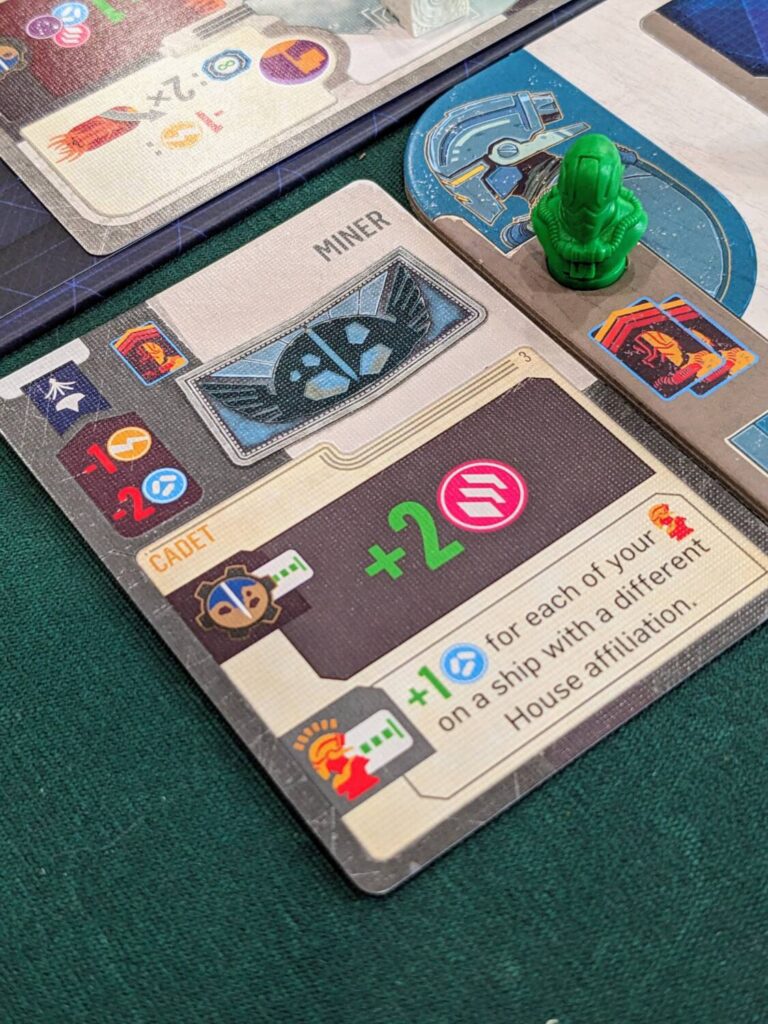
Operation cards come in three flavors: Cadet, Frigate, and Command cards. Cadet cards drive a crew-crafting system that pushes players to personalize the abilities of their two cadet meeples. Command cards offer one-time bonuses, some of which are fairly tame while others can be used for more significant actions, such as rebuilding House ships. Frigate cards serve two purposes: every Frigate card after the first offers a one-time bonus that escalates with each new Frigate card, and all played Frigate cards make the use of your personal player ship much more interesting.
There are eight different Crew board options, four unique sets of Frigate board bonuses, Secret Agendas, track bonuses, and a few other goodies, so between the Operation cards and these other features, Revenant’s best trait might be the variability packaged into each play. My four plays felt very different, and I focused on one Operation card type to drive my playstyle in each of my first three plays to wild effect.
(My favorite play was the one where I went hard on Cadet cards; tricking out my cadet meeples with two cards each helped me turn one into essentially the Starship Enterprise, with a bunch of effects that triggered when I used that pilot to land on a planet, with the other turned into a tail-whoopin’ fighter pilot that earned bonuses for doing a lot of fighting and not a lot of moving, useful when I wanted to wipe a sector clean of Voidborn forces.)

Bear Raid
Everything in Revenant funnels into a market manipulation game that outshines its worker placement format. In fact, Revenant is much more of a stock game than a worker placement game.
The Influence board is the heart of Revenant’s end-game scoring. There are two things to consider. The first is that there are seven tracks for the seven Houses in the game. Each track has eight spaces. As players take actions, they first place one of their crew members (either one of the two cadets, or their Captain) onto a ship, then advance one space on the track of that House. Some track spaces have a minor bonus for the first player who reaches that space.
But this choice alone is fascinating. If you need to just shoot down Voidborn ships, you can use any Fighter for that, but depending on which of the eight sectors of the board you want to clear of the Voidborn presence, you’ll want to pick a ship that suits your needs. Some sectors are seeded with a planet card that might provide resources, “Discovery Data” cubes, or Mining symbols that sync with played cards to trigger an additional river of bonuses. Using a Dropship helps with those planet cards, but picking just the right House for the job is an additional consideration.
That’s because of the second thing about that Influence board: each track has a Power rating, from 0-4. At the end of the game, you score 0-4 points based on where your marker ends up. If you are on space six of the Yarvek track, and Yarvek ends the game with four power, that just netted you 24 points.
That also means you are very invested not only in taking future Yarvek actions, but you are REALLY invested in keeping Yarvek ships on the map. Because Power is tied to presence. Each House begins the game with three ships on the map, and a fourth ship type (Shuttles) that can be added to the map using one of the major actions on an Arkship.
Revenant gives it to you straight: House ships are almost certainly going down at the end of most rounds. At first, there might not be any that bite the dust. But by the game’s late stages, expect to see some Houses with one, maybe two Power, or in an extreme case, maybe zero Power, because all their ships crashed and burned. If you spent the early part of the game investing in House Shiveus, it’s going to hurt when you see other players intentionally neglect sectors with Shiveus ships, causing those ships to be destroyed and their stock value (whoops, Power value) disintegrate into nothing.
There’s one other thing about investments: not all of them are public.

While every player has a certain amount of public influence on each track, making it easier to see that I am a Zenor man because I’ve been pushing my marker up the Zenor track in a particular game, every player also has “Hidden Influence” cards that can be procured in a variety of ways. Everyone gets two of these Hidden Influence cards during setup. But each time a player contains three Corruption tokens or collects three Discovery Data cubes or uses their personal Frigate ship or uses an ability that triggers through a variety of other game effects, they get even more Hidden Influence cards.
These are effectively shares in one of the seven Houses. In the early stages of Revenant, players care a little less about the House printed on the card, because they can always burn a Hidden Influence card to convert it into one of the game’s four core resources (Materials, Energy, Science, Neutronium). But later in the game, hoarding shares in the best, most Power-ful Houses is vital.
When it becomes clear that, say, the yellow player is building up an investment in House Belitan, you could follow the leader and take more Belitan actions on the board…and, you can also build up your hidden Belitan holdings every time you can draw and choose from a selection of Hidden Influence cards.
Yessir!!!
If you are a fan of economic worker placement games, Revenant is a home run. While no money is technically changing hands, we found during our review plays that Revenant works better as a teaching tool when you convince other players that they are investing in a portion of the best Houses. Finding ways to build up your portfolio of shares in those Houses is the majority of your end-game score. In the two multiplayer games that I won, I found ways to score sizable amounts of victory points by grabbing as many Hidden Influence cards as I could in the best 2-3 Houses in that game…and I went out of my way to ensure that the other Houses lost ships during the Skirmish phase at the end of each round.
Mindclash, I Have Questions
No one can hear you scream in space, but I did have a number of minor complaints about Revenant that dragged down its score.
It’s fair to say that I am a Mindclash fanboy. I did, after all, pay my own way to fly all the way to Budapest to spend time with their team. So, it pains me to report some of the following objections I have to the game’s final design.
My biggest issue with Revenant is the playtime. Each multiplayer game ran between 2.5 and 3.5 hours. Given that Voidfall is a game that usually takes about an hour per player, I am somewhat shocked to say that, depending on the speed of the people in your gaming circles, Revenant is not necessarily the shorter game. My three-player game took about three hours and 15 minutes, and that was my third game, one player’s second game, and another player’s first experience.
On a turn, assuming all House ships are still on the board, the active player has the choice of maybe a dozen different actions. That’s a lot. However, if a player has been preparing for their turn, they won’t need much time to execute. After a player’s main turn, they get the choice of taking one of five bonus actions. Some bonus actions are as simple as spending three science tokens to upgrade the ability of their Captain. One is even simpler: take one resource from the supply.
Sometimes, I found that I could take my entire turn in less than a minute. “OK, I’m using a cadet to operate the Dunlork Arkship, and that gets me two science. Then I’m going to spend those, plus a Hidden Influence card as a science, to upgrade my Captain.” Entire turn, done.
Sometimes, though, the actions are significantly more complex. “OK, I’m using my Captain to use the Belitan Arkship to play an Operation card at a one-resource discount. Before I take my action, my Captain ability lets me…” And then the river of multi-combo goodness begins to flow, at least for the active player. For everyone else, downtime can be significant in rounds where all players are doing more complex operations. And because of the end-game scoring mechanic, you will need to pay attention to what those other players are doing. If they suddenly dump their House Belitan stock by letting a Belitan Dropship stay exposed to Voidborn attacks in that Dropship’s sector, you’re going to need to pivot.
And that’s the rub, because I recommend playing Revenant at the full player count over the lower ones. I enjoyed my three-player game, but the four-player games featured a lot more action with track manipulation, interesting cardplay, the use of Captain, Cadet, and Frigate abilities that shook up the game state, and a little more guessing at which player was hoarding which Hidden Influence cards when end-game scoring came around.
Playtime will certainly come down a tad once players have a few plays under their belts, so if you are working on setting up a Revenant play group, now’s your chance to shine. But 90-120 minutes, which is listed on the box? I would be surprised if four players can knock out a game of Revenant in two hours, even after their first couple plays.

I’m somewhat shocked to report my second issue with Revenant, because it is production related: there’s no way on Earth I am letting this game out the door without a detailed Operation card reference and ideally a secondary player aid that reminds players about their Captain and Frigate board actions for each player. As is, all of this information represents the back half of the solo rulebook—and there is only one copy of the solo rulebook.
I’m not kidding.
That glossary, after just three plays of my review copy, is RAGGED, my friends. (My fourth play was with another backer of the Revenant crowdfunding campaign.) And despite the presence of Ian O’Toole for Revenant’s graphic design work, the Operation cards create a lot of questions and don’t do as great a job communicating what a card is supposed to do.
As an owner of Revenant, you simply must print multiple copies of the Captain powers, the Operation card index, and the icon guide for other players. The small player aid card that details the actions of each Arkship is fantastic, but it doesn’t go far enough to illustrate all the things a player can do on their turn.
That means a lot of time is spent watching players dive into rulebooks to figure out what each of their Operation cards can do, which badly extends the playtime. This leaves us with a worker placement game that could consistently run three hours or more with four players.

My third and final issue with Revenant might be isolated to being simply a Justin problem. Revenant feels a little loose, and not quite as “Voidfall” as I was hoping for.
Here’s what I mean: Corruption in Voidfall can be difficult to move off of a player’s personal board. But taking Corruption is usually the difference between taking a so-so action and taking a very sexy one.
In Revenant, taking Corruption is never really that bad. Players can contain Corruption in a lot of different ways, and then clearing all three Corruption tokens on their Contain Corruption area leads to getting another share / Hidden Influence card worth end-game points.
Strangely, there are corrupted actions on planets that are often just as good as non-corrupted actions. Corruption in Revenant just doesn’t feel hard enough to control, and never once made things feel tight during my plays (which included a few Voidfall players). In some ways, it almost feels like the Mindclash team wanted players to collect corruption, as opposed to situationally avoid it.
Fighters don’t feel powerful enough on their own, and are often less ideal than using Frigates (especially after players begin upgrading their Frigates). Pivoting late in the game is possible. Getting the resources you need to play Operation cards isn’t that tough. Using blocked actions on Arkships or planets can be worked around through some Operation card effects and even one of the other Arkships.
This is to say that Revenant, in some ways, is the Galactic Cruise of Voidfall games. Revenant is a worker placement game where you can usually find ways to do something very productive. You’ll never feel like you are blocked out, even late in games where a bunch of House ships have been eliminated.
I don’t think of this as a criticism, because this will make Revenant more accessible to more players. But for those of us who have an affinity for the difficulty level of Voidfall, be aware that Revenant is not nearly the puzzle that Voidfall is.
A Standalone Experience
Revenant is a lot of fun. It’s another win for a Mindclash team that has made a habit of marrying great game design with stellar production. While I wish Revenant was a bigger challenge, it’s still full of interesting challenges, and leaning into such a differentiated experience from what Voidfall offered is a triumph. Revenant is an almost totally different game, and it’s a game that fits into the idea of a Voidfall universe, particularly in the way both games allow players to craft their own ideas on how to build up their engine of attack.
I really love Revenant as a stock manipulation game. I enjoyed my plays when I kitted out my personal Frigate and my Cadet powers. There are a few very satisfying turns in each game. Finding ways to build up a secret hand of cards that can devastate your opponents is a major turn on with the design.
And for the Voidfall community, Revenant represents a shift away from Voidfall in a meaningful way, and I think that will mean that Voidfall junkies may or may not enjoy the Revenant experience. It’s a completely different style of game. Also, I prefer Voidfall solo or with two players, whereas Revenant is a game I prefer at the full player count. Both are table hogs, so be sure to put that extra leaf in the middle of your table to ensure you have enough space for the chaos!!