Disclosure: Meeple Mountain received a free copy of this product in exchange for an honest, unbiased review. This review is not intended to be an endorsement.
Michael Hardacre’s Rattlesnake, a two-player card game about a gun fight in the wicky-wicky-wild Wild West, is a fabulous marriage of setting and mechanisms. This thing is lean, mean, and jumpy. More sting than a scorpion and more bite than a…well, you know. It is tense enough that the components list should include brow sweat. And it’s so small! For form factor, this no-frills set of cards—with a gun token for flavor—is my favorite thing to come along since High Tide. There’s nothing quite like a big game in a small box.
The goal of the game is simple enough: kill your opponent. Well, I shouldn’t say “kill.” Pokémon has taught us that death isn’t always the end result of [checks notes] running out of health. Strictly speaking, your goal is to hit your opponent four times. Death is not the dictated outcome. Maybe all those hits grazed you. Maybe they missed organs. Maybe your opponent rushes you off to a hospital, where the gangrene can do its slow, ante-antibacterial work. I’m not a historian.
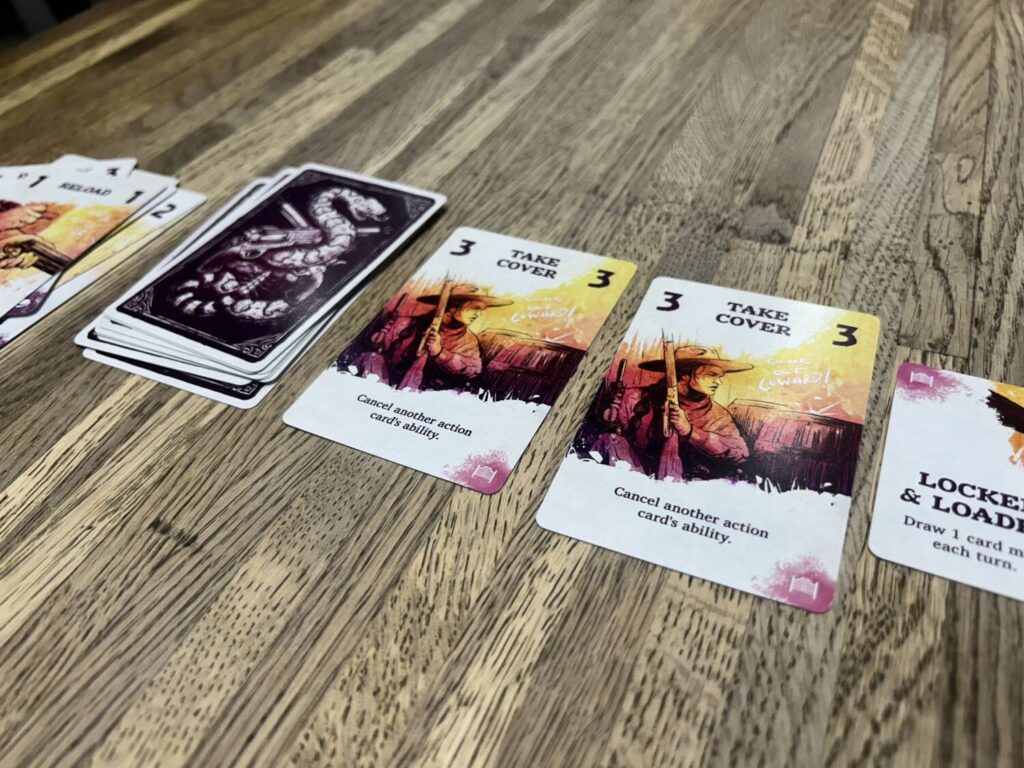
Each turn has two steps, both of them voluntary: you can buy a card from the market to add to your hand, and you can shoot. It is unusual for a game like this to make everything you can do optional. Many of the best Reiner Knizia games, which feel like antecedents, stand out by creating situations in which you desperately want to pass but cannot; Rattlesnake inverts that tension. There’s nothing more worrying than hearing your opponent start and end their turn by saying, “Pass.”
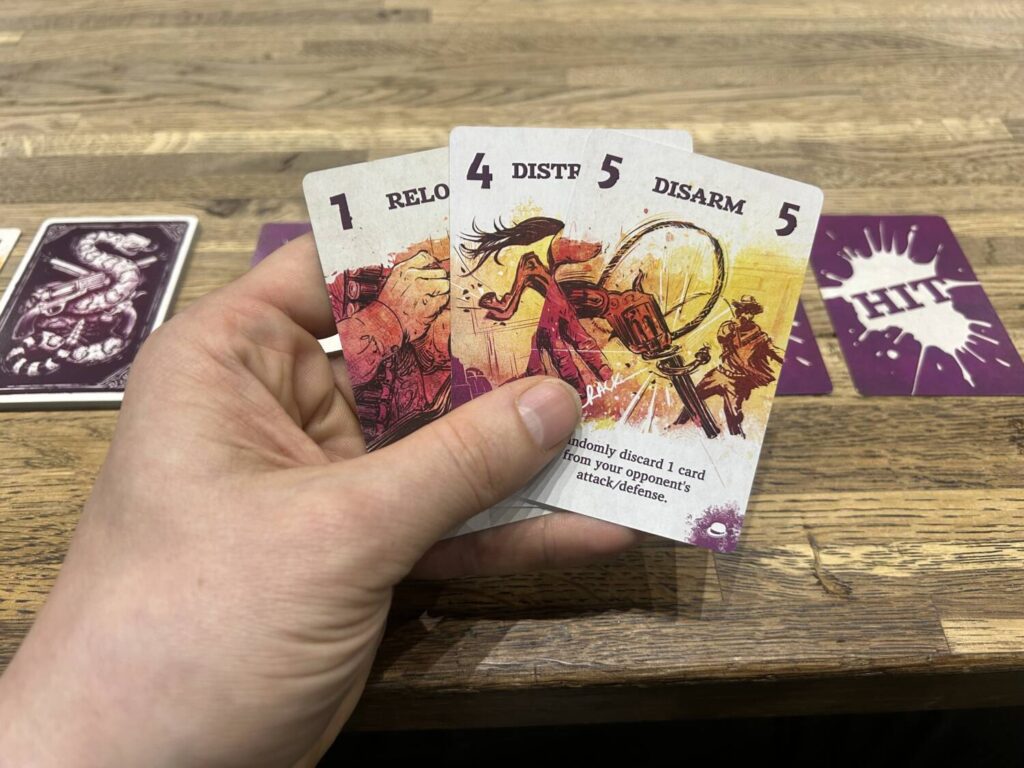
Shooting involves playing sets, either straights or multiples (a pair, three of a kind, etc.). When you decide to take a shot, you announce how many cards you’re playing and put them facedown on the table. The other player can choose to play any number of cards they want, and you simultaneously reveal. If the attacking player’s set is stronger, they score a hit. If there’s a tie, or the defender’s set proves stronger, it’s a miss. Nothing happens.
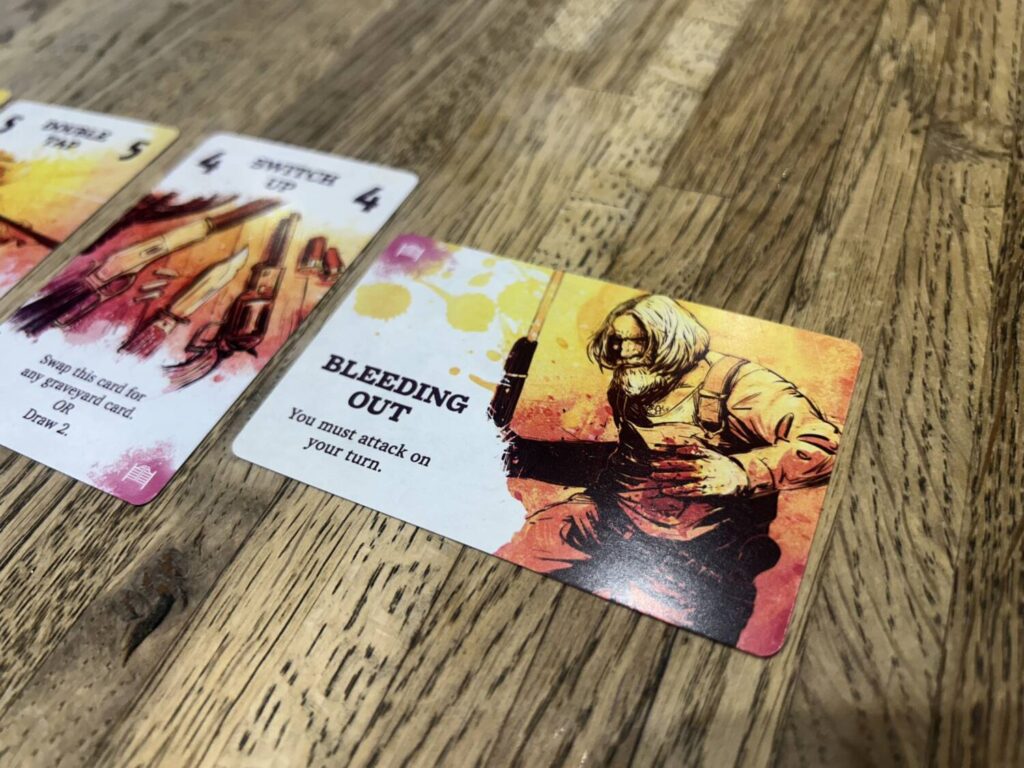
Things are deliciously complicated by the cards themselves, which are dual-use. Their values, 1-5, only factor into firefights, but the cards also have single-use abilities. These can be played at any time, and they are the greatest source of Rattlesnake’s texture. Players start with identical personal decks, and the card abilities let you do things like draw cards, discard cards, discard cards from your opponent’s facedown set, double the damage when you score a hit, and so on. My favorite discards all player cards involved in the current fight and makes both players reveal the top card of their deck instead.
Across five or six plays, the abilities have continued to reveal new angles and cross-pollinations. Some remarkable things are possible with the right string of abilities. Clever and discerning use can get you out of all manner of scrapes. The fact that using the abilities doubles as your mechanism for deck-thinning is a masterstroke on Hardacre’s part. Pay enough attention to what abilities you use over the course of the game and they can be used to your benefit in more ways than one.
Speaking of Mr. Hardacre, there are two things about this design that I want to highlight. The first is its patience. Rattlesnake plays with a remarkably wide palette of tempi for a game that plays so quickly. You can run and gun, or you can take your time. Both options exist. But the more players return to the game, the slower it becomes, since a player who runs out with guns blazing every turn will have to work fast to best a player who is taking their time and building a stronger deck. Rattlesnake clearly wants you to be thoughtful. The decision to have ties and defensive victories result in a miss ensures that the game leaves breathing room for intentional players to find their footing.
At the same time, Hardacre has clearly put a lot of thought into the long arc of the game. The market deck has five events shuffled into it during setup. Each time a player buys a card, it gets replaced with the next card on the deck, as you would expect. If the next card is an event, it has two permanent effects: it fills that market space, narrowing player options, and it adds or changes a rule. These rules are expertly designed to slowly ratchet up the pace of play. Cards get cheaper to buy. Attacks become mandatory. While you both never use all the event cards in a single game and never know the order in which they will come out, the final market card is always High Noon, which makes successful attacks deal two hits instead of one.
It would be easy for a game like Rattlesnake to grind on for too long, to overstay its welcome, but Hardacre and the development team at Osprey have done a tremendous job of ensuring that cannot happen here. This thing stays lean and mean all the way through, and it only gets meaner, whether they included the brow sweat or not.