
Disclosure: Meeple Mountain received a free copy of this product in exchange for an honest, unbiased review. This review is not intended to be an endorsement.
For the most part, the team at Mighty Boards has never done me wrong.
After a middling experience with their recent release Red North, I didn’t rush their other SPIEL Essen 2025 release, Pinched!, to the table until recently. But after doing plays at three, four, and five-player counts, I’m excited to share that Pinched! was a blast. Save for my thoughts on how the game’s random card draw can affect scoring and notes on a specific player count, I highly recommend giving Pinched! a look.
“I’ll Take That”
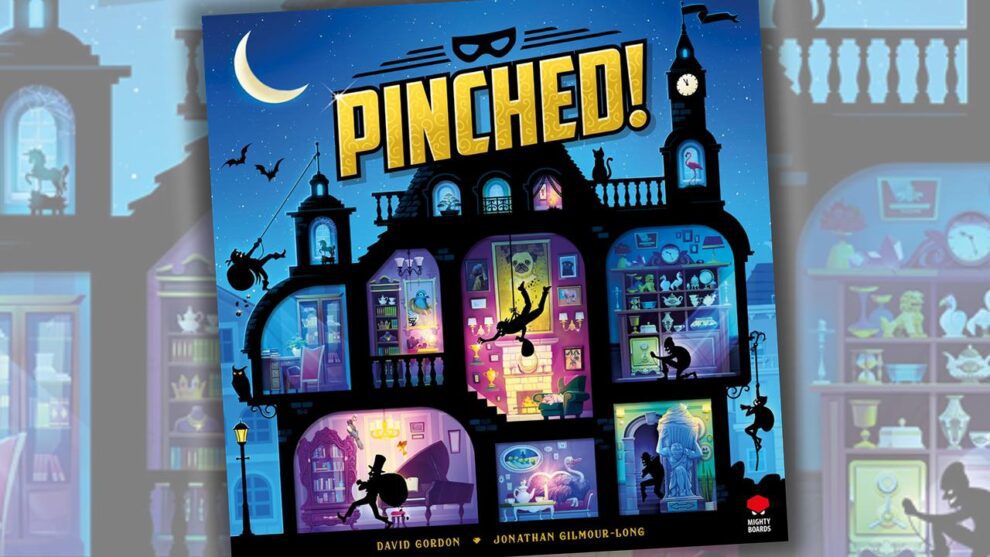
Pinched! is a hand management and set collection game of bluffing and thievery for 2-5 players. Over a series of turns, each player (taking on the role of a thief in a gang of them) will serve as the Mastermind for a given turn. Using a hand of location cards, the Mastermind will select a heist location from amongst the 3-5 locations available in that game.
The Mastermind plays this card face-down into the center of the table, then each other thief will play a card from their own hand of location cards in the hopes of matching the location selected by the Mastermind. During the reveal, two things could happen. If the Mastermind picks a location that no one else picks, the Mastermind gets to take all the face-up item cards at a location. If the Mastermind’s location is matched by any other thieves, then the Mastermind joins that thief to take cards from that location in player order starting with the Mastermind. If able, the Mastermind gets one additional card from that location.
Anyone who is not the Mastermind then gets a single card from three face-up item cards at a location called the River. After each selection, a new card is placed at the River, meaning each non-Mastermind always gets a card from a choice of three at that location. Meanwhile, the Mastermind has to sell or stash all items in their collection, with a limit of three unique item sets at a time in their stash. Sold cards are turned into points, and any remaining cards in hand must be discarded (this only applies to the Mastermind each turn, so all other players can continue to hoard items until they are the Mastermind on a later turn).
There are a couple wrinkles to everything I’ve just told you. Each thief must keep their stash visible at all times…so, everyone knows what everyone else is likely chasing to score the most points, critical when it comes time to guess which location the Mastermind is likely to visit for the heist that round. Also, each location has its own special set of rules, which come in basic and “Crown” flavors, the latter for advanced play.
When players visit Club Manor in standard mode, the Mastermind can gain additional cards from the top of the deck if they visit alone, but if they show up with other thieves, a safe token is advanced on a track of that board to boost the number of top-deck cards a future Mastermind can take when showing up alone at that location. In the Crown variant, more cards are available, boosting the chances that players try to visit that location in the hopes of showing up alone.
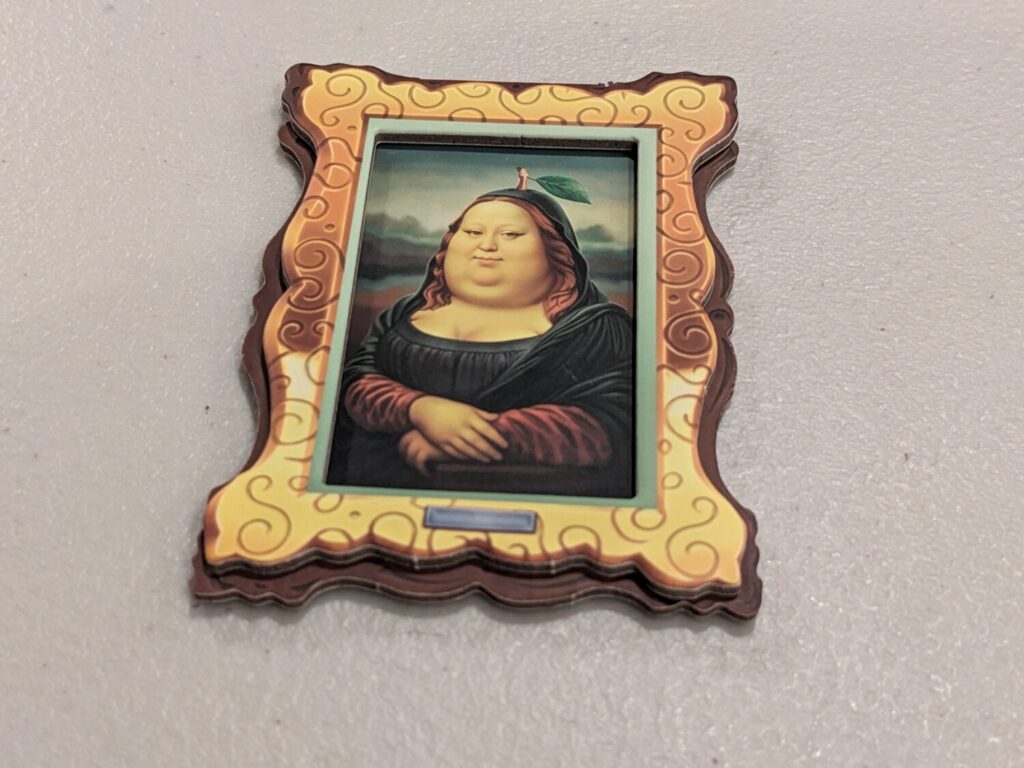
After 3-5 rounds where each player serves as the Mastermind, play ends…and the player with the most scored item cards in their stash wins. Extra points are granted to players who pick up special items at locations, such as the “Lisa Mona”, a famous painting that may or may not be available from Diamond Manor based on the standard or Crown format.
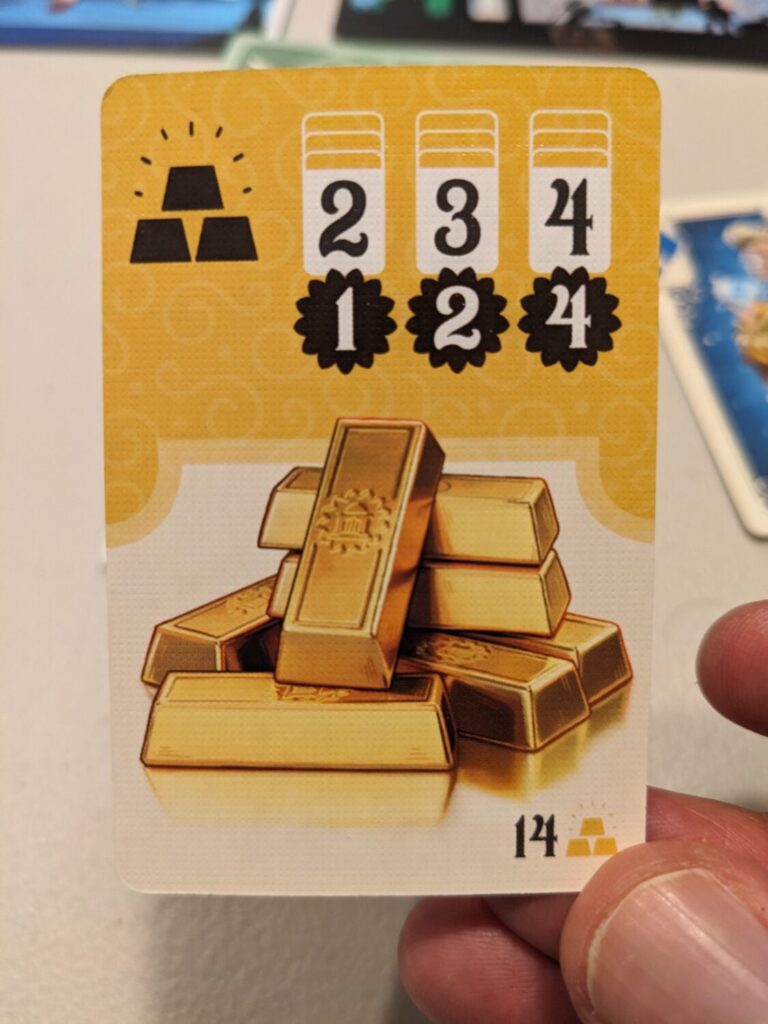
The game’s low scores almost guarantee that ties may need breaking, and in a strange twist, one specific item card type serves as a tiebreaker: the most gold bars. (This is made stranger only because gold is not the rarest item type in the game…that would be emeralds.) In two of my three plays, I lost as the tied player!
Thieving is Mostly a Good Thing
Our first play of Pinched! featured three players, and all of us agreed that we would never play it with less than three, so I didn’t bother to try Pinched! as a two-player game. Part of this assumption was that the game would likely be more raucous as more players were added, so I set out to play this with more players after that first run.
My second play was with the family; we did a four-player game with my wife and two kids (ages 12 and 9). Everyone loved it. Scores were tight. A location not available with three players, the Bank, was included in my four-player game and comes with a fantastic mechanic: if only the Mastermind picks the Bank, they get two cards from the top of the deck (this is the only location that does not have face-up item cards). If some, but not all, players pick the Bank, each visitor gets four cards from the top of the deck. And if all players pick the Bank, all players get zero cards.
So, the Bank comes with a lot of risk for the Mastermind, but a lot of upside for both the Mastermind and those lucky enough to join them…as long as the whole table does not join up. Table talk is encouraged in Pinched!, right from the start of the rulebook. Nothing got people talking like the Bank, and in a couple cases, it wasn’t clear who was bluffing and who was not. But when it paid off for the Mastermind, it really paid off, especially in cases where the other locations had cards that didn’t line up well with the face-up item cards in the Mastermind’s stash.
And my four-player game, like my three-player game, ended with another player winning in a tiebreaker.
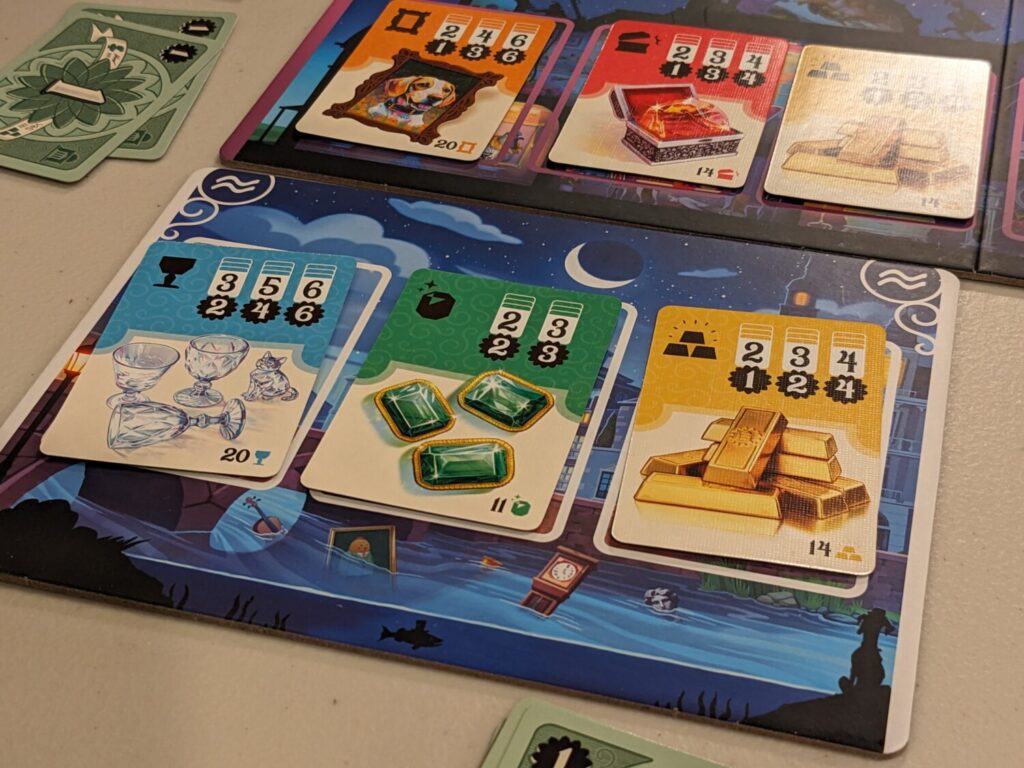
I ended my review plays with a five-player game with my review crew. Three of us had played before. Unlike the previous plays, I did all locations on their Crown side, meaning we were doing the advanced version of the game, using the recommended setup called The Full Monty in the rules.
My only real downsides with Pinched! surfaced during this five-player game. In part, this is because it is mathematically harder to guess the location of the Mastermind when you have only a 1 in 5 chance of getting this right (a probability of 20%). During three and four-player games, there are four locations, boosting chances of co-thieving to 25%.
I didn’t think this would matter that much on paper, even knowing those odds…usually, it pays best to go where the Mastermind can use cards that will boost their set collection scores when they sell items from their stash. But in that five-player game, there were usually two, maybe even three, good choices from which the current Mastermind could get what they wanted. One location, Heart Manor, has a secret passage that allows a player to go to a different location to get two cards on the Crown side…so, they could use that to go anywhere else!
This meant we regularly saw two of our five players, as Masterminds who have a plethora of options, going to locations alone. If a player had items in their stash that only could be found at one location—I’ve got a bunch of gold, portraits, and timepieces, so I’m clearly going to the location where I can get more of some or all of those items—it was usually easy to guess that a player was going there. And, since non-Masterminds always get one card from the River too, we had a bit of a runaway leader problem in that five-player game.
Even the River revealed itself only during this final play. A couple of times, players lucked into the card they needed thanks to the pull of another player from the River just before their turn. Sometimes, a player only had the option of one item type, when the River had three matching cards. Wild cards (representing information, a nice touch) are the best item in the game, and whenever a wild card hit the River, it was snapped up immediately. The randomness of a 176-card item deck (known as “the valuables deck”) can really work out for you…or, it can bite you in the rear.
Scores in that final play were all over the map. One player had seven points; the winner scored 27. Because players can only sell when they are the Mastermind, getting behind early almost guarantees a poor finish, and in a five-player game, Pinched! lasts just three rounds.
Pinch Pinched!
Despite the flaws that surfaced during this final play, I still recommend Pinched! as a very strong entry in the light-and-fluffy deduction game canon. Designers Jonathan Gilmour-Long and David Gordon have separately contributed some of my favorite designs over the years, from older titles like Dead of Winter: A Crossroads Game and Wasteland Express Delivery Service to last year’s Finspan and the family-weight LEGO title Monkey Palace.
That continues here with Pinched!. I am settling on the use of the standard sides of each location board and playing with exactly four players, and that’s what I will use when I break out Pinched! with groups (family or not) in the future. The playtime lands nicely in the 40-50 minute range regardless of player count and Pinched! is such an easy game to teach, set up and tear down. It’s a handsome long filler for almost any group of players.
Mighty Boards continues to kill it with these solid light-to-medium weight titles. Grab a copy of Pinched! when you can! (Just don’t, you know, steal it.)