
Disclosure: Meeple Mountain received a free copy of this product in exchange for an honest, unbiased review. This review is not intended to be an endorsement.

One pass of the rules and I could tell that the new Stonemaier trick-taking, engine-building game Origin Story was right up my alley.
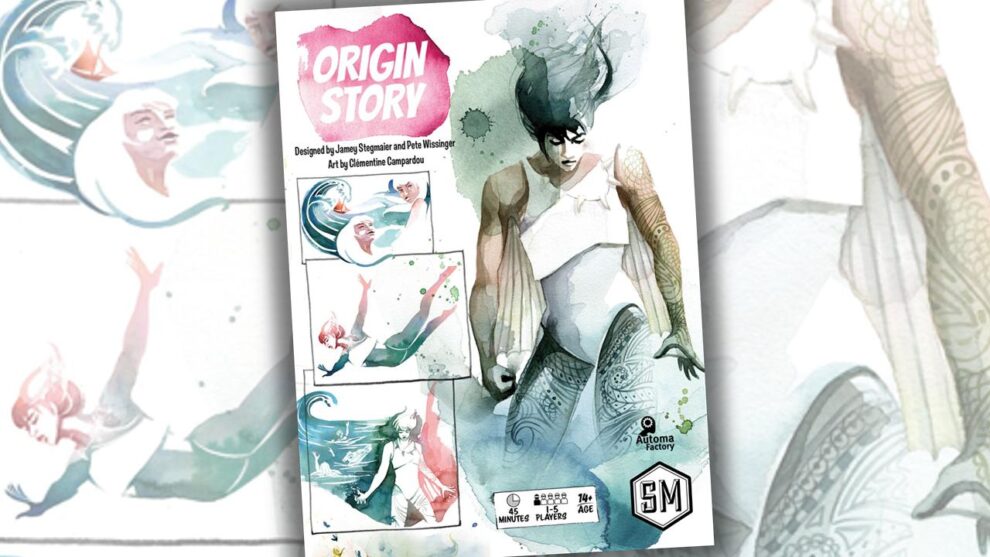
That’s because after the handsome production and cool art from illustrator Clémentine Campardou fades to the background, there’s a fun game under the hood of designer Jamey Stegmaier and Pete Wissinger’s new creation. Over the course of five rounds, players engage in standard trick-taking mechanics—eight-card hand, must-follow rule-set, four suits with one always representing a trump suit—with a very nice twist: in each round, the rules change just a little for every player, thanks to the ability to use “stamina” tokens to trigger player board and card effects for each of the 2-5 players in the game. (Origin Story does accommodate solo play, but that was my least favorite of the three plays I did for this review, at solo, three-, and four-player counts.)
Each player is a character, with a somewhat basic ability that can be activated as many as two times per trick-taking round with those stamina tokens. Nothing about the base characters is anything to write home about. But a huge deck of Story cards offer players a chance to craft their own trick-taking monstrosity. For each of the first four rounds, players are dealt a set of three Story cards, each with a power that might be a one-shot bonus, an ongoing power, or something that triggers at the beginning or end of a round…or, maybe, something else, like the Patience power I had in one game, which triggered every time I led a trick.

Players will pick one of those three Story cards to add to their player board, giving them authority over a specific way to build up their assortment of powers. Just before this step, each player is dealt eight playing cards from the main deck, with 52 cards spread across four suits, 13 per suit (they have names, but let’s just go with their colors: red, green, blue, and gold, the latter of which is trump in each round).
That means that in a four-player game, only 32 of the 52 cards are dealt to players. Even after one or two players get the chance to use their stamina-triggered powers to discard some of their hand cards to get new ones from the remaining draw deck, there are still a number of cards that are not in play each round.
Right before each round, players have to determine if they will play as a Hero (attempting to win as many tricks as they can) or a Villain (taking no tricks at all; imagine “nil” bids in card games such as Spades). This is done simultaneously, but in secret, leading to a fun reveal just before the round begins.
From there, standard trick-taking rules apply. One player leads, players must follow if they have any cards of the led suit, players can play off-suit if they don’t have the suit in hand, gold is trump. Lots of the card powers allow for the subtle change in card value, so when there’s a tie, the first played card of a tied value wins the tiebreaker.

Chaos, Inc.
The engine building presented by the Story cards is the big reason I recommend Origin Story. That led to a lot of chaos in my two multiplayer games, in part because there are so many playing cards that are not dealt in a round…that’s because each player has their own engine/tableau that changes the rules in each round. But by the later rounds of the game, everyone has as many as five powers EACH (one from their character, four from their Story cards), and while nothing is too much to remember or handle, it’s this chaos that serves as the break point for some of the players in my group.
One player absolutely loved this level of chaos, and I think he had the most fun of any of us during our four-player game. He did everything in his power to turn the tables whenever he could. One guy in that same game leaned into his character, Sylvia, which very clearly was designed to be combined with other game effects that push a player into Villain territory, to try and take no tricks every round. That is a very vanilla way to play Origin Story, but one that can still be satisfying if it can lead to a victory (and in that case, it did).
Others seemed to like the idea of evolving player powers more than the execution. This is not your grandmother’s trick-taker, so one can never get too comfortable with whatever you think of as standard trick-taking play. These days, there are so many different types of trick-takers out there that I seem to never meet players any more looking to just play something like Spades or Hearts. Even if they want to try Hearts, games like Rebel Princess Deluxe Edition change the formula in enough interesting ways to take precedence over older trick-taking standards.

In that way, Origin Story is very much a “game of the now.” You can lead gold on the first trick of a round, meaning that the game’s trump suit doesn’t have to be “broken” to be played. That hand you were dealt that had four 13s? No guarantee that that will win any tricks. That Patience card I mentioned earlier? It gets crazier: it asks the lead player to deal a card off the top of the deck to lead the trick, meaning there’s an extra card that no one sees coming on the table that could throw off a player’s plans.
Scores can really be swingy in Origin Story. I had a game where I won by a dozen points (in games where winners usually scored in the 30s or low 40s), a game which was effectively over by the third round. I also had a game where I scored just 14 points in total after four rounds on my way to being blown off the table.
So, Origin Story immediately becomes a game that is not for everyone. All good. Even I had some issues with the way scoring works in the fifth and final round, when each player reveals one of their two Superhero milestone cards to score a larger-than-normal bonus, serving as a bit of a catch-up mechanic to make the final round meaningful. In the third round of each game, an event card is drawn to change one or more of the game’s rules for just that round.
And, a bit like recent trick-takers like Lunar Skyline, a series of poor deals might lead to a player getting blown out for no good reason at all. That’s card games for you!
Knowing all this, I like what Origin Story offers as an engine-builder trick-taking game. I don’t have another game like it in my collection, so I can see it sticking around for a while. And, who knows—in a world where expansions show up on a regular basis, a few new Story cards mixed with a couple new playable character boards might spice things up a tad.
Origin Story details
- Designer: Jamey Stegmaier, Pete Wissinger
- Artists: Clémentine Campardou
- Publishers: Arclight Games, Feuerland Spiele, Ghenos Games, Maldito Games, Stonemaier Games
- Release Date: 2025
- Player count : 1 - 5
- Age range : 14+
- Time range : 45 minutes
- Mechanism(s): Trick-taking
- BGG Geek Rating: 7.23525 - converted to Meeple Mountain scale: 3.5.
- More articles about Origin Story.