
Disclosure: Meeple Mountain received a free copy of this product in exchange for an honest, unbiased review. This review is not intended to be an endorsement.

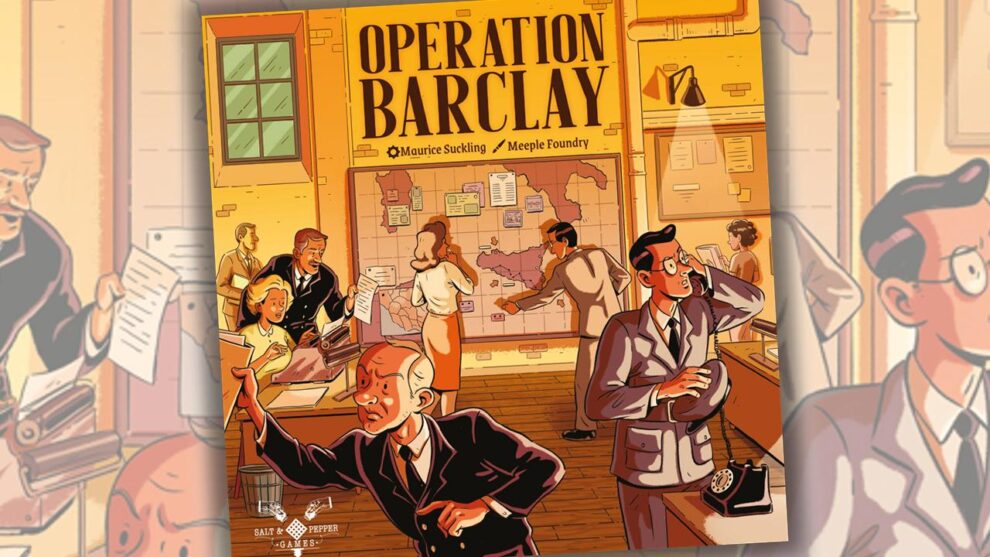
Operation Barclay is one of the most inspired marriages of setting and mechanic that I’ve ever had the pleasure of experiencing. How did designer Maurice Suckling get the idea to pair the story of Operation Barclay, the Allied plan to feed the Axis false information about an upcoming Mediterranean invasion, with poker and a shell game? It’s such a remarkable idea, such a perfect idea. Most game designers would sacrifice body parts in exchange for an idea this good.
While the real Operation Barclay was about convincing the Axis that the Allies would invade Greece when they were in fact planning to invade Sicily, Operation Barclay the game gives us a bit more ambiguity than that. There are five possible areas of attack, stretching from Morocco-to-France and Egypt-to-Turkey. The Allied player places wooden Intelligence tokens into each of them. One lane, whichever the Allied player decides to make the Primary Offensive Sector, gets four positive Intelligence tokens and one negative. The Secondary Offensive Sector gets three of the first and two of the second, and the other three Sectors, red herrings all, get two and three.
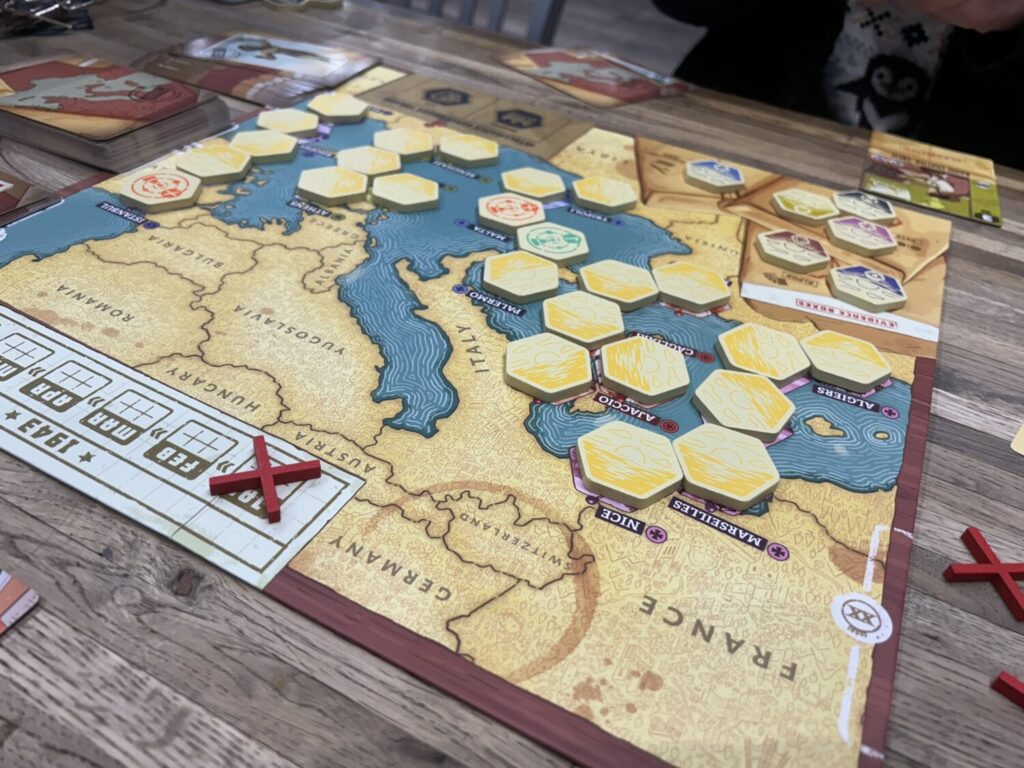
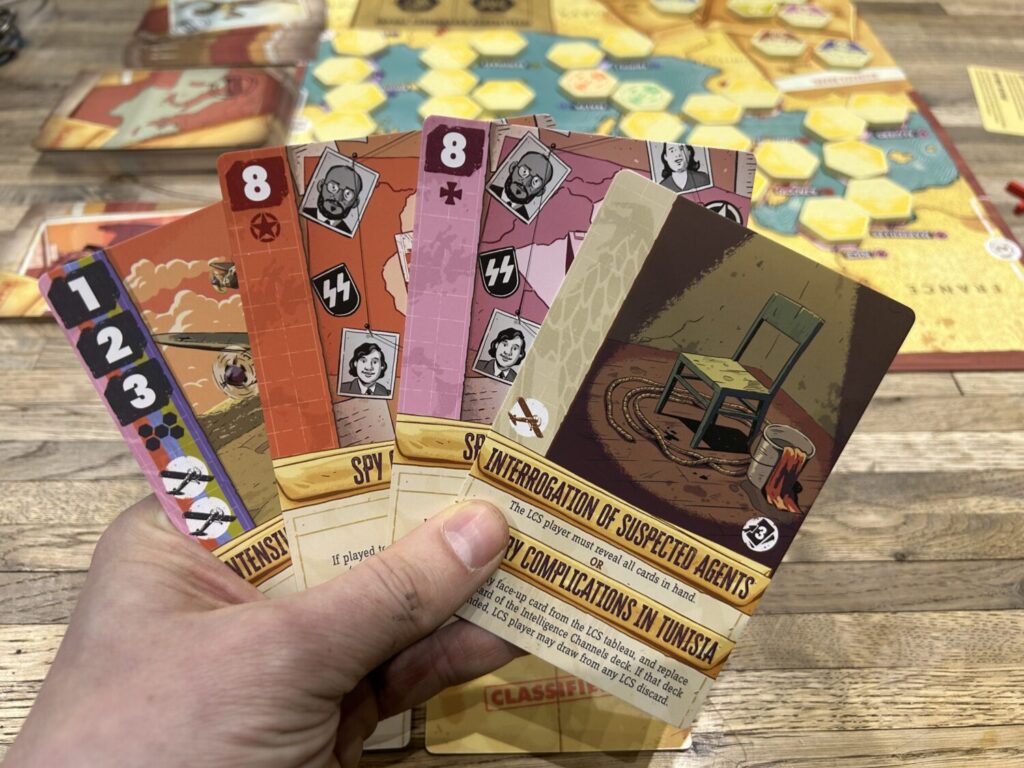
The goal of the Axis player is to positively identify both Offensive Sectors. They do that by winning Evidence tokens, which correspond to each of the five Sectors. Each Evidence token won lets the Axis reveal one Intelligence token on the board. This is all managed via a sort of modified-poker in which the players take turns playing a card from their hand down onto the table. The first three cards are played face-up, and the final two are played face-down, but the goal will be familiar to anyone who’s spent time in a saloon; you’re trying to form five of a kind, or a straight, or a high card in a pinch.
The six Evidence tokens—one for each sector and a wild—are randomly split into three groups at the start of each round. Two will go to the player with the stronger hand at the end of the round. One will go to the player with more icons on their cards. The other three are a little more complicated. Halfway through the round, once the three face-up cards have been played, each player places a secret bet on who they think will have the stronger hand that turn. If only one of them is right, that player gets all three of the remaining tokens. If both players are right, the Axis player gets to take one.
Like Operation Barclay itself, this is a game entirely about misleading, about bluffs and feints. The decision to include a betting component is both a smart mitigation tactic—you can’t get entirely hosed if your opponent keeps drawing better cards—and thematically appropriate. There’s nothing to stop me from starting a strong hand and then intentionally botching it. Operation Barclay fosters an environment in which you cannot trust anything you see, but you are nonetheless forced by circumstance to act.
But
For all that Operation Barclay gets right conceptually, I don’t particularly enjoy it as a game. It falters on the fundamental: you are much too subject to the luck of the draw. If one player consistently draws weaker hands than the other, they are unlikely to win. Betting isn’t the only attempt to mitigate this, but all the added bells and whistles are insufficient to the task. Operation Barclay is a magical concept. It’s not a great game.
I try my best to ignore the fact that Meeple Mountain reviews have ratings. We use them for practical purposes; ratings help with SEO. While I spent much of my youth slavishly devoted to lists, rankings, ratings, etc., I have grown to find them much too constricting. They aren’t always a problem. For a game like Earthborne Rangers or Hot Streak, this is easy. For something like Operation Barclay, it is much more difficult.
This game does not benefit from the easy metrics of ratings. Whatever number I put here, whatever basket I slot Operation Barclay into, it will give you the wrong idea. If you were to ask me as a player if I liked it and would play it again, my answer would be a pretty resounding, “No.” I did not enjoy my plays in any sort of immediate sense. If you were to ask me as a reviewer if I thought it was worth a look, my answer would be a full-chested, “Yes.” There is a fantastic game in here somewhere. I catch occasional glimpses of it out of the corner of my eye. Even if Operation Barclay doesn’t fully succeed, it is worthwhile. How do you put a star rating on that?
Operation Barclay details
- Designer: Maurice Suckling
- Artists: Carlos Ureta, Meeple Foundry
- Publishers: 25th Century Games, Fox in the Box, HIT Games, Salt & Pepper Games
- Release Date: 2024
- Player count : 2
- Age range : 14+
- Time range : 25 - 40 minutes
- Mechanism(s): Betting and Bluffing, Hand Management, Secret Unit Deployment, Variable Set-up
- BGG Geek Rating: 7.02344 - converted to Meeple Mountain scale: 3.5.
- More articles about Operation Barclay.