
Disclosure: Meeple Mountain received a free copy of this product in exchange for an honest, unbiased review. This review is not intended to be an endorsement.
I’m getting old.
If you’d asked me a decade ago whether I’d review a wargame, I would’ve given you the weirdest look. I’d seen the wargamers at conventions. The plexiglass smothering the boards. The tweezers plucking at tiny counters. The custom player aids showcasing the latest Excel technology. It wasn’t for me. I wanted my cubes, cards, and meeples.
But pessimism has colonized my emotions for the past few years. Too many crowdfunding projects promised giant boxes with campaign games that lasted longer than the average American marriage. An endless barrage of announcements for yet another reprint of an old board game or another video game franchise turned cardboard. I wasn’t buying what the industry was selling.
So I retreated to older games and expanded my horizons. “Let me try this wargame stuff,” I thought to myself. After all, there must be a reason this genre has been around for decades, even inspiring the first highly successful role-playing game, Dungeons & Dragons. My first step? Quartermaster General 2nd Edition. A fast-paced World War 2 game that uses the randomization of cards instead of dice. I liked it. No, I lied. I loved it, and I wanted to see what modern wargaming looked like.
The One Hour Promise
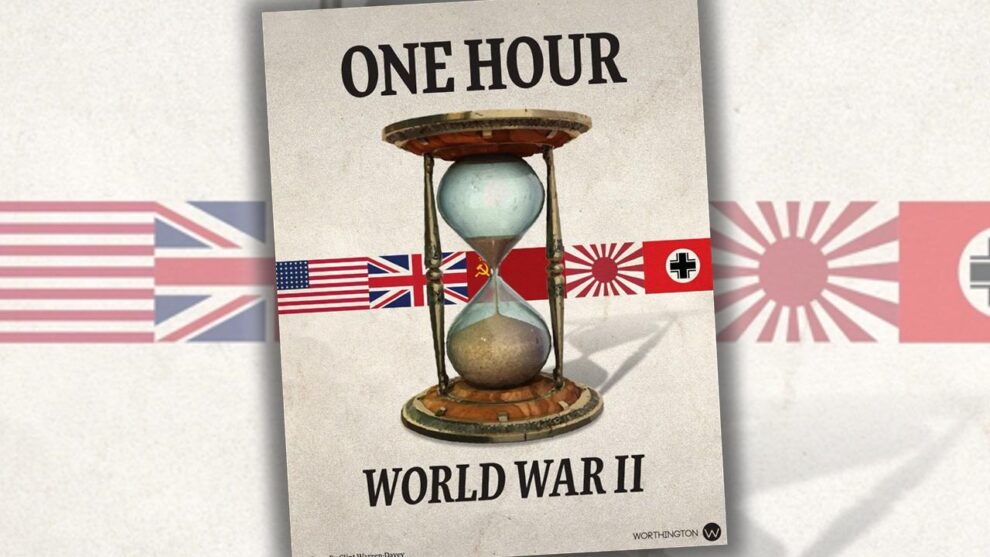
This is where One Hour World War 2 enters the stage. A game promising to be, well, under an hour using light components. A small single board and only one cardboard sheet for counters? Not even Lovecraft could conjure such madness.
Of course, I have to answer the important question: Does this game truly last just an hour? It should be yes, and it is. Every session I’ve played for this review has been under an hour, even with new players. I’ve read some reviews claiming it could stretch to two hours, but honestly, that’s coming from people who take way too long to make straightforward decisions. If anything, the game’s difficulty comes from its rulebook, not its playtime. I’ll get to that shortly.
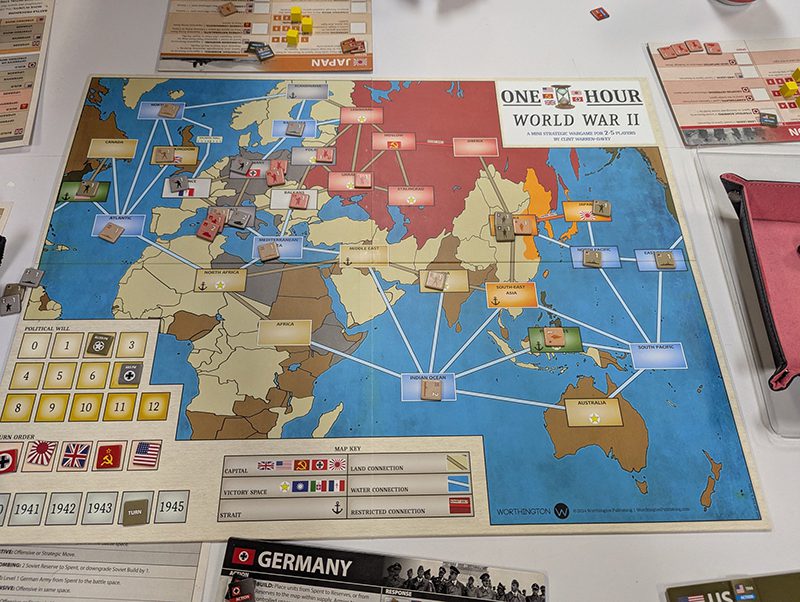
But we do need to talk about the flow of the game. Unlike what you’d expect from a typical World War 2 game, this isn’t about conquering the world. It’s about draining the political will of the other side. You have your Axis players, Japan and Germany, versus the Allies, the UK, US, and Soviet Union. Then there are minor nations like China, Italy, and France, which aren’t separate players but are controlled by the major powers and become key areas of conflict.
To lower your opponent’s political will, you need to score points. The map is dotted with points of interest, and you need to control either neutral or enemy territory to earn them. For example, Poland starts under Germany’s control. Germany doesn’t score points for it because it’s part of their home territory. However, if the Allies capture Poland, they score it. One Hour World War 2 is a game about pushing forward.
Token Gestures
Now let’s talk about the actual gameplay. Everyone gets a handful of action tokens and a player mat. On their turn, they can either pass or play a token to take an action. The actions themselves are straightforward.
Build lets you add units to the map or move units from spent to reserves. Upgrade improves your Air Force or Naval Aviation, making your land or sea units stronger. Strategic Move gives you the opportunity to rearrange your unit positions, keeping supply lines in check. And Offensive is where you move your units to attack.
Is that it? Not at all. The big disruption to the structure here is the response system. After a player takes one of the four main actions, the other players may respond, and the countries and actions they can use are fixed. For example, whenever Germany builds, the Americans can respond with a Strategic Bombing, reducing Germany’s building capacity or shrinking their reserves. All it takes is one action token.
That doesn’t sound like much until you realize your action tokens are extremely limited. For context, Japan starts with 2 and Germany starts with 3, with no further additions throughout the game. Meanwhile, the Allies start with very little. Russia starts with 1, the US starts with 1, and the UK starts with 2. Throughout the game, the Allies gain more action tokens, but their slow start gives the Axis players an early foothold.
Accuracy Over Fantasy
In respect to the arc of the war, the “meta” behind One Hour World War 2 is clear: the Axis players try to grab as much territory as possible and hold on, while the Allies must figure out how to slow the Axis advance while building momentum.
Going back to the US situation, they can do strategic bombing when Germany builds. They also have a response to Russia’s build action, using Lend Lease to give Russia more units and make better use of the build. Yet they can’t ignore Japan in the Pacific, which is slowly building up and trying to take control. The US needs to expand as well, so what are the best options?
That’s the question One Hour World War 2 wants you to answer. It’s a game about opportunity cost and demonstrating the power of small-scale decisions and their aftermath in the grand theatre of war. The system itself isn’t complicated, despite its shoddy rulebook. The depth lies in understanding the context of each situation and using it to your advantage. Because of the limited number of actions, every decision matters. Placing a unit in the wrong place, upgrading the wrong traits, or engaging in the wrong battle can easily put your side at a major disadvantage.
The Sixty-Minute War
Speaking of battles, they’re easy to resolve. Add your units’ strength and the appropriate bonus (Air Force for land, Naval Aviation for sea), then roll some dice. 1-3? Nothing. 4-5? +1 to your side. 6? +2.
After getting the numbers, the attacker can spend reserves to boost their side, followed by the defender. Whoever has the highest strength wins, and the losing player must place their unit into the “spent” space on their board. This is important because land is controlled not by the absolute absence of the enemy, but by having more units than them. This can mean cutting off supply, and cutting off supply means they can’t launch offenses, can’t use reserves, or even gain the added bonus.
So far, One Hour World War 2 sounds pretty good, right? Clean mechanics, interesting decisions, quick playtime. Then you open the rulebook.
One of the reasons I didn’t get into wargames earlier is I was never a fan of their rulebooks. Labeling sections with decimal points, overexplaining simple concepts, little care for formatting, and chunks of meaty paragraphs that could’ve easily been broken up. Unfortunately, One Hour World War 2 keeps this tradition alive.
Manual Labor
To give one clean example, the first half of the rulebook explains the actions you can take and constantly references supply and control. Does it introduce these concepts at the beginning, creating a mental anchor point before explaining the actions? Nope! Instead, it puts them after the action explanations.
It even lists all the response actions and their details in the middle of the action explanations, rather than putting them in the back of the rulebook for easy reference. It’s aggravating.
Yet that aggravation didn’t stop me from enjoying this one. Yes, there’s a John Deere’s worth of friction to deal with, but the journey is worth it. While the World War 2 theme might be overplayed, the system presented certainly isn’t.
Unlike many other World War 2 games, One Hour World War 2 isn’t interested in entertaining wacky scenarios or rewriting history. It isn’t Axis & Allies with a different set of rules. It wants you to respect what happened in World War 2, and that constraint might turn off some players.
Since the game insists on sticking to the historical narrative, with Axis players being powerful but slowly dwindling while the reverse happens with the Allies, it does mean the first few opening moves might feel the same. Germany pushes toward France and the Soviet Union. Japan attacks China or expands its fleet in the Pacific, threatening the Philippines and Australia. The Allies? They can only respond. How and when a player responds is what creates the replay value of One Hour World War 2.
Lone Wolves vs. The Pack
As the game progresses, the reverse becomes true, assuming the Allies haven’t lost yet. The Allies end up with an overwhelming number of actions and must take as much territory as they can before their political will is drained. This results in an uneven experience. It becomes quite clear the Axis are merely watching the Allies take their turns while crossing their fingers, hoping their early gains can hold off the Allied onslaught.
It’s an interesting change of pace, and I appreciate the historical authenticity it brings. However, some players in my sessions didn’t care for it, and I can easily see players conditioned by other World War 2 games echoing those same complaints. The game chose historicity over balanced engagement, and that’s a deliberate design decision with real consequences.
Despite the late-game shift, the game nails something crucial about the conflict: how the two sides actually operated. The Allies must work together from the beginning, coordinating their meager resources just to stay afloat and slowly build up. The Axis starts strong enough to act as lone wolves, with Germany and Japan pursuing separate agendas in their respective theaters. This asymmetry in playstyle isn’t just good game design. It reflects the historical reality.
And it’s this dynamic that fosters the most interesting conversations at the table. The Axis players might not collaborate as often as the Allies, but their moves can still relieve pressure from each other. If Japan pushes hard into India or threatens Australia, the UK player has to make a difficult choice: continue pressuring Germany in Europe or pivot to defend their Pacific interests.
Meanwhile, the US and Soviet players must decide whether to compensate for the UK’s shift or stick to their own plans. These aren’t abstract strategic puzzles. They’re genuine debates that emerge naturally from the game’s structure, forcing the Allied players to negotiate priorities and coordinate their already limited resources. The table becomes a makeshift war room, and those discussions feel earned rather than forced. That’s the magic of One Hour World War 2.
I came to this game as a skeptic. I’m leaving as someone who finally gets why people spend hours hunched over hex grids with tweezers. The gateway worked. That said, it won’t be for everyone. The rulebook is rough, and its commitment to historical accuracy over sandbox freedom will divide players. But if you want a tight, historically grounded experience that respects both your time and the conflict it depicts, this is worth pushing through.
One Hour World War II details
- Designer: Clint Warren-Davey
- Artists: José Ramón Faura
- Publishers: Worthington Publishing, LLC
- Release Date: 2024
- Player count : 2 - 5
- Age range : 12+
- Time range : 60 minutes
- Mechanism(s):
- BGG Geek Rating: 7.55707 - converted to Meeple Mountain scale: 4.0.
- More articles about One Hour World War II.