
Disclosure: Meeple Mountain received a free copy of this product in exchange for an honest, unbiased review. This review is not intended to be an endorsement.
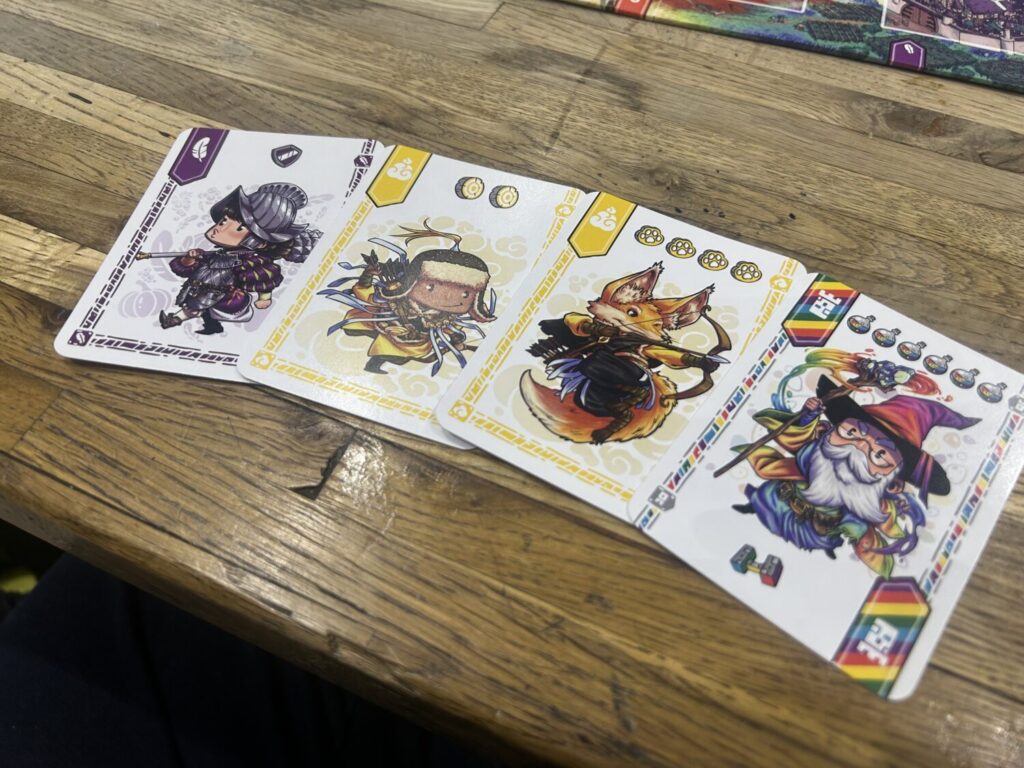
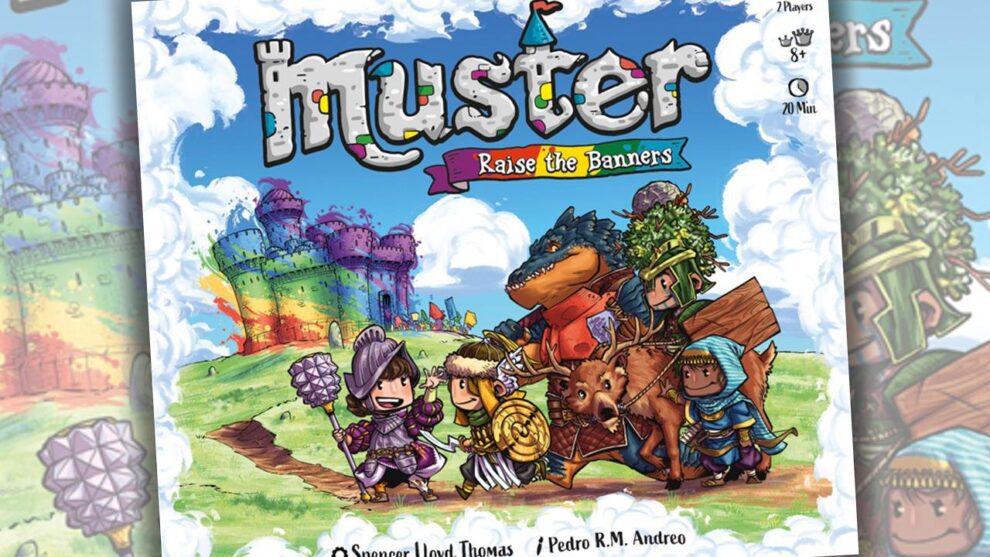
Muster: Raise the Banners, from designer Spencer Lloyd Thomas and with vibrant art from Pedro R. M. Andreo, is a quick little two-player lane battler. Each turn, you play a single card to its matching lane, or discard a card onto one of the central spaces, then draw a card. The catch is that the cards have to be played in ascending order. If I play the mighty green six early in the game, I can’t play any more cards to green.
This may sound familiar to some of you. It certainly did to me. Muster draws a whole heap of inspiration from Reiner Knizia’s 1999 masterpiece Lost Cities, one of the greatest two-player games ever published. I don’t knock Muster for that, and you shouldn’t either. It adds some flair of its own, like the two-sided wild cards that can be played in conjunction with other cards, and the Rainbow cards, which can be discarded to any center slot to open up that particular lane to cards of any color.
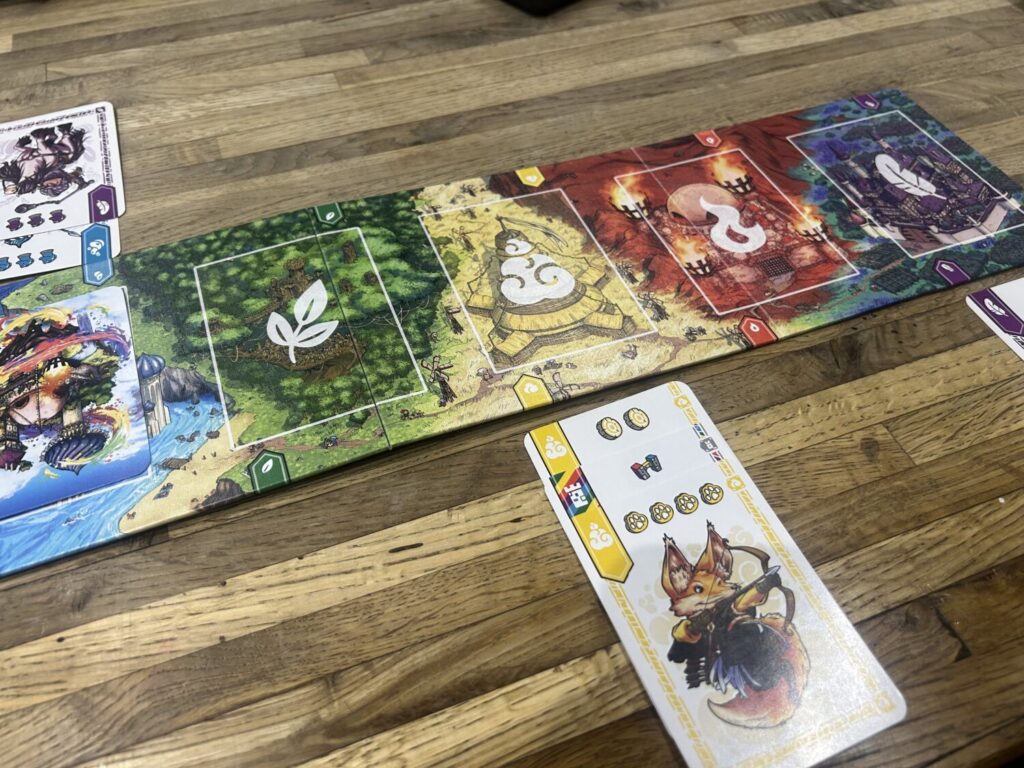
This is a great idea. It means that you never quite know when a lane is done. I can’t confidently lock in Yellow and then go spend my time elsewhere. Alternatively, if I spend all of my early resources securing Yellow, my opponent can use a well-timed Rainbow card to make their Yellow resources helpful in other lanes. Unfortunately, it doesn’t quite work.
Muster should very much appeal to me, but the game consistently fails to percolate. The decisions are a little too flat, the tension a little too diffuse. All of the bells and whistles that have been added to the Lost Cities framework are to the detriment of what makes the original system so good: it is punishing. Lost Cities is compelling because you have no recourse when you realize you’ve made a mistake. It is a tightrope walk. Muster gives you too many lifelines. You rarely find yourself making a pained discard, and there are enough wild cards in the deck that you don’t find yourself too worried about playing cards in increasing order. It’s bowling with bumpers.
A game like Muster is caught between the world of simple lane battlers like Schotten Totten and Lost Cities on the one hand and complex lane battlers like Compile and Air, Land, & Sea on the other. Muster adds just enough stuff that any potential pressure gets vented immediately, but it doesn’t add enough to create a richer, elevated experience. It’s a hard balance to strike. In the attempt, we are left with a perfectly functional game that doesn’t feel like much one way or the other. It’s hard to Muster much in the way of enthusiasm.