
Disclosure: Meeple Mountain received a free copy of this product in exchange for an honest, unbiased review. This review is not intended to be an endorsement.

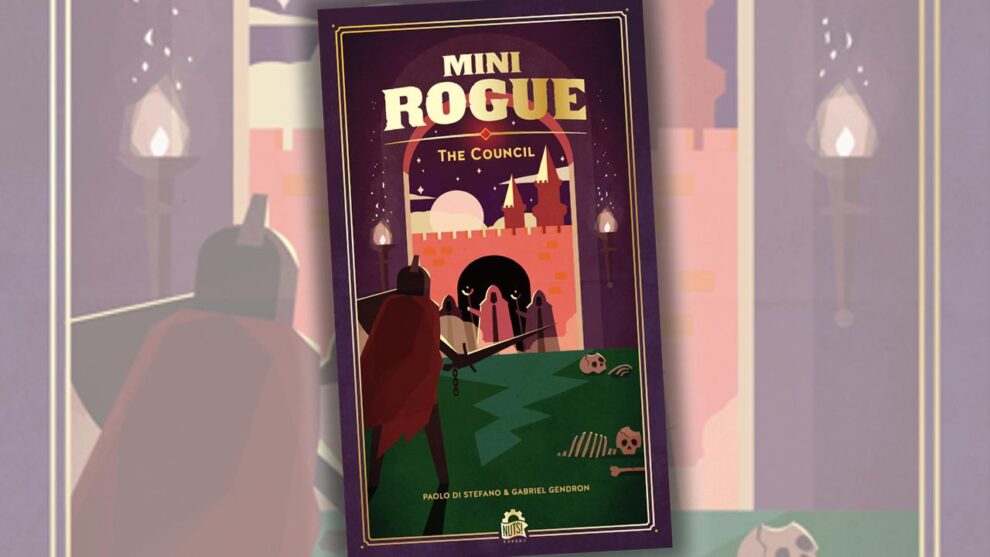
Mini Rogue: The Council (2026, Nuts! Publishing) is a dream come true for rogue-like video game fans like me. Sometimes, I just want a quick-playing challenge to table by myself, and I now see why the Mini Rogue series (first released in 2016 as Mini Rogue: A Roguelike Microgame) is so popular with tabletop players who also love rogue-like video games.
I was recently musing about my love affair of rogue-like video games such as Dead Cells, Balatro, Brotato, and The Binding of Isaac in an article on BoardGameGeek. Around the same time, I cracked open my review copy of Mini Rogue: The Council and was instantly hooked. That’s because gameplay in Mini Rogue is so easy to parse.
Players take on the role of one of the four included adventurers: Rat Catcher, Plague Doc, Alchemist, and the Flagellant. A series of rooms (laid out as a 3×3 grid of room cards), an enemy hit point (HP) tracker, and a personal play area that tracks player HP, food, spells, gold, and experience points (XP) are all you need to get rolling.
Across four floors, players must navigate 2-3 “areas” per floor, with each area represented by the 3×3 grid. Starting in the upper left corner, players must first complete that corner room before moving orthogonally from room to room until reaching stairs or a boss in the bottom right corner of the current area.
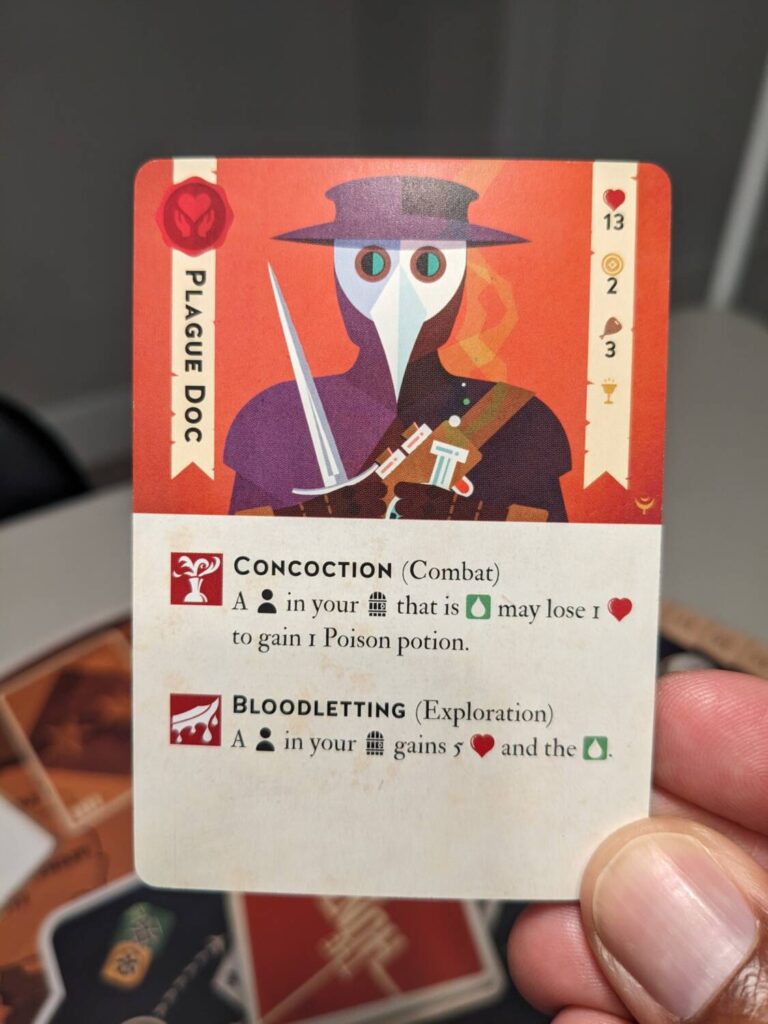
Every kind of room you would expect to find in a quick dungeon crawler is here in Mini Rogue: traps, monsters, shops, rest areas, shrines, tombs, etc. Usually, you can see which room type you are walking into. Sometimes, a game condition can change this ability, meaning a player might be walking into their next room blind.
A dungeon die and personal player dice dictate most decisions, so move, roll, move, roll again is the typical pattern. More XP adds player dice to the pool. Curses limit full damage abilities during attack rounds. Death arrives often. It’s all standard issue stuff…and I think that’s why Mini Rogue works well. Dungeon crawling, for a fan of dungeon crawling, is lovely. Don’t mess with the formula too much, and make delivery easy enough for me to get this one out consistently.
I’ve now played Mini Rogue a dozen times—YES, a dozen times!—evenly split between in-person and on Board Game Arena. BGA is now my preference because it moves so much faster than I can. Reshuffling room cards takes a little time, but over a few plays, that adds up. I love the footprint with the physical game, but the BGA implementation is a very attractive offer. (I also did plays of the base game, which I do not own, on BGA to learn the game’s systems. Mixing the base game with the new elements from The Council—fully standalone—is something else that gives BGA the edge.)
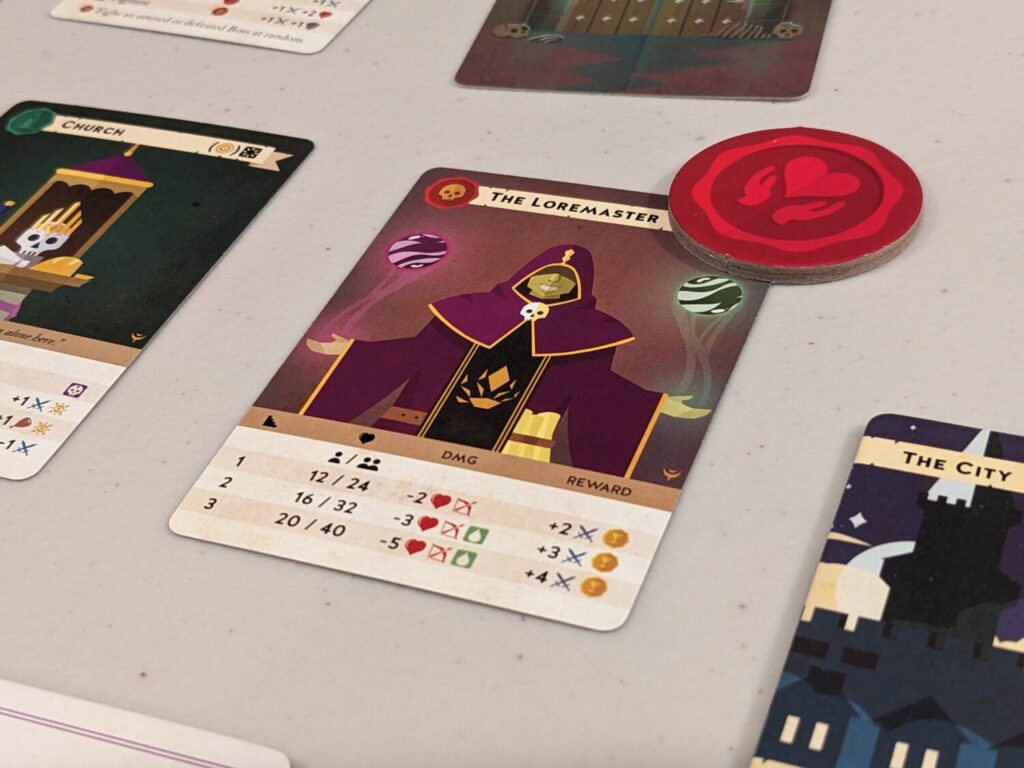
Mini Rogue does the things games like this should do. I want to find some loot, then use that loot to take out a pool of rats, an honor guard, an evil-looking sorcerer type. I want to toe the line between feeling great because my health gauge is full, then later riding that same razor’s edge as I hope to skate through another monster encounter with almost no health left over.
The Council—again, a standalone product in every way—offers extras like Overlord mode, a way to have a friend manage boss encounters, as well as a campaign mode. The campaign mode seems a little too challenging, even for a rogue-like where you will get murdered a ton anyway.
I was surprised to find that the campaign starts players off nearly dead and without many options to build up their health before entering a normal 3×3 area after a quick ramp up to try and find supplies and kick off a boss fight. I died so quickly during these two campaign rounds that I quickly pivoted back to the main game mode, and haven’t come back to the campaign since.
My main knocks for The Council, beyond the challenge level of the campaign, are all tied to replayability. I’ve already seen every room card (every player will on their first play, assuming they can survive even one area) and I desperately want more item variety. The best thing about Dead Cells is the almost unlimited amount of unique items that can be found spread across the levels. In Mini Rogue, by my third or fourth run, I had already played enough to both see and acquire every item card in the game.
Expansions certainly grow the pile of options, but it almost feels like I have to own 3-4 expansions and/or the base game to feel like the variety from run to run feels fresh.
Also, the difficulty here is staggering. The best way to win seems to be tied to unlocking more of a player’s dice pool…that means reaching level six on the XP track for the first unlockable die and level 18 for the second. I’ve still never had a run where I even got to the third die, in part because getting XP requires defeating monsters, and managing a player’s own HP to stay healthy enough to survive a lot of battles feels a little too steep. Across 12 runs, I’m 0-for-12, and I’ve died on the first or second floor (so, within the first five areas) about two-thirds of the time.
I like that the game is hard, but then I want to start successive future runs with more stuff, more health, etc. True “rogue-like” play is only an option in campaign mode…and I can’t even get started in that format. So I’m at a crossroads for now; I’m not sure I’ll need to play it more, unless I want to punch myself in the face to try and fail more often at the campaign mode.
That’s not all bad, though. Running through the normal mode is still fun, even if it is limiting. As a 20-minute activity on Board Game Arena, I expect Mini Rogue to live on forever.
Mini Rogue: The Council details
- Designer: Gabriel Gendron, Paolo Di Stefano
- Artists: Gabriel Gendron, Prashanka Mawalagedara
- Publishers: Nuts! Publishing, Tranjis Games
- Release Date: 2026
- Player count : 1 - 3
- Age range : 12+
- Time range : 40 - 60 minutes
- Mechanism(s): Cooperative Game, Dice Rolling, Push Your Luck, Solo / Solitaire Game
- BGG Geek Rating: 8.10022 - converted to Meeple Mountain scale: 4.0.
- More articles about Mini Rogue: The Council.