
Disclosure: Meeple Mountain received a free copy of this product in exchange for an honest, unbiased review. This review is not intended to be an endorsement.
The publisher Combo Games—the same publisher that gave us 2024’s underrated sushi-smuggling tableau builder Neko Syndicate, designed by Dani Garcia—is officially on my radar. Although I thought their light puzzler Keyframes was a miss, it was a miss designed by two of my favorite designers, the folks known as Llama Dice (The White Castle, The Red Cathedral, Flatiron).
That means Combo is working with the right people. So, I took a flyer on their new abstract game Kilauea, designed by David Bernal and Ferran Renalias. Bernal is the man behind 2024’s Salton Sea, a Devir game that had my single favorite mechanic in a game that year. Renalias is a co-designer of games I’m intrigued by, including The Battle of Versailles and Lacrimosa.
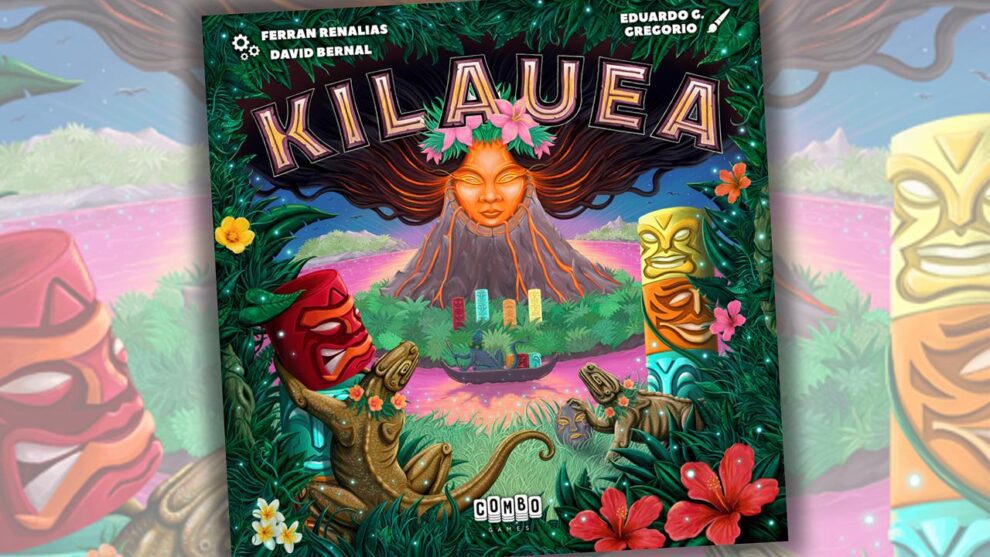
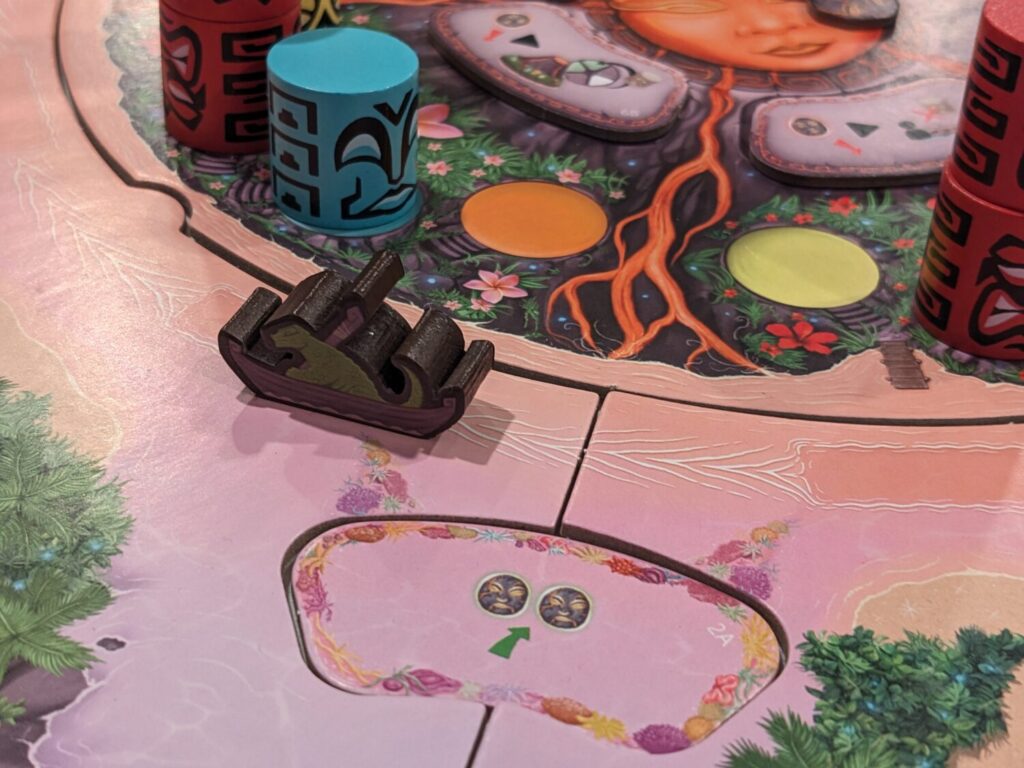
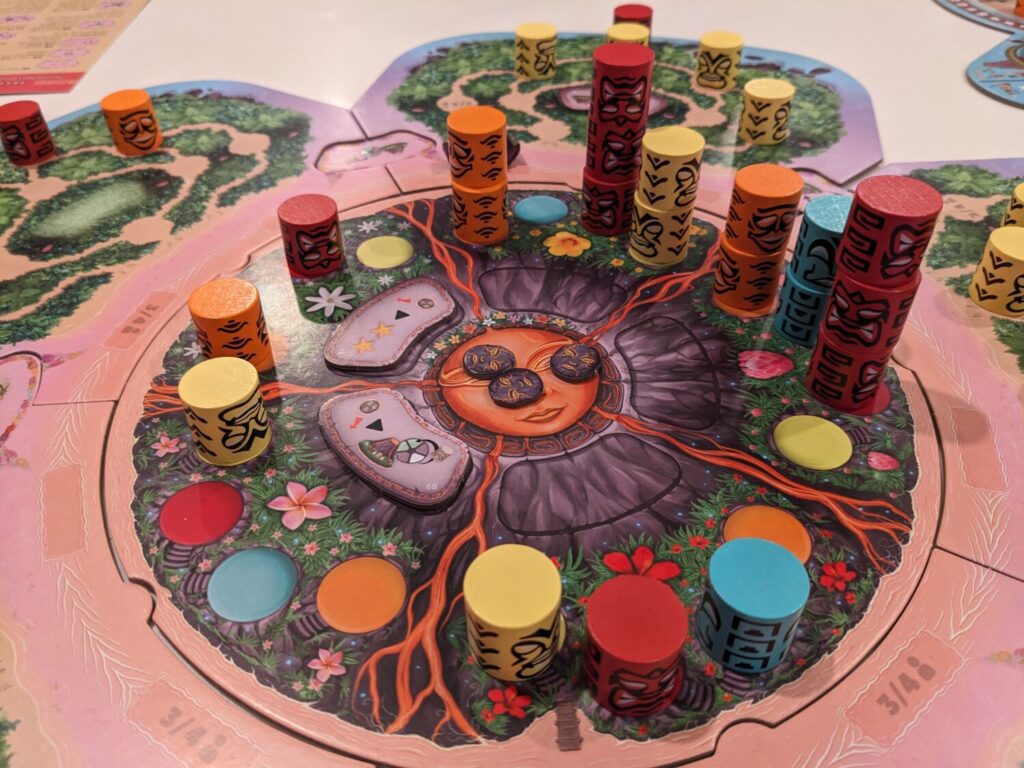
So, designers? Check. The game in the box is gorgeous, too, with beautiful, chunky tiki pieces in four different colors and a rondel with a cute little canoe token. Before my second play, I set up Kilauea on my dining room table, and my wife and two kids both called out their adoration for the look of it on the table. “I don’t know what’s going on there, but that looks fun!” said my wife.
Kilauea has a lot going for it. As a game, however, it was fine. I wanted to like Kilauea a lot more than I actually did.
Do, Undo
Kilauea is an abstract strategy game for 2-4 players. The game’s scoring mechanic is what sets it apart, as Kilauea is an area majority game…sorta.
Here’s what I mean. Over the course of an intermediate and a final scoring phase, players must collect tiki tokens from forests to store on their four-slot canoe, then deliver those pieces to either a central volcano or to a personal island that matches the same arrangement as the volcano. Pieces on a player’s personal island are what scores them points. But they only score points when forests are emptied, and at that moment, the volcano area is resolved.
In the volcano, the tiki color with the most pieces is worth one point per piece. Here’s the twist: the tiki color(s) with presence, but fewer pieces than the most prevalent color, score three points per piece.
That means your personal island goal is to place pieces in the color that you hope will be present, but slightly less present than the color represented most. That way, they match the color in the volcano of each section that will score the most points.
It’s a tricky game to explain, and it’s even trickier to manipulate scoring, because players are constantly sniping each other to ensure that the color you want to score most doesn’t score much at all. The game’s turn structure includes a variety of secondary actions that allow a player to manipulate the pieces in the volcano area, and in the forests, and even in their personal island area.
In my experience, this also led to a ton of “do-undo” turns. You know the ones—I move a red tiki into the pink petal volcano area, to hose you and your chances at scoring reds by INCREASING the number of pieces there. (Remember, the most prevalent color scores less points than the other colors.) Then, on your turn, you undo my move by finding a secondary action that allows you to move that same red piece to an adjacent volcano sector.
In a two-player game, Kilauea suffers mightily with this issue. In some ways, this would be fine if the game moved at a steadier clip. But for such a simple exercise, Kilauea can take about 45 minutes with two players, much too long for this kind of an abstract. We did a four-player game with my review crew—a first play for everyone—and that play took about 75 minutes.
Well, Hmm
Kilauea is a tricky onboarding experience. The secondary action tiles, which are double-sided and include options for volcano-specific secondary actions, feature icons that I really struggled to grasp even during my second play. The graphic design and iconography featured on the player boards should have helped navigate both turn options and scoring rules, but that never stuck with players, either.
The strange irony with Kilauea surfaced when we learned that Bernal is the designer of Koinobori, another game with very similar mechanics to Kilauea, including the movement of cards to different columns in order to manage each player’s scoring potential. In many ways, Koinobori does Kilauea better than Kilauea does itself. Koinobori is easier to teach, easier to score, features a much more satisfying level of interaction, and is faster than Kilauea.
Kilauea is absolutely the more handsome product, as Koinobori is just a deck of cards. But in terms of achieving a goal, my group was surprised how much more we wanted to get Koinobori back to the table after completing our plays of Kilauea.
I do think Kilauea is worth a look if you table abstracts with larger groups. I say that, because many of the titles covered by our resident abstract experts (Tom and Andrew) are two-player-only affairs, and the abstracts I appreciate most are also two-player-only games. Kilauea, at two players, is not recommended, but at three or four players, the volcano shenanigans are certainly more interesting.
For the look of it alone, peep a look at Kilauea during your next visit to the Combo Games booth at a convention near you. However, I’ve personally moved on to track the 2026 release slate for Combo, because I know their catalog will be worth a look.