
Disclosure: Meeple Mountain received a free copy of this product in exchange for an honest, unbiased review. This review is not intended to be an endorsement.
I appreciate that the game Ipso (2026, Gigamic) reveals itself immediately…because it is not great.
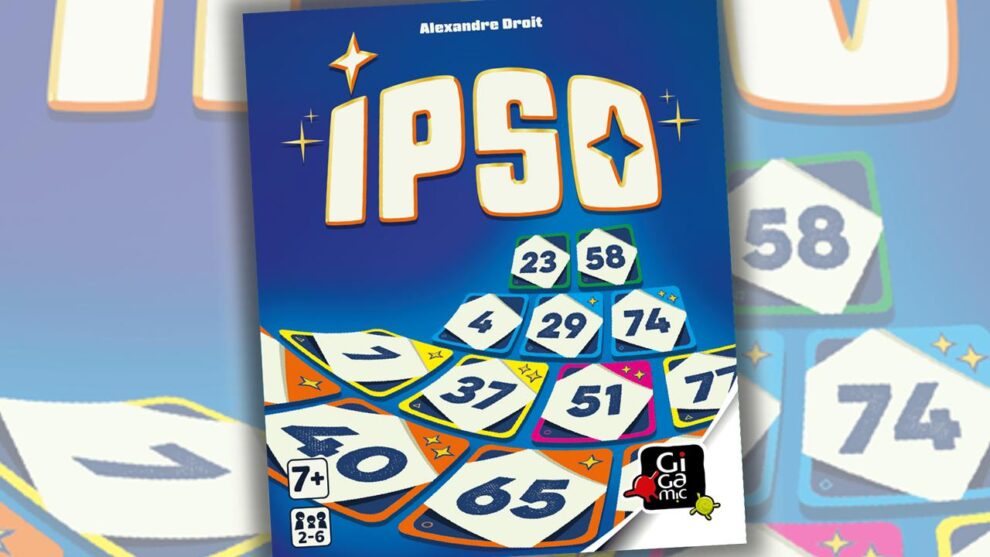
That’s not to say that it’s a complete negative, though. A deck of 90 cards, spread across five suits (and, importantly, NOT in numerical order) is used to seed the play area. Each player gets 14 cards dealt face down, which are then used to build a pyramid. A 15th card, represented by a single, bright, very large star, sits at the top of this pyramid. A market of two cards from the deck is built in the center of the play area, then the game begins.
On a turn, players select one of the two face-up market cards to replace one of their face down pyramid cards. That replaced card is never technically owned by the pyramid’s owner; it is simply moved, face-up, into the market, so that the next player always has two cards to choose from.
Choose your face-up card wisely, because scoring is tied to three simple elements. The first is the easiest: at the end of the game, only rows that feature cards in ascending order will score any points. Second, if the row is eligible to score, each card is worth a single point, but if the entire row is made up of only one color, each card is worth two points. Finally, some of the cards in Ipso feature one or two star icons in the upper right corner; if the row scores, those extra stars count as well.
Once each player has 14 face-up cards, each player has one final choice. They can keep their large star card at the top of the pyramid to score three extra points…or, they can toss that card to deal themselves one new card from the top of the draw deck to replace a single card in their pyramid. This might be useful for a row that could score big points if just the right card flops off the top of the deck.

That’s it. That’s Ipso. And, Ipso failed to ever really resonate with players in my play groups, nor did it seem to jazz the four opponents I took on when I learned that Ipso is available on Board Game Arena.
Here are the positives. Ipso plays very fast; even in person, Ipso with four players wraps up in about 15 minutes. Online, a two-player game of Ipso lasts 3-4 minutes, max. Decisions are literally binary: you have a choice of two cards on any given turn, and when the number are very low or very high, it’s easy to guess where those should go in your tableau because a row needs to end up in ascending order or it will not score. Like other retail products from Gigamic, the form factor is nice and the footprint is tiny.
Some of those positives feed the negatives; for example, when a single-digit card flops into the market, the next player is absolutely going to take that card and place it in one of the left-most spaces of their pyramid. Not interesting. When a card has two stars on it, it’s just categorically better than a card that has no stars. As a result, players will often report their frustration in seeing yet another card enter the market that becomes an “instabuy” for their own pyramid, even if the colors don’t match a row. Cards with stars are automatically worth at least two points if they have a star on them, and three points if they have two, assuming that row scores.
Winning a game of Ipso feels very luck driven, and in most cases, the majority of a player’s rows will score even with the luck of the draw. Each time I played online, I noticed players doing the same things I thought to do in person: with four rows in the pyramid (besides the top star card), everyone tries to spread both their number ranges and their color ranges early on to ensure they can give themselves a chance at getting a full row of cards of the same color. Low numbers go left. Numbers in the 40s-60s go broadly in the middle of a row. If you draw something higher than 80, it goes on the right. Everyone takes star cards when they hit the market.
Ipso might be a better fit for younger players…but I suspect that even younger plays will figure out the meta quickly. I wonder who the target audience is here. More casual players, certainly, but wouldn’t Yahtzee be just as interesting as a luck-driven exercise?
If you had to pick one way to play Ipso, my advice would be to play it on BGA because of the short playtime. That way, you also won’t find out that Ipso apparently stands for “Inserez, Progressez, Scorez, Optimisez”, which translates to “Include, Plan, Score, Optimize.” (This is why I do not design games!)