

Disclosure: Meeple Mountain received a free copy of this product in exchange for an honest, unbiased review. This review is not intended to be an endorsement.
Inkwell, designed by Jasper Beatrix, Lewis Graye, and Joey Palluconi, and published by DVC Games, is a beautiful object. There are a handful of games centered around illuminated manuscripts, an aesthetic for which I will always be a sucker, and this is far and away the most pleasing. The title, in gold foil over a detailed illumination, is a feast for the eyes. The components in the box are no less filling, though I wish I could extend the compliment beyond the aesthetics. Inkwell is, I think, three games all at once, and it doesn’t quite succeed as any of them.
The most obvious reference point, the one I’ve seen repeated the most in BGG reviews and on social media, is Azul. While I understand the point of comparison, the games don’t really have much in common at all. You choose your bits from a public central board and put them in matching slots within your own private sphere, but that’s about it. The specifics are so different that they undermine any meaningful commonality. You could describe the games as similar, but you’d be doing both Inkwell and Azul a disservice.
When choosing ink from an inkwell, you take all the cubes, regardless of color, and add them to accommodating spots on your board. Your choices change what’s available to other players only in the sense that you have removed an option. Part of the joy of Azul, what makes it a great game, is in the permutational development, figuring out what moves now will either help you later or seriously trip someone else up. It has teeth. Inkwell has neither broad horizons nor bite. The horizon for decisions ends more or less at the tip of your quill.
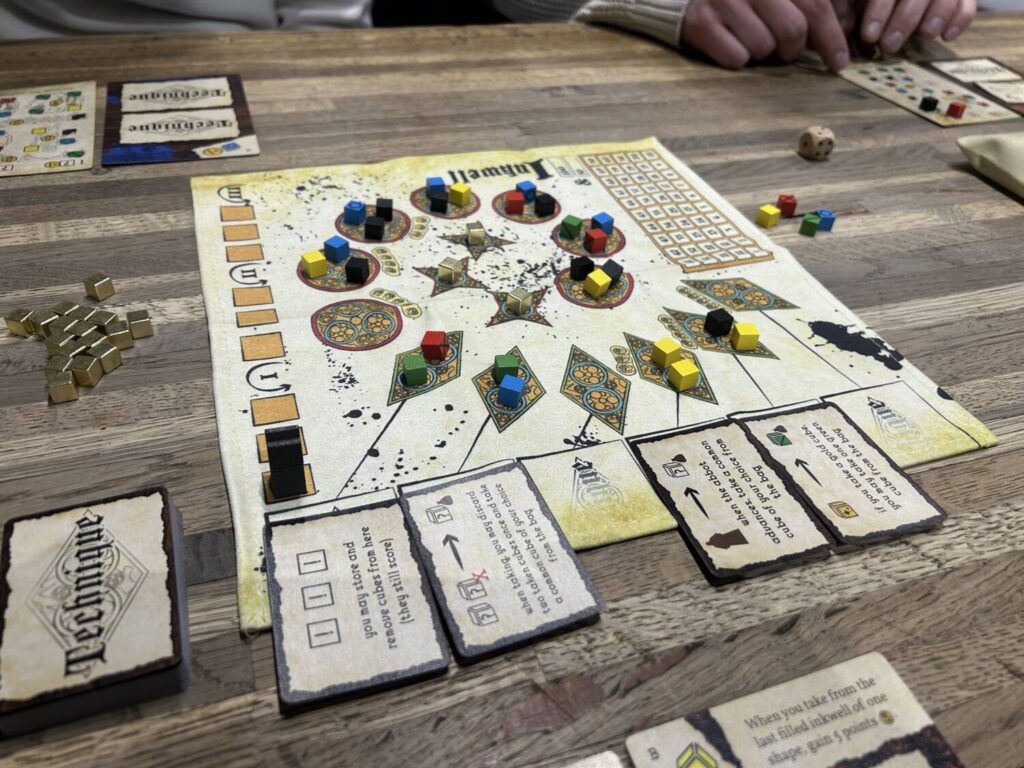
There was a glimmer of hope when I saw the rule stating that you cannot take the contents of an inkwell unless you have room for all of its cubes. You don’t expect a rule like that to be there for no reason. It suggests a game played with daggers out, with players constantly looking from one board to another, plotting ways to manipulate the pool to the disadvantage of others, but those daggers stay sheathed in our boots. There are too many cubes and too many slots. Across three or four games, I can only think of a single occasion when a player went with one option over another because of an opponent’s board state. Come to think of it, across all of my games, we never had a player unable to take cubes on their turn. The tomes are too busy and the options are a little too flexible for the game to be confrontational.
If we can’t get the gentle pummeling of Azul, then how about the sort of pastoral, heads-down puzzling of a Cascadia or, better yet, a Harmonies? Here, the problem is that Inkwell isn’t interesting enough. For how beautiful it is, for how much I enjoy the setting, there isn’t much of a puzzle here. You take cubes, you place cubes. Certain illustrations on your manuscript are worth more points than others, so you do want to prioritize, but most of the game is spent capitalizing on obvious opportunities rather than discerning. If I’m doing something this straightforward, I want it to be full of spikes. That’s where the fun comes from.
The final option, and the game I think Inkwell really wants to be, is Innovation. Let me explain.
If you’ve never played Innovation, it is a bonkers game. Nonsense happens constantly. The people who don’t like Innovation don’t like it because it feels too chaotic. The people who love it—and people do love it—have an exhaustive knowledge of the cards and thrive in the chaos. This may not seem like an obvious partner for Inkwell, but that’s because I’ve left something out.
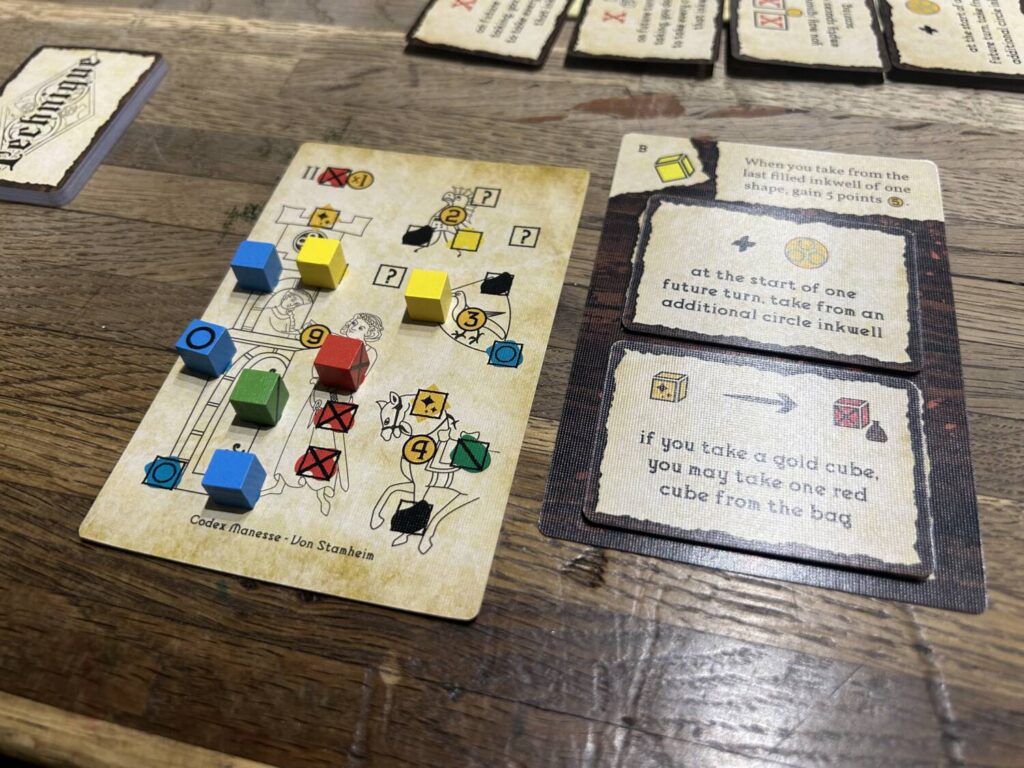
Certain of the inkwells furnish the player with both ink and a technique card. You can take up to two technique cards during each of the game’s three rounds, for a total of up to six. The powers in and of themselves are pretty straightforward; they allow you to store cubes you otherwise wouldn’t have space for, or take extra cubes from the bag, or take extra cubes on your turn, that sort of stuff. Most of them stay active for the rest of the game, and the order in which they fire is up to you, which means the last round can produce quality shenanigans. I take three cubes, including a red cube. Whenever I take a red cube, I get to take another red cube from the bag. I have a matching ability that applies to the green cube I took, and I have the ability to trade two cubes in for any other cube, so I’ll trade those two extra cubes for a yellow cube, and, wouldn’t you know it, every time I take a yellow cube, etc. etc. You see the idea.
It is in those frenzied moments, when you get a combo that really pops off, that Inkwell feels closest to alive, even if it still doesn’t quite get over. If that particular dial were cranked up to 11 or 12, if players were able to get those kinds of machines going earlier in the game, Inkwell would be a fascinating little exercise in the absurd.
As it is, Inkwell isn’t sharp enough for an Azul, it isn’t interesting enough for a Cascadia—not that I think Cascadia is all that interesting, to be honest—and it isn’t wild enough for an Innovation. It ends up in a monastic isolation of its own creation.