
Disclosure: Meeple Mountain received a free copy of this product in exchange for an honest, unbiased review. This review is not intended to be an endorsement.
Concerning Formatting
Before we begin, we should discuss formatting. Meeple Mountain’s house style is to italicize the names of games. Arcs, Catan, Kabuto Sumo: Sakura Slam. This is not contentious. They are, after all, titles of authored works, and deserve the grammatical demarcations befitting their status. When it comes to classic, authorless games such as chess and checkers, there is a schism within the church of Meeple Mountain. Some believe they should be capitalized too, but this has (as evidenced just now by my flagrant disregard for the house style) never sat well with me. Chess has no single author. “Chess” is a name, but it is not a title, and the dominant English convention is to neither italicize nor capitalize it.
The same is true of most traditional games, a number of which will be discussed in the article that follows. Cribbage, oh hell, solitaire, koi-koi, and canasta will come up, but they will only be capitalized if they happen to begin a sentence, and they will only be italicized for the purposes of emphasis. This would not be worth explaining if this article did not also cover French Tarot and scopa.
You see the issue.
“French Tarot” is generally capitalized in English in order to separate the card game (French Tarot) from the deck with which that card game is played (French tarot). Scopa is not capitalized, but it is italicized, falling as it does under the custom of italicizing words from other languages. We’ve adopted “tarot” as our own, but we have done no such thing with scopa. We still call una scopa a broom.
Back to Your Regularly Scheduled Programming
For all the great games that are put out every year, for all the impressive designs and fancy illustrations and ingenious bits of production, I don’t know that I’ll ever love a game as much as I love oh hell, a century-old trick-taking game that’s also known as contract whist. All you need to play is a deck of cards, a piece of paper, a writing implement, and a group of friends who know how to laugh when they’re having a bad time. A game takes less than half an hour, it rewards skill without freezing out new players, anyone can have a bad or a good night, and it is funny in any case.
That’s all I want any game to be, really. I love a dense, knotty puzzle, or an incredible story, but my interest in more involved games ebbs and flows, while my adoration for a simple card game burns ever brighter. They’re quintessential, aren’t they? There’s a reason they’ve survived for so long. They rule.
Even beyond the sleek, elegant world of trick-taking and shedding games, there’s a lot to love. I appreciate the clunky absurdity of cribbage—truly the Calvinball (capitalized, not italicized) of card games—and the tedious rhythms of canasta. Learning these games, even if I rarely have cause to play them, connects me to our larger past. It’s good to remember that board games exist because, before they became a commercial force, they were a simple and ever-present part of life.
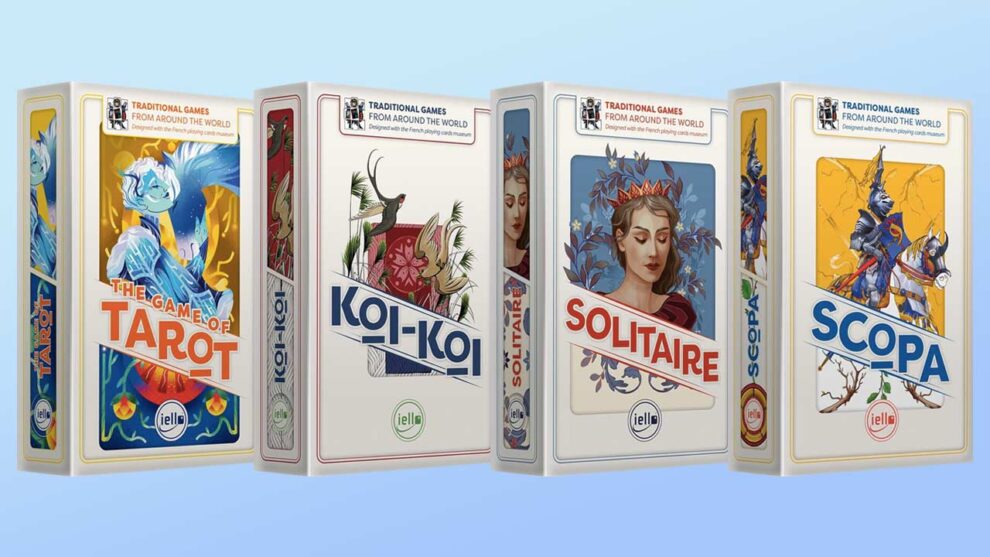
It comes as no surprise, then, that I am an easy mark for French publisher Iello’s new Traditional Games line, which is kicking things off with beautiful slipcase editions of French Tarot, scopa, solitaire, and koi-koi. Each comes with a set of beautifully-illustrated cards or tiles as well as a rulebook that includes a brief history of the game in question, a good explanation of the rules, and a list of popular variations in the back.
I want to stress that these are good explanations of the rules. Take it from someone who spends a lot of time looking at such things; a good explanation of a traditional ruleset is hard to come by. A lot of the resources we have available to us nowadays were written on the cheap, or by someone who wasn’t good at writing down rules, or written by someone who can’t take a moment to step outside their own familiarity to realize that “meld” might be confusing for new players. I recently had to teach canasta using the Bicycle Player Card website’s rules explanation, which is horrific. To have a reliable source of information about this stuff is already enough to warrant the existence of this set.
In the case of French Tarot in particular, the good people at Iello have outdone themselves. French Tarot is a devil of a thing to learn. The only argument I ever had with my French ex was in fact a direct result of her struggle to teach a group of us how to play. It has a relatively labyrinthine set of conventions around bidding, following, and scoring, all of which can make for an unwelcoming initial experience. Instead of teaching you everything at once, the manual divides French Tarot into three learning games prior to your first full round. It’s very smart, and using it I had no issues teaching French Tarot to a group of players who’d never come anywhere near it. There were plenty of questions, but they were comfortable questions, and that’s what matters.
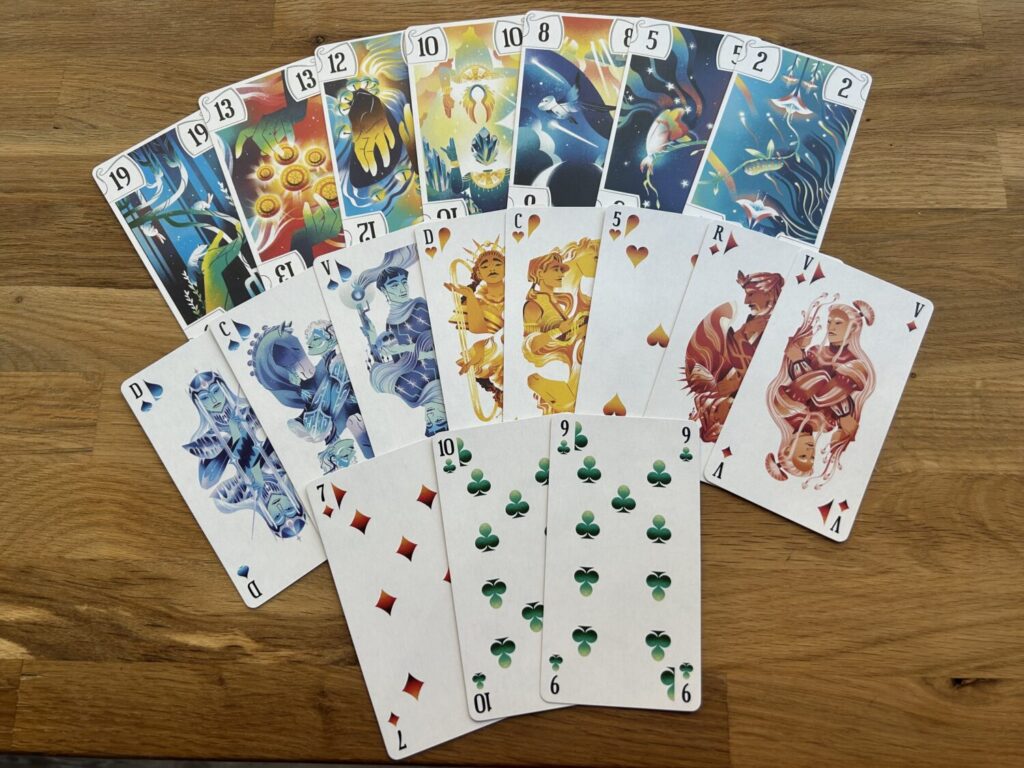
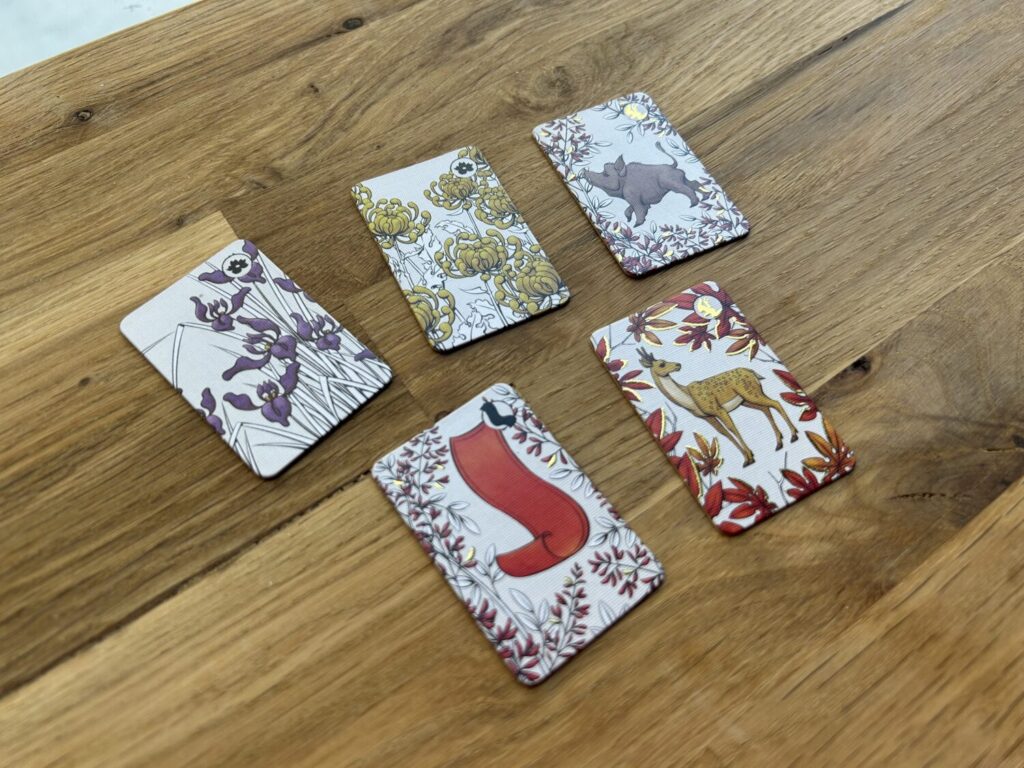
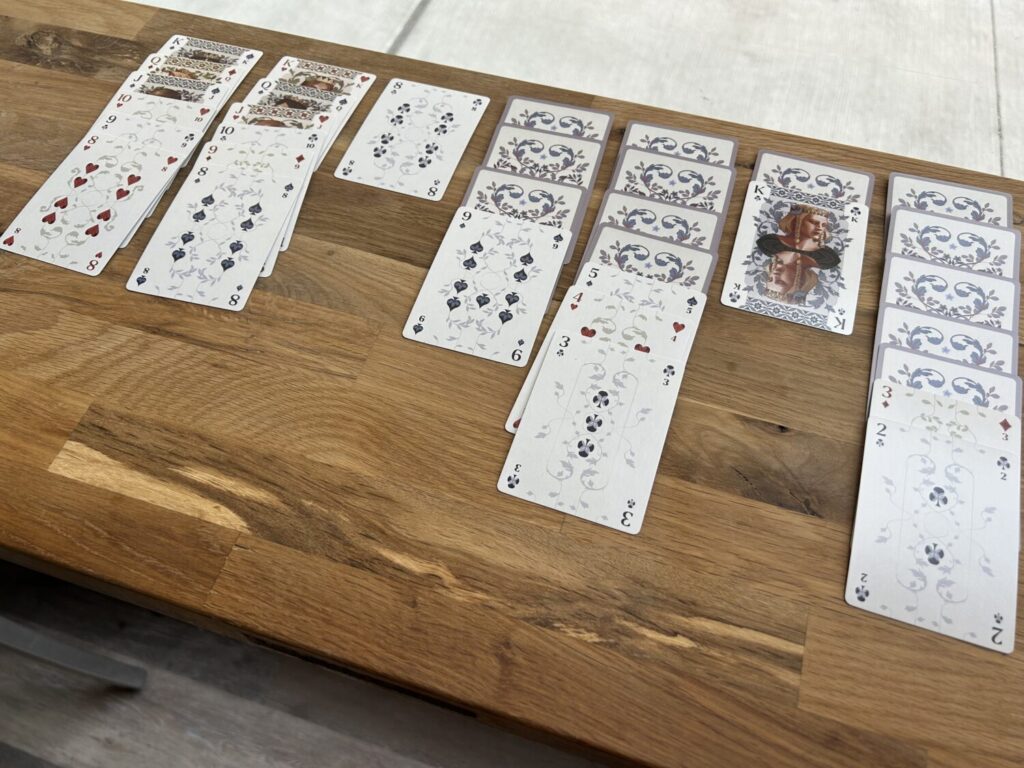
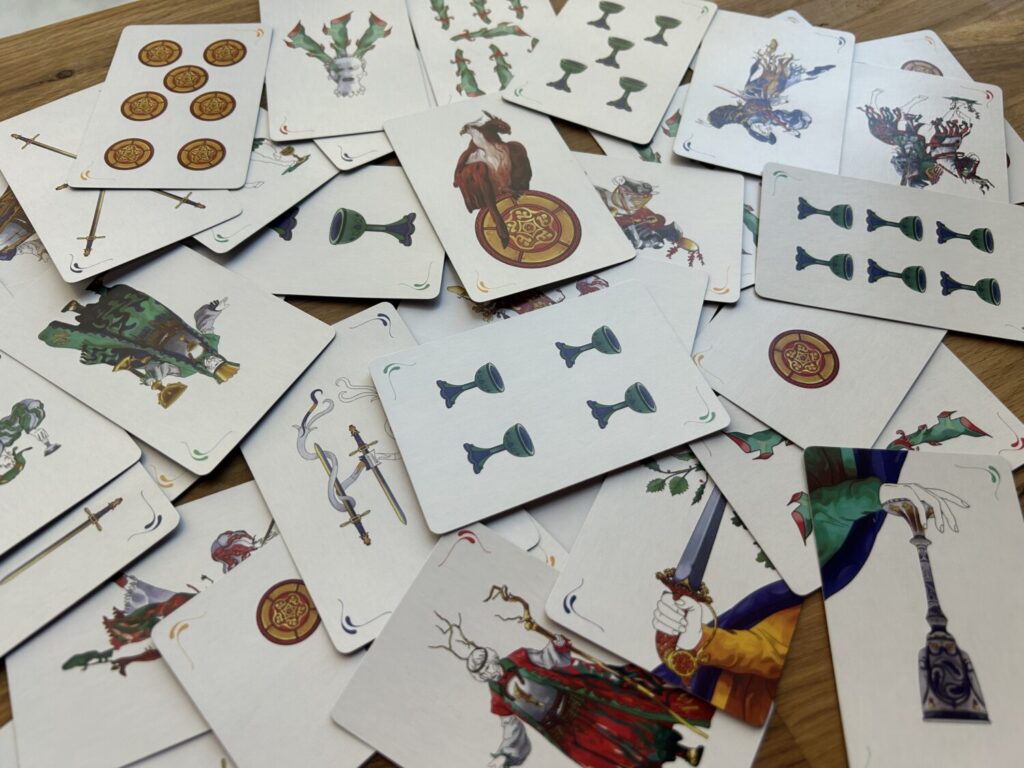
Across all four volumes, the decks themselves are beautiful. The art is gorgeous without going overboard. Cards are readily recognizable as what they are, which isn’t always a guarantee when you’re looking at arty decks. The trump cards in the French Tarot deck stand out with their beautiful, modern-with-a-touch-of-Deco designs. The scopa deck aims for traditionalism. The solitaire deck is a good standard deck. In all cases, the card games shuffle well and handle well, which is what you want. The hanafuda tiles used for koi-koi are fabulous, though they are a pain in the oshiri to shuffle. But even that, in its way, is part of the tradition of the game; hanafuda became commonplace when Japan banned playing cards, which were introduced by Portuguese missionaries. They were specifically designed to not look like something you’d play a game with.
I love that Iello included koi-koi in this set. It shows thoughtfulness, a willingness to break away from Occidoxy, an intentionality that we should all bring to these sorts of exploits. I hope Iello makes a hundred more of these. They are wondrous both in intent and in execution, marvelous excuses to take time in serious consideration of the games that led us to where we are today. These are the games we could sit down and play with our great-great-great-grandparents. People spend a lot of time and a lot of breath on the games that come out now. What a joy to sit and think about the games we have the privilege of taking for granted.