Disclosure: Meeple Mountain received a free copy of this product in exchange for an honest, unbiased review. This review is not intended to be an endorsement.
In the broadest possible strokes, games are created out of three or four things: what you can do, what you can’t do, what you want, and, occasionally, what you don’t want. Not every game includes something you don’t want as a category unto itself. You don’t want to end up with few resources in Catan, sure, but that’s just the inversion of what you want: resources with which to build things. I’m talking about things like running out of food in Agricola, where there is a specific punishment meted out by the rules.
In High Society, a fabulous auction game for three-to-five players by designer Reiner Knizia and recently out in a new edition from publisher Allplay, those four categories are crystal clear. That’s never a bad thing. Many of the best games provide clear, succinct definitions for each of them. High Society is a masterpiece not only because it provides ready definitions, but they work, delightfully, at cross-purposes.
The goal of High Society is, of course, to have the most points at the end of the game. There we have our first definition:
What do you want? To have the most points.
Points are accrued through the purchase of various cards, revealed from the top of the deck and auctioned off one-by-one. On your turn, you can either raise the current bid, or you can pass. The last bidder standing discards the money they bid and takes the card. Everyone else reclaims their bid. As far as the mechanics are concerned, that’s everything you can do.
What can you do? Raise the bid or pass.
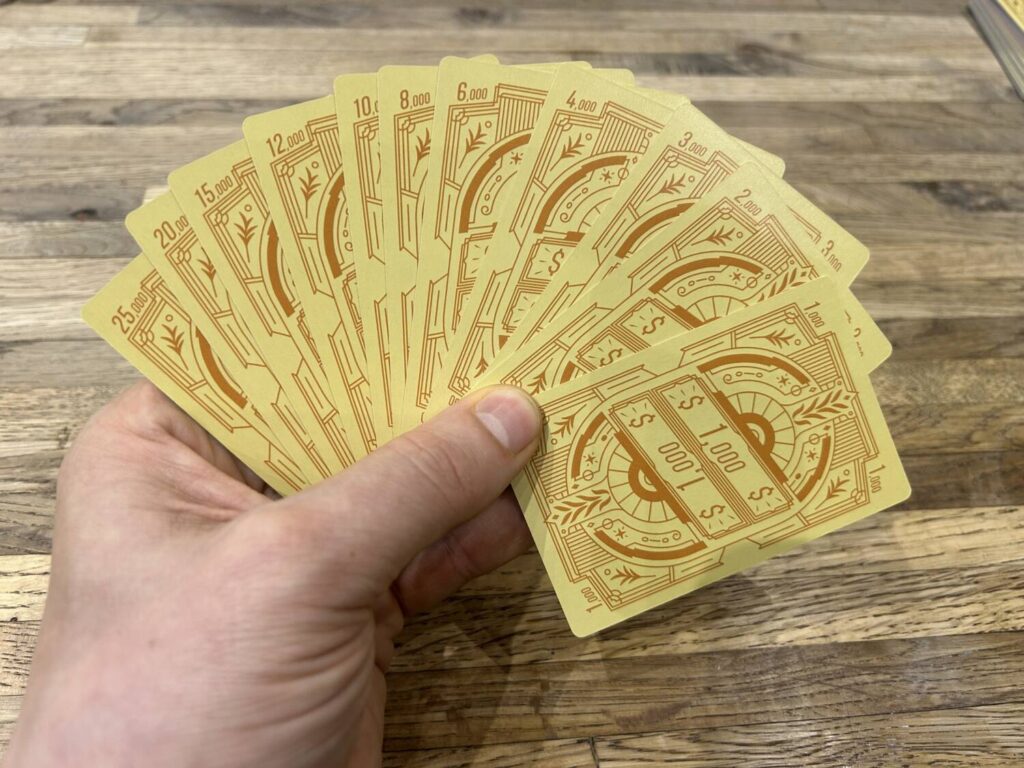
So far so standard. Each player starts the game with all the money they’re ever going to have, a handful of cards valued between $1 and $25 million. When bidding, the money you’ve already put down can’t be replaced; it can only be added to. If, for example, I opened with a bid of $1 million and the auction gets back to me with a standing bid of $2 million, I can only raise my bid to $3 million if I still have the card worth $2 million in my hand. I can’t pick up my $1 and replace it with my $3. If I spent my $2 earlier, I’m going to have to bid a higher amount.
That is the game’s only negative restriction, so we stand at three out of four:
What can’t you do? Make change.
It’s a wonderful restriction because it inflates the value of smaller bills. They provide you with flexibility. Having the ability late in the game to raise your bid by a small amount while others are forced to make near-exponential leaps is the sign of a game well played. Deciding to use your $1 million is nearly as agonizing as deciding to use your $25. Good stuff, in my opinion.
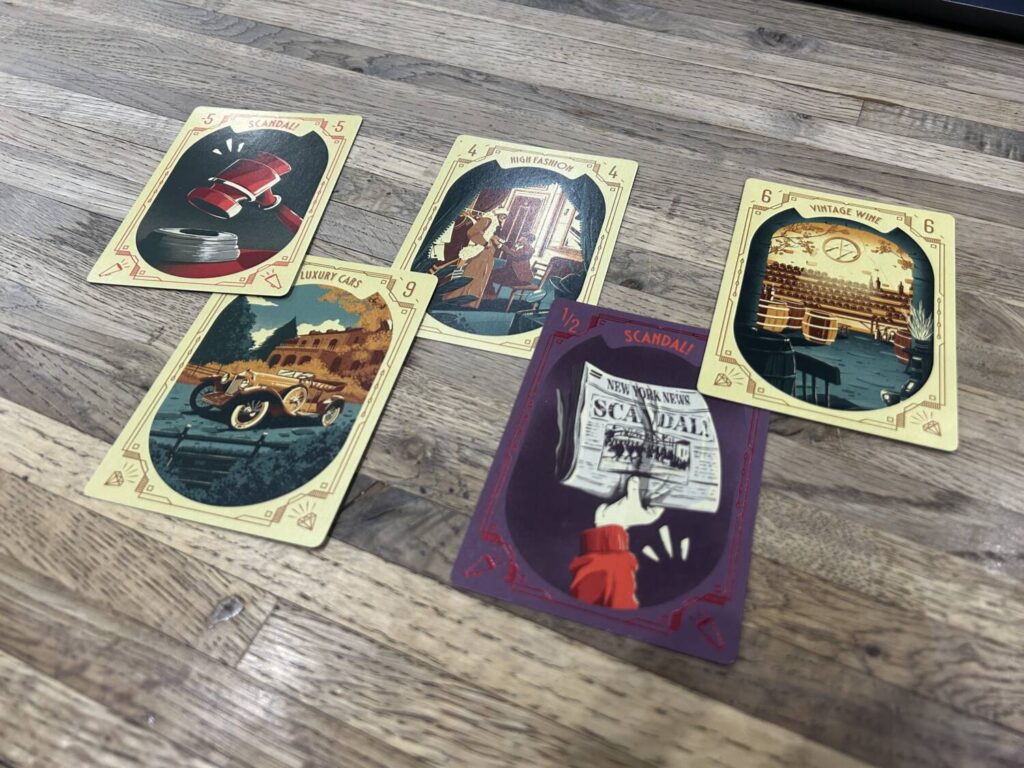
Within the deck, most of the cards have positive effects. Some are worth 1-10 points, and a handful act as multipliers or have some other positive impact. But there are a handful of cards that hurt you. They may be worth negative points, for example, or they may cause you to discard a score card. For these, the auctions work a bit differently. The “What can you do?” remains the same; you can raise the bid or you can pass. But the “winner” of the auction is whichever player passes first. If I pass, I take my bid back into my hand and claim the negative card. Everybody else at the table has to pay. You are paying to not take the card.
While you calculate the money you have left, the money you’re willing to spend, and how much money you think you can get others to spend, there’s one more thing you have to keep in mind: High Society’s corker of a scoring restriction. At the end of the game, the player(s) with the least money remaining is/are automatically eliminated. We simply do not truck with poors, you see. What would the neighbors think?
And so, at last, our final definition:
What don’t you want? To spend the most money.
If someone is raking in the points, they’re probably also throwing away too much money. You can happily sit back and let them spend. You yourself must also spend, but the process of making sure you don’t spend the most turns High Society into a high-wire act. I love auction games for their uncertainties and impenetrability, and this one turns those burners up so high that the house is liable to burn down any second.
This is all a tremendously academic way of discussing a game that is, first and foremost, a blast. I don’t mean to make it sound so rigorous. High Society is a wonderful game that I’m glad to see back in print. It is a masterclass of design because what you want and what you don’t want are in constant friction. What you can and can’t do push against each other in interesting ways. The contrapuntal pressures act invisibly to create this experience I can best describe as, “Fun.”