
Disclosure: Meeple Mountain received a free copy of this product in exchange for an honest, unbiased review. This review is not intended to be an endorsement.
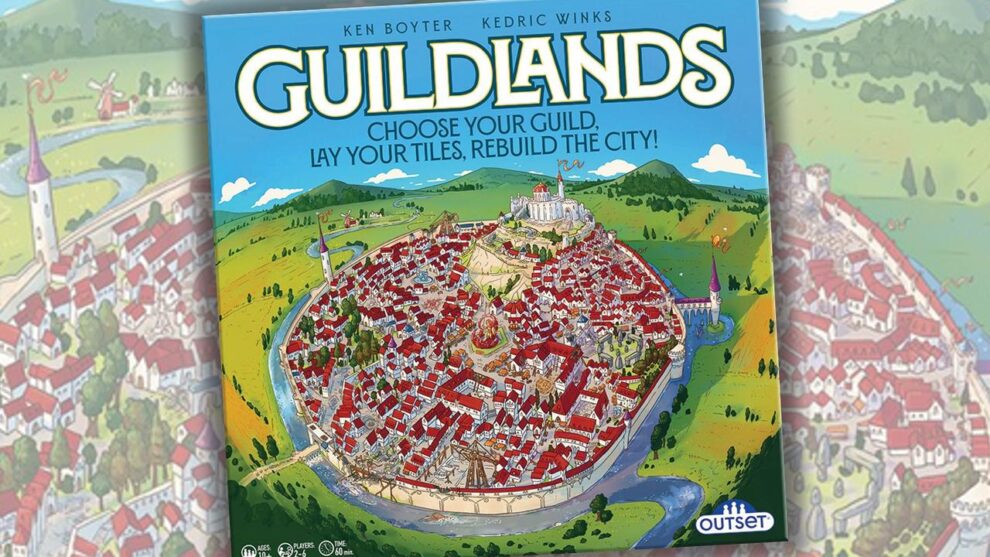
Earlier this year, while working on our Most Anticipated Games of Gen Con list, I came across Guildlands, an asymmetric tile-laying, city-building game. You might say to yourself, “That’s quite a mouthful”, and I’d agree, but I’d still strongly suggest you give it a whirl. Because I’ve never played another game quite like this one.
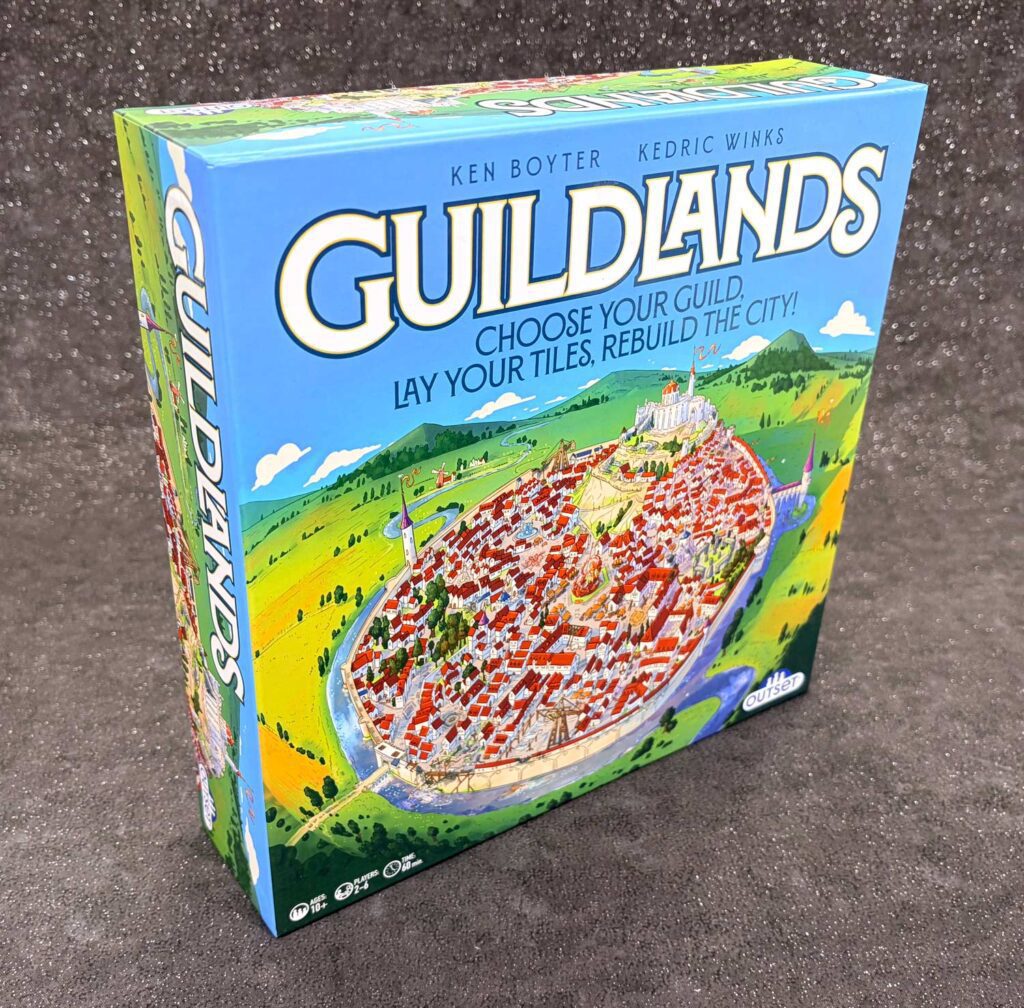
Guildlands Overview
In Guildlands, each player runs a guild in a fantasy city. The goal is to earn the most points by placing tiles into the shared city, and arranging them in ways that benefit your guild. The catch is that each guild not only has different scoring objectives but also different actions they can take on their turn. Guildlands is what you might get if you smashed together Root and Carcassonne.
Actions
So, just what are you doing on your turn? One or more actions as follows, in whichever order you prefer.
Tile action – mandatory
Each turn you must take a tile action. You can lay a tile by placing it into the city directly adjacent to any existing tile in the shared city, rotating it any way you like. Or you can rotate an existing tile at the edge of the board, leaving it where it is but spinning it to your desired orientation (as long as the tile has no workers or tokens already on it). In this way the city grows and changes according to the whims and demands of the guilds.
Special Action – optional
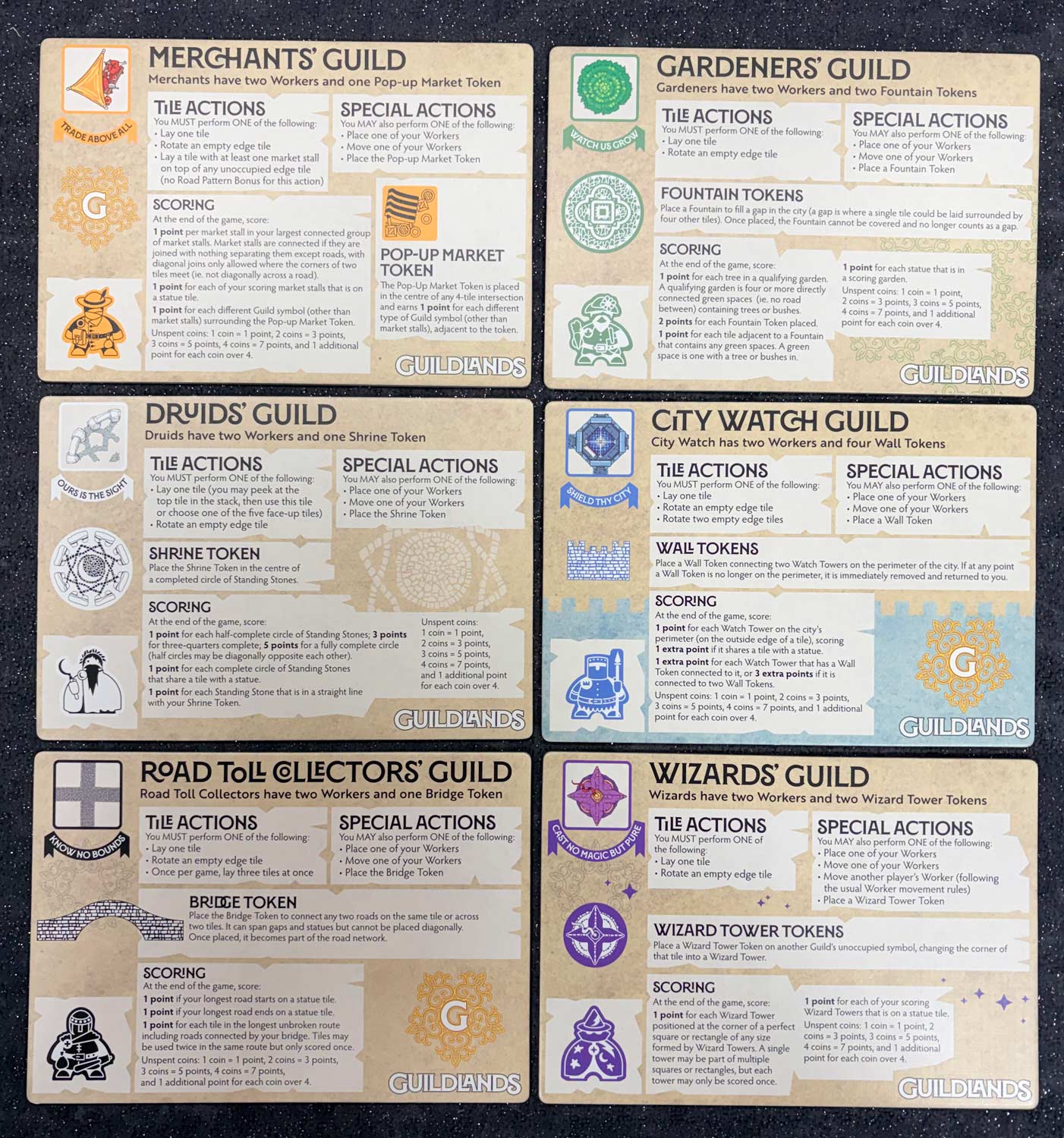
You can also perform one of your guild’s special actions, which is where the magic of the game occurs. Every guild has 2 of the same actions: placing a worker anywhere on a city tile that doesn’t already have a worker, or moving a worker to any other tile, along an unbroken stretch of road. Each guild also has one or more additional special actions unique to them, which advances their scoring conditions.
- Gardeners Guild – place a fountain token
- City Watch Guild – place a wall token
- Druids Guild – Place the shrine token
- Wizards Guild – Place a wizard tower
- Merchants Guild – Place the pop-up market token
- Road Toll Collectors Guild – Place the bridge token
Once per turn, a player can also pay a single coin to take an additional tile action or special action. Just keep in mind that coins are worth points at the end of the game; up to 7 points for a set of 4.
Guildlands Strategy
With only a handful of different actions players can do in the game, Guildlands becomes an exercise in timing and denial. Almost every scoring condition has to do with tile placement; not only of where a tile is laid but also how it is rotated relative to the tiles next to it.
The Merchants Guild, for example, scores the largest connected group of market stalls. So that player will constantly be selecting tiles that feature market stalls and attempt to lay and rotate the tile such that it aligns with other tiles. Even rotating one tile by a quarter turn can break up a large group of market stalls and prevent a large point payout.
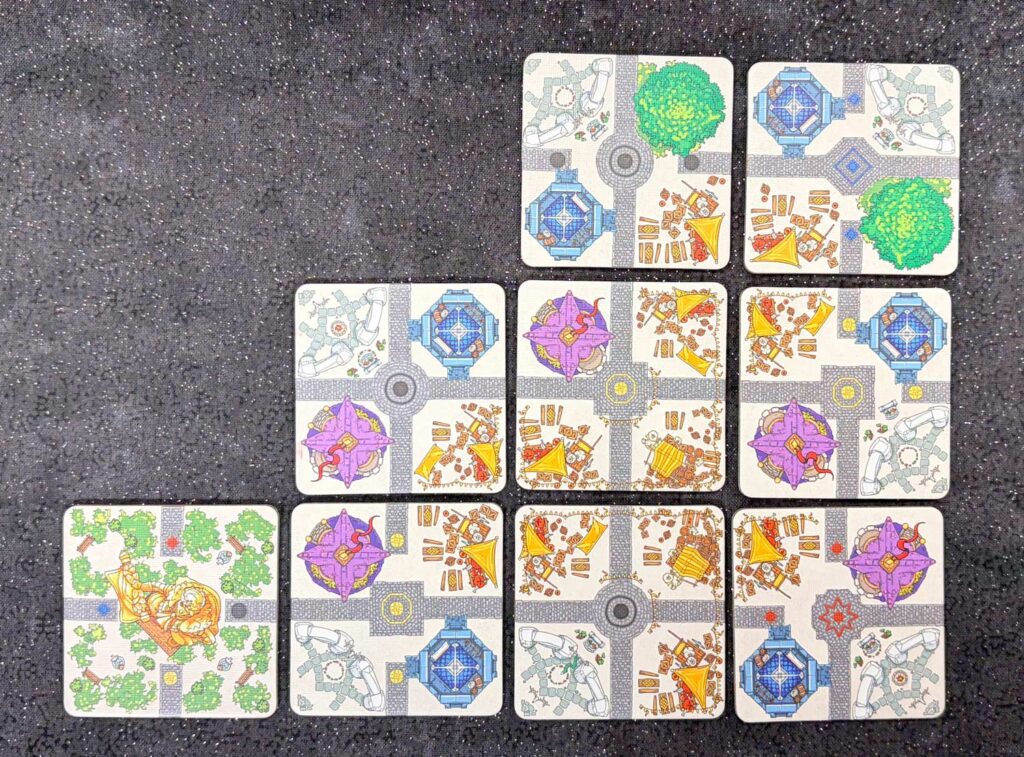
Players have a few tools at their disposal to help prevent their plans from going awry. A tile that contains a worker or another player token cannot be rotated. Placing a key tile along the edge of the board is risky, so the active player can drop, or move, a worker onto that tile to lock it into place. Additionally, tiles can only be rotated if they have at least one exposed edge. Taking an extra turn to drop a tile can allow you to lock your tiles into place and guarantee they won’t be rearranged.
Extra turns can only be taken if a player has a coin to pay for it. Depending on the player count, each player will begin the game with between 1 and 3 coins. You can earn additional coins as the game progresses by placing tiles such that the icon at the center of a tile forms a connection with only two other tiles featuring the same icon. In almost every game of Guildlands I’ve played, there were several times when a player only placed a tile in order to earn a coin. Sometimes you’re lucky, and that tile’s placement overlaps with your goals. But sometimes you just need a coin. So, players should keep a close eye out for roads that have 2 icons of a color in order to pick up a quick bonus.
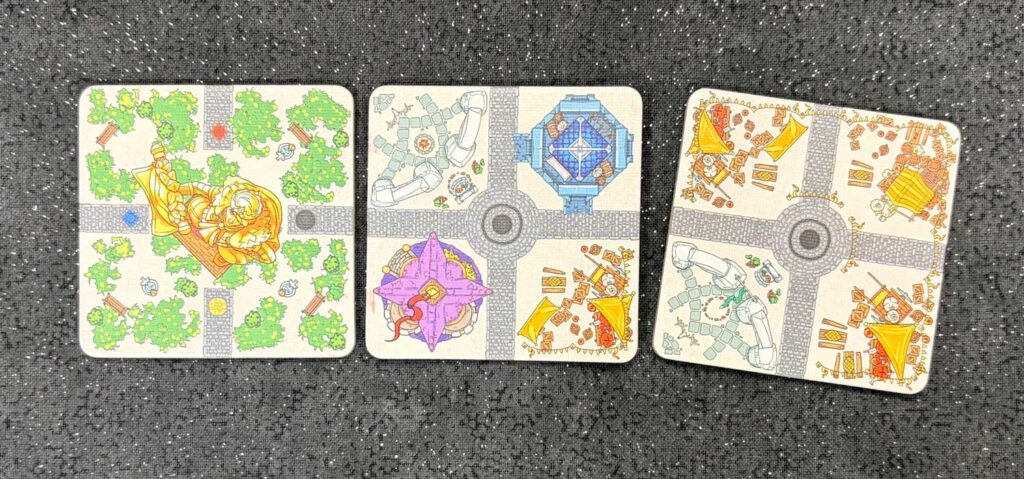
Guildlands is definitely one of those games where it pays to understand how your opponents score. Understanding their motivations will help you counter them more effectively. But even then, you always have to decide whether it’s more useful to improve your own position rather than destroying your opponent’s position.
The game ends when the final city tile has been placed. In the games of Guildlands I’ve played, scores range from 15 to 26, so every little bit counts.
Final Thoughts on Guildlands
Going into my first game of Guildlands I was quite excited. I love tile laying games—the growth of the tableau fascinates me, especially in a game where every player has a slightly different goal. No two guilds have precisely the same scoring conditions. The Druids guild scores when there are 2 or more standing stones icons in a circle, while the Gardeners guild scores for each tree in a garden containing at least 4 green spaces. The Road Toll Collectors guild scores for their longest unbroken path, while the most complex guild, the Wizards, score for each of their wizard towers which are positioned at the corner of a square or rectangle which has a tower at all 4 corners.
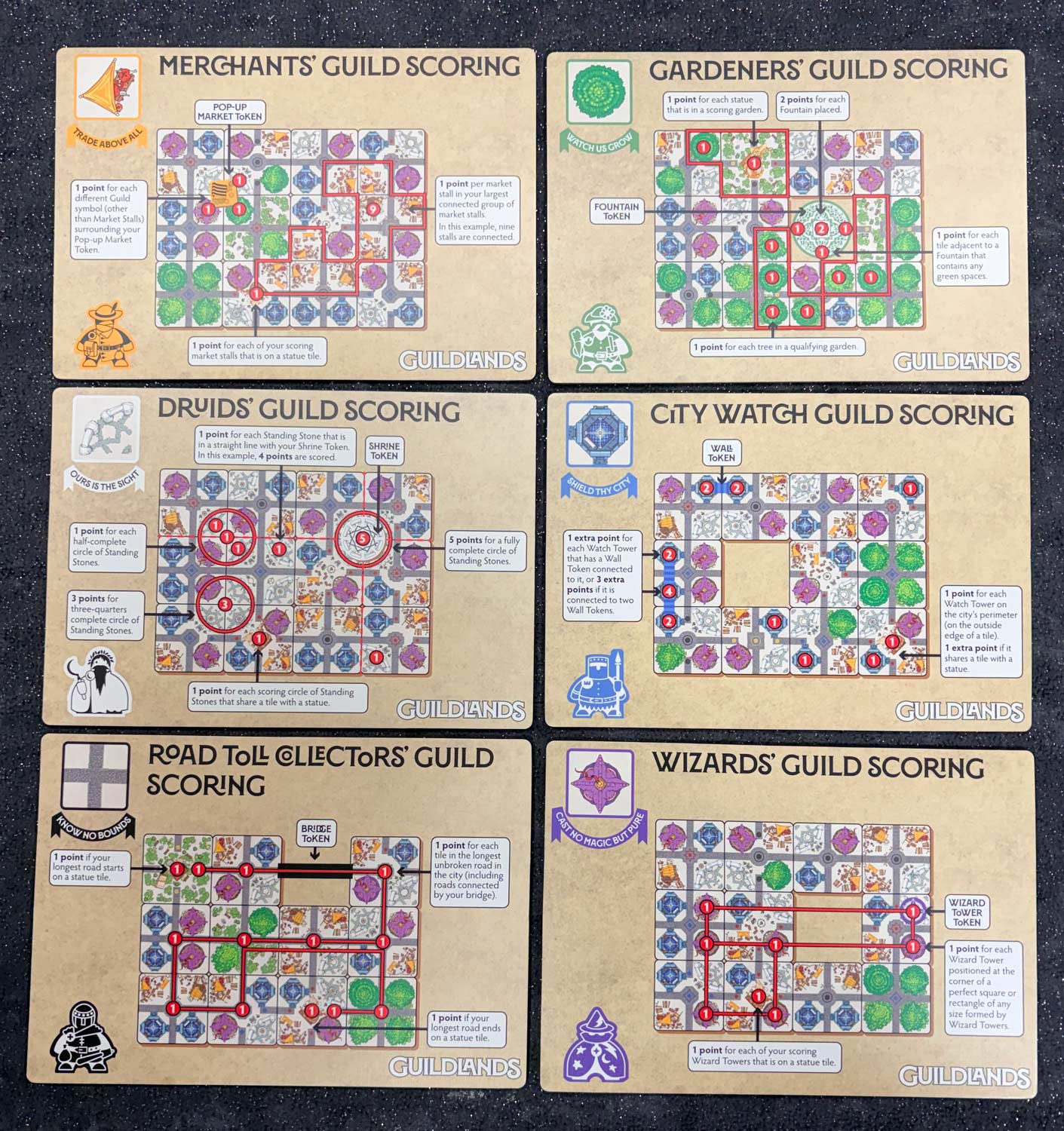
Guildlands is a very spatial game, and one in which players must constantly pay attention to every tile placement. Every city tile features 4 icons—sometimes all 4 are the same, but usually there are 2-4 different icons. This means that a laid tile, which benefits the person placing it, could also be rotated to benefit another player. While this is exciting to me, I have people in my gaming circles who wouldn’t do well in a game like this because they have trouble seeing patterns.
The components in Guildlands are excellent. Not only are the tiles and player boards thick, but the graphic design and artwork are excellent. The rulebook is well laid out, with clear examples, and the back of each player board features illustrations of how to score their unique scoring conditions. And I haven’t even mentioned the player pieces—all of them are brightly-colored, chunky wooden pieces with silk-screened illustrations to help the color-blind.

That’s not to say that everything about Guildlands is perfect. In our plays, some of the guilds seem to be either overpowered or easier to score with. The Druids, for example, can score anywhere in the city, while the City Watch guild can only score for tiles along the edge. As previously mentioned, the Merchants guild aims to have a single connected group of market stalls, and it’s relatively easy to break that up,so that player will need to work harder to maintain their connections.
But after our games were through, our group debated its merits. What we determined was that each player thought the other guilds’ special abilities were overpowered. That leaves me to conclude that Guildlands is a strategic game that not only benefits from repeated plays but also doesn’t reveal its secrets easily.
I had the pleasure of meeting the designers of the game (Hey Ken and Kedric!!) at Gen Con and got a personalized lesson in how to play Guildlands. They also gave me some background about the game and spoke briefly about plans for spin-offs or expansions. I’m thrilled to have had the chance to meet them, and I’m even happier that I’ve had the opportunity to play Guildlands. If you have the chance, you should play it as well.
Guildlands details

- Designer: Kedric Winks, Ken Boyter
- Artists: Laszlo Riba
- Publishers: Outset Media
- Release Date: 2025
- Player count : 2 - 6
- Age range : 10+
- Time range : 45 - 90 minutes
- Mechanism(s): Pattern Building, Tile Placement, Variable Player Powers
- BGG Geek Rating: 7.64127 - converted to Meeple Mountain scale: 4.0.
- More articles about Guildlands.