
Disclosure: Meeple Mountain received a free copy of this product in exchange for an honest, unbiased review. This review is not intended to be an endorsement.
Disclosure: Meeple Mountain was provided a pre-production copy of the game. It is this copy of the game that this review is based upon. As such, this review is not necessarily representative of the final product. All photographs, components, and rules described herein are subject to change.
In the wide world of board game themes and gameplay, ‘Alchemy’ feels like one of the most commonly represented. This might just be my own bias though, as it turns out I have quite a few alchemy focused games in my own collection. From the widely popular Flamecraft to the hit bagbuilder Quacks to marble mayhem favorite Potion Explosion and more, I’d somehow become an accidental alchemy aficionado.
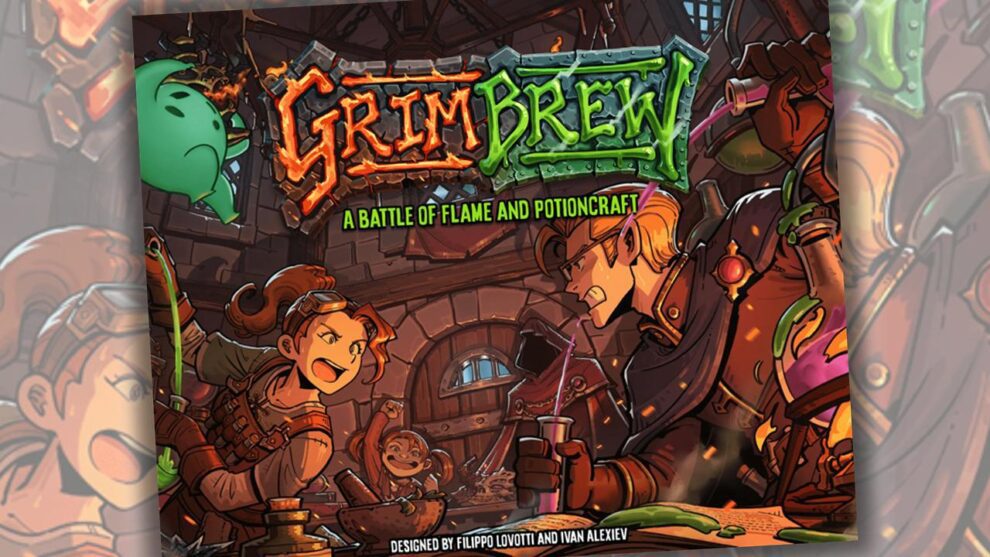
Maybe that’s why when Meeple Mountain was provided with a review copy of Grimbrew from Lucky Omen Studios, I quickly (maybe subconsciously) volunteered to provide a review for it.
Even though Grimbrew thematically has a lot in common with other alchemy themed games, it also separates itself in some unique and interesting ways.
Collect & Brew
As you might have expected, in Grimbrew, two to five players compete to collect the most points by gathering ingredients and brewing potions. Turns are as simple as the premise of the game.
On a player’s turn, they can:
- Take an ingredient from a shared market
- Brew a potion
- Rekindle flames
Active flames are required in order for players to brew potions and refresh the market (more on this in a moment). When taking the ‘rekindle flames’ action, players flip two of their five flame tokens from inactive to active, leading to more options on their next turn.
Play continues until the 20-point per player point pool is depleted which triggers the end of the game.

Despite the simplicity of the available actions, there’s a decent level of strategy thanks to a couple of unique details.
First, when brewing potions, ingredients (which consist of three different symbols and colors) must be provided in a specific order. Most potions provide up to five points when all ingredients are provided, but players have the option to brew with fewer ingredients and receive fewer points in return. As a general strategy, it’s a smart move to occasionally brew potions for less than the full amount of points due to the next mechanic.
Once brewed, all potions provide a bonus to the players who brew them. Brewed potions are placed underneath player boards, leaving the bonus symbols visible.
In most cases, the bonus is a permanent symbol or color, which makes brewing potions on future turns easier. This led to a bit of a tableau/engine building aspect that was highly reminiscent of Splendor. The other bonus found on potions provide additional endgame scoring opportunities. For example, a bonus of one point per specific symbol in a player’s area or one point per brewed potion.
The other notable tweak is to what happens when ingredients are collected. Many ingredients provide one or more symbols and a color, but there are also a limited number of ‘wild’ cards that provide any color or symbol. However, some ingredients also include an effect that triggers once players place the ingredient into their area.
Card effects are based on the number of symbols, colors, or active flames in a players area and range from gaining extra points, rekindling inactive flames, and placing or removing mawlings.
Mawling Madness
Speaking of mawlings, these mischievous little creatures add a fun twist to the accompanying straightforward gameplay. Each player has three mawlings available and they serve as a light ‘take that’ mechanic. Mawlings are used to steal points from other players by moving them from a players own board to a competitors.
When brewing potions, if an opposing player’s mawling is on the brewing players’ board, the mawlings owner receives one point per mawling.The only way mawlings can be placed on another players’ board is through card effects when collecting ingredients.
The mawlings work well a couple of reasons:
- Mawling effects are rare. Of the 64 ingredient cards in the game, only 13 (20%) have a mawling effect; 9 of the 13 cards place mawlings, while the remaining four remove them.
- The penalty isn’t too severe. Mawlings simply steal points and that’s it. This doesn’t push the game too far into an aggressive competition like some take that mechanics do.
- They keep the game close. If planned well, mawlings can be used by lagging players to steal points from leading players to keep the game closer.
Planning for and utilizing the mawlings adds an extra strategic layer that players need to consider.

A Refreshing Recipe
Even more impactful than the mawlings is the inclusion of an optional refresh action. Before taking one of the three standard actions discussed earlier, players can choose to spend one of their active flames to refresh either the potion or ingredient market.
It can’t be understated how useful this action is.
In all of my review plays, players ran into situations where the market didn’t have what they needed at the moment. With a quick refresh, more often than not, they were able to get the right potion or ingredient, or at least something closer to what they were looking for.
Grimbrew’s simple refresh definitely had me thinking about others games where this would be a welcome inclusion. After playing Grimbrew and then going back to Splendor shortly after, it was hard to not think of what Splendor would look like with a refresh action to update the market or even just one row of the market. Even other great market drafting games like Harmonies and Azul would, I feel, be enhanced by a trade-off refresh action like what’s found here.
Precise Measurements
After finishing my review plays, one thing was obvious: lots of balancing and fine-tuning went into making Grimbrew.
Across all six of my review plays, the difference between first and last place was just a handful of points. In multiple games, there was tie between at least two players, sometime for first place and other time for second or third.Anytime a game can consistently produce tight finishes like this, the designers, in this case, Ivan Alexiev and first-time designer Filippo Lovotti, deserve a good deal of credit.
Artist Jourdan Tuffan also deserves a shoutout for his fresh, ‘grim’ (pun intended) take when it comes to an alchemy themed game. Despite the surprising number of alchemy themed games in my collection, I can definitely say Grimbrew has the most unique look of all of them.

The attention and care put into Grimbrew is also notable in the stellar rulebook. I’m a sucker for a detailed, yet easily consumable rulebook and Grimbrew definitely exceeds the standard. In addition to being generally well organized and superbly laid out, there’s even a Frequently Asked Questions section, a glossary, and detailed description of card effects and potion & ingredient bonuses.
Missing Ingredients
Even with all of Grimbrew’s standout qualities, I feel like a couple of small additions could have taken it to the next level.
There’s no ‘game within the game’ for how players organize potions underneath their player board. It would have been interesting to see a public or private goal objectives system where players tried to complete their player board in a specific way to earn extra points or bonuses. Another end game system where players with more of a certain color or symbol could have also added an extra layer of strategy
It’s also worth noting that tucking cards underneath the player boards was also a bit finicky as the boards aren’t dual layered. Hopefully, this is an option when the full version of the game is released.
Ultimately, Grimbrew is an extremely well-designed and balanced experience. Even when compared against other games with similar themes or mechanics, Grimbrew separates itself in unique and interesting ways.
I guess I’ll be keeping another alchemy game in my collection!